





Autodidacticism is fine, but if someone needs to be steered in the right direction expeditiously—if, say, the author only has 250 pages available and doesn’t want to take up 200 of them showing their hero reinventing the wheel1—providing a protagonist with a mentor to point them in the right direction is a huge timesaver2.
Here are five works with necessary mentors.
Sam Anderson — Robert A. Heinlein’s Starman Jones
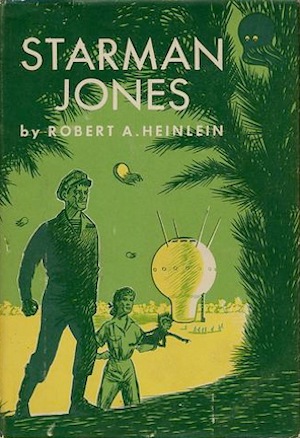
Naïve young Max Jones would love to follow in his astrogator uncle’s footsteps. But Max’s uncle never arranged for Max to follow him into Astrogator’s Guild. This means there is no legitimate path to the stars for poor, honest orphan Max.
Enter Sam Anderson. Sam is not young, not naïve, and long-ago abandoned honesty for shameless pragmatism… as Max finds out when Sam steals Max’s precious astrogation manuals. Sam may be a scoundrel, but he’s the scoundrel Max needs if Max is ever to become a starman.
Given the book was aimed at teens, it’s an interesting choice on Heinlein’s part that Sam’s various illicit plans often succeed and result in temporary embarrassment at worst, but the first time Sam does something unambiguously heroic and selfless, it gets him killed3.
Aahz — Robert Asprin’s Another Fine Myth
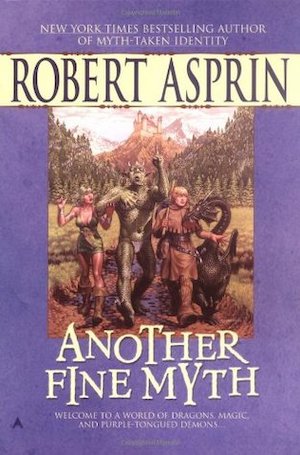
Skeeve willingly became the wizard Garkin’s apprentice, since the alternative was either starvation or hypothermia. Perhaps Skeeve would have become a great mage under Garkin’s watchful eye. Sadly, an assassin’s bolt cut both Garkin’s life and Skeeve’s apprenticeship short.
Just before dying, Garkin summoned his old friend Aahz. It’s only after Garkin’s murder that Aahz discovers that Garkin cheekily stripped Aahz of magic as a playful jape. Only Garkin can reverse that spell, which Garkin is too dead to do. Having no better option available, Aahz must tutor Skeeve to use magic in Aahz’s place… because the fate of the worlds is at stake.
Good news for people who like this comedic fantasy series: There are twenty-one volumes. Good news for people who go “meh” at this novel: the Phil Foglio4 graphic novel adaptation improves on the original material.
Skanderbeg — Elizabeth H. Boyer’s The Sword and the Satchel
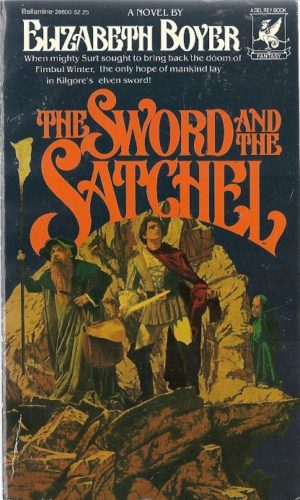
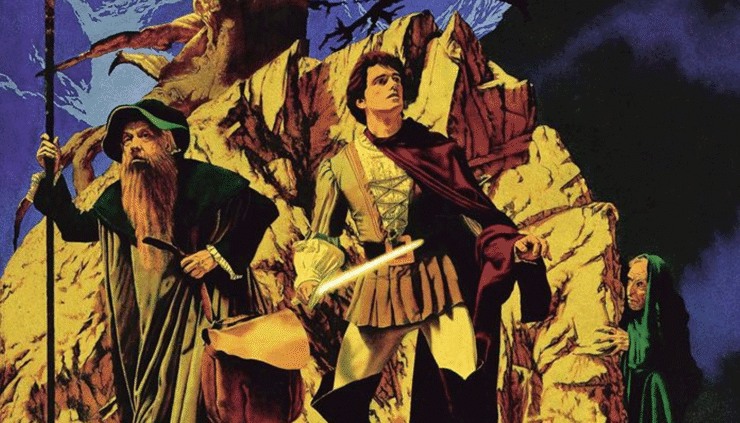
Headstrong Kilgore is determined to relive the legends of old. The icy doom spreading across the world is just the sort of peril a great hero could avert. Kilgore’s astonishing success at withdrawing the great sword Kildurin from ancient Brandstok oak marks him as a potential hero. Too bad the teen does not know what he is doing.
Eight-thousand-year-old wizard Skanderbeg has the knowledge Kilgore lacks… or at least, convinces Kilgore that he does. Assisted by warrior woman Asny, Skanderbeg and Kilgore set out to save the world from the ice.
Cynics will point out numerous parallels between The Sword and the Satchel and The Lord of Rings. There are important differences, not least of which is that The Sword and the Satchel is comedic, while Lord of the Rings is tragic. Also, Gandalf is much more competent than Skanderbeg, just as Frodo is more competent than Kilgore. Ansy is entirely competent. Too bad she’s not the one waving Kildurin around.
Ferdinand the High Priest — Miya Kazuki’s Ascendance of a Bookworm
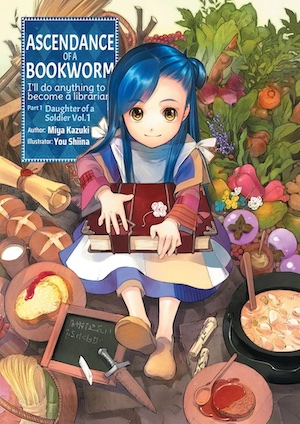
Crushed under her own book collection, bookworm Myne was reborn in a secondary fantasy world. To Myne’s horror, this is a world without mass-market book publishing. Myne’s quest to address this shortcoming is imperiled by Myne’s tendency to assume anything that bores her is unimportant and can be ignored. This belief could easily result in Myne’s death.
Fortuitously for Myne, her magical potential and otherworldly knowledge win High Priest Ferdinand’s attention. More importantly, they make Myne worth protecting from her own relentless obliviousness and all of the powerful people Myne inadvertently annoys. Even for adept Ferdinand, keeping Myne alive and on the narrow path of useful productivity will be difficult.
The main lesson I took from this series is “make sure your bookcases are sufficiently sturdy and well attached to the wall,” closely followed by “if you have to be endlessly naïve in a dangerous universe, be the protagonist in a long-running series.”
Frieren — Kanehito Yamada & Tsukasa Abe’s Frieren: Beyond Journey’s End
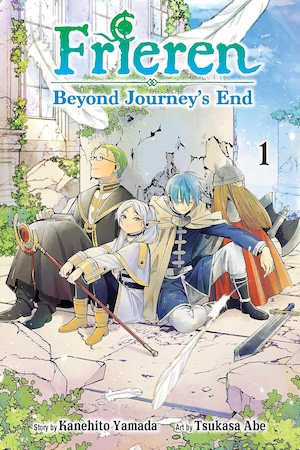
Fern is an orphan (not a rare thing in a demon-haunted secondary universe fantasy world). What is rare: Fern is an orphan with tremendous magical potential. Fern needs mentoring of a sort her adoptive father, Bishop Heiter, cannot provide.
When Heiter was simply a corrupt priest, he and three companions—Himmel, Eisen, and Frieren—saved the world. Neither long-dead Himmel nor dwarf Eisen can tutor Fern. Elf mage Frieren could… provided the wily Heiter can con Frieren into accepting a short-lived human apprentice.
Often, mentors learn as much as they teach. Frieren is an example. Among the lessons she learns is that while humans are mayflies, the correct thing to do isn’t to avoid connection to escape loss. It’s to enjoy people while they are still alive.
Mentors are extremely common in speculative fiction. Some of them even survive their narrative purpose. No doubt you have your own favourite examples. If so, please mention them in comments.
- You know what technology does not appear to have been reinvented over and over? The wheel. Also stringed instruments, which astonished me when I discovered that. People have embellished stringed instruments, but inventing them from scratch, not so much. ↩︎
- Of course, there’s the issue of—you know what? That can be its own essay. ↩︎
- I am always annoyed each time I reread Starman Jones that Sam always dies. He never seems to learn from all the previous times I’ve read the book. ↩︎
- Say, did Dragon Magazine ever run the What’s New with Phil & Dixie “Sex in D&D” strip? ↩︎

@footnote 4: apparently not, at least not within the pages of Dragon. However this comment says they did the episode in “the second [book collection] of What’s New“.
And, of course, a goodly chunk of Xxxenophile could be interpreted as properly doing it.
Isn’t all of Xxxenophile about properly doing it?
No, XXXenophile is pretty much all about doing it, properly or otherwise. :D
I love seeing the “Myth” series mentioned. A big favourite from my teen years!
Aral Vorkosigan does it well enough once he’s gotten over his youthful antipathy to the role.
As far as I am concerned, the best mentor character in fiction, certainly in animation, remains Uncle Iroh, from Avatar: The Last Airbender.
The Myth series certainly hit diminishing returns after the first couple of books.
There is also Chade in Robin Hobb’s Farseer books. He is absolutely a mentor to Fitz, but is questionable in how he is an assassin and teaches Fitz to be one as well and his own tendency to secrets hinders Fitz at several places.
Mentor of Arisia
I should think Tom Swale and Carl Romeo, in Diane Duane’s “Young Wizards” series, count as mentors who don’t fade away even as the series’ main protagonists grow and evolve. (Actually, Duane’s broader body of work has some other good examples, particularly in her Rihannsu cycle, but also in The Wounded Sky, in which K’t’lk literally evolves in the final pages.)
Merlin, of course…
Puddleglum, in The Silver Chair, is kind of an unwitting mentor.
In the Mage comics, there’s Mirth. But I guess that’s really just a recycled Merlin.
You mention Sam Anderson, but really, Young-talented-but-naïf-male-protagonist/older-wiser-and-cynical-male-mentor is pretty much a Thing in Heinlein. The prototype mentor character being, of course Jubal Harshaw.
In the original “Earthsea Trilogy,” Ged/Sparrowhawk starts as a y.t.b.n.m.p. but becomes a mentor in books two and especially three.
Funny, they seem to be much easier to come up with in fantasy than SF. Must be a trope kind of thingy.
Does Vergil count as a mentor to Dante?
Notable lack of them in a certain “wizards at school” series – mostly they turn out to be imposters, traitors, incredible procrastinators, or destined to die horribly just as they start to be helpful. Or two or more of the above…
I can’t help mentioning Mentor of Arisia, because of the name you know, even if I don’t think he needs to be one of the five here.
If I remember correctly, the Saturday morning live-action Shazam! series also named its mentor character “Mentor” (and in fact had Billy occasionally call him by name right there in the scripts, completely failing to embrace the irony factor).
Ningauble of the Seven Eyes and Sheelba of the Eyeless Face can always be counted on to understand their role in the story, which is to point the heroes in the right direction and then get out of the way.
Desdemona is a great mentor for Penric (and the echoes of all her former humans).
Ooh… I was going to ask about women mentors
Another Sam, Sam Loomis of Edgar Pangborn’s Davy, also comes to an untimely end. Then there’s Master Li in Bridge of Birds and its sequels. As Hughart puts it:
(I keep imagining that someday the quote function will actually work)
Wouldn’t a post about “Five Helpful Mentors Who Were Mostly Ignored” be more interesting?