






Welcome to the Tor.com eBook Club! November’s pick is Spin, the first book in a sci-fi trilogy from Robert Charles Wilson. You have until Monday, November 7th to get your FREE ebook copy—but first, here’s what makes this Hugo award-winning novel stand out from the pack!
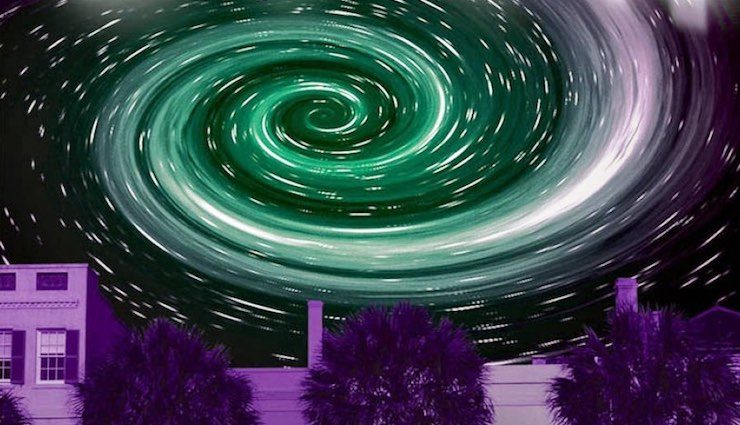
In the first Superman film, our hero flies around the Earth with such speed that it alters the rotation of the planet and begins to turn back time. This scene wouldn’t leave me alone as I read Robert Charles Wilson’s Spin for the second time. The book begins when three children witness the stars disappearing from the sky. The Earth, now encased inside a bubble, is thrust out of time, slowed to the point that for every year on Earth, millions pass outside the bubble or, as they call it, the Spin.
Wilson grounds his phenomenon in scientific terms, but I could not help but think of the Spin as Superman, flying along the equator, slowing down time to a crawl. I can’t imagine that’s what the author had in mind, but such is the beauty of reading. We bring what we will to the text.
Although the science fictional conceit is central to the plot, which follows the unraveling of who put the Spin in place around the Earth and why, Spin is actually more a family drama than science fictional adventure. Tyler Dupree and Diane and Jason Lawton watch the stars go out from the sky together. Through Jason’s father, E.D. Lawton, the trio find themselves at ground zero of humanity’s response to the Spin and our climb to free ourselves from its clutches.
Spin is a tremendous novel that won the Hugo Award for Best Novel in 2006. I love it and here’s five reasons you will too.
The Creeping Apocalypse
The Spin shows up one day and the world ends, or at least it will. As time flows more slowly on Earth, the rest of the solar system races toward a dying sun. This is when the Earth, long since passed beyond the ‘goldilocks zone’, will no longer support human life. But that fact is a few generations off. How many no one knows for sure, but distant enough that the Earth ends not with a bang, but with a whimper, edging toward self-destruction in fits and starts. We elect continually more extreme politicians. We pursue continually more hedonistic choices. We don’t care who we hurt because it will all be over soon. Or will it? The humans in Spin know they will die, either when time ends or the Spin disappears and unleashes the sun to scour the Earth’s surface. And so, Wilson offers us a car crash in slow motion—the slow descent into anarchy. It is eerie and haunting and all together too real for comfort.
Following the Thread
Robert Charles Wilson has a knack for causation. The barrier comes down, decoupling Earth from the flow of time. What happens next? The entire novel is in many ways an answer to this question. How do we communicate without satellites? How would this change the economy? What kind of people would we elect? What sort of weapons would we bring to bear against the Spin? And, ultimately, how would we react to the rapid extinction of our species? Wilson finds the internal logic of his world and never deviates, fully immersing the reader in his carefully constructed reality with an unmatched verisimilitude.
Mission to Mars
As far as space colonies go, the one in Spin is extraordinary. Why? It all comes down to time. Interplanetary space travel is impractical, not necessarily because we lack the technology to make it happen, but because of the travel time involved. How do we support human life for such an extended period of time in the harshness of space and still have resources left at the other end to start a new life? Now consider that the Earth is moving at a fraction of a faction of the temporal speed as Mars. How does that change the timetable? I won’t spoil it here by spelling it out, but suffice it to say Wilson’s solution is clever, and the implications of a human planet with a few extra millions years of evolution even more so.
Family Drama
I opened this article with the idea that Spin is more family drama than anything else and boy, is it: the relationship between the twins—Jason and Diane—and Tyler Dupree, their dearest friend caught in the middle, offers a fascinating triangle. Jason, a once-in-a-generation kind of young mind, wants nothing more than to please his father. Diane wants nothing more than to distance herself from everything. Tyler wants nothing more than Diane. In addition to these three young people growing up beneath the starless sky, we also meet their parents, whose desires flit on the sidelines, charting the course for their children’s lives. Even as the world ends, the connectiveness of family never ceases to reign supreme.
Faith
If there’s a central argument in Spin, it is this: the only faith humanity should indulge in is faith in each other. Naturally, as the world ends, people turn to religion. End-of-days cults are scattered across the landscape. Through Diane we become privy to some of their machinations, and get a sense of the depths to which we might sink to bring about some misguided sense of closure. Jason places his faith in technology, in ingenuity, in the unseen hand that created the Spin. And what does Tyler believe in? He believes in Jason and Diane, keeping the faith of their friendship above all else. He is their confessor and, often, their redeemer.
These are my five reasons you’ll love Spin, and I suspect you all have your own. I’d love to hear them.
Justin Landon used to run Staffer’s Book Review. Now he kinda blogs at justlandon.com. Find him on Twitter for meanderings on science fiction and fantasy, and to argue with him about whatever you just read.

This has been on my list of want to buy/read for quite a while now. Guess I’ll go searching. :)
I just couldn’t love it.
Pretty much, humanity gets bumped to the heat-death of the universe. Even the bloodiest zombie apocalypse holds out hope for the future. It’s just a matter of getting rid of the zombies: or in the case of I Am Legend or The Girl With All the Gifts, the zombies turning out to be the new improved humanity.
But there’s no hope left in Spin.
I couldn’t read this; cardboard characters dragged through computer-generated plot.
Things I liked:
it was an idea I wasn’t quite thrilled at first (sounds so utterly claustrophobic), but he injects such optimism into it. So what if the Sun goes supernova – it’s just one planet, one sun, one solar system. Some of the ideas felt so refreshingly new to me. What the author did with Mars – I just grinned while reading, I liked it so much.
The book reminded me of reading Asimov’s or Clarke’s fiction when I was younger. The sciencey parts vaguely felt like “Rendevouz with Ramadan”. The same way that Asimov-Silverberg’s “The Bicentennial Man” felt to me like an Asimov-with-all-the-feels, this book felt like an A. C. Clarke-with-all-the-feels.
But the sociopolitical effects of the Spin – I have to say, I’d kind of forgotten them. Basically, I preferred the Jason-chapters to the Diane ones. But I liked the fact there was a whole world besides the scientists – even if it was an apocalyptic-cult-crazy world, it was still a whole world.
Loved this series. Wilson is one of my favorite writers. He creates real characters rather than the cardboard ones we so often get in SF.
I didn’t like it, and the sequel was even worse. The writing was way below the standard of his other work. And the plot was a clockwork plot. You can see the gears turning. Character actions are driven by the author’s needs and not the interface between their characters and the situation. Very disappointing from a usually stellar writer. Gives every impression of being written to fulfill a contract.