





Although I don’t have specific data to back this statement up, I’m surely pretty safe in saying that the vast majority of novels feature human beings. While many authors have created sci-fi and fantasy worlds full of aliens, robots, elves, and dragons, there’s also usually at least a smattering of humans along for the ride.
Even in stories that may seem devoid of humans on first glance sometimes, you’ll sometimes find us lurking in there somewhere. For instance, humankind is extinct in C. Robert Cargill’s robot-filled Sea of Rust (2017), but the details of how humans were wiped out is also provided as part of the story. And while the only two characters in Terry Bisson’s hilarious flash fiction “They’re Made Out of Meat” (1991) are aliens, their whole conversation is about humanity so it doesn’t exactly feel like it lacks humans.
But there are some stories that omit Homo sapiens completely, and are instead entirely populated by characters that are aliens, animals, or machines. Here are five such sci-fi short stories and novels.
“There Will Come Soft Rains” by Ray Bradbury (1950)

In Allendale, California, a lone house has been left standing after a nuclear explosion. The family that lived in the house are dead—all that’s left of them are their haunting silhouettes on one of the outside walls—but the automatic systems that made their lives easier don’t know that. Every day the machines in the house pointlessly carry out the tasks they were built for: meals are cooked, dishes are cleaned away, and baths are run.
Written after the atomic bombings of Hiroshima and Nagasaki and in the midst of the nuclear arms race, “There Will Come Soft Rains” is still powerfully resonant today. Although Bradbury doesn’t paint a detailed picture of the destruction across the city, the image he creates of the empty house is enough to be utterly chilling on its own.
“Love Is the Plan the Plan Is Death” by James Tiptree, Jr. (1973)
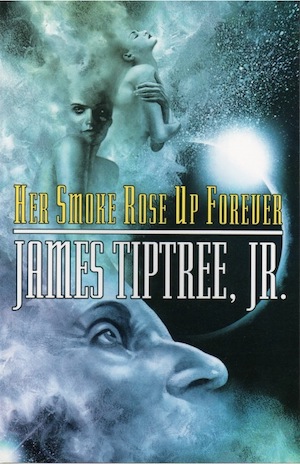
Although “Love Is the Plan the Plan Is Death” might not be the easiest story to come to grips with (it probably didn’t help that I went into it completely cold), fighting through the confusion is worth the effort if you want to experience an alien perspective that has absolutely no conception of humanity.
We’re in the head of Moggadeet for the duration of the story and he isn’t quite like the other members of his six-legged and scale-plated species. Unlike the rest of his kind, he has knowledge of how their life cycle works and this causes him a fair deal of stress (though I won’t say why). It’s a weird perspective to inhabit, but it’s undeniably creative and compelling.
“Exhalation” by Ted Chiang (2008)
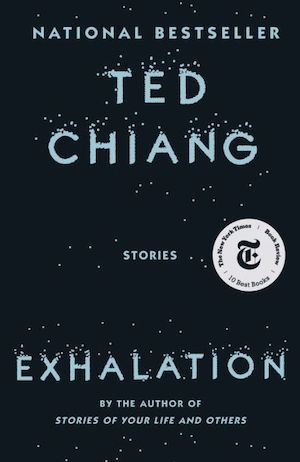
“Exhalation” is an account left behind by an unnamed scientist. The writer is a member of a race of mechanical beings that rely on argon extracted from underground to function. But the inner workings of their brains remain a mystery and when the clocks start to run fast and no mechanical reason can be found, the scientist decides to perform risky brain surgery on themself.
Aside from being an interesting take on a scientific concept (that I won’t reveal), “Exhalation” is a rumination on life and death that is just as applicable to humanity as it to the mechanical writer’s species. While existentialism isn’t always the most cheery subject, I found this story’s conclusion to be incredibly uplifting.
Of Ants and Dinosaurs by Cixin Liu (2010)

Of Ants and Dinosaurs started life as a novella in 2004, before being expanded into a full-length novel in 2010. As far as I’m aware, it’s been translated into English twice since then—by Elizabeth Hanlon and Holger Nahm—and is also sometimes titled The Cretaceous Past.
Set during the Cretaceous period, the story starts with a group of ants helping to dislodge a chunk of lizard meat that is caught, irritatingly, between a T-Rex’s teeth. Both species realize that they can help each other; dinosaurs can benefit from the dexterity of ants, while the ants can benefit from the dinosaurs’ creativity. The little and large life forms decide to form an alliance, which leads to both of their societies rapidly advancing. But along the way cracks start to form in their symbiotic relationship.
Of Ants and Dinosaurs is both an alternate history of the prehistoric world and a parody of human history. The story essentially functions as a fable—one that manages to be both pointed and playful—with humanity’s destructive greed and competitiveness placed under the microscope.
The Galaxy, and the Ground Within by Becky Chambers (2021)
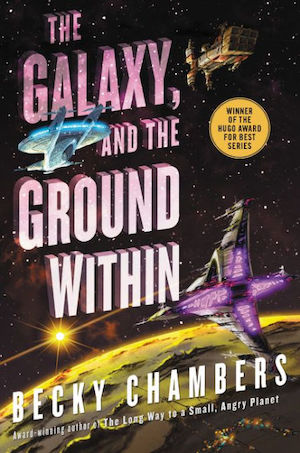
Admittedly there is one scene with a human in The Galaxy, and the Ground Within—plus a couple of other mentions of humans—but the vast majority of the story is focused on the interactions between various alien races, so I think it deserves a place on this list. It should also be noted that while it’s the fourth book in the Wayfarers series, it can absolutely be read as a standalone.
The book is set on Gora, a planet that doesn’t have very much going for it—it’s basically just rocks—except for being close to a wormhole transit hub that spacefaring travelers use to move between the more popular parts of the universe. When a technological failure halts all traffic to and from the planet, four different alien species are forced into close proximity at a refueling station.
The Galaxy, and the Ground Within is low-plot and low-stakes, in terms of its narrative. With nothing to do but wait, the various aliens end up chatting about their many differences—both physiological and ideological—and bonding over their similarities. There is, as would be expected, a little bit of interspecies conflict, but the overall feeling is one of coziness and community.
I haven’t actually read all that many sci-fi stories that lack human beings, but I’d love read more, so please feel free to add your own recommendations in the comments below!


The Monitor, the Miners, and the Shree by Lee Killough has a multi-species observation post on the pre-technological world of the titular Shree, none of the species being human.
Was Chemel not human?
I read it as something primate-like, but not human, and If that’s her in the illustration the cover artist agrees.
It’s a huge spoiler so I won’t mention the title, but there’s a Harry Harrison short story whose characters take pride in humanity’s long history… and are taken aback when archaeological evidence surfaces proving they are an entirely unrelated species.
I think I found the one you’re talking about. I enjoyed it, thank you.
As an archaeologist and professor of anthropology, I not only enjoy but assign as a reading Ursula K. Le Guin’s brilliant “The Author of the Acacia Seeds” (1974). Non-human academics and their scholarly conceits crack me up.
I think that humans are only mentioned in passing in the Buck Coulson poem at the beginning of Asprin’s Bug Wars and play no role in the plot.
I haven’t read that since it was new (and I came here to mention it). Someone on the protagonist’s side mentions in passing (iirc) a planet with furry apes that have just started walking on the ground, which Aspirin confirmed was the only appearance of humans in the novel.
“The Crucible Of Time” by Joihn Brunner follows a race of mollusc-like invertebrates as they discover astronomy, find their system is headed for a crowded area of space, and try to develop the means to avoid extinction.
IIRC, no humans appear in Cherryh’s last Chanur novel, Chanur’s Legacy.
Even in the other Chanur novels, I appreciate the fact that the point of view remains resolutely on the non-human side.
Sorry to blow my own horn, but my story “Aleyara’s Descent” from the May/June 2023 Analog and its upcoming sequel “Aleyara’s Flight” are set in the preindustrial era of an alien world, so humans are nowhere to be seen, which made it challenging to find ways to describe the aliens and their ways without Earthly referents or comparisons. “Descent” is the title story in my new story collection that’s coming out July 1, which contains another story, “Growth Industry,” that features no speaking human characters, though there are some humans playing a role in the background.
The Books of the Raksura by Martha Wells has many different kinds of humanoid and non-humanoid people, but no humans. The closest is the main character’s species, but even they’re shapeshifters with a definitely non human society.
The Chronicles of Sir Crabby has a couple of humans as minor characters, but almost everyone is a sea creature.
Everyone in The Chronicles of Osreth is a goblin, elf, or a mix.
It’s been a while since I’ve read either, but I think maybe these fit?
Far-Seer by Robert J. Sawyer – sentient dinosaur-type aliens
Barsk by Lawrence M. Schoen – humans are extinct and the characters are uplifted animal races
If I remember correctly, in The Fifth Head of Cerberus, Gene Wolfe wrote three related tales, in which it is unclear whether the human colonists on the planets Sainte Anne and Sainte Croix replaced the shape-shifting natives or vice versa. Unclear to them as well as to the reader. Thank you for ambiguity and for unreliable natives.
This is what attracted me to The Dark Crystal as a child – the fact that it had no humans in it (although at least some of the characters are humanoid). I first read the novelization, then saw the movie, then read The World of the Dark Crystal by J.J. Llewellyn, and have since seen Age of Resistance and read more about the making of the original film; I still have a bit of a soft spot for the world.
Katherine Addison’s The Goblin Emperor and its sequels are technically in a world with no humans, although her elves and goblins are certainly human-like. Works with solely non-humanoid characters are rarer (talking animals aside), but I am sure they exist.
I am not much of a writer (to say the least), but one of my current personal projects is a short piece of fiction that is the life story of a non-humanoid alien; humans do make an appearance, but only briefly.
I agree about The Dark Crystal. One of the things that disappointed me about Labyrinth as a followup was that it had humans in it. I was impressed that TDC committed completely to its alternate world.
It only gets in on a technicality, but Iain M Bank’s Culture canonically aren’t (Earth origin) humans, they’re mostly a mixture of various similar humanoid species, to the point where practically no one can trace their lineage back to a specific planet.
That’s a cop-out though, because they’re basically ‘humans’ as far as the plot goes.
Yeah, I’d say that doesn’t count. If the story explicitly defines and refers to its characters as human, then they count as “human characters” from a narrative standpoint even if they’re technically humanoid aliens — cf. Star Wars or Battlestar Galactica, or any alternate-world fantasy universe with humans in it.
Recommend “The Narrow Land,” short story by Jack Vance, in which the characters are humanoid but not human.
How about The Dust Garden by Robert L. Read? Not even an intelligent being in it.
My novel Water to Water features only members of the alien species on a planet that’s never heard of Earth or humans (nor does it do so in the course of the story).
The Gods Themselves by Asimov (1920 I think, no, I am not that old – old but not that old) features characters who, while they behave in human-like ways, are decidedly non-human in “biology”.
The Gods Themselves is from 1972, and it has three sections, only the second of which involves alien characters in a parallel universe.
Charles Stross wrote Saturn’s Children and Neptune’s Brood in a setting after after humanity’s extinction. All the characters are androids. Both were nominated for Hugo best novel award.
Like some others mentioned in the comments, this one is fantasy, not sci-fi. Human beings maybe appear very minorly (at the tail (lol) end, and in the background) but Jo Walton’s Tooth and Claw is about a Victorian-style society of dragons. And not a human story swapped for dragon characters. It’s dragons! Their society and social mores are built around the biology of being being giant, flying, flame-breathing lizards. It’s such a good, weird book about the sexual mores, religious hypocrisy, and social strategizing of being a member of a species whose primary accumulation of size and power comes from eating one’s own parents and babies.
Great list! Thank you for including my wise and struggling buddy Moggadeet! The ones I have to recommend are “sci fi” in the same way Tiptree’s story is ie: this is not the life we know and there are no humans.
The first story that came to me was Learning to Move Against the Current from Anne E. G. Nydam’s Bittersweetness and Light. It is sweet, extremely non-human, inspired by crinoids, and nonetheless deeply relatable.
The Earth Spirit’s Favorite Anecdote from the 2021/Small Beer edition of Zen Cho’s Spirits Abroad is extremely non-human while being far too human, in a wonderful way!
I’m going to find and read every one of these, and re-read The Galaxy and the Ground WIthin!