







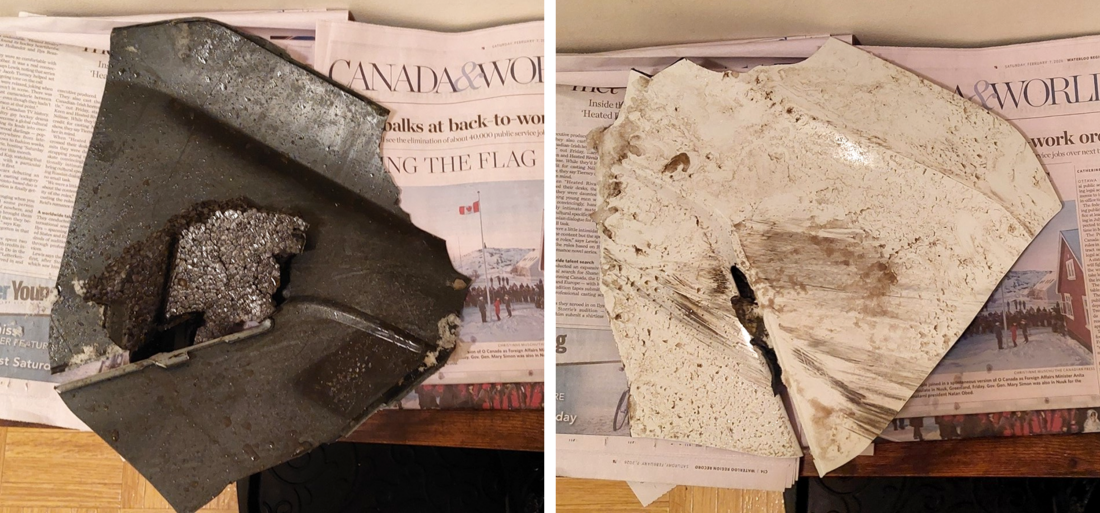
Not very long ago, my attention was caught by an enigmatic fragment, which flew past me, just under knee-height, before deeply burying itself in a nearby snowdrift.
It was clearly a small piece of a car, but did it come from the rear of a car, which was what initial evidence suggested, or the front of a second car I failed to spot? Alas, I was on my way to work1 and did not pause to investigate, although I did make time to collect my mysterious trophy on the way home. I suppose I will never know2.
Such enigmas are frustrating in real life. For authors, enigmatic artifacts can be the stuff of plot, allowing their characters to show off their intellectual and athletic prowess. Consider these five examples, drawn from across the decades.
“Lost Art” by George O. Smith (1943)
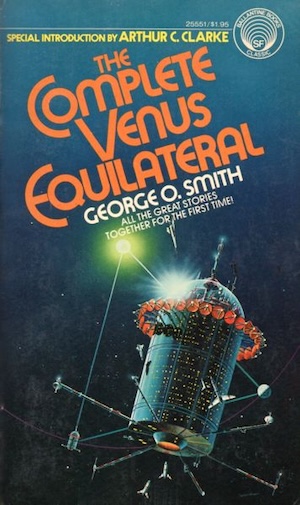
Enthusiastic engineers Barney Carroll and James Baler do not fully understand the forty-century old Martian device. However, the old Martians did believe in technical documentation, so the chums believe they are in possession of all the information they need to unravel the gadget’s secrets. This is why the pair elect to experiment with the relic in the middle of town.
What the old Martians failed to predict is that certain facts considered by them so obvious that they need not be mentioned might be unknown to people from another, alien, civilization. Carroll and Baler lack the information needed to operate the gadget safely. After all, safety is not their primary concern3.
It might seem odd that some core bit of information could be lost so thoroughly. But consider one of the world’s oldest known jokes: “A dog walks into a bar and says, ‘I cannot see a thing. I’ll open this one.’” We know that was a thigh-slapper back in Sumeria. We do not know why.
World of Ptavvs by Larry Niven (1966)
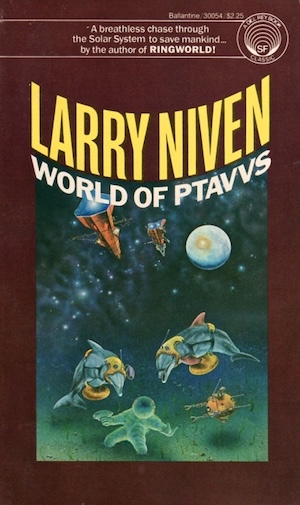
The 1.5-billion-year-old “Sea Statue” is clearly artificial. It is equally clearly not of human origin. Its reflective surface suggests an intriguing possibility. The apparent statue could be an alien within a time-freezing stasis field. If so, placing the statue inside another stasis field would nullify the original stasis field and free its occupant.
A billion and half years ago, the galaxy was ruled by the Slavers, telepathic aliens whose formidable powers of mind-control almost made up for the fact that the Slavers themselves were all dolts. Every Slaver and all of their slaves died in the great uprising… all save one, the Slaver who has until now been imprisoned in stasis. The Slaver that curious humans are about to free.
The first quarter of Known Space’s 22nd century was an interesting time from the UN’s perspective. First, humans stumbled over non-technological aliens in the Sirius System. Then they unleashed a would-be world-conquering alien. Then, a super-intelligent interstellar traveller with a penchant for genocide swung by for an extended visit. I imagine officials in the know were subject to severe on-the-job stress.
Roadside Picnic by Arkady Strugatsky & Boris Strugatsky (1972)
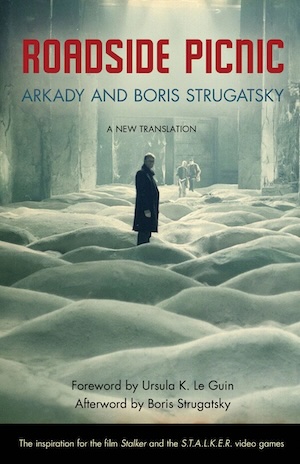
The aliens arrived on Earth, lingered briefly, then left without ever bothering to communicate with humanity. Disappointing. Humanity had to settle for poking through the alien’s discarded trash. Happily, the aliens were profligate litterbugs.
Prudence demands cautious examination, under the watchful eyes of the International Institute of Extraterrestrial Cultures. Greed demands a more forthright approach. Stalkers grab what they can, and hope to survive the result. A few get rich. Others may pray for death.
While I do own the old DAW translation of this classic, I recommend the more recent Chicago Review Press edition. The translation (by Olena Bormashenko) is better and the ancillary material fascinating.
Blake’s 7: “Sarcophagus” — TV script by Tanith Lee (1980)
By the ninth episode of season three of British SF television show Blake’s 7, Blake is gone, leaving cold, amoral Avon as captain of the starship Liberator. When Liberator encounters a derelict starship in deep space, Avon is sensibly cautious. Nevertheless, he, along with the craven coward Vila and telepath Cally, venture on board.
The three find an ancient ship, a sarcophagus, a dead alien, and a timer counting down to an event for which the trio would be well advised to escape. Sensibly, despite impediments, Avon, Vila, and Cally manage to return to the Liberator. The only problem is that they’ve brought something back with them.
Cold, amoral Avon did not pick Vila and Cally because they had the qualifications to conduct deep-space archaeology. He selected them because they were the two crew members least likely to stab him in the back while conducting deep-space archaeology. Camaraderie wasn’t really a thing on the Liberator.
Vestiges by Laurence Suhner (2012)
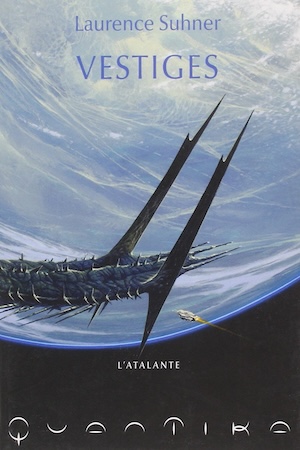
The Great Arch orbits quasi-habitable Gemma. The Great Arch is clearly artificial. Since no human made it, it is clearly alien. Beyond those facts, little is known. The aliens appear to be long gone and the Great Arch is, as far as anyone can tell, inert.
Visionary scientist Ambre Pasquier believes she can uncover alien secrets down on the planet itself. Xenologist Seth Tranktak believes Ambre is on the right track. More importantly, he believes betraying her to an ambitious oligarch and the local militia is the key to his personal power. Revelations await! Few pleasant.
The is the first of three installments. Rather frustratingly for monolingual me, while I found a translation of the first volume, the other two are, as far as I can tell, only available in French.
There are surely more than five works that showcase insufficiently cautious characters investigating dangerous enigmas. Perhaps you have your own favorites examples. If so, please mention them in comments below.
- What would I have done had it hit me? Applied pressure to stop the bleeding (if any), limped home, changed, and caught the next bus. I plan for two significant service disruptions per commute, so in all likelihood I would have still been on time. Had the injury been more dire, I would have seriously considered seeking medical help despite the possibility that this might have left the theater short-staffed. ↩︎
- Unless I showed it to someone who knew one end of a car from another. But that would be extra work for which I would not get paid. ↩︎
- Jim’s sister, Christine Baler, watches the chaos and carnage escalate from a safe(ish) distance with the air of someone who has seen events very much like this play out before. I imagine her played by Myrna Loy, with an expression very much like Loy’s during The Thin Man’s airgun scene. ↩︎

Main one I think of is the Rama series by Arthur C Clarke.
Rama series? There was only one book. :)
Actually there were three more I think, Rendezvous with Rama, Rama II, Garden of Rama, and Rama Revealed.
There are “no” sequel novels in the same sense that there was never a Highlander 2, or that Star Trek: Enterprise‘s series finale was actually “Terra Prime” and “These Are the Voyages” is just an ugly rumor.
In addition to the sequel trilogy that Gentry Lee wrote in collaboration with Clarke (or perhaps in consultation, since Lee did most of the actual writing), Lee also went solo on two novels set between Rendezvous and Rama II, Bright Messengers and Double Full Moon Night. But I gave up on the sequel trilogy after its second book, so I never read them.
“The party told you to reject the evidence of your eyes and ears. It was their final, most essential command.”
But in any case, regardless of if you liked the Rama sequels or think they are “true” installments of the series, it sounds like they still count as an example of “Science Fiction stories about investigating enigmatic artifacts”
Oh, come on, it’s just a joke, as should be obvious from the smiling emoticon Bruce used. There’s no “party” involved, no coercion, and no intent to mislead. Nobody who says “There were no Rama sequels” or “There was no Highlander 2” expects anyone to actually believe it; on the contrary, we expect that people will know our statements are so obviously counterfactual that they’re clearly facetious.
Certainly only one book that was actually by Arthur C. Clarke; the others were by Gentry Lee with limited input by Clarke, despite how they’re credited. And certainly only the original Rendezvous with Rama actually feels like a Clarke novel, with his optimistic view of the future. So yeah, I also feel the original is the only one that counts.
Well, several Clarke short stories are some kind of guided tour of planet Earth after international competition in performing uncontrolled nuclear fission on population centres leaves the ruins literally glowing, which takes a lot more radiation than “The Simpsons” suggests. And in one case just before the cataclysm, of course. But his novels, I suppose you’re right, they are less glum.
Whatever Clarke may have done in his other works, Rendezvous with Rama paints a very optimistic future, so Lee’s sequels tearing that down in favor of a depressing dystopia was one of the reasons I felt they failed as a continuation.
Good point!
Clarke really liked this theme of enigmatic alien artifacts. The other obvious one is the monolith in 2001, which itself is some-what based on two of his previous stories, The Sentinel, and Encounter in the Dawn. I’ve got a feeling there might be more.
Tanya Huff’s The Better Part of Valor (part of her Confederation of Valor series) features Sergeant Kerr, her squad, and a civilian salvage operator investigating a distinctly odd alien ship. Unfortunately for all of them, their lieutenant is not the cautious type.
Blindsight by Peter Watts has a group of eccentric (but very much not comical) misfits sent to investigate an alien ship discovered just close enough to the solar system to make it worth a visit. A fascinating read, but not one if you’re looking for a happy ending. Fortunately available for free on the author’s website.
Humans find an alien artifact in Sleeping Giants, the first in a trilogy by Sylvain Neuvel. It’s told as a series of transcripts (interviews, radio. etc.), and has a good feel of just trying to figure out what it is they’ve found and how to make it work. I was a bit disappointed in the sequels as I felt they explained too much and went a different direction to what I wanted, but that’s a me problem not one with the books.
Obvious examples: Clarke’s Rendezvous with Rama and the ST:TNG episode “Relics”. A number of other ST episodes qualify, such as “Tin Man” and “Inner Life”. Babylon 5 had a lot, given its underlying premise. “Thirdspace” was all about “wow, giant ancient artifact, let’s turn it on!”
Timothy Zahn’s Spinneret is another pleasant example.
Indeed. I reread this not too long ago (2003) and it held up well:
Here’s my 2003 “review” in toto:
“A/A+ on reread, wonder-cable. Fast & clever, classic Analog puzzle-piece. Reread sometime?”
“The Vorlons were terrified of this thing. What could possibly go wrong?”
Oh, and Vernor Vinge’s A Fire Upon the Deep. Very “I wonder what happens if I press this button?”
Not to mention The Peace War et seq. Good stuff, especially the sequel. Whose title escapes me.
Algis Budrys’ Rogue Moon springs instantly to mind. There the artifact is extremely lethal, so the scientists come up with serial cloning of a sort. Greg Bear’s Eon and sequels, and for that matter arguably Larry Niven’s Ringworld.
“Cloning” reminds me of Pohl and Williamson’s Farthest Star. And of course Pohl’s Gateway and its sequels qualify.
Alan Dean Foster, The Tar-Aiym Krang, always has a special place in my heart.
Also “Voyage to the City of the Dead”.
Public service announcement: don’t read the sequels to Bob Shaw’s Orbitsville.
How about JG Ballard’s Report on an Unidentified Space Station?
Now, that’s an obscure one….
The 2019 anthology Footprints in the Stars from eSpec Books contains multiple stories about humans discovering alien artifacts, including my own “The Stuff that Dreams Are Made Of,” which is kind of like Roadside Picnic in that the alien artifact (or rather, a cast-off fragment of an unknown larger artifact, kind of like that car fragment at the top of the article) is so inexplicable and devoid of context that people just project their own assumptions and hopes and fears onto it, and it’s that clash of beliefs that provokes the story’s conflict — so that the protagonist nicknames the artifact “the MacGuffin” after the Hitchcockian term.
The story descended from an older idea I’d had about a single alien footprint being discovered on the Moon, with all the rest of the evidence of the aliens having been wiped out by an impact crater. But since there was no way for the characters to learn anything more, it was an anticlimax and the story didn’t really work (even though I flashed back at the end to show how it had happened). It was only with the MacGuffin concept that I realized the key was to focus on what people projected into the emptiness, reflecting their own hopes and fears (and I’m sure Solaris influenced me there).
Your mention of Solaris reminded me of another Stanislaw Lem story, one of his Pirx the Pilot stories. Pirx is the sole witness to a large, fast-moving alien artifact / ship moving past his ship. No other witnesses or means to record or follow it to investigate. Very bittersweet.
Lem had a few variations on the theme. Another one is His Master’s Voice where the “artifact” in question is an alien signal.
Well, the word “artifact” means “made by craft,” something created by a sapient being’s effort rather than occurring naturally, so the word does validly apply to a technologically generated signal.
Excession, by Iain M Banks fulfils the criteria, even though it’s being investigated by incredibly advanced aliens (compared to the usual human explorers in this genre).
There’s also a strange dome, with an impossible gate to another timeline, hidden away on a parallel Earth in Charles Stross’s Merchant Princes series (I forget exactly which book). This is a rare case of ‘Chekov’s Enigmatic Artifact’, that isn’t metaphorically taken off it’s mantelpiece until the following series of books.
Oh, and there’s Peter F Hamilton’s Pandora’s Star series in which humanity decides to investigate a pair of stars which seem to have an impenetrable barrier around them. Given the title you can probably guess that this turns out to be a very bad idea.
Also his Against a Dark Background. I have an entertaining (I think) review over at Goodreads:
https://www.goodreads.com/review/show/476272190
Fair to say, this is a very popular SF trope!
The Protomolecule from the Expanse series comes to mind….
And, of course, their new series, just beginning. Hot stuff, if you have missed it. If VERY dark…..
Oh, and also James White’s rather lovely False Alarm. 3 men investigating an alien base on Titan with a number of oddities. Eventually 2 of them decide that a major function of it is to call a lifeboat for any stranded aliens, and that they’re going to set it off and hijack said lifeboat.
Embarrassingly, it turns out
Oopsie.
Only one possible answer:
David Brin Startide Rising
The artifact was quite harmless. The reaction of the galaxy – less so.
“Cyber Way” by Alan Dean Foster. Navajo sand paintings turn out to be a way of accessing higher dimensions and beings, if you know how. Someone figures out how and shenanigans occur.
Second Genesis by Donald Moffitt
A group of humans —
raised by wolvesre‑created by the alien starfish-like Nar, who had discovered Earth’s ancient genetic and cultural broadcasts in the previous novel The Genesis Quest — sets out from the distant galaxy where the Nar nurtured them and returns toward the Milky Way to uncover the truth about their origins. Having achieved effective immortality, they travel aboard Yggdrasil, a living Dyson‑tree starship driven by a Bussard ramjet. [en.wikipedia.org]As they approach humanity’s ancestral region, they find that many stars near Sol appear to be surrounded by immense artificial constructs — Dyson‑like shells composed of vast circular solar collectors and transmission arrays. These enormous, enigmatic megastructures suggest a level of astroengineering that far surpasses anything known from pre‑extinction humanity, making them exactly the kind of awe‑inspiring cosmic artifact that begs investigation in a “mysterious‑artifact” sci‑fi discussion.
Like the other Moffitt series (“Mechanical Sky” series, A Crescent in the Sky and A Gathering of Stars), the science part of this fiction doesn’t really work that well. For one thing, Bussard ramjets have severe problems. For another, the handwavy galactic-wide “this is why species die in galaxies every few hundred million years” explanation feels completely unmotivated. But it’s a fun ride. It led to me spending a couple days trying to import the Dyson shell disks to Celestia, just so I could explore what it would look like in person.
@David
While I usually enjoy your footnotes, footnote 3 today had me laugh out loud. Well played, Sir.
I hope I remember right that the sister in “Lost Art” casually let the reader know that she too had relevant knowledge to experiment with a mysterious Martian electrical device, and the wisdom not to. And the… something… to let the young men make their own trouble while she watched. Given the date of publication, it is possible that she was respecting the social convention of women deferring to decisions made by men.
You might want to check out my novel SURVIVE (The Atlantis Grail, Book #4) which has a very important ancient alien artifact investigation as part of its storyline. Yes, there is a mysterious sarcophagus and an entire moon filled with ancient ship relics, and teams of scientists working on it, trying to uncover the mysteries.
Vera Nazarian
Thanks for the tip! One of my libraries has the ebook. Would I be OK starting out at #4?
Actually, if I’ve read any of your stuff, GR doesn’t know about it. Where do you recommend I start, as a hard-SF fan?
Robert Charles Wilson’s The Mysterium deals with the consequences of messing with a radioactive fragment, of unknown composition, found in an archaeological site in Turkey, as I recall. We never do find out what the fragment was a fragment of, or how it produces its effects, but it seems Wilson was more interested in exploring the alternate history to which it gave access.
James White’ All Judgment Fled features an alien spacecraft that may or may not be crewed. Mike Resnick called it Rama done right.
Colin Kapp’s The Pen and the Dark (1966) is the most enigmatic problem the Unorthodox Engineers try to handle – an vast column of darkness several miles across appears overnight on a colony world – it’s possible to walk in, but the environment is increasingly dark and inhospitable the further you go in. The Engineers are sent to investigate, and eventually find a seemingly impermeable barrier. Eventually they break through… which turns out to be a spectacularly bad idea.
Delaney’s Babel 17 (1966) is an interesting one, an enigmatic artificial language created for alien reasons. Can’t really say much more without spoilers.
The alien cylinder ship from Star Trek IV is another strong contender, I think.
Several of Andre Norton’s novels involve artefacts or ruins left by “Forerunners,” the name given to an unknown alien civilization of incomprehensibly advanced technology who were destroyed in some galactic war long before the age of space travel in which the novels occur. See particularly, “The Sargasso of Space,” “The Zero Stone – Uncharted Stars” duology, and “Forerunner Foray.”
The usual
suspectsClarkes, of course.The (beginning of the) Perry Rhodan series.
Stephen King, Tommyknockers.
(please excuse my username, account createion was broken for me for the last few months.)
Monolingual you? Is that, like, even legal in Canada?
Here I am in France, struggling along with my school-French that is nothing like the way people actually talk, and you, so close to Quebec, have the gall to be monolingual? Fnord.
Meanwhile, back at the artifactory, one might mention H. Beam Piper’s “Omnilingual,” in which Our Heroes are unable to decipher anything from an entire Martian civilization (a situation which also arises on Bronson Beta in After Worlds Collide, but appears much easier there…) until someone finds . . . a periodic table of the elements.
I’m surprised you didn’t mention the common in the field term BDO, or Big Dumb Object?
I did used to speak functional Portuguese but I lost it after not speaking it for 55 years.
You’re in luck! He’s already covered that more specifically (yes, the following is a link, the comment formatting here is terrible): A Brief History of the Big Dumb Object Story in Science Fiction.
We see a fair amount of this in Anne McCaffrey’s Dragonriders of Pern, as well
I’m surprised that H. Beam Piper’s “Omnilingual” did not make a mention. But, I would guess, that it does not match the secondary thema of ‘unpleasant surprise’
Elizabeth Bear’s Ancestral Night.
That was going to be one of my recommendations, as well — I really enjoy the White Space series, especially this one!
The Blood Spire in Alastair Reynolds’s novella Diamond Dogs (yes, a David Bowie reference).
Not the written word, but surely Halo qualifies!
Into The Ocean of Night by Greg Bear (RIP).
I correct to be polite: not Bear but Gregory Benford. Benford was still alive last I heard, despite serious health issues.
Sylvain Neuvel’s Sleeping Giants series is great as an audiobook!
Star Trek has many examples of this trope, but the example that jumps to mind is The Motion Picture, where the Enterprise is dispatched (fresh out of a refit, with untested equipment, the crew incompletely trained, gaping holes in the command roster, and with newly back-in-the-chair Admiral James T. Kirk in the throes of a full-blown midlife crisis) to investigate a massive glowy thing which has just cut a path through the Klingon Empire and is making its way through Federation space towards Earth, effortlessly disintegrating anything it crosses paths with. The crew has to figure out what it is, what it wants, how they can make sure it won’t be a threat to Earth, all while Kirk grapples with the terrifying possibility that he might be too old for this young man’s game.
Except that V’Ger was a sentient being rather than an artifact. Okay, it turned out to have an artifact as the original seed it had grown from, but said artifact was of 1970s United States manufacture and thus could hardly be considered enigmatic.
The Schlock Mercenary series by Howard Tayler includes multiple instances of “insufficiently cautious characters investigating dangerous enigmas.” Because of the space opera framework of the series, the enigmas tend to investigate right back while being very vocal about it. Sometimes this ends well.
I would also like to point out that Schlock himself is a dangerous enigma.
What was the episode of Red Dwarf where Rimmer is investigating a space pod that the ship took aboard? If I remember correctly, Rimmer was certain that it contained the remains of a Quagaar warrior… that looked oddly like a chicken carcass.
(“Waiting For God,” Series I, Episode 4)
It was actually one of the Dwarf‘s jettisoned garbage pods, IIRC.