





There are many SF novels about future Earths that are crowded dystopias. Some authors have dared to imagine future Earths that are no longer crowded. Let’s call this bucoliforming: the transformation of a once-crowded Earth back into thinly populated wilderness.
Sometimes these futures are happy, sometimes sad. Sometimes depopulation is due to benign reasons (everyone up and left for new planets), sometimes due to catastrophe. Here is an assortment of stories about bucoliformed future Earths.
The Hieros Gamos of Sam and An Smith by Josephine Saxton (1969)
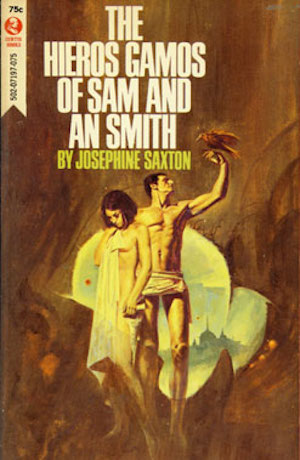
The nameless boy wanders an empty world, prudently avoiding those few people he encounters. Whatever event reduced the human population, it seems not to have affected the implausibly well-stocked stores. Convenient for a boy all alone.
The boy’s solitude ends when he finds a dead woman and her still living newborn. Unwilling to leave the child to die, he carries the infant with him. It quickly becomes clear that this is a world that’s all too realistic when it comes to the needs of babies, something for which the fourteen-year-old boy is ill-prepared. Nevertheless, he perseveres.
Readers may not be convinced that in the wake of a catastrophe it’s realistic to posit fully stocked stores whose wares never expire. I don’t believe that strict realism is what Saxton was aiming at in this slender novel1.
The Bright Companion by Edward Llewellyn (1980)
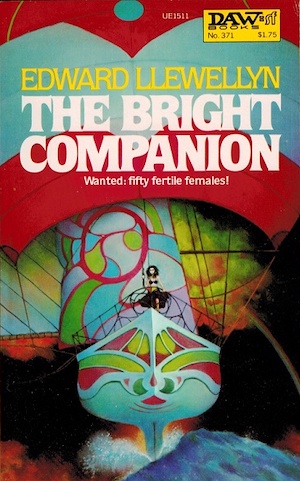
Impermease is a marvelously useful chemical. A pre-Chaos human would have been hard-pressed to avoid it in some form, whether in the form of birth control, cancer treatment, or pesticide. That was unfortunate, as an unnoticed side effect of Impermease was to sterilize the daughters of any woman exposed to it… something that was overlooked until virtually the entire population was exposed. Cue a population implosion2 and the Chaos it triggered.
David is a pariah to the local post-Chaos patriarchs, who have no love for surplus men in general or for David’s late parents in particular. Anne was the patriarchs’ property, treasured for her fertility. Together, David and Anne might be able to escape the patriarchs…but only if they can somehow reach the Enclave, which is overseas and quite possibly mythical.
David and Anne would also be fine subjects for an essay about adventure leads who spend the entire novel bickering with each other.
A Choice of Gods by Clifford D. Simak (1972)

In 2135, virtually every human on Earth vanished. The handful left behind had no choice but to embrace rustic lives. Quite unexpectedly, those left behind discovered that not only were their lifespans vastly increased, but that they were developing vast mental powers that more than compensated for the technology now lost.
Thousands of years later, Earth’s people are content with their quiet lives. The revelation that their long-vanished kin also survived and continued the path of technological innovation Earth abandoned is unwelcome. So is the news that Earth’s lost children are on their way back to a home that no longer wants them.
In addition to the extended lifespans and psionic powers, the humans left on Earth were not entirely forced back to 19th century technological levels. By 2135, there were vast numbers of robots, most of them eager to keep serving humans. This faithful labor force is, for some reason, curiously unacknowledged by the humans.
The Stand by Stephen King (1978)
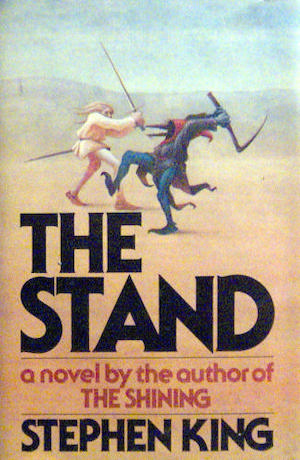
“Captain Trips,” a highly contagious influenza developed as weapon by the American Defense department, escapes and spreads across an unprepared world. In short order, the Cold War is a fading memory. So too could be the human species. Slightly less than one percent of humans survive.
What was the continental US is now a very empty place. Survivors gather in two locations: Boulder, Colorado and Las Vegas. The Boulder folks have been pulled together by dreams of a kindly grandmother, who presides over a community that is, in the main, cooperative and benign. Those who flock to Las Vegas live under the despotic rule of the demonic Randall Flagg.
Flagg does not brook opposition. The Boulder community must go. The conflict between good and evil shapes the rest of this doorstop book.
Used bookstore fans should be aware there are two versions of this story. My MMPB is the lean 1978 version, which clocks in at a slender 817 pages, while the expanded 1990 edition is 1154 pages. The expanded edition alters the timeline somewhat, and restores some cuts. Which is the superior edition? The better one, of course.
Brother in the Land by Robert Swindells (1984)

Caught in a downpour, Danny Lodge takes shelter in a WWII pillbox. This happy accident means Danny is one of the very few to weather the Soviet nuclear attack on Britain. Unlike most Brits, he is alive and largely unharmed.
David’s mother is dead, as are most of his neighbors. His father is traumatized and his hometown of Shipley is in ruins. The Lodges owned a shop, so there are supplies…for now.
Despite the destruction, government survives in the form of the local Commission. That’s excellent news for the Commission but less excellent for the survivors. The Commission controls food and water. Those who can’t be or won’t be slaves will be eliminated.
It’s astonishing how many British thermonuclear-conflict stories of this era reference Protect and Survive, the official guide to surviving nuclear war. The authors of these stories are convinced that the government advice was largely useless and that post-apocalypse life would be dire. US authors (such as Dean Ing) wrote a number of novels in which Americans survive and thrive. Were there any such books published in the UK?
The works mentioned above are only a few of the stories about a future bucoliformed Earth (in fact, there’s another list here, which was published just after I’d initially turned this in—one of those cases of having roughly the same idea at the same time, though with different examples, happily). And I didn’t even mention the thriving Japanese subgenre of population-implosion fiction. No doubt many of you have your own favourites. It might even be that I have not mentioned them in previous essays. Feel free to discuss them in comments below…


Something I’ve noticed in used book stores is that 1990 editions of the Stand are common and the 1978 edition is nowhere to be seen. Given how huge print runs were in the 1970s, I suspect that means people are hanging onto the 1978 version but not the 1990 one.
I first read The Stand as a kid in the 1980s, my Mom’s softcover copy of the 1978 text.
Sometime after the 1990 edition came out (probably in the Oughts) I bought and read the revised version.
Sometime after that I found a copy of the 1980 text in paperback and bought that with the glee of someone finding a classic vinyl edition of a favorite record that was “ruined” by a digital remaster when brought to CD.
An analogy which, I guess, reveals my own feelings on the topic: anyone’s mileage will vary, and perhaps the first version one read will be one’s favorite, but my impression was that the new scenes added little, perhaps even detracted in some instances, and that King’s attempts to update some of the “dated” cultural references were inconsistent and often unhelpful (I feel like Larry Underwood’s pre-pandemic rise and fall makes a lot more sense in the context of ’70s pop than ’80s, but maybe that’s just me).
Anyway, my suspicion is I’m not terribly unique or odd in preferring the earlier text. Quite sure I still have both on the shelves, but if I had to part with one it would surely be the “Complete and Uncut” hardcover instead of the original version, and not for any risible notion my battered paperback retains any collector value; it’s simply the one I’d rather re-read if I ever get around to doing so.
Also could be that the 1978 Stand paperbacks have all lost their structural integrity. It was a big book! Hard to read without stressing the spine.
Concerning footnote 2, a minor plot point in Herbert’s “The White Plague” was all the cetacean species being affected.
Obligatory shoutout to John Whyndam.
And J.G. Ballard.
The Scarlet Plague by Jack London is an early example, and seems, to me at least, to be a strong influence on Earth Abides.
I just listened to a radio adaptation of the London.
Was it a Fredric Brown extremely short story?
The last man on Earth sat in a room.
There was a knock at the door…
Yep, and it’s a bit longer than that and a classic “aliens are stupid” story. Like many Last Man stories, it’s not entirely bleak as long as you don’t think about (Rot13) gur rssrpgf bs rkgerzr vaoerrqvat
Charlie Fletcher’s A Boy and His Dog at the End of the World is set in a world two or three generations after a sudden catastrophic decrease in human fertility. There’s hardly anyone left in the British Islands by the time of the novel – earlier efforts to sequester the few remaining fertile people and get them to breed were so coercive that they led to revolt.
This is a fascinating book. We read this while driving down to Big Bend Natl Park, and this story seemed to fit the drive.
Extra word “are” in the antepenultimate paragraph’s final sentence.
Is that a nod to the late Michael Flanders and Donald Swann? Wherein I mean, was that word actually used outside the not politically correct song, “Have Some Madeira, M’Dear”, or anywhere without at least being a bid to be reprinted in Private Eye “Pseud’s Corner” or, apparently, a technical term identifying specifically the third last syllable of a word? So, anyway, hi.
Fixed, thanks!
Speaking of Simak, most of City would have fit in nicely here if you hadn’t already done it. Except, I suppose, that it isn’t technically a novel.
Then there’s Robert McCammon’s Swan Song, a sort of dark mirror of The Stand.
I wouldn’t call The Stand an example of a bucoliformed Earth. The action in the book–either version–takes place over less than a year, so that the survivors haven’t had to encounter what their world is going to be like when the infrastructure in which they are still living really breaks down.
Souls in the Great Machine by Sean McMullan
Las Vegas?! One of the cities on earth which is *most* dependent upon highly advanced civilization to provide basics like water and food. Why wouldn’t survivors gather at literally any other city?
That would eliminate Phoenix and frankly much of the cities in the Southwest.
Flagg is evil, Vegas is evil.
George R. Stewart’s Earth Abides represents the more bucolic end of the spectrum.
Terry Nation novelised his TV series Survivors.
The Forge of Gods + The Anvil of Stars by G. bear have some of that.
One of the first science-fiction books given to me by parents or grandparents is a candidate for this column. Z for Zachariah by Robert O’Brian was a very depressing read about a post nuclear war wasteland. Good but a downer.
Yes, this was in schools when I was in Grade 6, 7, 8 (the early 1980s) …I don’t remember it after that. We didn’t have it assigned as reading but it was in the library and I think even a copy in the classroom.
_Marooned in Realtime_ by Vernor Vinge definitely fits, and is an excellent read. It’s a sequel to _The Peace War_, which was also quite good.
That is one of the first ones that came to mind for me. I reread it a couple of years ago, and enjoyed it just as much as I did the first time. It works both as SF and as Mystery
See also “The House in November” by Keith Laumer.
I have a shelf of Laumers, and I remember the plots of maybe five or six of them.
If they’re the Retief stories, you only have to remember one plot.
plus one more for the Bolo books (which I loved).
In books I think you’ve covered before, Spider Robinson’s novel “Telempath” features a thriving bucolic settlement although it starts with a man on a mission into very nearly deserted New York City, and a John Wyndham job involving rare astronomical phenomena and vigorous plant growth portrays a very rapid population decline, except for the vigorous plants, which have what may be considered an unfair advantage. Or the humans, a disadvantage.
“The Bright Companion”: If impermease in the environment has that effect on people (and other species), then before long, we are all “On The Beach” doomed anyway. Would you get more than a novella out of it in the time? Perhaps it wasn’t appreciated (except in “On The Beach”) how widespread chemical pollution gets, how fast. Plastic straws at the South Pole or whatever (editor please check). Or the substance may be broken down environmentally, but being named impermease, it sounds indestructible. So, I must remember to catch UK TV reruns of “Doomwatch”.
And why didn’t this post… Also, the online “Evil Overlord List” of tyrants’ “do’s and don’t’s” includes at #98 a note about attractive couples of whom “circumstance… forced them together against their will and they spend all their time bickering and criticizing each other” requiring the Overlord’s special and proactive attention. And probably not just because of how annoying all that is.
From John Wyndham may specifically be mentioned: The day of the Triffids, The Chrysalids, The Kraken Wakes
I just finished re-reading all 6 of Edward Llewellyn’s books. Four of these books (inclusive) are all in the “Bright Companion” timeline, which is chronologically, the 3rd book, but the 2nd one published.
In the series of books, there are aliens and time travel (one way). Fun stories. Too bad he died just before his 6th book was published.
Have you met the Brits? <asked in the most incredulous way possible>
Also, the Brits have actually been through a modern war on their turf. They know exactly what it’s like afterwards.
Hmm, thinking of the Children of the Dust by Louise Lawrence manages to have it both ways. Things are indeed dire and the government advice is largely beside the point and self-serving. But the sister who stubbornly sticks to the rules does survive – but it is only possible for her to follow the rules because her older sister looks after her. And people will go on to thrive but I don’t think there’s any sense of them being a continuing British people.
I lived in the UK from about six months to age 5. In fact, my original accent was very much south of the river. That’s where I spent the Cuban Missile Crisis.
One thing about The Stand is that is does address the food expiring problem, although the citizens of Boulder don’t seem to think really hard about planting that next spring. Or what to do when all the clothing starts falling apart.
In the extended edition, somebody who had a very close-up experience of what happens if you get appendicitis and there is no surgeon nevertheless decides that moving hundreds of miles away from everybody else with a group of like half a dozen people is a great idea. This is presented as a happy ending.
Like pretty much everything of King’s I have ever read, there’s 60 to 80 percent immersive, memorable, and compulsively readable story and then 20 to 40 percent No.
Canned food can survive dozens, if not 50+ years. There are YouTubers that eat canned food that expired 60+ years ago.
At the Beach predated all of these…and is still the best
“On the Beach,” but yes, a fantastic book!
Swan Song gives The Stand a run for its money.
The word is >shy<
as in..
The Shy Era
The cold shy earth
A shy talk at the the townhall
Wittgenstein’s Mistress is an amazing book in this genre.
Some of my favorites:
“Wool,” by Hugh Howey (the Silo series)
“Ariel” and “Elegy Beach,” Steven R Boyett
“Station Eleven,” by Emily St. John Mandell
“The Book of Koli,” MR Carey
“The Postman,” David Brin
“Bird Box,” Josh Malerman
“The Fifth Season,” NK Jemison
“The Girl With all the Gifts,” MR Carey
“The Dog Stars,” Peter Heller
“Zone One,” Colsin Whitehead
“Dies the Fire,” SM Sterling
and a bonus kinda sorta fits: “Seveneves,” Neal Stephenson
Just a few, there are so many more fantastic examples of the genre. I have 174 books on my Goodreads marked as “post-apocalyptic fiction”, doh!
I got into post-apocalypse back in the ’90’s. As a kid in the 1980’s I practiced dumpster-diving until Nuclear Winter theory taught me to give up and love the bomb. I would hazard any Brits who had heard of Dean Ing back then paid him no mind for the same reason.
1949’s “Earth Abides!”
And of course there is that early example, The Last Man by Mary Shelley, witch a tiny number of survivors of a plague making their way through life in Europe.