









Science fiction, being entertainment rather than instruction, frequently traffics in setting and plot elements that have only a passing acquaintance with SCIENCE… and sometimes no acquaintance at all.
Some of this is due to authorial ignorance. Authors might have skipped any physics courses, know nothing about thermodynamics, and see nothing wrong with the notion that one can heat fuel to millions of degrees using only reflected light from a 5000 Kelvin source. Sometimes plot demands some authorial sleight of hand. If you need to get your characters from planet A to planet B faster than relativity would allow, you have to invent wormholes, FTL, teleportation, or some other kludge.
And sometimes, at least at one time, you had to ignore any scientific background you might have acquired in order to sell stories to John W. Campbell, Jr., editor of Astounding, later renamed Analog, a premier SF magazine of the 1940s through the 1960s.
Campbell had two virtues treasured by professional authors: his magazine paid comparatively well, and it paid without the need for lengthy lawsuits. He balanced these virtues with a stable full of hobbyhorses, each new hobby horse odder and less tethered to reality than the previous (see, for example, his defense of the scientifically impossible Dean drive). Incorporating one or another of Campbell’s pet concepts into one’s work appears to have greatly increased the likelihood that he would purchase a story. Which gets us to psionics in science fiction.
Campbell was by no means the first fervent believer in parapsychology. Efforts to research psychic phenomena go back at least as far as the 19th century. He wasn’t even the first person to incorporate psychic powers into SF. But he was the most prominent true believer who also happened to edit what was for quite some time the best paying, most influential post-Gernsbackian SF magazine early in SF’s history. He was therefore in a position to greatly amplify the frequency with which psychic powers (renamed “psionics” to sound more science-y) appeared in science fiction.
Noted critic William Atheling Jr.’s Practice Makes Perfect—But It Can Also Cut Your Throat (1957) observed that by one count “113 pages of the total editorial content of the January and February 1957 issues (of Astounding) are devoted to psi and 172 pages to non-psi material,” and by another, the same issues had “145 pages of psi text, and 140 pages of non-psi.” I’ll explain where the two sets of figures came from later.
Here are five classic SF stories crafted to appeal to Campbell’s quirks.
Get Out of My Sky by James Blish (1957)
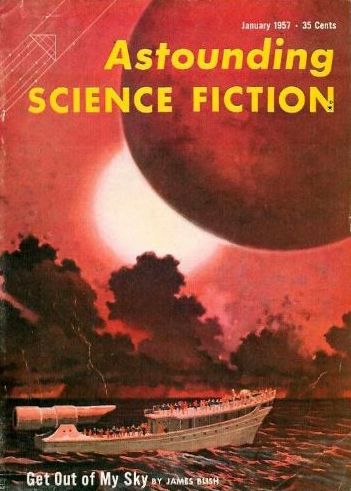
(First appeared in Astounding Science Fiction, January 1957, and Astounding Science Fiction, February 1957)
Rathe and Home are Earthlike worlds that orbit each other, tide-locked just as the Moon is tide-locked to Earth. Land on Home is limited to the hemisphere antipodal to Rathe. Having belatedly explored their world ocean and so discovered Rathe’s existence, the people of Home are displeased by this unrequested addition to their sky. The fact that Rathe has natives makes Rathe even more abhorrent. This is the sort of problem H-bombs were designed to cure. The natives of Rathe, preferring to remain alive, turn to the powers of the mind to forestall doom.
Normally I’d review the five works on this list in dogged publication order, but I wanted to discuss this work first. It’s the very work that led William Atheling Jr. to equivocate about psi vs non-psi in the two issues of Astounding mentioned above. Get Out of My Sky’s first installment lacked psi but the overall plot depended on mind-powers. William Atheling Jr. had an unusually keen insight into Blish’s creative processes, as “William Atheling Jr.” was the penname under which James Blish published his SF criticism. And yes, Atheling did comment on Blish works. Not always favourably.
“Novice” by James H. Schmitz (1962)

(First appeared in Analog Science Fact & Fiction, June 1962, later incorporated into the fix-up The Universe Against Her)
Fifteen-year-old Telzey Amberdon’s visit to Jontarou provides her least-favourite aunt Halet with a pretext to persecute Telzey. Telzey’s beloved pet Tick-Tock being the only known living crest cat, Halet sets in motion the process to have Tick-Tock confiscated for the Life Banks (arguing that this would be for the greater good). There are just two flaws in this plan: Halet underestimates both Telzey and the crest cats, who are not extinct at all. Nor does Halet realize that an attack on Tick-Tock could threaten the lives of every human on the planet. Human survival will depend on Telzey’s ingenuity.
Telzey is very smart, has relatives highly placed in the government of the Federation of the Hub, and subscribes to ethics sufficiently pliable as to justify whatever action seems necessary to handle the crisis at hand. A seemingly endless suite of psionic powers hardly seems necessary to make this plot work. Nevertheless, Telzey possesses mental abilities that should make the most hardened foe think twice…and yet they never do. Of course, spiteful Halet had no idea that her that niece could re-write minds.
Weyr Search by Anne McCaffrey (1967)

(First appeared in Analog Science Fiction & Fact, October 1967, later incorporated into Dragonflight)
Pern is but one of many settled planets, one that has long been forgotten by the mainstream of galactic civilization. Periodic calamities overlooked at the time of settlement have reduced Pern to a patchwork of feudal holdings, such as the one cruel lord Fax took for his own. Young Lessa is determined to see Fax punished for overthrowing and murdering her family. Her taste for revenge blinds her to the greater destiny that fate has in store for her.
The people who settled Pern no doubt had many marvelous technologies, Due diligence before colonizing Pern was not one of them, which is why ravenous alien Thread falling from the sky came as a rude surprise. It’s fortunate that while the Pernese may be technologically backward, they and the pet dragons I probably should have mentioned earlier are armed with a wealth of mind-powers.
Pandering to Campbell could pay off on grander stages: McCaffrey’s tale was nominated for the Nebula, won a Hugo, and kicked off the long-running, popular Dragonrider series.
Un-Man by Poul Anderson (1953)
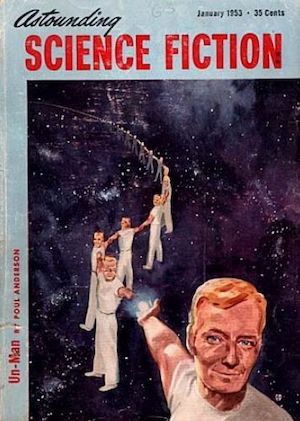
(First appeared in Astounding Science Fiction, January 1953)
The world barely survived World War Three. A world government is necessary to avoid World War Four. All right-thinking people therefore support the UN. Only blinkered nationalists oppose the UN, like the cabal who murdered UN agent Martin Donner. Among the nationalists’ many flaws: a foolish belief that killing Martin would confound the UN. Martin, you see, was simply one of many clones of man-of-action Stefan Rostomily. All the murder achieves is to earn the undivided attention of Martin’s clone-brother Robert Naysmith. Should Naysmith fall in his turn, there are legions of clones to replace him.
Anderson’s desire to sell to Campbell may have been balanced by his desire for scientific verisimilitude. Anderson’s tale offers one of the more notably mundane explanations for supposed telepathy that I’ve ever encountered: the alleged habit of most people to subvocalize their thoughts combined with exceptionally acute hearing.
“The Greatest Invention” by Jack Williamson (1951)
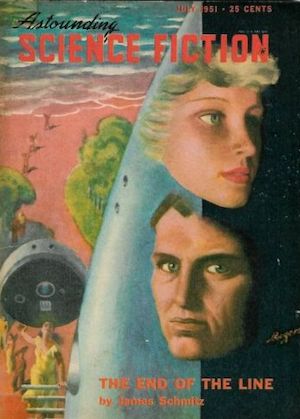
(First appeared in Astounding Science Fiction, July 1951)
Human cultures across the galaxy credit fabled Atlantis as the garden from which civilization grew. Atlantis’ true location is a mystery, dozens of worlds each claiming they were the planet where Mankind began. One scientist has convinced himself that Atlantis must have been on Earth. His efforts to understand how such a backward world could have invented, then lost, interstellar flight blind him to a more pressing challenge: surviving the homicidal intentions of a companion determined to protect Truth from mere scientific fact.
Brevity would have been strength. This rambling tale does have some points of interest. Williamson takes the time to explain why all inhabitable worlds have ecologies in which humans could have evolved: successful colonization requires whole ecological networks to be introduced, rather than a single species of hopeful pioneers. More relevant to the purpose of this essay, this is said to be the story that coined the term “psionics,” which the story assures us is key to advanced civilization for reasons never made clear. Or, at least, it’s key for authors wishing to sell material to John W. Campbell, Jr.
***
These are hardly the only stories I could have cited. Perhaps you have your own favourite examples of stories meticulously shaped around the very special mental powers that Campbell loved, or others where the author clearly just crammed them in in a bid to get that wonderful check from Astounding/Analog. If so, comments are, as ever, below.
In the words of fanfiction author Musty181, four-time Hugo finalist, prolific book reviewer, and perennial Darwin Award nominee James Davis Nicoll “looks like a default mii with glasses.” His work has appeared in Interzone, Publishers Weekly and Romantic Times as well as on his own websites, James Nicoll Reviews (where he is assisted by editor Karen Lofstrom and web person Adrienne L. Travis) and the 2021 and 2022 Aurora Award finalist Young People Read Old SFF (where he is assisted by web person Adrienne L. Travis). His Patreon can be found here.

I recall reading that Anne McCaffrey sincerely believed that psionics was valid science and that her fiction about it was pure science fiction, not fantasy. So it seems that she, at least, wasn’t just trying to appease Campbell’s sensibilities.
There was a time when scientific research seemed to lend credence to claims of psi powers, before magicians like James Randi exposed the trickery being used by the tested psychics, or pointed out the flaws in the experimental designs. So Campbell’s influence wasn’t exclusively to blame.
Psi powers were also quite common in TV and film sci-fi, notably Star Trek and Doctor Who, because they were easy to depict with minimal special-effects expense.
“Get Out of My Sky” was one of the most disappointing reads I’ve ever had. The first half is on the way to being wonderful — I was enthralled. Then came the second half, and the introduction of psi — and the complete ruination of the story. And, yes, it was very amusing to see William Atheling so presciently realize that Blish ruined his story on purpose so he could sell it to Campbell.
“Pays well and on time” is a heck of an enticement to craft fiction in very particular ways.
I guess that’s one of those very commodifiable knacks that are useful because they are oddly more uncommon than one would expect, like being able to sift search engine results into “useful” and “garbage”, or the one on which I have built a theatre career, “shows up.”
The Traveller RPG, which was reasonably hard for a first gen SF table top RPG, had and still has Psionics in it. It was written under the influence of those 60’s novels and at the end of the era that did think it could be science. It became a major part of the background (Zhodani, Psionic suppressions, etc.) that it’s still there in the 5th edition. I just ignore it personally, so there is very little impact on the games I run.
There was a set of cross over rules in the Thieves’ World box set for using Psi as fake magic that was hilarious to game however.
Ah, memories of a pitched submachine gun duel fought between two Classic Traveller telepaths using life sense to compensate for being in pitch darkness. It turned out one of the things life sense won’t detect is an impenetrable bulkhead between two telepaths.
I don’t know if Richard S. McEnroe’s The Shattered Stars began as a Traveller adventure but it does explain why even psionics-hostile governments might want to turn a blind eye to a psionics institute.
A shame, really, that The Demolished Man was relegated to a footnote, as it is one of the two best “science” fiction stories about telepathy I have ever read — the other being Silverberg’s Dying Inside, one of the higher high points* of his ’70s self-reinvention as a serious writer. (Joanna Russ, in a review, described him as “a sossidge factory turning into a real writer,” or words to that effect.)
* Of which, to be fair, there were quite a few.
A sampling of stories off the top of my head:
Psion, Joan D. Vinge, and the other novels in that continuity.
Damn near everything ever written by Mark Clifton: “Star Bright”, “Sense From Thought Divide” (and the other stories in the “Ralph Kennedy” series), They’d Rather Be Right, etc.
Alfred Bester’s The Stars My Destination is also based entirely on psi powers, though almost completely different ones than in The Demolished Man.
Asimov forayed into psi numerous times, including the later novels in the Foundation series.
Heinlein too, many times. Time for the Stars, “Lost Legacy” are two that stick with me.
Clifton and my teenaged failure to read closely is why I bought Bester’s Starlight: The Great Short Fiction of Alfred Bester. I thought it would have “Star Bright”, which I had enjoyed. Since “Star Bright” is by Clifton and not Bester, it didn’t.
Another one with psionics that was first serialized in 1954, and then made into a novel in 1957 is They’d Rather Be Right by Mark Clifton and Frank Riley which one the 2nd Hugo Award for a novel. Okay, so psionics is not the focus, but since Bossy the machine that grants immortality also makes people telepathic. And a natural born telepathy made Bossy possible, well it is about psionics.
9: That’s one of the Hugo winners that I’ve not only never read, I’ve never seen a copy of it.
Julian May’s Pliocene – Milieu series is heavily predicated on various psi powers. With an homage to Paradise Lost thrown in, because of course it is.
A.E. Van Vogt’s The World of Null-A and sequels are at least partly along the lines of “Un-Man” — I recall Gosseyn used the subvocalization trick, but he also had some real psi abilities (“the map is the territory”). This has always been one of my favorites in part because my wife loves it, and she usually turns up her nose at less-than-hard science in her SF.
@10: I thought that was the one where my attempts to read all the hugo winners derailed, but apparently not. I wrote a review:
“One of the twelve most influential books in science fiction.” said Barry N. Malzberg, but I can’t imagine why. There’s nothing novel (even for the time of writing, I think) about it, and a whole lot of handwaving.
No idea where I got it, though. I don’t have a copy now.
13: I came away from a recent reread of Malzberg and Pronzini’s The End of Summer with the impression Malzberg loved 1950s Astounding SF with the heat of a thousand exploding stars. I was a bit surprised, given the sort of fiction Malzberg writes. Kind of like discovering Margaret Atwood is surprisingly well-informed about the art of Margaret Brundage. Not an overlap I expected.
10: See, not everything that befalls you is bad!
A list of sf works that incorporate some variation of psionics must run into the thousands. One old favorite of mine is the weird, flawed, brilliant The Mind Parasites by Colin Wilson.
John Brunner’s The Whole Man (1964) springs to mind, as an early favorite of mine. He also wrote something called The Psionic Menace in 1963, although I haven’t read that one.
I just remembered that Asimov actually put psionics — specifically, mind reading and mind altering — into the hands of the Mule in Foundation And Empire, the second Foundation series novel.
@11, Yes, I quite enjoyed the first book but found that in each subsequent one the amount of page-time spent on psychics psyching at each other seemed to increase, and I couldn’t muster enough willpower of my own to make it through the final book.
@10) My paperback copy of “They’d Rather Be Right” is called The Forever Machine — might be easier to find under that name?
@13) I thought “They’d Rather be Right” an, er, rather terrible novel — but I did think that it was ambitious and advancing semi-original (but utterly crackpot and rather (there I go again) distasteful) ideas; so in a way I could see why readers back then liked it. (The other reason it won, I think — as others have suggested elsewhere — is that fans of Astounding were so upset that a novel from Galaxy won the first Hugo they made sure that an ASF serial would win the second one.)
>18: Heck, Asimov introduced telepathic *robots* in THE ROBOTS OF DAWN and used them (R. Giskard and R. Daneel) as a way to retroactively tie his Robots, Empire, and Foundation series all together.
Probably my favorite example of telepathy in sci-fi is the nighthorses in C. J. Cherryh’s RIDER AT THE GATE and CLOUD’S RIDER, aliens who communicate telepathically–but only in images.
This is where I have to point out, once again, that Psionics is more realistic than FTL travel. The former just requires postulating some unknown mechanism, and could work completely within the realm of physics as we know it (admittedly, not in the way it’s usually portrayed); the latter, requires rewriting pretty much all of physics as we know it.
FTL is flat-out magic. The only reason it’s more accepted than Psionics is the style of stores that are popular these days
@22/Rose Embolism: “FTL is flat-out magic. The only reason it’s more accepted than Psionics is the style of stores that are popular these days”
Not true at all. FTL propulsion methods such as warp drive and wormholes are outgrowths of the equations of General Relativity (Einstein himself, along with Nathan Rosen, first proposed what we now know as wormholes), and theoretical physicists over the past several decades have worked out detailed physical models of how they would work (pioneered by Kip Thorne for wormholes and Miguel Alcubierre for warp drive). The upshot is that they are theoretically possible but prohibitively difficult due to the immense energies required and the need for some kind of exotic matter with negative energy to stabilize them. However, theoretical workarounds have been devised that reduce the energy requirements considerably, so it’s quite possible that future theorists will devise further workarounds that bring it closer to practicality. It’s enormously unlikely to be achievable in practice, at least without the technology of a civilization one or two Kardashev levels above ours, but the theoretical foundations of it are entirely sound.
As for psionics, on the other hand, there isn’t even an inkling of a theoretical explanation for how such a phenomenon could exist; it’s just a label, an arbitrary handwave. No credible scientist that I know of has ever published a theoretical paper detailing how psychic powers would work, the way dozens of theorists have done for warp drive, wormholes, Kerr black hole singularities, and the like. It’s just superstition dressed up with a sciencey-sounding label.
Also, I disagree that psi powers as depicted in fiction could work within the bounds of known physics. On the contrary, what I dislike about psi powers is that writers tend to use them as a cheat to circumvent physics, to give characters unlimited magical powers without regard to physical law. Telekinetics are shown to be capable of lifting masses immensely larger than themselves without any expenditure of metabolic energy, or any need to anchor themselves or obey the law of action and reaction. Or they can teleport as if by magic, as in The Stars My Destination. Telepaths can perceive anything anywhere, even with no possible way for information to reach them. They can even ignore the speed of light, since psi is often used to allow instant communication across interstellar distances.
It’s also used as a cheat to get around other realistic limits, like linguistic coding. Psi is a common fictional handwave to allow universal translation between languages (notably in Doctor Who, where the TARDIS’s telepathic circuits are the explanation for why everyone in the universe seems to speak English), assuming that it taps into universal concepts that transcend differences in spoken language. But in actuality it’s the other way around: Every brain encodes concepts according to its own individual map of associations, and the only way we can communicate is by agreeing on common terms for those concepts. If you could read people’s minds directly, it would probably be less comprehensible than speech, except for broad universal things like emotions or sensory images.
Granted, FTL is used as a shortcut and handwave in the same way. But there is actually a solid theoretical basis for it, while there is none for psionics.
What about Marion Zimmer Bradley’s Darkover books? And Zenna Henderson’s The People stories?
The Telzey stories were one of my favorite series growing up. Schmitz’s Witches of Karres is also psionics.
Nicoll bete noire Randall Garrett, with Lawrence Janifer, wrote a series narrowly tailored to Campbell, featuring an FBI agent and a telepath who thought she was Queen Victoria; fix-up collection named Brain Twisters.
the alleged habit of most people to subvocalize their thoughts combined with exceptionally acute hearing.
I believe that’s what Pat and Tom in Time for the Stars thought they were doing.
@7- I though of Lost Legacy too, but had to look the title up.
Now I wonder if Douglas Adams ever read the Blish story.
@5: Something else life sense won’t detect? Hivers! As far as psi is concerned, Hivers are inanimate objects – ESP can see them, TK can pick them up, but their minds can’t be read and they never, ever have psi strength. A lot of fun can be had with that…
@23: If FTL existed it would violate causality. Period.
28: I did not know that about Hivers.
@29: Sadly, it pokes a hole in an idea I had for how to prevent uncrewed vessels from using jump drives. But I came up with another I like at least as much.
@24 I was thinking of The People also.
Some of Andre Norton’s science fiction had psi communication, although the ones I am remembering are communication with nonhumans.
@28/Patrick: “If FTL existed it would violate causality. Period.”
Not if the timeline is immutable, which theory argues that it is. There are some quantum theorists who believe that retrocausality happens all the time, that advanced waves propagating backward in time may influence quantum events in the present and explain things like the two-slit experiment and the way photons seem to know in advance what the outcome will be. In which case it isn’t necessarily a problem if FTL communication causes events to happen out of order, because events being influenced by future information would be an integral part of normal physics anyway, rather than the paradox we assume it would be.
Don’t get me wrong — in real-world terms, I think it’s highly likely that FTL will never be achieved. But as a fictional premise, it can be handled in a way that’s almost entirely grounded in real physics, with only a slight amount of fudging necessary to deal with things like causality violation. That is not true of psionics, which has absolutely zero basis in any real scientific observations or theory. FTL is mostly legit physics with a small amount of artistic license; psionics is just magic by another name.
(And as I mentioned, psionics is often portrayed as permitting instantaneous interstellar communication, which would create the exact same paradoxes as FTL drive. So it rather cancels out as a comparison of the two.)
@18: Yes psionics is an element in both Asimov’s future histories, Heinlein has telepathy in his future history (allowing secure communication among the Howard families), Clarke has it in Childhood’s End, and Niven in the Known Space universe. It’s everywhere
A. Bertram Chandler’s first sales were all to Astounding, and the navy ships in his Grimes universe typically carried a psionics officer (because telepathy, however uncertain it might be, could be lifesavingly faster than waiting for the mail packet) — but it’s not clear to me that these were linked; from what I see in ISFDB, most Grimes that didn’t go directly to Ace was published in other magazines, possibly because Chandler had steady-enough employment in the merchant marine that he didn’t need to write to Campbell’s whims.
@1: McCaffrey did non-Pern psionics stories for Campbell (e.g., the cover story “A Womanly Talent”, and others in that near-contemporary setting), but she also sold them to other editors; e.g., the first Rowan stories went to F&SF. So I’m not surprised to hear she was a Believer.
@7: Heinlein scattered uses of psi — not in his mainline future history that I recall, but lightly in some stories (e.g., unreliable telepathy in “Gulf”, a clairvoyant in Starship Troopers) and as the basis for others not sold to Campbell (e.g. “Lost Legacy”, “Project Nightmare”).
If the Gaussjammers = sail and Manschenn Drive = steam, presumably the FTL radio is radio, which would make the telepaths…. carrier pigeons, maybe?
On the television front, what about Talia Winters and Bester in Babylon 5?
@25) Brain Twister was the title of the first novel in the Garrett/Janifer psi series, which was called “That Sweet Little Old Lady” in its Astounding serial. It’s not a fixup. The other two novels are The Impossibles (serialized as “Out Like a Light”) and Supermind (serialized as “Occasion for Disaster”.) The first is … very slight, very fluffy, but (very mildly) entertaining. The other two are significantly worse.
All published as by “Mark Phillips”. And technically at that time the collaborators were Randall Garrett and Larry M. Harris — Janifer changed his name in about 1963 (stories in 1962 were as by Harris, but his novel Slave Planet, from 1963, was as by Janifer.)
@28,
If FTL existed, causality as we know it would be changed. In any case, see Sabine Hossenfelder, https://www.youtube.com/watch?v=9-jIplX6Wjw
@36/Lou: Babylon 5‘s use of psi powers was exactly the kind of thing I was complaining about — using the label “psionics” as a handy “get out of physics free” card, a blanket handwave for anything that allowed ignoring physical law or common sense. One of the first major episodes focusing on psi powers involved a psychic human evolving into a godlike being of effectively infinite power, much like Star Trek‘s second pilot except with a happier ending. Too many writers just use psi as an excuse to throw pure magic into what otherwise presents itself as science fiction. I just resent that mentality, that simply slapping the word “psionic” onto something completely impossible somehow constitutes an “explanation” for why it works. That’s about as much of an explanation as “a wizard did it.”
On that note, can anyone recommend works of fiction that actually try to come up with a rational explanation for psi powers and keep them within the bounds of plausible physics? There was the story mentioned in the article about hearing people’s subvocalized thoughts, but what other attempts have been made? I’ve tried it myself to an extent in my Star Trek tie-in fiction, positing that telepathic powers have an EM component and also invoking quantum entanglement to justify their instantaneous, non-local nature. I once came up with a theory for an unused comic book idea involving a class of particles called psions that were an undiscovered fourth generation of quarks and leptons, and that resonated with brain waves. (I used that theory in one of my later Trek books — I didn’t bother to reconcile it with the EM idea.) I’ve published a couple of stories (one in Galaxy’s Edge, one on my Patreon) set in a fantasy universe with a mystical/psychic phenomenon called Wyrd, but its capabilities are bound by physical laws like conservation of energy, much like Niven’s Mana. But I’m curious if other authors have made attempts to present psi powers as something with a scientific justification, rather than just an excuse to break scientific laws with impunity.
@40 I’d try Hollow Man by Dan Simmons. I can’t guarantee it will pass the scientific plausibility test, but I do remember thinking it was the most convincing sounding handwave for telepathy I’d ever heard, at least. But it’s been a long time since I read it, and couldn’t confidently summarize the explanation.
Anne McCaffrey’s “To Ride Pegasus” is very much SF, and starts with a person having a precognitive episode just as he is hooked up to a new type of brain scanner, thereby documenting proof that something happened in his brain during the episode. The rest of that book is discovering/documenting new abilities and trying to work out how to make a place for them in society. They help with law enforcement efforts, etc. “Pegasus in Flight” and “Pegasus in Space” come two generations later, with that society established but new variations still being discovered. Her “Tower” series is set much later.
As a kid, I loved Telzey Amberdon’s adventures, as it was cool to imagine having mental superpowers. As an adult, rereading them, I found her rather frightening.
Ursula LeGuin’s City of Illusions and The Left Hand of Darkness both include telepathy (“mindspeech”). In fact, a large part of the plot of City of Illusions depends on the bad guys’ ability to mindlie, which humans can’t do. And what about The Chrysalids by John Wyndham?
Niven’s Known.Space setting leans heavily on psionics, especially telepathy Kzin have telepaths, the Thrintun and Grogs have mind control powers, occasional humans have some telepathy, or even telekinesis (like Gil the ARM with his telekinetic arm.)
@40/ChristopherLBennett – I thought that Asimov at least tried to handwave the Mule’s telepathy in Foundation and Empire by making out that he was somehow interpreting and manipulating the electromagnetic signals from the brains of his victims. It’s not a particularly convincing explanation, but it’s better than nothing.
I do think–given what I know of Campbell–that the idea that psionics might allow you to “ruggedly individualize” your way out if the laws of physics was probably part of the appeal for him.
@6 – Silverberg’s Dying Inside was not his only foray into psi. There’s also The Man in the Maze and The Second Trip. Ironically, none of them were published by Campbell; the first was serialized in Galaxy, the second in Worlds of If, and the last in Amazing.
@11 – I remember that a press release and possibly a sample chapter of The Many Colored Land was being handed out as a freebie at the 1980 Boston Worldcon.
The Garrett/Janifer collaborations seem to be available on Project Gutenberg. Find them here. There’s also something called “Pagan Passions”, which presents itself as soft porn with the conceit that the Greek gods have returned.
@40,41: Blish’s Jack Of Eagles doesn’t so much provide a scientific explanation as technobabble one, but what it does insist is that psionic power can be approached scientifically – in the middle of a hard-boiled plot, even!
I was hoping for something more than vague handwaves. There are plenty of those. I was hoping there would be something that had attempted a more in-depth explanation of the physics and/or neurology behind psi powers.
I suppose maybe you could count the Tines from Vernor Vinge’s novels, a wolf-like species that form group intelligences of multiple individuals that link minds through sonic transmissions. It’s not psi, but it functions analogously to telepathy. That’s one way to do it — to posit aliens who’ve evolved the ability to communicate mind to mind, rather than asserting a nonexistent psychic ability in humans. One of my own older, unpublished ideas is a hive-mind species linked by naturally evolved radio communication.
I suppose that to a large extent, the function of psi powers in fiction has been taken over by cybernetics, positing futures where humans are linked to the communication/information network by brain implants.
Babylon 5‘s use of psi powers was exactly the kind of thing I was complaining about — using the label “psionics” as a handy “get out of physics free” card, a blanket handwave for anything that allowed ignoring physical law or common sense.
Psi in Babylon 5 is actually extremely limited – there’s an episode in which an experiment has produced a super-powerful human telepath who demonstrates his unprecedented, terrifying mental powers by throwing a coin across a small room. Shortly after that, the sheer apocalyptic scale of his supernatural abilities being uncontainable by mere human flesh and bone, he evolves into a superbeing of pure energy who can, we can assume, throw a coin across a medium-sized room.
COWER BEFORE MY GODLIKE MIGHT, PUNY FLESHLING
ping
“Ow!”
As I recall, in Vernor Vinge’s work, the Tines are able to operate collectively because the laws of physics governing thought differ depending on where you go in the galaxy, with even individual intelligence becoming impossible towards the centre.
The idea of hiveminds based on natural radio transceivers comes up a fair amount in Olaf Stapledon’s books, but he treats this as separate from telepathy, which is its own thing.
Is there any recent SF thar takes human telepathy seriously?
Most arbitrary use of psi is in Known Space as well:
Hyperdrive allows you to travel one light year in two days.
Any limitations? Yes, if you fly too close to a star in hyperdrive, it blows up.
Can you detect stars while you’re in hyperdrive? Yes, you can use this handy mass detector.
Cool, let’s send out automated probes in every direction to explore the galaxy! You can’t. The mass detector is a psionic instrument and can only be looked at by a human.
What.
@53/jaimebabb: “As I recall, in Vernor Vinge’s work, the Tines are able to operate collectively because the laws of physics governing thought differ depending on where you go in the galaxy, with even individual intelligence becoming impossible towards the centre.”
Not really. The Tines’ World is in the innermost region of the Beyond, the realm where FTL travel and superintelligence become possible, and just barely outside the Slow Zone where normal Earth-style physics and intelligence exist. Since the limits vary smoothly from the inner to outer edges of the Beyond, that means the Tines exist in a realm that’s just barely beyond the laws of our part of the galaxy.
As far as I can recall, there’s nothing about the workings of their intelligence that requires any oogy-woogy science; it’s actually subject to a lot of physical limits, for instance, the group intelligence breaks down if there’s too much noise interfering with their sonic communication, or if they get too far apart, or if there are too many members in the pack for a stable equilibrium between minds to be achieved. It’s basically just canine pack psychology taken to an extreme thanks to the sonic “telepathy.”
“Is there any recent SF that takes human telepathy seriously?”
Depends how you define SF. It’s still a standard trope in SFTV franchises like Star Trek, Doctor Who, and DC and Marvel. If you mean prose SF, there were those Niven/Lerner continuations of Known Space a few years back, but you’re probably talking about newer universes. Let’s see… Cixin Liu’s Trisolarans in The Three Body Problem and its sequels communicate by the electromagnetic form of telepathy; all their thoughts are completely open to each other, so they can’t comprehend human deception.
@54/ajay: The FTL propulsion system that can only be used by a living person isn’t really an arbitrary trope, since it serves the narrative purpose of providing an excuse for why dangerous space exploration has to be done by people instead of machines. Gene Roddenberry’s Andromeda did this with slipstream drive, which used a handwavey interpretation of the quantum observer effect to claim that only living intelligences could navigate in slipstream, and even sentient A.I.s couldn’t do it (which was weird, because the story otherwise treated A.I.s as fully sentient persons).
54: I think it’s one light year per _three_ days. Still, stars around here are 5 LY apart on average, and the UN of the 24th century should have extremely good star maps. What are the odds a probe would get too close to an uncharted star.
My suspicion is that the UN, having established interstellar colonies in the 21st and 22nd century, noticed that thus far they’d been visited by a Pak, nearly been conquered by a Slaver, had to fight several wars with the Kzin, and encountered not one but two vastly more powerful alien civilizations, and concluded all further expansion would buy them is the chance find something as advanced as the Puppeteers and as peaceful as a Kzin. So they stopped looking.
See also More Than Human (1953) by Theodore Sturgeon, a fix-up novel based on three novellas, introducing “homo gestalt”, the ability of a group of otherwise unrelated people with psychic abilities who are able to unite their minds in a “gestalt” to use their powers as a single being. Underlying the concept was that this was supposed to be the next step in human evolution.
@35: a cute analogy, but IIRC telepathy in the Grimesverse was also instantaneous — flaky, but instantaneous. It also served (in a cute link with with Anders’s column yesterday) as a universal translator: in the first appearance of Grimes, the telepath on his ship and one from a neighboring civilization communicate immediately, but when they blow up on meeting (the other civilization being antimatter) video communication is reduced to gestures.
@57
A similar concept shows up in Slan by A.E. van Voght, the titular Slan being a telepathic “next step in human evolution”, who were periodically born to normal human parents and also were illegal (I shouldn’t wonder if Stan Lee was influenced by this when creating the X-Men)
@22: There have actually been thousands of experiments conducted in parapsychology, while to my knowledge human-scale FTL is lacking those. It just happens that when those experiments have returned positive results, they get criticized on methodological grounds (for not eliminating every possible source of experimenter bias, usually) or just plain ignored. Nothing so far indicates that anything useful has ever come out of those experiments, or that repeatability has been shown by independent researchers. So whether anything is really there, it can’t be monetized or reliably employed in the activities we value (war, advertising, habit-forming substances, etc.). Other research areas having similar issues with methodology and repeatability, for instance antidepressant development, miracle diets, mindfulness training, and similar social/psychological endeavors, have at least been able to produce marketable products or attract significant grant money. But those seem to have less appeal for science fiction writers looking for a hook to hang their plots upon.
@49) Yes, I’ve read Pagan Passions. It is as you say presented as soft porn, and I suppose by late ’50s standards it qualifies, but it’s very soft porn indeed. The line in which it was published (Beacon/Galaxy in some permutation) often made an attempt to “present” their novels as soft porn, and so for instance their printing of Poul Anderson’s Virgin Planet is so packaged. (There’s really no sex in the novel, though some is implied.) Likewise, Cyril Kornbluth and Judith Merril’s Mars Child (written as by “Cyril Judd”, one of your more transparent pseudonyms) was reprinted by Beacon/Galaxy as Sin in Space, with a provocative cover. I’ve read Mars Child and there’s no sex in it, and I doubt Kornbluth and Merril added any for the reprint, but who knows?
I’ve actually read all of Janifer’s SF novels (that I know of, it’s possible some were published under pseudonyms I don’t recognize) and I give capsule reviews of them here: The Novels of Laurence M. Janifer.
@60/Paul Connelly: “There have actually been thousands of experiments conducted in parapsychology”
Of course there have, and many of them have claimed to demonstrate results — yet somehow there is still a complete lack of a theoretical foundation for how they supposedly work. If there were really anything there, surely those thousands of experiments would’ve led to a theory, a testable explanation for what is actually going on physically and neurologically. It’s not science if you just describe observations — you have to explain them, and rule out alternative explanations. You have to offer a theory of how and why the observed phenomena happen, what underlying principle causes and unifies them, and that theory has to make predictions that you can test in order to verify or refute it. As far as I know, nobody has ever formulated a testable theory of the mechanisms underlying alleged psychic phenomena. And unless that happens, there’s no reliable evidence that the reported experimental results don’t have a mundane explanation.
Warp drive and wormholes, conversely, arise from a verified theory. They’re extreme solutions of the equations of General Relativity, a theory that was formulated to explain the observed phenomena of gravitational attraction between masses. That theory makes many predictions that have been consistently verified by observation and experiment. Wormholes and warp drive are also predictions arising from the exact same theory, just by plugging more extreme numbers into its equations, although the theory does predict that actually creating them in practice would be prohibitively difficult.
Anyway, we’re not talking about real life here, we’re talking about science fiction. We’re talking about the difference between soft science fiction, where you can posit any unreal thing without having to explain it, and hard SF, where the speculative concepts are extrapolated from known science and developed in a logical way. FTL travel, while probably forever unfeasible in real life, can be a hard-SF concept, because there is a solid theoretical basis for it that can be built on by an author. But without a theory of psionics, a nuts-and-bolts explanation for how it supposedly works, it can never be more than soft SF or fantasy.
Telepathy is Samuel R. Delany’s Babel -17 is based on the idea that the human nervous system generates EM noise which can be picked up by an antenna, but only one with the complexity of another human nervous system, It’s a try at a real-world justification, at least. Mind you, the entire plot of Babel-17 is predicated on the strong Sapir-Whorf hypothesis, so the whole thing’s intrinsically suspect anyway.
I have the SFBC edition of They’d Rather Be Right, which I acquired in the usual way. Don’t remember it being as bad as people are claiming, but it’s been a long time since I actually read it.
A lot of my favorite stories already mentioned, although in hindsight many of them look like wish-fullfillment fantasies. Wouldn’t it be cool if…
The powers in Kathryn Kurtz’s Deryni books are presented as magic but are otherwise indistinguishable from psi.
Anderson’s tale offers one of the more notably mundane explanations for supposed telepathy that I’ve ever encountered: the alleged habit of most people to subvocalize their thoughts combined with exceptionally acute hearing.
This reminds me of the original 1968 novel Escape from Witch Mountain. The 1975 movie version, and (I believe) most subsequent retellings, portray the childrens’ ability to communicate with each other as telepathy, but in the original story, they can talk to each other at ultrasonic frequencies that are inaudible to normal humans (while moving their lips as little as possible, so that their speaking is less obvious). I don’t recall whether this ability was shown as having an effect on their ability to hear other ultrasonic sounds.
Catherine Asaro, who has a degree in physics, includes telepathy in her Saga of the Skolian Empire SF/Romance novels. It’s still fairly handwavy, but she provides an explanation of how the telepathic characters have microscopic structures in their brains that amplify brain activity for transmitting, match the brain activity of others for receiving, and interpret the signals received (I’m not sure how similar this is to Delany’s explanation described by @63 above).
There’s the Greg Mandel trilogy by Peter F Hamilton, which follows the titular Greg Mandel, a veteran of a British Army program to weaponise psychics by means of an artificial ‘gland’, which allows test subjects to unlock previously latent psychic abilities. The program was mostly considered a failure, but the books are set some time later, and Greg works as a private eye, using his basic ‘mind-reading’ to pick out when people are lying etc. Also, in his Nights Dawn trilogy, Edenists have a telepathy called ‘affinity’ which works due to some kind of hand-waved quantum-entangled structure, genetically engineered into their brains.
@59 It has occurred to me that a lot of the SF of the 1940’s and 1950’s that involves people with psi powers being the “next step,” or some kind of “homo superior” may be related to the writers having come of age at a time when eugenics was still considered a legitimate branch of the biological sciences.
@67/Russell H: What annoys me are those various stories postulating that psi powers have always been an evolutionary “advance” in humanity since prehistory, but have always been latent or only present in a minority. I mean, surely any subset of the population with that kind of survival advantage would’ve long since out-reproduced those without it and become the majority.
68: oh, that’s easy to explain. Psionic powers have always existed, and they’re definitely an advantage, but the problem is shutting them off. A psyker who spends too much time surrounded by the constant babble of other minds eventually goes mad. Most of them flee into the wilderness and live a hermit life (hence the worldwide stories of holy men, prophets etc living at the tops of mountains or in deserts, and generally being very grumpy) and therefore do not reproduce.
Fortunately, modern technology has a cure – it’s invented the smartphone, the best conceivable way of distracting a human being. Now, a psyker who’s stuck on a crowded train, instead of going nuts from the echoing thoughts of his sixty fellow passengers, can simply pull out his phone and take his mind off it by scrolling Twitter. Armed with their phones, the psychics are back in society, and the dawn of a new race of man is finally at hand.
@69/ajay: Oh, people had ways to distract themselves from thinking long before smartphones — listening to music, reading magazines or tabloids, having banal conversations just to hear themselves talk, the works. I remember witnessing plenty of such things when I rode the bus to and from school all those years. I remember one day when I was riding into college — I was awed by how beautiful the clouds in the sky were that day, and saddened to realize that not one other person on the bus had noticed them, because they were all preoccupied with their various distractions.
I was often amazed by the simplicity and repetition of the conversations I heard fellow passengers having. Sometimes it seemed the actual words and topics were beside the point and it was simply an excuse for social bonding. I imagine a lot of texting exchanges these days are much the same, except with a lot more emojis.
One of the more diverting conversations I listened to on the bus involved the efforts of two awkward teens to flirt despite having none of the applicable verbal skills. They had a friend who did their heroic best to keep the process moving along but progress towards what I assume was going to be a mutually desired date was glacial and largely inarticulate. The detail that sticks in my mind was the loud interjection “I LIKE CATS!” which coincided with a moment of dead silence on the bus.
Still went better what happened with a teen at a pizza place I happened to be in, in which her attempt to flirtatiously twirl her iPod earbud at her beau ended with the earbud smacking her in the eye.
@68,70/ChristopherLBennet
There’s a Known Space story where it turns out that Neanderthals were all telepathic, but since they could literally feel others’ pain they weren’t any good at fighting, hence their extermination at the hands of non-telepathic Cro-Magnon. That one was a Man-Kzin wars shared universe story, Dean Ing wrote it.
That’s called phatic communication, and serves exactly that purpose. It’s often compared to physical grooming behaviors among other primates.
I think Niven noted that if psi or magic were real, evolution would likely have taken advantage of it by now.
I don’t know of any mechanisms other than vague “EM” handwaving or outright cheating (controlling environmental nanites or such), but occasionally authors do at least try to follow constraints. The big one to my mind is Vernor Vinge’s The Witling, where people with teleport powers have to obey conservation of energy and linear momentum. (I think Vinge confessed to giving up on angular momentum).
OTOH, as noted, psi often _is_ FTL. Babylon-5 had Centauri linked-twins who traveled with the emperor, and some of the First One activity seemed long range too though it was vaguer. Liaden psi can be FTL too, and also runs up to very high magic levels too. Oh, and Centauri all had pre-cognitive dreams of their deaths, for some reason. Babylon-5 also had “life force”, which I sadly recall atheist JMS defending in newsgroup arguments.
Julian May had psi interacting with new physical “fields” but that doesn’t explain anything.
I do have the impression that psi is less common in new SF that’s not continuing a series.
@73/zdamien: “Babylon-5 also had “life force”, which I sadly recall atheist JMS defending in newsgroup arguments.”
Oh, good grief, yes, I absolutely loathed that idea, that everyone had a fixed amount of “life energy” and how healthy you were or how long you had to live was purely a function of how full the tank was, rather than anything to do with overall health or metabolism or anything. Just incredibly stupid, bad medical science, yet it came up over and over in the series. Probably my least favorite thing about B5.
Getting back to Poul Anderson, the telepathic Aycharaych in his Flandry novels was using a means of sensing the radio signals generated by the electrochemical activity of others’ brains, although Anderson was too committed to physics (except for his FTL McGuffin) to make this easy – Aycharaych was the product of an old civilization that had evidently practiced some form of genetic engineering in the distant past, and even he had a difficult time interpreting what he picked up. And he was easily foiled by headsets that generated short-range radio noise.
@75
Anderson used a similar idea in one of the Maurai stories, where the protagonists appeared to have telepathy with each other, later revealed to be by means of radio transmitter/receivers surgically implanted in their brains.
@75/Raskos: I’ve only read the later collected editions of Anderson’s Flandry stories and others in that universe, but I got the sense that he originally wrote them more fancifully, then revised them a decade or two later in their collected forms to make the outdated or fanciful ideas more scientifically plausible. But I don’t know that for sure.
I am currently rereading Ian M. Banks’s Excession (1996), definitely science fiction, in which one of the artificial spaceship “Minds” (hyper-advanced AI’s) nonconsensually reads the minds of humans. The book seems to imply that all Minds could do this psionic trick, but they choose not to, considering it unethical and/or distateful. The Mind’s name is Grey Area, but other minds call it the derogatory nickname “Meatf**ker.
@75 – That’s right, I’d forgotten. But that was technological rather than innate.
@77 – I’d only read the Flandry stories as collections myself, but they covered a fair span of the author’s career. Aycharaych showed up with his psychic abilities, pretty-much as originally described in the earlier stories, in A Knight of Ghosts and Shadows, one of the Flandry novels, which was published in the mid-Seventies.
@79/Raskos: Well, sure. I wasn’t suggesting that Anderson removed concepts from the rewritten stories, just that he worked in better scientific rationalizations for them after the fact. That’s how some of it seemed to me, anyway.
81: I remember an Anderson tweak to The Enemy Stars in which he replaced instantly propagating gravity (something that popped up in a number of early Andersons) with tachyons,
@80 – Oh, no, didn’t mean to suggest you were implying that. My memory might be at fault here anyway.
I’d look out the Flandry collection that has the story with the first appearance of Aycharaych and see how his ability is presented but I’ve got a review to get finished and submitted tonight, and anyway the book might be boxed.
@82/Raskos: I just checked my own copy of Agent of the Terran Empire, the collection including that first story, “Honorable Enemies.” The afterword to the 1980 edition specifically says the early stories were revised for that edition to clarify some of their scientific weaknesses — I guess I didn’t just get that impression, it was stated outright. It doesn’t say if those revisions applied to Aycharaych’s telepathy, but I wouldn’t be surprised if they did.
There’s a passage in the story, after Flandry figures out that Aycharaych is a telepath, where he and his colleague talk about the limitations of telepathy (pp. 100-101 of the January 1980 Ace paperback edition):
“Low rate of data conveyance at those frequencies, as well as high noise levels and rapid degradation of the signal. Not to speak of the coding problem. Different races have such different brain-activity patterns that a telepath has to learn a whole new ‘language’ for each. In fact, he has to do it for every single member of a non-telepathic species like ours; we don’t grow up in a shared communication mode, the way we do with our mother tongues…
“But Chereion’s a very old planet… Somehow, they must be able to detect and interpret something mental that intelligent beings have in common universally, or almost universally. I’ve been wondering about — oh, a fantastic inborn ability to acquire information, store it, chase it up and down every branch of a logic tree till the meaning emerges — in hours, minutes, seconds?”
That passage feels to me like it was added in the reprint. After all, he acknowledges the scientific problems with telepathy, then throws in a “somehow” to handwave how Aycharaych’s abilities defy them. Which suggests that he originally wrote those abilities more fancifully, then tried to paper over it once he knew better, or at least lampshade it. (Well, lampshades are often paper…)
But that first paragraph is a very good debunking of the idea of telepathy as a shortcut for instant translation or instant reading of a person’s innermost truths.
@73: OTOH, as noted, psi often _is_ FTL.
In one of Diane Duane’s Rihannsu novels for Star Trek (now considered non-canonical), she entertained the idea that Vulcan mental powers could be used for to support communication between linked telepaths over interstellar distances (a few light years)…but that FTL travel rendered such communication impossible, because the difference in frames of reference and time dilation between a telepath on the planet and one traveling at near light speed (or, presumably, above) meant that the thoughts received were too fast and/or slow for the receiver to comprehend them. (If I recall, she claimed that for the telepath on the planet, the thoughts of the shipboard one would seem impossibly slow, and for the shipboard telepath, the thoughts of the planetbound one would seem impossibly fast; I do not know if that would in fact be the case.)
@84
Heinlein had one where identical twins were ( at least sometimes) telepathic with each other, so starships took one along while the other stayed on Earth, for communication. I don’t recall issues with thinking speed, but the protagonist’s twin married, had children, and died while the protagonist was still in his early 20s due to time dilation.
@18, @46, @63, @75: Of course “science fiction” writers are likely to present psionics as a phenomenon of physics as much as magnetism is.
I think I remember one of Isaac Asimov’s stories, by the content it may be the relatively late and self-revising “The Bicentennial Man” – aimed but not set at America’s Bicentennial, i.e. 1976 – where in a court trial, evidence for the personhood of robots includes demonstrating robots with telepathy. However, the first effort to “demonstrate” it is just two robots fitted with radio. This is deemed not to qualify and it’s blocked with a Faraday cage. Then a living human brain, a scientist who has been excorporated so that he can go on some space probe mission or possibly to the deep sea, is brought in to testify and demonstrate his genuine telepathic relationship with a robot brain colleague. This isn’t stopped by the Faraday cage. I don’t remember if the mission plan is for Dr Brain to telepath his findings back to the robot.
Scientific investigation of psi phenomena is legitimate work even if there aren’t any psi phenomena. In my amateur opinion, it’s good practice for later, and if it contradicts your personal belief, for or against, that’s good too. It teaches scientific objectivity.
Idle consideration of the traditional roots of psionics suggests that I offer up general supernatural stuff like ghosts (I was going to say Macbeth, who sees lots of invisible things, but there’s a scolding ghost of the prophet Samuel in the bible pointing out that summoning a ghost is against the Ten Commandments – or something), “Jane Eyre” ‘s mystery voice encounter and a similar incident in “The Secret Garden”, and basically Spiritualism, including that only especially sensitive people can do it.
@68, @69: There’s lots of cases where other animals have better senses than humans, which is unfair if humans are supposed to be the best animals.
Mentioning speech suggests that a writer could claim that language actually suppresses development of telepathy. I suppose this allows it to appear in people who have a language disability. And in animals, of course.
In Douglas Adams, the paradise planet Kakrafoon was cursed with telepathy by envious neighbours. The Kakrafoons quickly developed a great proficiency in small talk. If they stop talking, their brains start working.
In a recent Iron Man story, having met a telepathic creature, he’s shown reciting digits of the number pi in his head to hide his thoughts. There are very few comics characters who know that we can see their thoughts. Except when the writer suppresses the thoughts, though.
@84/tinsoldier: “In one of Diane Duane’s Rihannsu novels for Star Trek (now considered non-canonical)”
Just to clarify, no Star Trek novels have ever been considered canonical, except for Jeri Taylor’s Voyager: Mosaic and Pathways while Taylor was the showrunner of the series, and those were contradicted by subsequent showrunners. In general, canonical tie-ins have always been very much the exception, not the rule, and can only really happen when the creators of the canon are actively involved in creating the tie-ins (e.g. J. Michael Straczynski outlining and supervising the Del Rey Babylon 5 novels, or Joss Whedon “showrunning” the post-series comics for Buffy or Firefly) — and only when the original series is no longer active, since even allegedly “canonical” tie-ins tend to get overwritten by new core canon. (Even onscreen canon can be overwritten by new canon — ask Bobby Ewing or Laurie Strode.)
But yes, the Rihannsu novels offered a conjectural version of Romulan society that differed from what was later established in canon.
“but that FTL travel rendered such communication impossible, because the difference in frames of reference and time dilation between a telepath on the planet and one traveling at near light speed (or, presumably, above) meant that the thoughts received were too fast and/or slow for the receiver to comprehend them.”
That wouldn’t apply to FTL, because there’s no time dilation in warp drive. Duane was referring to the relativistic generation ships that the ancestors of the Romulans used to migrate from Vulcan, experiencing time dilation because they were traveling close to the speed of light in normal space.
@86/Robert Carnegie: “Scientific investigation of psi phenomena is legitimate work even if there aren’t any psi phenomena.”
Of course it is, but so is trying to farm a barren field. If you’ve been trying for decades and have yet to get any productive results — in this case, definitive evidence and a testable theory of the mechanism behind it that reveals something verifiably new about the workings of the universe — then a reasonable person would have to suspect that the field is simply the wrong place to farm — or at least that its arability remains undemonstrated. The burden of proof is on the extraordinary claim.
“It teaches scientific objectivity.”
Skepticism is objectivity. It’s being open to the possibility that something is wrong as well as the possibility that it’s right, and waiting for evidence before believing something. Science always expands to encompass new truths when the evidence is there, as it was for evolution, relativity, quantum physics, etc. But it’s not objective to believe something without evidence, or without a shred of a theory about how it supposedly works.
True believers of psychic phenomena, UFOs, and the like are always demanding that skeptics “keep an open mind,” but it’s hypocritical, because they refuse to open their minds in return to the possibility that they could be wrong.
@68/69/70: Pstalemate had an alternate answer: the psionically gifted can see their potential future selves, who are sufficiently different that the present-day version goes insane. (ISTR an analogy involving a child reading an adult’s mind.) I’ve blanked on how the lead character gets around this.
There’s also the possibility, pointed to at varying strength in various stories, that a few psis in each generation eliminate most developing psis as potential threats, or at least discourage them from breeding.
And there was a story in which close proximity involved such thorough mindreading that hatred resulted, which would mean telepaths would have almost as much difficulty reproducing as Shakers. (No title comes to mind, but the last line was something like Get out. I hate your f***ing guts.)
@84/85: Duane was very likely deriving from Heinlein’s TIme for the Stars, in which I specifically remember the on-ship twin getting some very limited communication as his ship neared lightspeed — and that communication required putting the Earth-side twin in something like a coma so he could listen long enough to get a complete message, or send slowly enough to be understood. I don’t remember whether not all twins did this or there was complete severance closer to peak speed, as a girl whose Earthside twin was a severe prude was finally able to kiss a boy (not the narrator) without interference during that period. Isn’t it amazing what details stick in the mind from over half a century ago?
@85: Adams may or may not have been aware of “Big Sword” (1958, reprinted in an English-edited anthology in 1966), in which a telepathic alien concludes that humans stop telepathing when they start blowing air through a slit near the bottom of their heads; the alien “solves” this with an improvised gag.
@88: Thank you! It’s been several years since I last read Duane’s work; it seemed to me that the relativistic effects applied to slower-than-light travel, but I wasn’t sure
@89 The first thing that popped into my head there was a story or series of stories by Timothy Zahn with telepaths who couldn’t stand each other. Trying to Google for it, I get a story with telepaths whose power means that if they get anywhere near each other they’ll burn their brains out–not sure how well I’m remembering it.
The series seems to be called Distant Friends, with the individual stories being “Red Thoughts At Morning,” “Dark Thoughts at Noon,” and “Black Thoughts at Midnight.”
Those who are now curious about “They’d Rather Be Right” might like to know that it’s included in a Science Fiction Megapack e-book very cheaply. Look for Mark Clifton.
@89 – The story you’re thinking of is “Journeys End”, by, once again, Poul Anderson.
ajay @54 — Lois McMaster Bujold used something similar in her Vorkosiverse stories: moving a ship between the 5-space wormholes required a conscious human pilot. If one wanted to temporarily block a wormhole route, one had to sacrifice a valuable skilled-and-trained volunteer. A normal wormhole transit isn’t mentioned to cause problems with electronics, but does tend to cause weird effects for passengers. For many people, it’s just dizziness/nausea, but for people who have the aptitude needed to become a pilot, there can be things like “little hallucinations, or odd time-stretching effects”. To me, this implies that there may be some relationship between consciousness and 5-space in that setting.
ChristopherLBennett @62 — The failure to reproducibly demonstrate psionic effects experimentally is often put down to observer interference. If someone knowledgeable about scientific methodology is observing, that makes the psionic stuff fail; it works fine if it’s only being observed by believers. But that, itself, would be a psionic effect that should be measurable in a rigorous study: a way of determining the state of belief of the observer. Do a double-blind study in which the experiments are observed by a series of external parties, some of whom are psionics believers and some of whom aren’t, in such a way that those observers can’t give cues to the subjects. Correlate the failures of the subjects’ supposed abilities with the mindset of those observers.
Lois McMaster Bujold’s Ethan of Athos featured Terrance C, a telepath whipped up by Cetagangan geneticists. The story made no attempt to explain the physics of telepathy.
@95/Joel: “The failure to reproducibly demonstrate psionic effects experimentally is often put down to observer interference. If someone knowledgeable about scientific methodology is observing, that makes the psionic stuff fail; it works fine if it’s only being observed by believers.”
Awfully convenient for the believers, that. I’ve heard the same kind of self-serving crap from UFO cultists — that UFO phenomena only manifest to people who already believe in them. That kind of argument is basically a wholesale rejection of empiricism and rationality. Fundamentally it comes from ego — they’re too vain to admit they could be wrong, so they have to make up crazy justifications for the persistent lack of evidence of what they insist is real.
As you point out, if they claim their experiments are susceptible to observer bias, then they’re basically admitting that their experiments are inadequately designed. The whole point of scientific methodology is to rule out observer influence or other sources of experimental bias. You only trust a result if different experimenters independently arrive at the same results — and if others fail to falsify it. The test of a valid scientific principle is if it holds up despite disbelief.
Also, why would it work that way? Again, what’s always missing in claims of psychic phenomena is a theory, a model for exactly what is physically happening and why. And without a testable theory, it’s nothing more than an article of faith.
@67 Eugenics never went away entirely and is about to rebound in a major way with genetic engineering. The term may remain unpopular, and the methods will evolve, but the practice will only accelerate in the years and decades ahead. I doubt it will succeed in producing psi powers, alas, but one may hope.
@98/Skallagrimsen: Why would one hope for psi powers? Would they be a good idea if they were possible? Would they even be good for anything? As Poul Anderson pointed out in that Flandry quote above, they wouldn’t allow instant translation or deep understanding of other people; it would probably be harder to understand another person’s inner thoughts, which are idiosyncratic, than their words and facial expressions, which are universal symbols.
Anyway, near-future technology will allow brain implants that let people communicate or connect to the internet, which would seem to render psychic abilities unnecessary.
@CLB, 40: I believe there’s a story included in the SFFHoF anthologies by name of “First Contact” that postulates aliens who communicate via infrared pulses. As they are, however, functionally deaf, the net result of the situation is that both the humans and the aliens are telepathic, but only from the perspective of the other group.
Which I always thought was a fairly elegant way to handle things.
Poul Anderson thought telepathy unlikely. More likely impossible.
But he opined to me that if it was possible, it might be carried by Extremely Low Frequency waves. That would explain the low rate of information apparently sent by apparent telepathy.
I was amused by the possibility that telepathic information might hitch a ride on ELF waves.
@89 The lead character was trying desperately to save his girlfriend from her psionically-induced madness coma. The lead character thought his own madness was an Alien Entity. He “surrendered” to it, in effect saying something like “do what you want with me, just save her.” In the process, he realized that the entity was his future self with thoughts so much more mature as to seem alien.
Now that I think about it, I see some similarities to the recent climax of Star Trek: Picard. Data wins by seemingly surrendering to and merging with Lore. The main character of Pstalemate wins by seemingly surrendering to and merging with his future self.
One of the Vorkosigan series involves a genetic engineering program to create a telepath, but I don’t think it was explained in any great detail what the physical basis for the actual telepathy was. The resulting powers were modest compared to some works mentioned in this thread.
IIRC, Asimov once defined hard SF as “legitimate science extrapolated rationally”, which seems like it might indicate a certain amount of irritation with the Campbellian trend. Although he also participated in it as noted upthread, so maybe I’m reading too much into that.
@68, @69, @87: I just reminded myself that in James White’s “Sector General” stories, alien telepathy is an accepted fact as of 1957 I think – Dr Conway’s First Educator Tape is of a Telphi insect group-mind – and in the next story, “Trouble with Emily” (1958), it comes up that humans and, eventually, several other species have a vestigial or sub-functional organ of telepathy, which exposure to an actual telepath can stimulate; our minds can be read (we don’t seem to need an organ for that) and can receive telepathic messages. This is news to Conway, but it doesn’t seem to be a secret.
I think there it’s not known with certainty why humans aren’t fully telepathic; science hasn’t decided. I already suggested here that our spoken language has displaced the telepathic faculty.
I’m somewhat more sanguine about alien telepathy in fiction than human telepathy. It’s always possible that aliens could’ve evolved a form of communication that appears telepathic to us, as long as it’s got some physically real process underlying it like radio or infrared communication, sub/ultrasonics, scent, or the like. A lot of what seems to some people like “psychic” ability in animals is just their ability to hear or smell things humans can’t. Scent/pheromonal communication isn’t likely to have the complexity and directionality needed for intelligent linguistic communication, but I came up with a partial workaround for that for a plantlike alien species in my Star Trek: Enterprise novel Patterns of Interference (or rather, in a decades-old unpublished novelette that I cannibalized for a subplot in PoI).
But postulating it as a yet-unverified ability in humans is where I draw the line. As I said before, given how many people have tried to confirm psychic ability in humans over the decades, if there were actually anything there, surely we’d have concrete evidence and a theoretical understanding of it by now. Also, there’s the coding problem that Anderson pointed out. It would only work within a species that had evolved to communicate with each other that way. It wouldn’t be comprehensible to another species any more than spoken language or any other form of communication, not unless they’d learned it first.
Although I suppose, at a stretch, one could posit an alien species that could not only detect electrical activity in others’ brains from a distance, but is superintelligent enough to quickly extrapolate patterns and meanings and teach itself to decipher their thoughts. That’s basically what Flandry was suggesting about Aycharaych in the passage I quoted. But it’s highly implausible. For one thing, that kind of fine detection from a distance is probably impossible. Any head movement would smear out the signals; there’s a reason you have to attach electrodes directly to someone’s head to read their brain activity, or get them to hold very still in an imaging chamber. Even if it were possible, the observer would need time to observe people’s actions, reactions, and conversations to map brain patterns to their meanings. It wouldn’t allow instant communication, but it might work as a story shortcut if the aliens have time to observe first before making contact. Maybe there’s even a workaround to the detection problem, but I’m not sure what it would be (other than the one I used in my novel Only Superhuman, which involved sneaking nano-sensors into the subjects’ hair).
I came here to mention Julian May and her sprawling Galactic Milieu series, and was gratified to see it mentioned several times already. I’m not sure how they hold up, but I sure loved them as a teen.
Chris @103: One detail about Terrence Cee’s telepathy is that it had to be “activated” by his eating a lot of the amino acid tyramine. He claimed to have “a sensory organ squatting like a spider in my brain“.
ChristopherLBennett @97: As I recall, it was used as an “explanation” for why supposed psychics (etc.) kept getting shown up by stage magicians and other informed skeptics. Supposedly, they used their real powers most of the time in their performances. But on those occasions when skeptics showed up, that made the special powers fail, so the psychics had to fall back to using stage magic to produce the effects. (Uh huh.)
@105: Now you’re reminding me of the dire Trek novel Dreams of the Raven. Supposedly these avian alien beings were able to peck open the skulls of their victims and eat their brains, thereby assimilating their knowledge and being able to impersonate them via audio-only messages. Able to reproduce their voices exactly (with their beaks?!) so the imposture was undetectable.
By coincidence, I just came across an article about something similar to what I discussed in my last post:
https://www.iflscience.com/ai-brain-activity-decoder-can-translate-thoughts-into-written-words-68686
They’ve trained an AI to be able to decipher the gist of the words a person hears based on a scan of their brain activity, occasionally getting an exact match for a phrase or its underlying concept. But it only works with about 15 hours of training the device to learn a person’s brain activity patterns, and they have to spend the whole time in an MRI chamber. And it’s easily confused if the subject is distracted and thinks about something else. So it might have applications for helping restore communication for stroke victims or the like, but it’s unlikely to be usable to invasively probe people’s thoughts from a distance.
@107/Joel: I rather liked Dreams of the Raven. I won’t address the brain-absorption thing (though I think it was influenced by the largely discredited experiment that seemed to show you could teach flatworms to run a maze by feeding them the pureed brains of other flatworms), but as for beaked animals producing humanlike speech, parrots and macaws can do it, because they have anatomy in their internal vocal tracts that mimics the way human lips and tongues shape the airflow.