






These days it’s easy to imagine a world transformed by human ingenuity from the verdant wildernesses that preceded human civilization to lifeless deserts surrounded by anoxic oceans, a world well on its way to become a runaway hot, wet greenhouse planet not unlike Venus circa 700 million years ago. We know that is what many people want, because that is what they are, by greed or apathy, choosing.
Some SF authors prefer to follow their imaginations along entirely different lines. These people prefer worlds with ecological complexity comparable to a pre-Holocene extinction Earth, worlds in which the human role isn’t to cheerfully carve holes in the network of life. It could happen! It’s more likely than faster-than-light travel or time travel, and look how many books have featured those!
Don’t believe me? Here are five works that envision environmentally responsible futures, just in time for Earth Day.
City by Clifford Simak (1952)
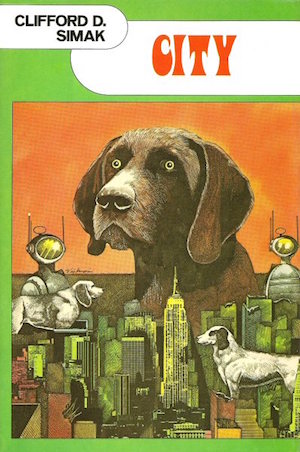
As Simak makes clear in the author’s foreword to the 1976 Ace mass market paperback edition, the short stories that together comprise City1 were written out of disillusionment, from the author’s conviction that “there was no limit to the horror that men would inflict on one another.” City is intended as a counterbalance to the hopeless world in which Simak found himself living.
City takes the reader from a world where cities are vanishing, to one in which the beings of Earth live tranquil lives in a pastoral wilderness2. The Dogs of the distant future owe a great debt to the Webster family, in particular the wonderful knack the Websters have of making decisions for what were entirely justifiable reasons whose ultimate effect is to render humanity as we know it extinct3. By the era of the Dogs, humanity is no longer a factor and the world is a happy place. At least for a time, anyway; that’s as much as we can hope for.
Aria by Kozue Amano (2002 to 2008)

This manga’s creator is sure that humans have what it takes to be environmentally responsible. They can be creative force that can turn a dead world into a living one. In this tale, a few centuries of effort have turned the desert world of Mars into the ocean-covered Aqua4.
Having Thalassafied Mars, humans are content to use it as a stage on which to satisfy needs at the top of Maslow’s Hierarchy. Akari arrives in Neo-Venice determined to become an undine, a gondolier. Aria is a slice-of-life coming-of-age tale told in twelve volumes, an amiable story that provides the artist ample excuse to indulge in what TV Tropes calls “scenery porn.”
A Psalm for the Wild-Built by Becky Chambers (2021)
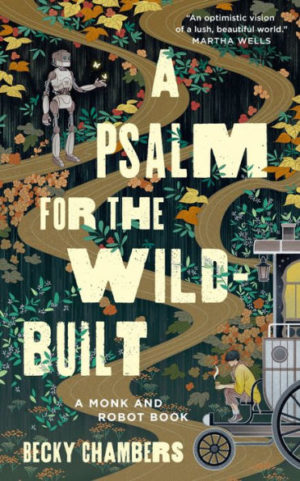
Having abruptly become self-aware, humanity’s robots eschewed the traditional pastime of conscious robots—tearing their exploitive creators limb from limb—in favour of migration from the human regions to a land the robots can call their own. Humans, in their turn, embraced the opportunity to reconsider their ways. By the time Psalm begins, humanity enjoys a peaceful, ecologically sensible way of life. As for the robots, there has been no contact with them since the Transition; their fate is unknown.
Tea monk Dex has a fancy to hear the chirping of crickets. These insects being rare, the monk’s quest leads them towards wilderness and long delayed contact with the robots. Robot Mosscap is willing to play guide to the inquisitive human, in return for which all Mosscap asks is that Dex allow the robot to satisfy its curiosity about humans. Relentlessly good-natured adventures ensue!
Foxhunt by Rem Wigmore (2021)
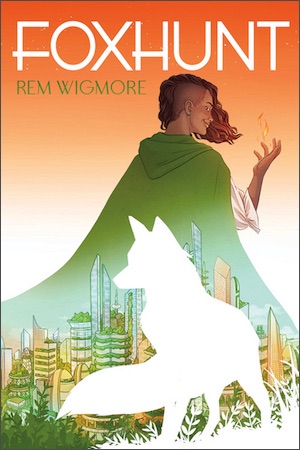
For travelling entertainer Orfeus, humanity’s brush with ecological suicide—the Brink—should be a historical curiosity as relevant to Orfeus’ life as Justinian’s Plague is to a 21st century American. Life should be a sequence of bold romantic entanglements, followed by exits of varying degrees of gracefulness.
Civilization’s ecologically conscientious ethos prevails thanks to the efforts of vigilante groups like the Order of the Vengeful Wild. The Vengeful Wild prioritizes zeal and swift punishment over due diligence. This is a problem for Orfeus, who has been targeted by the Vengeful Wild for crimes Orfeus is certain she did not commit. Convincing the Vengeful Wild of her innocence could be impossible5… unless Orfeus inveigles her way into the Order and unravels the case from the inside.
A Half-Built Garden by Ruthanna Emrys (2022)
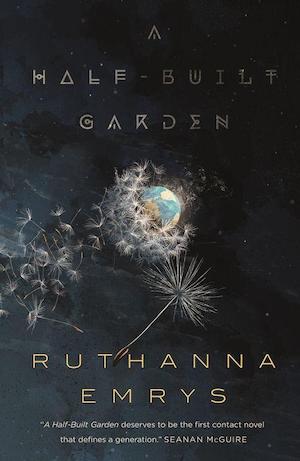
The Dandelion Revolution broke the power of the great corporations and old nations. The dominant polity is watershed-based, the ruling credo focused on rebuilding sustainable ecologies. The bad old past isn’t that far past. Thus, when Judy Wallach-Stevens is alerted to soaring phosphate levels, she expects a leaking relic or perhaps some modern scofflaw… Aliens were not what she expected, but aliens are what she gets.
Humans are the first living technological civilization the alien Ringers have managed to contact. The space-dwelling aliens are here to save humanity from itself. More exactly, the Ringers are here to save us from Earth, from the limits of planet-bound existence before those limits destroy us. This is an offer people like Wallach-Stevens have no interest in accepting. If only the Ringers were not so completely sure of themselves; they are convinced that refusal would be the kind of delusion typical of an immature civilization and as such, to be ignored.
Many authors have tried their hand at similar themes of ecological responsibility. These five books are, therefore, only the tip of a very large iceberg. The odds are good that the five above do not include one of your favourites. If so, feel free to mention them in comments, which are, as ever, below.
- “City” is a curious title, given that the very first story is set after technology renders cities as we know them obsolete. ↩︎
- The Ants of “City” are an exception. Created by a mutant genius, they are technologically capable and disinterested in sharing their world with others. Happily, there are other worlds and in any case, the Ants prove as ephemeral as humans. ↩︎
- In the backstory to “City,” most humans have opted to be transformed into superior Jovian lifeforms. The handful that refused transformed chose hibernation; they have slumbered for millennia. ↩︎
- There are cats in this manga, but they too have been transformed. Into the stuff of nightmares. Be happy images don’t work in footnotes. ↩︎
- Regarding the impossibility of convincing the Vengeful Wild that they made a mistake: “What was the proof?” Orfeus said suddenly. Maybe it would help. “Proof is unreliable,” Faolan said. He kicked the door open. “We just have prey.” ↩︎

One recent example is The Actual Star, by Monica Byrne (2021), which is told in three threads — one a millennium in the past, one in 2012, and one a millennium in the future. In that future, the tiny remnant of the human race has adopted a very eco-friendly way of life (enforced by some pretty icky social pressures, but hey!) It’s quite a good novel.
Fans of hilariously awful disco-era books could do worse than to seek Callenbach’s Ecotopia. An American travels to the breakaway nation of Ecotopia, where he is quickly converted to the Ecotopian way, which includes literal tree hugging, shorter but more ecologically conscious lifespans, house calls from the secret police, and views regarding African Americans that appear to have been lifted from the more unfortunate Robert Crumb cartoons. Truly, a classic of its sort.
Perhaps Robert Graves’ Seven Days in New Crete?
I recently finished reading S.B. Divya’s Meru, which is very much concerned with ecological responsibility after the horrors of the Anthropocene Extinction. Good one, this, full of star-crossed lovers, exotic biotechnology, and the ethics of consciousness. Well worth a look,
@@@@@ 3 Finally. Someone else who’s read this.
Kim Stanley Robinson’s Pacific Edge was set in a future California where humans were trying to reconcile modern industrial culture with a functioning and diverse natural environment, carefully and not always successfully. But at least trying.
Always Coming Home by Ursula K. Le Guin is as eloquent an example as I can summon.
In City , the Ants were ephemeral? I don’t have it handy, but I thought the last story was the Dogs and such deciding that the Ants were going to inevitably take over Earth?
There was a sequel in which Jenkins discovered the Ants went the way of the humans. I think it was in the John W. Campbell, jr. memorial anthology.
@5) I bought a copy of Watch the North Wind Rise aka Seven Days in New Crete a few months ago … haven’t got to it yet.
Many years ago I came across “Dear Akari-Sama” the fan-written manga of Akari Mizunashi’s life on an ecologically destroyed Earth and how she escaped to Aqua.
http://paricross.sakura.ne.jp/aria/ariatop.html
Google will help you find translations.
I made the mistake of using Google image search after reading footnote 4. Apparently the people of Neo-Venice have completely forgotten how gondolas are actually sculled, at least in the manga (stills from the animation aren’t quite so bad). Maybe the selection of images online isn’t actually representative though.
@2 Ecotopia is a political tract barely disguised as a novel. It’s pretty bad, considered as art. Even as polemical literature, I doubt anyone who wasn’t already predisposed to its author’s worldview would find it very persuasive. Ralph Nader loved it, of course, but he’s obviously the kind of philistine who can’t distinguish between a good novel and one that champions ideas he’s fond of. (A very Marxist notion: the purpose of art is social change, Good art promotes positive social change, while bad art supports the status quo. Literary artistry, psychological depth, powerful imagery, are irrelevant, or even pernicious if they serve a reactionary agenda.)
That said, I’ll admit to having a small fondness for Ecotopia for its role in inspiring the notion of a politically independent Pacific Northwest, a proposition that pleases me greatly. I’m not the only one: the Cascadian Secessionist movement has thousands of sympathizers: flags for the Free Cascadian Republic are not an uncommon sight here in Seattle, for example. If western Washington, Oregon, and British Columbia, say, do ever break away from the U.S. and Canada and form their own nation state, Ecotopia will deserve credit for having fostered the idea in the collective consciousness.
I’ve even heard it proposed that our new nation should be called Ecotopia. This, however, would be a ghastly mistake. Other nations would laugh at us, and we’d deserve it. It’s a silly name, and would be even if it didn’t happen to derive from a bad science fiction novel. I wouldn’t be adverse to naming a boulevard or institute somewhere in honor Ecotopia, but the only proper name for an independent Pacific Northwest would be Cascadia.