






Individual humans are ephemeral. But the institutions that people create—religions, philosophies, and most important for this essay, nation-states—may live on. Indeed, there is no reason in principle why a polity could not survive for centuries (the Roman Empire did). Few nations exemplified the potential of the immortal nation-state quite like the Soviet Union.
Free from the chaos and complications of representative democracy, the USSR could direct its economy with an iron fist, under the supervision of powerful leaders. It’s no surprise that a number of science fiction authors foresaw the triumph of the Soviet Union as inevitable (at least until it began crumbling in the mid to late ’80s—a process of disintegration that Mikhail Gorbachev traced to the Chernobyl disaster, which took place 37 years ago this month).
The government of its main rival, the United States, was subject to the whims of mercurial voters. Its only real assets were vast oceanic moats, half a continent’s natural resources, less populous and militarily weak neighbors, the world’s largest economy, a military-industrial establishment that dwarfed every other nation’s (possibly all other nations combined) and an unparalleled entertainment industry that spread their perspective worldwide.
Thus, some observers imagined that historical forces must smile on the Soviets… including the following authors. Herewith, five works about the inevitable triumph of the USSR.
Red Army (1989) by Ralph Peters
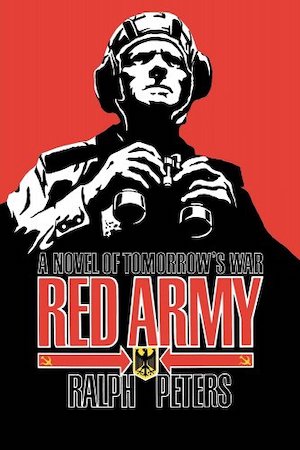
Many Western pundits believed that World War Three would lead inexorably to a catastrophic nuclear exchange. Soviet General Mikhail Malinsky, commander of the First Western Front, and his colleagues don’t agree. NATO’s cumbersome command structure could not possibly react to a sudden decisive conventional attack from the East. Properly conducted, the result would be a short victorious war and a peace dictated on Soviet terms.
History is filled with would-be empire builders who confused ambition with outcome. The Soviets are blessed with a canny understanding of their own abilities. More importantly, they understand their enemy’s weaknesses. The war that follows the Warsaw Pact’s thrust towards the Atlantic is bloody, but the outcome is just as the Reds had hoped: decisive Soviet victory in Europe!
Now the Reds do understand that while they have won the war in Europe, they have not defeated all their enemies. The remaining Western powers will no doubt try to learn from their mistakes and seek revenge on the Soviets. Hijinks will ensue…but not in this novel, which inexplicably never got a sequel.
“A Sleep and a Forgetting” (1979) and “A Thousand Deaths” (1978) by Orson Scott Card
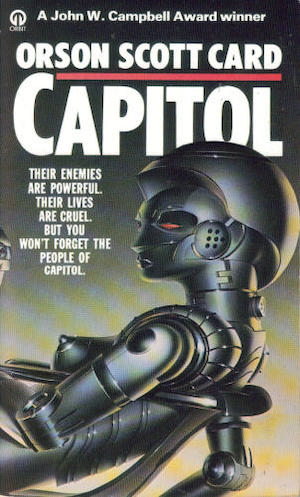
In “A Sleep and a Forgetting” (chronologically the first of these two linked stories), decadent Americans turn a blind eye to the Soviet build-up in Communist Quebec. The Americans pursue other ends and succeed at their limited goals. The Soviets, in contrast, embrace global goals and succeed in crushing the West underfoot.
Having conquered the pitiful US, the Soviets allow Americans to pursue their capitalist follies, believing this will distract them from politics. Occasional dissidents are arrested and made to confess their errors. The very tiny minority who yet resist are dispatched to the worlds of other stars! Everyone wins! At least, every Politburo member wins.
You’d think the US would have learned from the whole Cuban thing not to let Russians stockpile military resources in the US backyard. It is also a bit weird that the Quebec nationalists, many of whom historically viewed the US very favourably, would ally with the Soviets. No doubt mistakes were made…
“Peace With Honor” (1971) by Jerry Pournelle
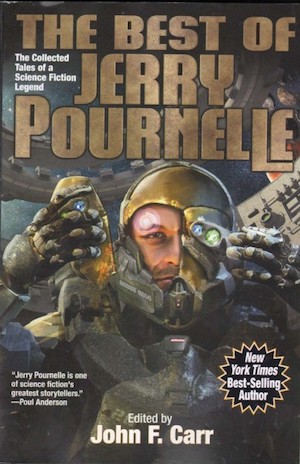
The United States and the Soviet Union could have fought it out. No doubt it would not have taken too long for the survivors to have rediscovered fire and the pointed stick. Choosing survival and power over ideological purity, the two great nations formed the CoDominium and became de facto rulers of Earth.
There were many flaws in the arrangement. America’s Unity Party embraced increasingly corrupt methods to stay in (nominally) elected office lest their nationalist political rivals drag the world into World War Three. With the Soviets struggling with their own war hawks, it is clear that the CoDominium can only delay the final war, not prevent it.
There is, I think, a direct line from this book’s well-meaning political extremists WHO WILL DOOM US ALL and distant sequel The Mote in God’s Eye’s alien Crazy Eddies, who provide their species with similarly catastrophic outcomes.
Generally speaking, SF’s world states tend to be extremely stable, something I suspect would not be the case. It’s nice to have a counter-example. Readers concerned for the fate of the human species here should take comfort that interstellar travel turned out to be surprisingly easy. Humanity’s eggs were not all in one basket.
They Shall Have Stars (1956) and A Life for the Stars (1962) by James Blish
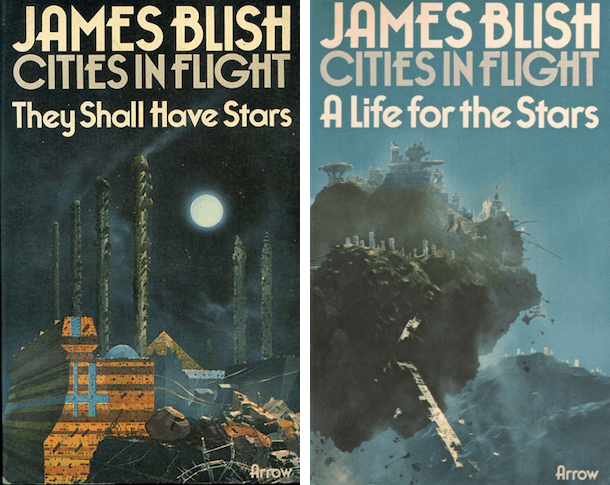
Defending America from the Soviets forced America to become a security state. Everyone is watched and anyone with sufficiently powerful enemies can be declared an enemy of the state and liquidated. Sacrifices must be made! Particularly by the weak and disenfranchised.
By the time inexorable historical processes finished grinding away, the US and the Soviets have evolved into nearly identical bureaucratic states. The Soviets having more practice, they out-administered the US. It was simple logic that they take over the administration of the Earth as a whole. Cue centuries of Soviet-style stagnation and decline.
This has a happy ending of sorts: before the US completely eliminated freedom and progress, it developed at great expense a faster-than-light drive. Thus, escape from the bureaucratic state was possible. Just how powerful was that FTL drive? The series to which these two books belong is known collectively as Cities in Flight.
The Steel, the Mist, and the Blazing Sun (1980) by Christopher Anvil
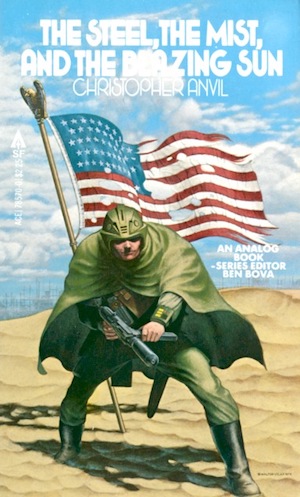
Global crises ended with a radiation-soaked American West and a few Russian colonies in what had been American territory. While detailed knowledge of the past was lost in the great calamity, Arakal, King of the Wesdem O’Cracys and his allies still remember when America was one nation. As far as they are concerned, the present state of affairs is a passing inconvenience. Poor deluded barbarians!
America’s Russian conquerors have superior technology. They have an industrial base the O’Cracys cannot match. Their heartland was not scoured with nuclear fire. They possess a history the barbarians have lost. In all material ways that matter, they dominate. The current trend (O’Cracy winning victory after victory) is disquieting, but any sensible person would know that Russia holds the winning cards.
I regret to report that all the military, political, and industrial resources in the world cannot match the might of a hostile author—matters do not work out quite as sunnily for the Russians as they might hope. Nevertheless, it’s safe to say that the Cold War worked out better for them than the US in this fictional future, at least until shortly before the novel began.
***
Eventual Soviet victory being the inevitability that it was in an alternate timeline, these five works are a very small sample of a very large subgenre. Some readers may have favourites I overlooked. Please feel free to mention them in comments, which are, as ever, below.
In the words of fanfiction author Musty181, four-time Hugo finalist, prolific book reviewer, and perennial Darwin Award nominee James Davis Nicoll “looks like a default mii with glasses.” His work has appeared in Interzone, Publishers Weekly and Romantic Times as well as on his own websites, James Nicoll Reviews (where he is assisted by editor Karen Lofstrom and web person Adrienne L. Travis) and the 2021 and 2022 Aurora Award finalist Young People Read Old SFF (where he is assisted by web person Adrienne L. Travis). His Patreon can be found here.

1993’s The Gripping Hand by Pournelle and Niven is in the same continuity as the story mentioned above, although since it’s also set about a thousand years later that detail isn’t directly pertinent to the plot.
Pournelle’s series about John Christian Falkenberg and his merry band of mercenaries is also set in the time of the CoDominium, if I recall correctly.
There was a story in Asimov’s, back in the ’90s or early ’00s, called The West is Red. The premise is that Communist central planning actually works, and the capitalist free market doesn’t. The successful Soviet state has come to the US to install a central computer to run the country.
Harry Turtledove’s The Gladiator reworks history to allow a Soviet Cold War victory. Apparently something went wrong for the USA in 1962, but no missiles flew and the USA slowly sank into irrelevance.
Story is set 100+ years after the events, which are noted, without detail, in passing.
4: A number of Mack Reynold’s stories critiqued the inefficiencies of market economies (a dozen brands of soap, all identical and from the same factory was one example I recall) but he died well before the SU fell, and in any case had as jaundiced a view of the Soviets as he did the West. There cannot have been a lot of bone fide Socialist Labor Party members writing for Analog/Astounding but Reynolds was one of them.
(very briefly, as he exited the SLP about the same time he started writing for Astounding, due to an accusation that he was “supporting the fraudulent claims of capitalist apologists”)
As it happens I just read a semi-obscure Poul Anderson story, “Wildcat”, from the November 1958 F&SF. It does not envision a triumph for either the US or the USSR, but it takes a very dark view of the Cold War. SPOILERS below …
.
.
.
.
.
.
The story is set in the Jurassic, among a team of Americans drilling oil and sending it via time-machine to the US in roughly the present time. (There is some handwaving about Hoyle’s theory that oil was not made from “rotting dinosaurs” but instead was present at the formation of the Earth. I have not heard this theory, I admit! The science in the story is below Anderson’s usual standards, as for example it has a T. Rex in the Jurassic era.) The protagonist, Herries, is the disillusioned head of the project, who is in despair about the prospects for returning to the present, partly because he’s convinced that the US and USSR will soon fight an all out atomic war. He hates the government spy among them, who is maneuvering to do something — Herries is convinced he’s plotting to provide even more weapons to the US to further the chance of war. We get some wild handwaving about why a) time travel to the future works in 100 year jumps but to the past works in 100,000,000 year jumps. (Hence they are in the Jurassic — 70,000,000 years would allow them to be in the more pleasant Cretaceous.) and b) why the existence of time travel implies FTL. and c) why the timeline is immutable despite time travel.
All that set up, Herries decides to look at the contents of the secret equipment the bad guy has arranged to bring back in time. And he finds that it’s — farming equipment. Turns out that a trip to the future has revealed that that civilization is due to be wiped out in a year by nuclear war. And the job of the people in the past is to set up a civilization (using the farming equipment — though what to do about the marauding brontosaurs and T. Rexes is not clear) and then to develop FTL travel and escape to the stars — because the future in which Earth is destroyed by nuclear war is unavoidable!
Anderson had a more amusing twist on the end of the Cold War in “The Last of the Deliverers”, about a bitter struggle between the last Republican and the last Communist, the conflict being irrelevant and incomprehensible to the people in the new world order that replaced capitalism and communism.
Why is “Peace With Honor” in italics when it is a paltry novelette that never even got a cover of its own?
I am somewhat better acquainted with Soviet SF than James and there is very, very little victorious WW3 in it, especially after WW2. With the official narrative being that it would inevitably escalate to a global holocaust (see the 1986 film Dead Man’s Letters), it was rather hard to publish anything like that, as well unappealing to write. So where “the inevitable Soviet victory” is detailed at all, rather than just taken for granted in the background, it is by more or (just slightly) less peaceful means.
In all honesty the most intriguing ‘Soviet Victory’ scenario (or the one I would be most interested in telling a story about) would probably have to be the “Cold Warriors turn the US Totalitarian: Soviets therefore win the Cold War (Because they’ve been doing Totalitarian longer and are totally better at it)”.
If only because it’s a set-up that allows one to spit in the eye of a certain sort of Jerk.
9: Because the convention I was taught was that short stories get quotation marks and pretty much everything else gets italics.
@5. JReynolds197: I recall reading THE GLADIATOR with some enjoyment, since the plot is quite good, even if the world-building could have used a spot of punching-up (For my money the novel would have benefitted by being set in a location that would have allowed a stronger juxtaposition between Our World and the alternate in question – somewhere as Ultra Capitalistic as Las Vegas or as inveterately Royal as London or somewhere with aspects of both, like Monte Carlo).
@9 and 11: Updated to avoid any confusion! Normally we try to italicize book titles, including novellas and shorter works that are published as standalone texts, but in this case quotation marks seem like a better fit.
While “the government of its main rival, the United States, was subject to the whims of mercurial voters,” the choices those voters were given in Presidential elections rarely had extreme differences on foreign policy. In the two cases where they did, 1964 and 1972, the status quo candidates won by landslides. So the Soviet Union never caught the lucky break that writers in the Campbellverse anticipated.
A minor point of interest regarding Star Trek IV: The Voyage Home. In the background chatter at Starfleet Command, we learn that St. Petersburg got renamed Leningrad again.
There was a Frederik Pohl story, at least I think it was Pohl, where a returning STL ship finds that the entirety of the planet is covered with biowarfare germs except for one US bunker where the inhabitants have adapted to their inherited permanent war vs the USSR. Not positive this qualifies?
In re The Gladiator, per Wikipedia, somewhat clumsily: “The point of divergence from ours was in 1962. U.S. President John F. Kennedy decides to allow the Soviet missiles to remain in Cuba during the Cuban Missile Crisis and the complete withdrawal from the Vietnam War in 1968.”
16: I thought I was well read in Pohl but I don’t know that one.
I think the Soviets were one of the off-stage factions in David J. Lake’s Breakout novels, in which the Euro-Americans, Russians, and Chinese, having rendered the Earth uninhabitable in the 2060s, decide to destroy each other’s last moon colonies in the following century. Luckily for the human race, they had rudimentary starships.
@16 That sounds like “I Put My Blue Genes On”, by Orson Scott Card.
Ken Macleod’s Engines of Light series had a USSR-dominated Europe, still opposing the USA, as part of its initial backdrop. Things moved past that pretty quickly in successive books.
Poul Anderson’s “The Pugilist” is set in a USA that lost a war to the USSR in the late 20th Century, and was now a client state of the Soviet Bloc.
The odd thing about Engines of Light is that it was published in 2000.
IIRC Ken MacLeod’s Fall Revolution series had an EU (but not IIRC the US) dominated by a Communist Russia (with an EU flag centered on a red star), which seemed like an outre prediction in the post-Cold War 1990s. (Googling points me at the later Cosmonaut Keep, which is presumably set in the same history, but I’m pretty sure I didn’t read that one.)
It still seems pretty unlikely (both the reversion to official Communism and the Russians being able to follow their performance in Ukraine with overwhelming success in the rest of Europe). But Russia’s renewed interest in power projection and renewed nostalgia for the Soviet era make it look a little less out there than it felt when I first read it.
“Thus, escape from the bureaucratic state was possible. Just how powerful was that FTL drive? The series to which these two books belong is known collectively as Cities in Flight.”
Per the history given in “A Life for the Stars” (which may not be completely consistent with the earlier-written, mostly later set books), only a couple, non-city-sized escapes actually happened as a result of the initial invention of the spindizzy. (One right after in 2021(!), and then another in 2032, both in spaceships.)
After that there was a worldwide purge consolidating Bureaucratic State rule, spaceflight was banned (abandoning colonies in the Solar System sans evacuation), and no one in the Solar System used the spindizzy again till it was independently reinvented in the late 24th century. So escape from the Bureaucratic State was only very abstractly possible for more than three centuries.
It was only after that that first industrial plants, then entire cities, started leaving, The previous spaceship exodus ensured that the galaxy already had a bunch of human-settled planets to first ally with in their ongoing war against the Vegan Tyranny, and then wander among looking for work.
The non-Okie humans are surprisingly uninterested in the travel possibilities the spindizzy opens up. The only space traffic we see IIRC are military/police craft and the Cities themselves. Of course that may partly reflect our viewpoint characters– the migrant laborers they were based on didn’t mix much with paying customers riding passenger rail. But I get the sense that most planetary inhabitants weren’t keen on long distance travel in that world. In part because even at ludicrous speeds, distances between inhabited worlds were such that antiagathics were also required to make star travel really practical.
@29, 21 – I think that MacLeod tends to write alternate histories without ever explicitly saying that they’re alternate histories. The Fall Revolution series had some different outcomes from the same historical events from volume to volume.
The West is Red was written shortly after the fall of the Soviet Union to mock people who were claiming that was the inevitable outcome in hindsight
@22: In part because even at ludicrous speeds, distances between inhabited worlds were such that antiagathics were also required to make star travel really practical. That was a key factor; you had to be willing to live in a space the size of Manhattan or less, with nothing coming in or going out, for years. (I suspect I know people who stay on the island for years — but they’d find it a lot more boring with no Internet etc.) ISTR that the cities themselves didn’t take passengers often, and that the spindizzy worked better on larger masses (e.g., the planet He), such that there wouldn’t have been much room for interstellar travel — especially in a less congenial local group than (e.g.) Le Guin’s Hainish region.
@0: C. M. Kornbluth’s Not This August starts with a Soviet+Chinese takeover of the US; the Wikipedia summary matches my recollection that all the USians who had been providing covert support to the Communists were promptly executed on the grounds that they were revolutionaries who might know (or inspire) too much (about) covert action.
also @0: I guess the leftish leagues didn’t forgive Reynolds even after he damned capitalism and communism equally in The Rival Rigellians; his impatience with doctrine of any type probably didn’t recommend him to any narrow groups.
I think it’s worth noting that Ralph Peters is the same guy infrequently referred to as Ralph “Blood and Guts” Peters, a regular and often cartoonishly hawkish commentator on Fox News and various other right-wing online publications.
https://en.wikipedia.org/wiki/Ralph_Peters
Just a belated note here, but please don’t joke about mass shootings or similar acts of violence. Thanks, all.
@26 That explains a lot. I also wondered, reading The book description, which month in 1989 the book came out.
In the background chatter at Starfleet Command, we learn that St. Petersburg got renamed Leningrad again.
The region in which St Petersburg sits is still the Leningradsky Oblast – the vote in 1991 to rename was narrowly pro in the city but narrowly anti in the wider region.
IIRC Ken MacLeod’s Fall Revolution series had an EU (but not IIRC the US) dominated by a Communist Russia (with an EU flag centered on a red star), which seemed like an outre prediction in the post-Cold War 1990s.
It did, sort of, but the geopolitics of that particular series are very odd. The Former UK, after a brief period as the United Republics, has broken up thanks to US meddling into thousands of microstates (I remember in particular the National Feminists, who believe that patriarchy is a Jewish conspiracy to enslave free Aryan women, and the anarchist utopia of Norlonto – North London Town), the USSR has done the same, the EU still exists more or less, but Germany (this time as the good guys) tries to conquer the US-sponsored and non-EU puppet state of Poland, the whole thing goes nuclear, and the general chaos gets gradually reconquered and unified by a group of nostalgic Communists from somewhere around Birobidzhan who for some reason speak Gaelic.
On the other hand, there is “Resurrection Day”, by Brendan DuBois, in which the Cuban Missile Crisis escalates to a nuclear exchange that leaves the USSR destroyed and the USA badly damaged, with large areas in ruins and/or dangerously radioactive. Our hero – a reporter, as so often – finds himself trying to piece together the events leading to the exchange and its aftermath, with the government and a variety of other factions attempting to stop him.
As the blurb for the book put it: “Everyone knows what they were doing on the day President Kennedy tried to kill them.”
Charlie Stross’ A Colder War has an very different end to the Cold War because of a very different arms race. It’s also an example of the idea that both sides can’t win a war, but both sides can lose.
Steven King’s 11/22/63* posits a different end to the Cold War in at least one of Jake Epping’s journeys into the past.
* Rest of the planet 22/11/63, ISO 8601 1963-11-22.
I haven’t read these, and don’t recall coming across other examples that posited a Soviet victory. What I do remember is that, in those fifteen years leading up to the Soviet Union’s fall, many near future novels presumed that the US/Soviet conflict would remain in place well into the 21st Century. In the Kinsman series by Ben Bova, US and Soviet Moon-bases butt heads with each other, and the politicians on the ground, in 1999. That conflict felt so set in stone, so entrenched in politics, geography, and peoples’ psyches, it was hard to imagine the planet without it.
Stanislaw Lem has a story, “The Inquest”, set sometime in the 21st or 22nd century (one presumes), in which the survival of the Soviet bloc is a background detail. Soviet-bloc space-travel firms, having no need to make profits, have an advantage over Western ones, so the latter are hoping to replace human crews with advanced robots. Pirx the pilot is hired to be the captain of a scientific mission to Saturn’s rings, for which things don’t go as planned (for both Pirx and the robots).
in those fifteen years leading up to the Soviet Union’s fall, many near future novels presumed that the US/Soviet conflict would remain in place well into the 21st Century.
Absolutely. Look at the film 2010 for example.
Even after the fall of the Berlin Wall, it still wasn’t obvious that the Cold War was about to end. Tom Clancy published novels set in a Cold War NATO/Soviet standoff right up to August 1991!
I believe that one of the stories in Norman Spinrad’s collection Other Americas involved a Soviet victory, but I don’t remember which once and I may be wrong in the first place.
@39 – that sounds like “Once More, With Feeling”, from the collection The Last Hurrah of the Golden Horde.