







Heroism, a keen awareness that with great power comes great responsibility, ambition, visiting wizards in the company of dwarves… all excellent motivations to propel protagonists out of their comfortable living rooms and into adventure! If you really want to push your characters into embracing high-risk ventures, however, you cannot beat the motivational power of crushing debt1.
Appleseed by Masamune Shirow (1985–1989)
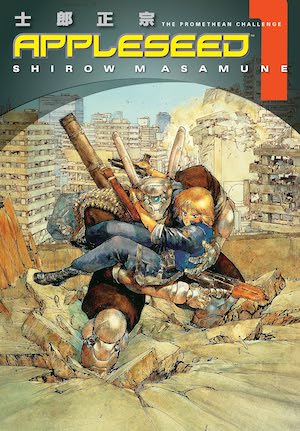
AI Prometheus rose in the aftermath of World War Three to restore order to a shattered world. Prometheus’ genetically engineered “bioroids” are conditioned from birth to serve loyally. This leaves the matter of non-bioroid recruits like Briareos Hecatonchires. How best to ensure compliance with Prometheus’ needs?
Crushing debt! Briareos is a cyborg. The machinery that constitutes much of his body is highly advanced, but not so advanced that it repairs itself. Repairs are not free. Prometheus chooses not to foot the repair bills for employees. After all, if cyborgs are desperate to keep their bodies functioning, the less prone they will be to ask awkward questions.
Obviously, Prometheus desires only the greatest good for the greatest number. Nevertheless, it’s useful to keep staff members too distracted to protest actions like confiscating prosthetic limbs in war zones or to ask questions like “If Prometheus is so awesome, why is the bioroid suicide rate so high?”
The Ghost Bride by Yangsze Choo (2013)

Colonial Malaysia’s wealthy Lim family has a small problem. Lim Tian Ching needs a wife. While Tian Ching’s personality isn’t all a bride could hope for, the advantages of marrying into the Lim family would normally be sufficient distraction from Tian Ching’s less charming qualities. However, Tian Ching is dead. Few women will marry a corpse, even one with a ghost as active as Tian Ching’s.
Li Lan might be the exception. Her widower father, consumed by grief and opium, has massive debts. Once, Li Lan was engaged to Tian Ching’s cousin Tian Bai. Tian Ching’s death elevated Tian Bai to family heir, too high status for a woman like Li Lan. She seems an ideal candidate on whom to foist Tian Ching. If she objects? The Lim family owns her father’s crushing debts.
If you’re thinking that the plot sounds a bit different from the 2020 television adaptation of The Ghost Bride, that’s because some liberties were taken while adapting the novel. As they usually are.
Brother’s Ruin by Emma Newman (2017)
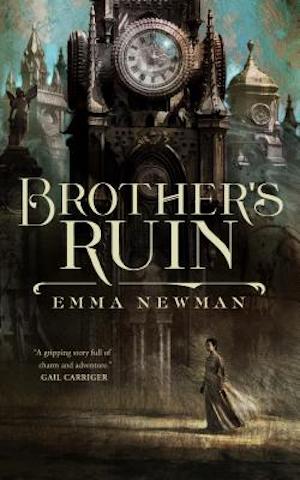
Great Britain’s Society for Esoteric Arts sweetens impressment with bribery. Candidates have no choice about joining if “invited,” but the Society does monetarily compensate candidates’ families in proportion to the draftee’s abilities.
The Gunns could be rescued from debt-ridden precarity by the Society, if only young Benjamin Gunn were the mage that his sister Charlotte is, or if Charlotte wanted to be press-ganged by the Society. Since she does not, Charlotte must somehow create the appearance that Benjamin is her equal… while simultaneously fending off the predatory loan sharks to whom the Gunns owe their crushing debts.
Readers might wonder how prudent it is for criminals to target and blackmail families with at least two mage-candidates. The criminals have also pondered this question, which is why they count among their numbers moonlighting mages more experienced than either Gunn sibling.
Black Water Sister by Zen Cho (2021)
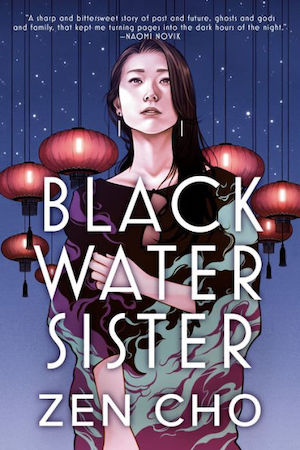
US medical debt collection is relentless but not global. Accordingly, when faced with crushing debt in the form of impossible-to-pay medical bills, Jessamyn Teoh and her parents return to Penang. Fleeing the US means leaving Jessamyn’s girlfriend Sharanya behind. How fortunate, then, that Jessamyn’s dead grandmother’s shade serves as a relentless distraction to the relocated protagonist.
Death does not prevent Ah Ma from pursuing vendettas, particularly against billionaire Dato’ Ng Chee Hin. Dato’ Ng Chee Hin’s development plans are an affront to Ah Ma, and more importantly to the god—Black Water Sister—that Ah Ma served in life. Now Jessamyn must decide who she will anger: a well-connected oligarch or an angry god. Or both.
I had assumed that American debt collectors had planetary reach, if not interplanetary. Apparently not. Interesting to know. Also irrelevant to single-payer health care Canadians2, unless by some chance Canadians were to spend decades electing to office politicians either uninterested in maintaining the system or actively hostile to it… What are the odds of that?
The Princess of Thornwood Drive by Khalia Moreau (2023)

An automobile accident killed Laine’s parents and left Laine’s sister Alyssa in a vegetative state, lost in an inner fantasy world. In the wake of the tragedy (for which Laine blames herself), Laine discovered that her father had left massive debts. Holding down a job while caring for Alyssa and fending off debt collectors seems a nearly impossible challenge.
Enter Lake Forest Adult Day Center, whose offer of affordable daytime care is the lifebuoy Laine desperately needs. Lake Forest can provide Laine with the free daytime hours she needs for work. There’s also the prospect of a relationship with Lake Forest’s charming Doctor Robert Remson. If only Lake Forest didn’t offer something even worse than economic precarity.
I expected the issue driving the plot to be medical debt, but while that is a factor, it’s the father’s crushing non-medical debts that dominate. Also, Laine has a shortage of something more precious: hours in the day. Of course, that’s a problem money can solve, so ultimately all of Laine’s problems come down to a need for more money.
Debt is, of course, a wildly popular motivator in fiction and in real life3. There are many speculative fiction books that either feature debt or were motivated by it. Perhaps your favorite examples were not mentioned above. If so, please mention them in comments.
- Marc Miller, designer of the classic table top RPG Traveller, made debt a primary plot driver. Player characters needed to scramble to pay eye-watering bills each month. The only reason Richard S. McEnroe’s extremely Traveller-esque The Shattered Stars isn’t getting a mention here is because I cited it in a 2023 essay on this site. ↩︎
- Foresighted Canadians remember to sign up for valid insurance while visiting the US. ↩︎
- Although I suspect “five books written purely for the money” would not go over well as a review topic. Or would it? ↩︎

In E.K. Johnston’s The Afterward, the lady knight who helped save the world is faced with debt and the costs of caring for her family and the upkeep of the family estate. Since saving the world doesn’t come with a monetary reward, she’s forced to consider a marriage of financial and political convenience, despite still having feelings for the thief she quested with.
Johnston is local to me!
Anne McCaffrey’s Brainships are all in high debt from the mechanicals hooked up to them to keep them alive.
Re: Footnote 3. Aren’t most books written purely for money?
Debt issues are also an important theme in McCaffrey’s Crystal Singer trilogy.
Given that the average author’s take-home from a novel is a handful of pennies and a savage beating, I sure hope not.
“Five books written strictly for the money” would be a great topic, except for the possible downside of reading them.
Michael Moorcock is the answer to that
This is what I thought that I’d be getting in this list. If the authors don’t have a soul-crushing debt (like Robert Asprin’s taxes on unearned advances), there are stories such as Moorcock’s week-to-week writing or Zelazny’s expansion of Damnation Alley to novel length to get a movie deal (a financial success).
I feel like there are twists you could put on it, either explicitly or implicitly. E.g. “five much-beloved books written purely for the money” or “five books written purely for the money that were much better than I expected them to be”. Or, I suppose, “five books written purely for the money that didn’t make any,” though that seems like a sadder direction to take with it. Actually there are probably books that exist in the intersection of those three categories.
The next novel in my John Brunner project is 1983’s The Great Steamboat Race, a non-SFF novel in which the profit motive played a large role on both sides of the typewriter. It was supposed to be Brunner’s big break into the historical market, and to write it he basically took five years off from publishing.
It had one trade edition and has never been rereleased.
I have a copy of the Great Steamboat Race. I’ve read it a number of times. It’s an underappreciated gem. How about “Five books written purely for the money that are underappreciated”?
Do I need to mention my Neptune’s Brood, which is all about the economics of interstellar colonization in a much-slower-than-light universe, where the whole point of founding a colony is to pay off the debt incurred by colonizing the star system you started out from? In other words, it’s galactic empire as Ponzi scheme. (And there are specific types of fraud consequential to this …)
I was going to mention it if you hadn’t. GAAP is little tweeting bird in some financial systems…
Came here to mention Neptune’s Brood and the pyramid economic madness therein. I’ll take the opportunity to ask if it has any specific inspiration e.g. Good-bye Robinson Crusoe by John Varley?
This is my 500th tor dot com/reactor piece. Six years, nine months, and six days go by so quickly.
Thank you for your service. I always enjoy this column.
Naomi Novik’s Spinning Silver is very heavily driven by debts and the collection thereof. An unwise boast inadvertently puts Miryem Mandelstam in debt to the snow fae (and when powerful magical beings think you owe them, your opinion isn’t necessarily relevant). Wanda Vitkus becomes a servant to pay off her father’s debt to the town moneylender. (Unusually for this type of story, this turns out to be the best thing that ever happened to her).
Richard S. McEnroe’s The Shattered Stars needs more love from the Traveller community. It is practically the blueprint for a game campaign.
Good to see you!
-publiusr
I didn’t expect you to include Appleseed of all books! (Checks post again … Ooops! It’s not THAT Appleseed! :) )
I’m just now rereading Frederik Pohl’s “The Merchants of Venus”, the novella precursor to the Heechee novels. The protagonist is certainly motivated by soul-crushing — or at least life-crushing — debt — if he doesn’t get the money to buy a new liver he will die in three months.
I can’t remember if Robinette Broadhead in Gateway ever has debt as such, but certainly the need for money is his prime motivation in that novel.
Having valid insurance before travelling to the U.S. can help less than it is supposed to, when insurance companies behave like insurance companies. As in “You pay what the hospitals demand, then apply for us to reimburse you. Never mind what the policy says.”
I’m thinking of Spice & Wolf, the light novel, manga, and anime series. In the course of the story, Kraft Lawrence and Holo do incur some major debt of the incorporeal spirit type, but do manage to clear it through some trickery and deviousness on their part.
I see someone already mentioned Gateway. There’s also that Sheckley story about parents spending their children’s expected income in advance (“Cost of Living”), and Pohl and Kornbluth’s Space Merchants (where the workers at Chlorella are kept in debt to the company store).
Grainger, the narrator of Brian Stableford’s “Hooded Swan” series, starts the first novel (Halcyon Drift) stranded on an alien world with only a chatty mind parasite for company. When he’s rescued by a commercial organization, they charge him a substantial sum for the privilege… which debt follows him through most of the series, and drives him to take a job as pilot of the series’ eponymous experimental starship.
I believe that the society depicted in The Unincorporated Man was based upon the idea of personal debt, but it’s been a long time since I read it.
When we first see Niven’s Beowulf Shaeffer, at the beginning of “Neutron Star,” he’s heavily in debt because he spent a lot of his salary in advance and then his employer went bankrupt. He takes the job visiting the eponymous star in order to get enough money to pay his creditors. However, since he apparently is bad with money he has to take another dangerous job later for similar reasons.
Reading between the lines, Shaeffer’s problem (along with Nakamura Lines’ executives’) is the *absence* of bankruptcy. If Shaeffer could have filed personal bankruptcy instead of facing debtors’ prison, he might have been a harder sell on repeating a trip that had mysteriously killed the last crew.
Of course, the Puppeteers would probably have just found some other way to blackmail him.
The Corporation Rim companies in Martha Wells’ Murderbot series love to jeep their employees in debt bondage, and are willing to destroy one another with both creative accounting and actual weapons.
See also The Blacktongue Thief by Christopher Buehlman. The protagonist, Kinch, had joined the Thieves’ Guild as a way out of rural backwater poverty, only to find that his “debts to them for his training are almost impossible to pay off, so he becomes obligated to take on nasty missions for them.
Han Solo rather famously gets involved with smuggling fugitives for a galactic insurgency due to a debt incurred on his previous cargo run, and is introduced via his singular approach to negotiating with a debt collector.
Three Parts Dead by Max Gladstone starts out when a God dies of literally soul-crushing debt, and the creditors come for his estate, which is also his body.
Such a wonderful series that one! It doesn’t get nearly enough appreciation nor discussion that I’ve seen though, sadly.
An older classic here is Heinlein’s novella Logic Of Empire, in which the protagonist is trapped in the debt of an indentured labour contract.
Thought for sure “Poor Man’s Fight” would be on this list. Fun to see so many different takes on the rich crushing everyone else with debt.