





As previously discussed, parents can present a challenge for authors. Diligent, prudent, living parents might well interfere with their children’s plans to set out on bold adventures. However, two recent incidents drew my attention to parents as facilitators1. In some cases, parents could have a legitimate reason for encouraging their children’s ambitions in ways that facilitate plot.
Here are five sets of parents who supported their kids’ dreams and ambitions.
Mrs. Nash
Buck Henry’s Captain Nice (1967)
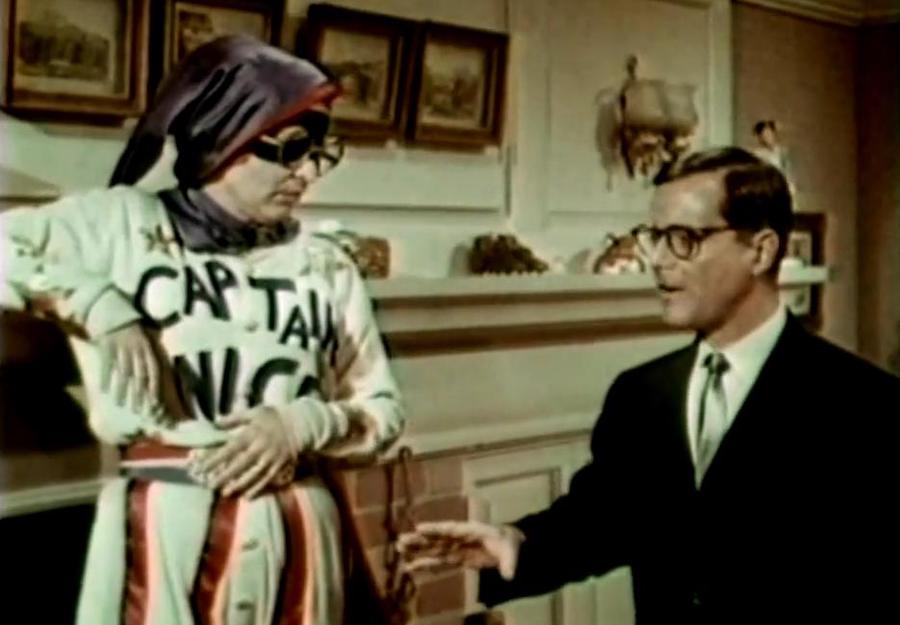
Superheroes have a tendency to be orphans. Police chemist Carter “Captain Nice” Nash (William Daniels) was an exception. Nash’s secret formula could temporarily imbue him with super-strength, invulnerability, and flight. However, whether timid Nash would have pursued a superheroic career on his own is an open question.
Enter Carter’s mother, Mrs. Nash (Alice Ghostley2). Mrs. Nash was quite enthusiastic about having a superhero son, providing him with encouragement and a costume… of sorts. As Carter was firmly under his mother’s thumb, he could hardly say no.
Some viewers might think this all sounds oddly like Mr. Terrific (also 1967). Both were attempts to cash in on the camp superhero success of Batman (1966). Both involved superpower-inducing chemicals, and both featured unlikely protagonists. There were some differences. Captain Nice’s formula provided invulnerability, which Mr. Terrific’s pills did not. Mr. Terrific lasted seventeen episodes, two more than did Captain Nice.
I didn’t say they were successful attempts to cash in on the camp superhero success of Batman (1966)3.
Cordelia and Aral Vorkosigan
Lois McMaster Bujold’s Vorkosigan Saga (1986–ongoing)
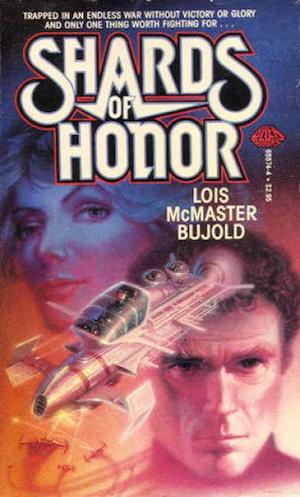
The Vorkosigans’ investment in Miles Vorkosigan’s happiness and well-being predated Miles’ birth. Injured in a prenatal chemical attack on his mother, Miles was certain to be born with severe impairments… on a planet whose culture mandated abortion and infanticide for broadly defined “mutants.” Miles’ parents rejected this local norm.
Throughout Miles’ life, Cordelia and Aral support and encourage Miles, even in pursuit of career goals, such as military service, where success is unlikely. When presented with Miles’ unauthorized clone Mark, the couple support Mark as well.
It could be argued that the greatest challenge Miles’ parents grapple with is not Miles’ physical issues, but rather his exuberant personality combined with a marked tendency to wander into plots. In fact, it’s possible that even if there’d been no chemical attack, Miles would have been sufficiently challenging that his parents would make this list.
Ririka Kato
Yūichi Sasamoto’s Bodacious Space Pirates (2008–2014)
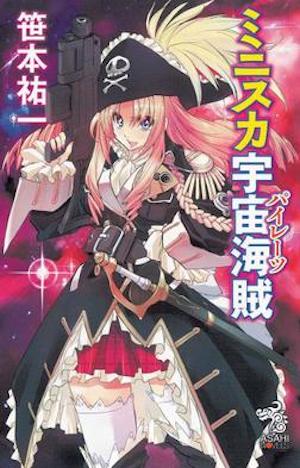
Teenager Marika Kato is astonished to discover her father is none other than Space Pirate Gonzaemon. Or rather, he was, as Gonzaemon has died. Furthermore, he was more of a privateer than a pirate. Among his legacies to Marika, his Letter of Marque. As new Letters of Marque are no longer granted, Gonzaemon’s colleagues on the privateer starship Bentenmaru invite Marika to become their new captain.
Privateering could be dangerous. Worse, it could imperil Marika’s grade-point average. Nevertheless, Marika’s mother Ririka encourages Marika to embrace her legacy. After all, Marika could get run over the next time she crossed a street4, so why not pursue an exciting career?
I suspect the fact that Ririka used to be “Blasters Ririka, Space Pirate” factors into Ririka’s risk assessment skills. On the other hand, Yukari Morita’s mother used a similar argument in Rocket Girls, so maybe “better to risk death doing something interesting because everyone dies,” is just a popular philosophy among light novel, manga, and anime parents. (Note: the original light novel series was originally published under the title Miniskirt Space Pirates.)
Urano Motosu/Myne’s parents
Miya Kazuki’s Ascendance of a Bookworm (2013–2017)
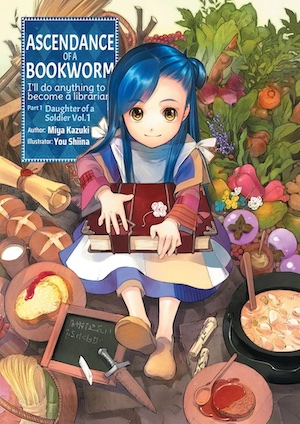
Left to her own devices, steadfast bookworm Urano would have spent her entire life—which turned out to be much shorter than Urano expected, thanks to insufficiently secured bookshelves—with her nose buried in a book. Her single mother did her best to encourage Urano to expand her horizons by dragging Urano with her into a long series of brief-lived hobbies.
Crushed by her beloved books, Urano wakes in the body of frail young Myne in a secondary fantasy universe. Urano’s host body’s parents are as doting as her lost mother, and the parental figures who eventually replace them are just as supportive. Lucky for Urano, whose obsessive focus on books (and the fact her new home does not appear to have them) blinds her to obvious danger.
One of the sadder moments in the series involves Urano’s belated realization of how much she owed her birth mother. By the time Urano has her revelation, Urano has died and been reborn in another universe, which means she will never be able to thank her mother.
Typhon Cutter
Madeleine L’Engle’s The Arm of the Starfish (1965)
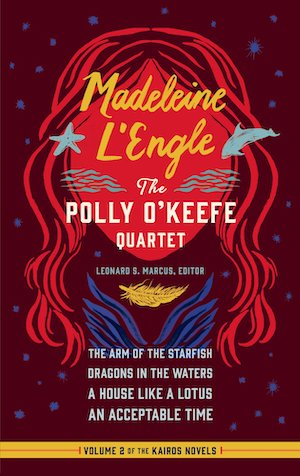
Carolyn “Kali” Cutter is an aspiring femme fatale preying on weak-minded do-gooders like Adam Eddington, Calvin O’Keefe, and the rest of the O’Keefe family. She’s pursuing profit and general skullduggery. Kali’s opportunities to embrace global villainy might appear limited. She is, after all, only sixteen.
Enter Kali’s father Typhon Cutter. Typhon is something of a villain himself. Rather than discourage his daughter from pursuing her vocation, he recruits Kali into his bold plan to purloin the secrets of human regeneration from O’Keefe. Not great from a moral perspective5, but definitely supportive.
To be honest, Typhon’s big plan (sell O’Keefe’s research to Red China) is a bit of head-scratcher. China in 1965 wasn’t rolling in cash. Weren’t there wealthier prospects? It may be Typhon wasn’t the smartest villain around, which would explain why he apparently never advised Kali to stick to swimming with metaphorical sharks, rather than the real article. Om nom nom.
No doubt I’ve overlooked many worthy examples (even discounting the ones I mentioned before). Feel free to mention your personal favourites in comments below.
- The first was a mother who spent four hours keeping her easily-bored, extremely energetic toddler happy without the adorable tot bothering the other patrons in the theatre where I work. This was a task on par with climbing K2 sans equipment. The second was a young person I overheard on mass transit describing to her friends how her parents’ reaction to her coming out of the closet was to produce a list of and orchestrate a series of dates with suitable young women. ↩︎
- More famous as Bewitched’s Esmerelda. ↩︎
- Living as we do in an age of endless remakes, may I point out that failed projects offer more room for improvement over originals than wildly successful classics? ↩︎
- Marika lives in the Tau Ceti system. It’s not clear if Truck-kun remained on Earth or emigrated to the stars. ↩︎
- Although where would heroes be without villains to oppose and temptations to resist? ↩︎


Although young Sam hasn’t done too much to be supported yet, one can be assured that Sam Vimes will be a supportive father worthy of a place in this list.
He did introduce Young Sam to the ‘poo lady.’
Tom Derringer’s mother in the Tom Derringer series by Lawrence Watt-Evans.
I thought at first it might really be highly unsupportive parents-example, Bill’s dad from Farmer in the Sky.
Speaking of Heinlein, how about Edith and Roger Stone? with pursuasion from grandmother Hazel Stone, they buy a ship and take their sons Castor and Pollux out to the Asteroids to sell things to the Belters
Thank you so much for remembering Captain Nice! I suppose I was in third grade, I think, when that show aired, and I loved it … though all my memory can come up with at this point is a bit of the theme song:
Look at those muscles on his arm, they’re like hammers!
Look, there’s a nut who flies around in pajamas!
That’s no nut, boy … that’s Captain Nice. (Mice?) (Nice, Nice, Nice, Nice.)
Ya know? I miss theme songs.
One might also mention as a sort of record-breaker the family in The Star Beast, who for several generations encouraged young John Thomasses to hang out and play with an increasingly huge and bizarre creature an ancestor had brought home from a distant planet.
Kimball and Clarissa Kinnison supported their Five to the limits of their ability, recognizing that their children had surpassed them in ability and that while they had to allow them to face the concomitant risks, they could at least do their part to help out.
Jemis Greenwing, of Victoria Goddard’s Greenwing and Dart books is a much-parented man, and although all three of his parents are missing at the beginning of the series, their influence and lessons are of continual aid to him. His father, war hero Jakory Greenwing, taught him to play cards and be himself before being lost in action on a distant frontier. His mother, Olive Noirell, kept him safe through the apocalypse, taught him religion (some observances of which are of vital importance locally), and remarried to Benneret Buchance, Jemis’ stepfather thereafter. Despite teenage Jemis’ prickliness, Buchance was all the father to him he could be, and included him in his will when he died.
I have to disagree at least in part where Kali and Typhon Cutter are concerned.
To me, Kali never comes across as a genuine villain; rather, I always read her as naively loyal to her father, who was using her as much as he was attempting to recruit and use Adam.
In particular, the shark encounter at the climax makes no real sense if one reads Kali as a genuine malefactor – a properly evil Kali would have set that up so that she was always clear of any real danger, and it seems clear to me from the denouement that what actually happens is that the shark attack jolts Kali out of her naiveté and squarely into the O’Keefe family’s camp. (It does not necessarily reform Typhon Cutter himself, but it does reveal that the elder Cutter is genuinely fond of his daughter, and that he values Kali above at least some of his villanous goals.)
In which context I read Typhon Cutter as more an abusive and dangerous parent (though to be clear, the abuse in this instance is purely psychological) than a supportive one. Yes, he evidently loves her for some values of “love”, but he is also willing to use her as a largely unknowing pawn in his business enterprises.
In the Tom Swift Jr. series, Tom Swift Senior is a scientist/inventor himself, and supports his son’s endeavors to the extent of allowing him free reign of the tropical island research complex. The fact that he was an adventurer himself in his youth probably had something to do with it.
In the comic Gold Digger Mr. Diggers, as a single father* is supportive of his daughters’ careers as tomb raiders** as well as their personal lives***, though as an archmage his abilities are very different from his daughter Gina’s science orientation.
* Their mother isn’t dead- she’s also supportive on the one day a year when they can contact the dimension she’s trapped in.
** To be fair, when the *tombs” are mostly alien or interdimensional warehouses filled with dangerous artifacts and beings, the context feels rather different.
*** One of his neat tricks when they reached dating age was to greet would-be dates with his “flaming skull” illusion. Given the girl’s inclination toward trouble it was probably as much for the date’s benefit as anything.