






Many SF fans—particularly those old enough to have consumed articles about Moon colonies, L5 colonies, and Mars colonies that no doubt lay in the immediate future (a future that never materialized)—feel some frustration that we humans never made it to Mars, much less to any planets outside the Solar System. BUT! There are other possibilities if we wish to explore an alien world. This very planet could become an alien world. Indeed, if we were to travel back in time, we would find that Earth was an alien world, nothing like the current planet we know and love (but not enough to refrain from destroying it).
Sufficient O2 to breathe is a comparatively recent development, as are land plants and land animals. Some eras had global glaciations that make the one that ended 12,000 years ago look like minor cooling. Someone dropped a few billion years in the past would find a world with a dimmer Sun, a closer (and thus larger-appearing) Moon, and an environment decidedly hostile to humans.
Who knows what will happen in Earth’s future? Even if we don’t trash it ourselves, other things might happen. If you want live on a strange, inhospitable, and alien world, perhaps all you need do is wait.
Unsurprisingly, a number of SF authors have played with the notion that Earth has been transformed into a functionally alien world. Consider these five venerable works.
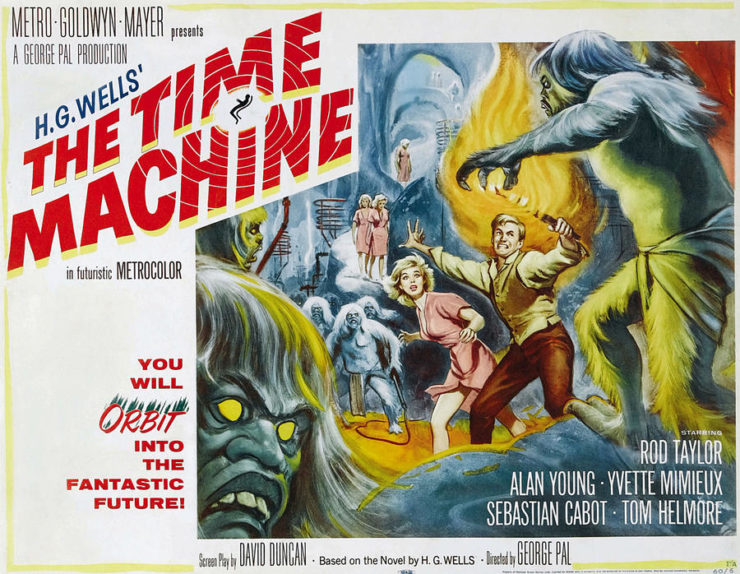
The Time Machine by H. G. Wells (1895)
Having devised a means of travelling through time (frankly, the title is something of a spoiler), the Time Traveller takes a comparatively short jaunt into the future. While there has been marked social evolution by A.D. 802,701, little of it desirable, that Earth is nearly identical to ours. Towards the end of the novel, however, the Traveller journeys 30,000,000 years into a future shaped by Lord Kelvin’s calculations, to find the Earth now quite forbidding:
At last, more than thirty million years hence, the huge red-hot dome of the sun had come to obscure nearly a tenth part of the darkling heavens. Then I stopped once more, for the crawling multitude of crabs had disappeared, and the red beach, save for its livid green liverworts and lichens, seemed lifeless. (…)
Beyond these lifeless sounds the world was silent. Silent? It would be hard to convey the stillness of it. All the sounds of man, the bleating of sheep, the cries of birds, the hum of insects, the stir that makes the background of our lives—all that was over.
All is not quite as depressing as first appears, for there is still life in the form of “a round thing, the size of a football,” with tentacles.
Earth’s Last Citadel by Henry Kuttner and C. L. Moore (1943)
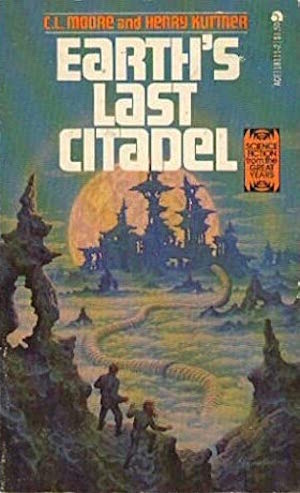
Axis agents Karen Martin and Mike Smith ambush Allied agent Alan Drake and genius Sir Colin just as Drake and Sir Colin discover an alien Light Wearer spaceship. All four are bewitched into entering the mysterious vessel. When they emerge, the travellers find themselves trapped in the distant future. The Moon, much closer now, looms large and Earth appears to be barren and lifeless.
However, despite eons of domination by the alien Light Wearers, there are still a very few humans left. Some, the pampered pets of the now-vanished Light Wearers, enjoy meaningless lives of G-rated hedonism in the last city on Earth. Meanwhile, the last remnant of undomesticated humanity scratches out a precarious existence in the wilderness. Impoverished Earth cannot support both groups. Survival for one must mean the extinction of the other. Who will be lucky enough to live on is a matter the four castaways must decide…and two of the party are Nazis.
“One Face” by Larry Niven (1965)
With their ship crippled by collision with space debris, it takes the travellers in this story some time to discover that their dire situation is actually much worse than they first realize. The ship’s star charts cannot determine where their last jump took them. This is because their final destination was not so much a where so much as a when.
The Solar System billions of years from now is inhospitable. The Sun has evolved off the main sequence, through a red giant phase, and is now a white dwarf. The Moon is gone. The Earth is an airless world tidally locked to the Sun. Not very inviting, but it’s where the castaways will spend the rest of their lives. On the plus side, if they cannot find some way to survive using only the equipment on their damaged ships, those lives won’t be very long.
“Stars, Won’t You Hide Me?” by Ben Bova (1966)
Humanity claimed the universe for their own. Having sufficiently vexed the Others, the universe’s true guardians, the entire human species is slated for extermination on each of the millions of worlds occupied by humans. Holman is one of the few survivors…perhaps the only one.
It’s only natural that Holman would flee all the way back to Earth. He overlooks one minor detail. Starships are limited to lightspeed. By the time Holman crosses intergalactic space, the Sun has aged into a white dwarf and the Earth is long dead. Spending his remaining days on Earth is not an option but he might, if cosmology favours him, escape the Others.
Earthchild by Doris Piserchia (1977)
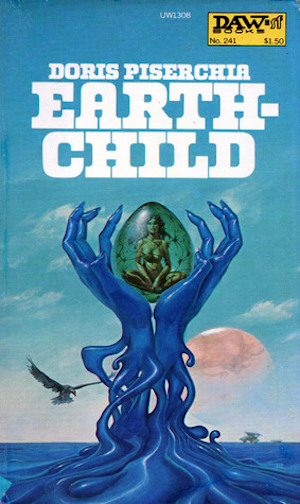
A visitor from the 20th century might not guess that the Earth that Reee calls home is only a short distance into the future, at least as mountains measure time. Dominated by Indigo, a vast, protean being, the Earth looks utterly alien. Nor would the hypothetical visitor have much time to correct their error before the swarms of voracious predators living with Indigo made short work of the tasty visitor.
Raised on Earth, Reee is adept at surviving her homeworld’s conditions. The Martians are another matter. The last remnants of humanity, the Martians raid their lost homeland for humans to shore up their numbers. What Reee knows but the Martians do not: Indigo can spawn convincing human replicas. If even one of them reaches Mars, then Mars will be transformed just as Earth was.
***
No doubt many of you have your own favourites not mentioned above. Comments are, as ever, below.
In the words of fanfiction author Musty181, prolific book reviewer and perennial Darwin Award nominee James Davis Nicoll “looks like a default mii with glasses.” His work has appeared in Publishers Weekly and Romantic Times as well as on his own websites, James Nicoll Reviews (where he is assisted by editor Karen Lofstrom and web person Adrienne L. Travis) and the 2021 and 2022 Aurora Award finalist Young People Read Old SFF (where he is assisted by web person Adrienne L. Travis). He is a four-time finalist for the Best Fan Writer Hugo Award, and is surprisingly flammable.

The future Earths in the After Man and Man After Man books are a little too conventional to fit this theme, but the far-future episodes of The Future Is Wild fit. Fungal trees and giant land-cephalopods are stranger than we get in some Sf alien worlds.
The (probably) fungal Prototaxites grew up to 8 metres… a third of a billion years ago.
I would add N. K. Jemisin’s Broken Earth series to this list.
Also Brian Aldiss’ Hothouse.
Oh, and a couple short stories: Poul Anderson’s “Epilogue” and James Blish’s “Watershed”.
Another that I think would fit here is The Night Land (1912) by William Hope Hodgson. Written long enough ago that the writing itself is something of a strange alien world. :)
Childhood’s End
Planet of the Apes and sequels
Wheel of Time?
The alien-terraformed Earth of Tony DiTerlizzi’s WondLa trilogy fits the bill, with its alien forests and elephant-sized tardigrades.
The third generation of Robotech (adapted from Genesis Climber Mospeada) also features an Earth that, while still having familiar continents, has been deeply reshaped by an apocalyptic alien bombardment (in the first Robotech War/Macross), an invasive alien biosphere (from the Second/Southern Cross), and deliberate terraforming/occupation (just prior to the Third).
In fact, a number of Japanese anime/manga have played with this trope over the years, including Dr. Stone (humans… removed for over three thousand years, allowing nature to reclaim the world, leaving the survivors as a stone-age tribe), the Godzilla: Planet of Monsters trilogy (Humans abandon Earth to Godzilla, then return after 20,000 years to encounter an entirely new, kaiiju-dominated, biosphere), Juushinki Pandora (the last survivors of humanity live in walled cyberpunk cities and try to fend off techno-organic mutants), Geneshaft (Earth itself is largely unchanged, but humanity itself has transformed into basically a different species through genetic and social engineering), Sabikui Bisco (a mushroom-based apocalypse has unleashed mutant animals and giant mecha), Eureka Seven (Earth has been sufficiently transformed by alien terraforming that most people think they’re living on a colonized alien planet), and Gargantia on the Verdurous Planet (Earth is completely flooded, with the remaining humans living on floating barge-cities while the squid-like Hideauze rule the depths).
See also “The Wind Whales of Ishmael” (1971) by Philip Jose Farmer. A “sequel” to “Moby-Dick,” Ishmael, after surviving the sinking of the Pequod, is somehow cast into a space-time rift, to arrive in a far-future Earth lit by a blood-red sun, with the oceans long since evaporated, but with men sailing airships to hunt airborne whale-like creatures. Also featuring bloodsucking vegetation, giant spiders that hunt in packs, and enormous tentacled flying jellyfish, the novel is like a weird mashup of Herman Melville and Edgar Rice Burroughs.
Earthchild was one of the weirdest books I ever read. I haven’t gone back to it, because I suspect the Suck Fairy paid it an extended visit.
“Indeed, if we were to travel back in time,”
Two noteworthy examples of the “alien past” in SF are Lovecraft’s THE SHADOW OUT OF TIME and AT THE MOUNTAINS OF MADNESS.
In the backwards direction, I recently ran across Robert Silverberg’s Hawksbill Station, where the Cambrian era is a pretty bleak setting for a prison colony. In the forwards direction, there’s the post-Singularity world of Vernor Vinge’s Marooned in Realtime. And in the sideways direction, Adrian Tchaikovsky’s Gates of Eden features some versions of Earth that took very different evolutionary paths…
@3: Jemisin has made clear many times that the Broken Earth series is not our Earth.
I’d add Nitrogen Fix by Hal Clement, where Earth’s atmosphere has tipped over into an unbreathable smog dominated by nitrogen compounds. It’s supposedly humanity’s doing (something to do with gold refining?), but I’ve always been suspicious of those aliens who find the new conditions entirely to their liking.
If we can also go back in time, there’s another Niven story, The Green Marauder. It’s a Draco Tavern story in which a truly ancient alien tells the tavern owner about a time very, very far in the Earth’s past.
There’s a Poul Anderson story … yeah, I know, that really narrows it down … about a military base back somewhere in the Mesozoic. Sorry, but i can’t remember the title. This may not fit because, while there is some focus on dealing with dinosaurs, the main focus is why the base was established.
There were also two of Alan Moore’s Tom Strong stories, where he and Dahlia are in a Precambrian (?) time when the world is dominated by one world-spanning very intelligent & malevolent green slime organism.
Robert Charles Wilson’s Spin books [1] end with humans being able to import fossil fuels from other worlds.. This plus it being billions of years in the future and the Sun being hotter results in
an Earth that is not that much more hospitable than Venus..
[1] Unforgivably, the publisher did not market these books as “the Spin cycle”.
@11: I did not know that about the Broken Earth series — I have not seen Jemisin’s comments to that effect. But I believe you!
That said, as I was reading it, I pondered the question, and to me, that made the most sense — that it was, in some mysterious sense, our Earth. But just because that’s what I thought doesn’t make it right!
Thanks!
A non-fiction entry is Henry Gee’s A (Very) Short History of Life on Earth: 4.6 Billion Years in 12 Chapters. He gives his speculations as to what the deep future holds for our planet. Basically, plants (that need CO2 and exhale O2) and animals (that need O2 and produce C02) join in symbiotic relationships due to CO2’s constant decrease over geologic time.
Eventually, the Earth is consumed by the Sun. Or at least baked by it. Subterranean life continues for a while[1]
[1] Several billion more years?
@11@14
I am dubious.
Citation needed.
My bad. I was dubious of @3 and @14, not @11,
Jan Zalasiewicz‘s The Earth After Us has something to say about the deep future of the planet, although as my copy is out of reach while I pack up my office, I can’t say much about it – he also has a lot to say about the effects of diagenetic processes over millions of years on what we leave behind.
Peter Ward’s Future Evolution looks at possible future trajectories of the depauperate biosphere we will leave behind us.
Happy that you mentioned the Piserchia, a favorite writer of mine who seems to have been forgotten. That is a terrific book.
VERY happy that @@.-@ beat me to the punch and mentioned The Night Land. People kvetch about the prose style, and I respect that, but I took to it at once and have reread the book several times.
@12: Perhaps you mean There Will Be Time; the summary at the link leaves out that Havig, thinking more technically than his enemy, establishes a base far enough back that even time travelers need scuba gear to make the trip.
Long before Wilson, back when there was less understanding of the probable life cycle of our star (and of plate tectonics), Arthur C. Clarke wrote of a mostly dried-out billions-of-years-from-now Earth in The City and the Stars. Side point: rather than the Moon disappearing, it was destroyed to keep it from falling onto Earth — but even that was so long ago that the apparatus is legendarily the last strongpoint against an alien armada.
In Fritz Leiber’s “A Pail of Air”, the Earth has become so cold that oxygen is solid outside of tiny shelters, hence the title. (I don’t remember him explaining how it got so cold.)
Arthur C. Clarke’s The City and the Stars — the revised version of Against the Fall of Night , set 2.5 billion years in the future.
Robert Charles Wilson – Darwinia (1998). One day in 1912, the entire European continent is replaced by a primordial wilderness from an alternate universe that diverged from our half a billion years earlier. Much of the rest of the novel is about exploring the ecology of this new continent, whose evolutionary history is radically different from that of our own world.
Another Niven entry: A World Out of Time, where the Earth isn’t even where we left it.
Also, Iain M. Banks’ Feersum Endjinn, where the only thing more alien than the Earth is the spelling.
Oh, and Harry Harrison’s Eden trilogy, where the Chixculub impactor missed us by _this much_ and dinosaurs (or their many-great descendants) still rule the Earth.
@@.-@ & 19; “The Night Land” is indeed an incredible novel, but the prose style defeated me the first time I tried to read it. I succeeded on my second attempt – a mere 35 years later! I’ve always wondered why Hodgson used its particular archaic prose style – it’s certainly nothing like the rest of his work.
Alan Moore’s novel Jerusalem describes an afterlife which includes a crude sort of time travel. In one chapter (“Eating Flowers”), a pair of ghost-characters decide to walk to the end of time. En route, their rest stops are in increasingly alien Earths.
The Five Books post about weird isolation is closed for new comments, so please excuse this tangent.
I am certain that I read, on or via this site, within the past two years, a Robinsonade featuring:
* A protagonist who is a cyborg for reasons that make other people uncomfortable
* He also doesn’t look “normal,” which also makes them uncomfortable
* His augmentations include e.g. improved durability, strength, and longevity
* He hires himself out for jobs that are dangerous for a regular flavor human
* Such as surveying underground structures on a terraformed planet that may or may not be artificial
* But when he gets back to the surface, it’s a moot point, because everybody is just gone with no explanation–like they were all raptured away
* He spends hundreds of years enduring solitude and manages to carve out a somewhat decent life
* The last paragraph describes a ship landing, and he has no idea who’s going to come out or what they will do
Does this ring any bells? I can’t seem to find it.
The Forever Hero by L E Modesitt
Shifting over to comics for 2000AD’s Meltdown Man by Alan Hebden and Massimo Belardinelli. A world full of post uplift creatures which turns out to be Earth after the polar magnetic flip when they find a map showing an upside down South America.
You’ve already covered Hot House in another column, another contender is The Genocides by Disch in which aliens apparently decide that Earth is the ideal place for a plantation – a monoculture of gigantic alien trees that grow overnight, cover the entire planet (not sure about the sea, it’s a long time since I read it) and destroy human civilisation as they do so. The surviving humans become scavengers living inside the trees. Unfortunately harvest time is coming…
20: It was a close encounter with a dark star that flicked Earth out of its orbit.
@30: Thank you; my memory had gone cold.
@22 brings to mind the Hoyles’ October the First Is Too Late, in which the Earth becomes a mosaic of different times; a yacht from present-day England sails into Athens during Socrates’s lifetime, while ~Mesoamerica is some millennia in the future and much of Asia is from after an “Inconstant Moon”-level solar flare.
T.J. Bass- Half Past Human.
Jack Vance- The Dying Earth
The conceit in the Walking With… series is that a time traveling documentary crew shows you what life was/is like “on location” in Earth’s prehistory. In episode 1 of Walking With Monsters, “Water Dwellers,” Nigel Marven visits different periods within the Paleozoic. It is a truly alien world, full of animals out of nightmares. He also has to carry an auxiliary air supply because the atmosphere on land does not contain the right mix of gases for human survival.
Although some of the CGI hasn’t aged well, the whole Walking With… franchise is worth a re-watch. I especially remember the scene in Walking With DInosaurs in which the team gets extremely close to a migrating herd of sauropods and explains why they are so eerily quiet (big squashy footpads) and at the same time so noisy (big rumbly tummies). The excitement when the scale placed along the migration track actually gets stepped on, allowing measurement of the lead dinosaur’s weight, is endearingly nerdy. See also “The Giant Claw,” a special in which Marven leads the viewer through the mystery of the terrifying fossil arms dubbed Therizinosaurus. His delighted surprise at the unveiling of what it actually looked like is contagious.
Stephen Baxter The Time Ships.
@myself 33: Apparently I’m remembering wrong, because I just found the Paleozoic episode on Youtube and Marven isn’t in it. But I clearly remember him getting too close to a giant water scorpion and getting hurt, and explaining through a face mask why he was wearing an oxygen tank on land. More research is needed.
Found it! It’s in Sea Monsters: A Walking With DInosaurs Trilogy. Still good viewing.
See also Clark Ashton Smith’s “Zothique” story-cycle, set in a deep future Earth where all continents but one have sunk into the ocean, and all “modern” technology is long-extinct, with civilization at an Iron Age level, with forms of “magic” having supplanted science.
@31/ That sounds a lot like Time’s Eye, by Arthur C. Clarke and Stephen Baxter, where the Earth gets turned into a patchwork of different time slices from across the last 2 million years. It ends with Alexander the Great’s army teaming up with a detachment of British Redcoats to fight Genghis Khan for control of ancient Babylon. I privately consider it a novelization of Sid Meier’s Civilization games.
The Hoyle long pre-dates the Baxter.
I recently found a collection of Mark Schultz’s Xenozoic Tales ( I think the comics were originally entitled Cadillacs and Dinosaurs). Quite fascinating post-apocalyptic adventures set in a strangely transformed biosphere. The story is good and the illustrations even better.
One which greatly disturbed me was William Tenn’s Of Men and Monsters, where men lived as tiny pests in the walls of monstrously huge aliens.
One Face is probably one of Niven’s most emotionally effective works (the dispassionate after-the-fact reconstruction of the disaster made shivers go down my spine), but Bordered in Black, right before it in the same collection, gave me literal nightmares. I sometimes wish he hadn’t lost the ability to write like that when he got rich…
His astronomy was wrong, though (though I believe he was right as far as then-current science knew). The galaxy will not age as visibly as he suggests, not in a mere few billion years, and there should be plenty of nearby main-sequence G-type stars for our protagonists to colonize (good thing this isn’t the universe of Aurora, where a horrible death would no doubt await them nonetheless); and the Sun will remain radiating fiercely as a white dwarf for probably five to ten billion years, not mere millions. Stars take a long time to cool. Of course this has no effect on the plot at all: I mean our species is never likely to last for even millions of years…
You really need to include Fred Hoyle’s “October the First is Too Late,” an underrated and overlooked masterpiece that needs an update and a Netflix miniseries.
You might benefit from checking out Stephen Baxter’s works.
Not only “The Time Ships,” but the Stephen Baxter / Terry Pratchett series of the “Long Earth” is all about a myriad of Earths, some of which are quite different.
[Baxter’s work is full of these themes, the overlap of parallel realities].
Then there’s his more recent “World Engines” duology, which once again focuses on alternate Earths that are very different.
Baxter has a number of short story collections, some of which include these themes. There’s one where the Pacific Ocean stretches across time, not just space – in fact it takes place in a close version of Earth where there’s a space-time tear across the Pacific ocean that brings you back in time as you travel across it. So it takes you back to different periods in Earth’s history.
Charles Stross’ “The Atrocity Archives” has a brief excursion to an Earth that’s been changed.
Octavia E. Butler’s Xenogenesis trilogy.
@42: Niven was at least well-off before he started writing; I recall one of his early dedications being to the ancestor (the Doheny involved in Teapot Dome?) who left him enough money that he could compress the many years of learning-to-write-while-making-a-living into a single year. Some authors just run dry.
@43: see @31. My guess is that the story would be weak without the meta arguments that go on mostly in the narrator’s head, and that those wouldn’t work on screen, but I’d love to be proved wrong.
At Winter’s End and The New Springtime, Robert Silverberg. After 700,000 years of an ice age precipitated by cometary impacts, anthropoid beings emerge from the shelter of caves somewhere in the Mississippi Valley, to a world where evolution has continued in other species. It’s never quite clear whether the protagonists are homo sapiens, unchanged or devolved, or the descendants of other primate species. The mystery of Deep Time pervades these stories.
The possibility of an island, novel by Houellebecq, has like 2 parallel stories, one of them in a far future, with isolate humans living by themselves; existential sci-fi, I’d call it.
Death’s End, from Three body problem, it too shows a far Earth’s future.
And I thought on Jemisin’s too :)
Stephen Baxter’s FLOOD. And his EVOLUTION. (both of which seem to be fairly thinly disguised arguments for a strong space program).
For me it has always been H.G. Wells “The Time Machine”. He made a good series of suppositions there regarding the coming century of conflicts. And I found the first movie adaption to be an interesting one, especially since the Traveler who had not gotten a name in the book, was called “George” by everyone else, the who played him was still around when it was first discussed on the news many years ago, and his daughter then a reporter was not aware of that.
Not an Earth altered unto alienness, but an Earth that is thoroughly alien nonetheless, is in Hal Clement’s Iceworld.
From the point of view of the visiting Saarians, it’s a planet so cold that things such as tin, sulfur, and even sodium are all solids — and way too much of the surface is covered with an “odd oxide of hydrogen” that is remarkably dangerous because of its heat-absorption capacity.