




The world is a vast place.
As someone who grew up multilingual, translations have always been part of my daily life. My parents spoke to me in different languages; I moved seamlessly between Argentine Spanish and Brazilian Portuguese; I became enamored with Catalan in class, and interpreted for many people, including my mother; I learned hiragana and katakana in a Japanese school of my neighborhood, then had to quit when I moved out. I can read some French, and write extremely basic Classical Greek, besides other minor and more temporary things that children learn if they listen to you for five minutes. Most of this is lost; life happens, and language is a muscle. If you don’t exercise it, you forget, but the important thing here is that this verbal melting pot is a reality for so many people. Speaking several languages; changing languages through life; learning basic aspects of one, or words with a friend from another continent; learning in school, through marriage, in your extended family, at work, studying abroad.
Translation is a fundamental part of literature. It’s what makes most of your favorite stories available in other countries (many of us categorize any book written in English and published elsewhere as “translations”, in fact!). Adapting a work of fiction from one language to the other can be extremely challenging, or blissfully simple. Some people are scared that the result means the reader might never fully experience the original, but there’s nothing mysterious about the act of translating. Like any other job, it can be mediocre, or bad, or biased, but most of the time it’s pretty accurate. And when it’s not, readers who do know the language will usually let you know through infuriated reviews on Goodreads, saying things like “[word] does not mean [translation], it’s MUCH more nuanced than that”, or—and this is where the real magic happens—sometimes you might feel like you need to read the original, and the only way to do this is by learning something new.
Maybe you don’t know where to start. Found in Translation is a new bimonthly column reviewing books translated to English in a variety of speculative shapes. Some traditional, some experimental, some told through cultural narratives that might seem peculiar if you’re not used to them, but all have the same unifying factor: there is always more out there.
I want to work, and I’m lucky enough to be able to. Of course I’m grateful for that. How could I not be? Except, well, I don’t want to work. I really don’t. Life has nothing to do with work and work has no bearing in real life.
Imagine an impossibly large factory, sprawling in all directions and looming over the nearest town and its citizens, most of which have already been employed by it, applied to a position in it, or know someone who did. All kinds of conveniences and services are available inside its perimeter. It’s so practical, so resourceful and entertaining in its own right that workers don’t need to leave—everything they want can be found inside. There are a hundred cafeterias and several specialized restaurants, there’s a shrine, a forest, a river, a bridge, a beach facing the ocean. They have their own means of transportation, apartment complexes, supermarkets, karaoke, a bowling alley, a museum, a hotel, a fishing center. And three species of animals that can only be found within it.
All we’re missing now is a graveyard, one of the characters tells us, but give them time. Who wouldn’t love to work for them?
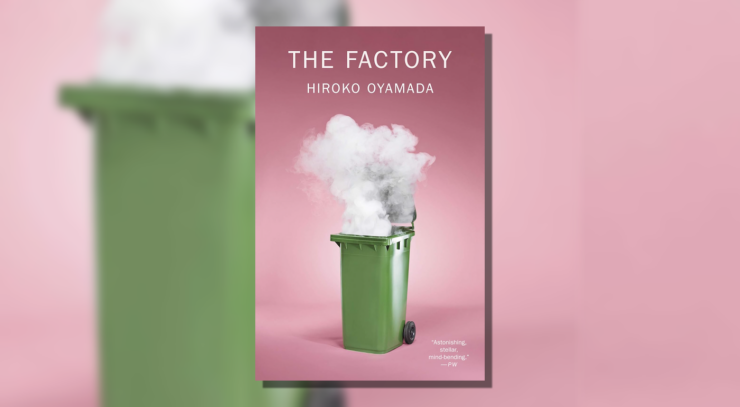
The titular factory of Hiroko Oyamada’s debut novel has not one, but three different protagonists. Yoshiko, a literature major hired as a temporary worker to destroy documents in the underground level; Furufue, a bryologist specialized in moss taxonomy hired to green-roof the factory; and Ushiyama, Yoshiko’s brother, who copy-edits seemingly incomprehensible texts, but hey, at least he’s employed.
All of the points of view of The Factory have one thing in common: they have no idea what they’re doing or why they’re doing it. On her first day at work, Yoshiko is made to sign a confidentiality agreement in case there is any sensitive information in the paper she shreds, but none of the documents seem to be of any value. Not that she’s interested in their contents. Ushiyama’s team, a group of copy-editors working in a cubicle, has accepted not only that everything they revise is gibberish, but that the corrections they send will be dutifully ignored. Furufue, in an even more absurd note, is constantly arguing against his presence at the factory since his one-man department has no goal or supervision and green-roofing is very much outside of his jurisdiction as a researcher, but HR manager Goto gleefully tells him he can take as long as he wants, and learn along the way. It’s very easy to get inside, but it seems that there’s no way out of the factory.
This permanent state of confusion—and the apathetic acceptance that comes with it— creates an atmosphere that is both surreal and humorous throughout the entire novel. The work they do is pointless and inscrutable. It requires a high level of detachment and tolerance for the mindless and the repetitive, not unlike many real jobs. Black birds proliferate, lizards are found in washing machines, employees come in and out, and every acknowledgment of this sense of irreality is quickly shut down. Everything is normal, the factory seems to say, just keep going, keep going.
Those three fictional species are the most peculiar aspect of the novel. The factory shag, a bird that usually gathers in clusters around the beach, but sometimes gets into the underground and must be removed by the workers; the grayback coypus, a peaceful but invasive kind of rodent; and the washer lizard, a pale little reptilian whose life cycle is entirely focused on the washing machines of the laundry. They start unassuming enough, but something feels off about them, and the ending offers an interesting answer—or more questions—regarding their origin.
The character’s voices blur into each other—and even their coworkers, some quirky, others incredibly mundane, seem like the same entity. Yet what could be seen as a flaw ends up enhancing the feeling that Yoshiko, Furufue and Ushiyama are indeed defined by their functions rather than their personalities.
In many ways, The Factory shares a soul with other modern stories exploring work dynamics within capitalism, like Kikuko Tsumura’s There’s no Such Thing as an Easy Job, in which the main feature is the absurdity of modern day jobs, and what this means for individual human beings and the societies they are part of. We live in a world where the lines between the personal and the professional are increasingly blurred. You’re no longer a worker, you’re a collaborator. You’re not part of a team, you’re part of a family. What you do in your private time can be scrutinized through the internet, your presence in social media is tied to your profession, and employers can contact you at any day or hour. If in a series like Severance workers must undergo a brutal split of their minds to create a worker that exists solely for the office, in The Factory the individual vanishes entirely. The worker isn’t in the factory; the worker is the factory.
Without the humor, it would be a horror novel or a dystopia, but Oyamada manages to make the experience enjoyable through parody. It’s one of those books that you can’t help but find charming how odd it is, but the more you read, the more the surreal becomes tangible, and you start to understand how a person can accept such outlandish tasks, or slowly morph into their work.
工場 (The Factory) by Hiroko Oyamada was published in Japan in 2010 and translated (Japanese to English) in 2019 by David Boyd (New Directions/Granta)
Buy the Book

The Factory



This sounds like something I might like. Thank you — and welcome to Reactor! I’m looking forward to seeing more of your recommendations.
I am very excited to see literature in translation highlighted in your newsletter!
Thanks for starting this column! I’m very interested in scifi and fantasy in translation, can’t wait to read more of your recommendations.