






My nation (which may not be yours) is in the midst of another election. On the one hand, it’s a glorious celebration of our right to choose who runs the nation for the next four years. On the other hand, many of us view with dismay the endless election—thirty-six full days of bloviation and punditry!—and the sinking feeling that it is all an exercise in deciding which of our colourful array of parties is least objectionable. Still, even if it feels like one is being asked to choose between the Spanish Influenza and Yersinia pestis, it is important to remember one take-home lesson from Herman Kahn’s On Thermonuclear War: even undesirable outcomes can be ranked in order of preference. The Spanish flu is bad. The Black Death is worse.
All of which led me to consider how elections have figured in speculative fiction novels.
It’s easy enough to find examples from what I might call near-future speculative history. No aliens, no spaceships, just a “What if?” in a recognizable future. Here are a few that I remember; readers can doubtless remember more.
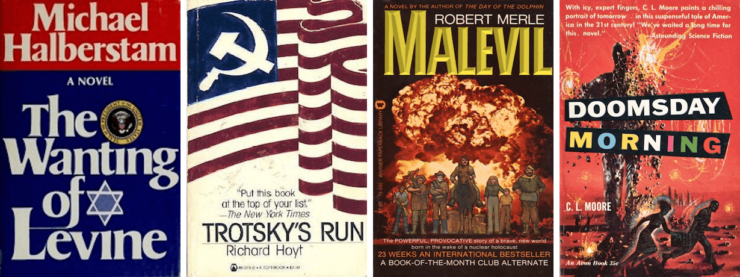
Michael Halberstam’s 1978’s The Wanting of Levine shows a Democratic Party poised to win the 1988 election. They hold the White House and incumbent President Bigelow is popular. An easy win! Except that Bigelow refuses to run again. The obvious choice for a back-up candidate, Senator Rackey, has just murdered his wife. The Party needs to find a new candidate soon. But who?
Hilarity ensues when backroom party functionary A. L. Levine’s name is inadvertently added to a list of possible candidates. Polling indicates that Levine is surprisingly popular for someone who has never sought the spotlight. Levine becomes the Democratic Party’s candidate. But is America ready for a Jewish president? And are Levine and his family ready for the spotlight?
I found this a charming but naive little tale. Halberstam seemed to have believed that given a choice between a decent fellow with a few flaws and someone who might bomb foreign cities for the yucks, Americans would go for the nice guy. An interesting hypothesis, which you can discuss in comments—but let’s keep it light, shall we?
Richard Hoyt’s 1982 spy comedy Trotsky’s Run also imagines an America in which the Democrats hold the White House and the incumbent is widely popular. Alas, he’s terminally ill. He suggests charismatic politician Derek Townes as his successor. Townes has the edge.
What the incumbent doesn’t know is that Townes is a Soviet mole! If elected, he will be a disaster for the US. But not for the reason you think. The strain of years undercover have driven Townes quite mad. He’s convinced that he is the reincarnation of Leon Trotsky and yearns to take revenge on the Moscow bosses who ordered his death in 1940. His finger will be on the nuclear button and catastrophe will ensue.
Enter disgraced British double-agent Kim Philby, who knows that Towne is a mole. He doesn’t know that Towne is mad. He alerts the US intelligence agencies, which are understandably unwilling to take a known double-crosser at his word. They send a few second-string field agents to investigate his claim. Hijinks ensue.
Like many of the spy novels of its era, the novel is sexist. But there is some fun in seeing how various intelligence agencies deal with a candidate who is both a Soviet agent and possibly the worst threat the Soviets have ever faced.
On to post-apocalyptic election fiction…
In Robert Merle’s Malevil, Emmanuel and his friends survive a nuclear holocaust because they were down in the wine cellar of Malevil, a sturdy Anglo-Saxon fortification dating back to the Hundred Years War. Emerging to find utter devastation, the survivors set about building a new world in the ruins of the old.
Post-apocalyptic settings are not known for their democratic leanings. Malevil is an exception (at least at the start). Most of the survivors are old drinking chums and discuss decisions before putting them to the vote. It never occurs to the men in this group to involve women in the process. Author Merle does not appear to have been entirely on board with his male chauvinist pig protagonists here, however, because while the men endlessly discuss the Matter of Woman and How Best Women Might be Managed, these discussions never have the slightest effect on what the women actually do.
C. L. Moore’s 1957 Doomsday Morning also starts with a nuclear exchange. However, the Five Day War that struck America crippled but did not destroy the country. Elections are held. Repeatedly. President Raleigh has been re-elected five times! Thanks, no doubt, due to his control of Communications US (Comus), which guides voters towards the only right choice.
But Raleigh is only mortal. When he dies, who will become President for Life? Comus boss Tom Nye intrigues to take power through a patsy, an actor who can play a politician and take directions. The actor tapped, Howard Rohan, is a self-loathing drunk who…but any more would be spoiler.
I know, I know. The idea of an actor playing a significant role in politics is completely ludicrous. What made this Eisenhower-era dystopia stand out for me is the way that Comus manages the US. For the most part, they eschew the standard midnight raids. Instead, they control communication, telling each American just what Comus wants them to know. It’s rather 1984, except that Comus is secure enough in its position to allow voters access to the voting booth. Why not, given that it won’t affect the outcome?
I can think of a few SF novels in which elections figure (SF defined here as novels with spaceships). Novels like Heinlein’s Double Star and The Moon is a Harsh Mistress, or Bujold’s A Civil Campaign. Perhaps another essay? If you can think of SF or fantasy novels that I should consider, tell me in comments.
In the words of Wikipedia editor TexasAndroid, prolific book reviewer and perennial Darwin Award nominee James Davis Nicoll is of “questionable notability.” His work has appeared in Publishers Weekly and Romantic Times as well as on his own websites, James Nicoll Reviews and Young People Read Old SFF (where he is assisted by editor Karen Lofstrom and web person Adrienne L. Travis). He was a finalist for the 2019 Best Fan Writer Hugo Award, and is surprisingly flammable.

In a glorious embrace of carrying an essay’s theme to its limit, I get trained as a Deputy Returning Officer tonight. More importantly, I get sworn in by Elections Canada, so from 6 PM to the day after the election, my ability to comment on federal matters political will be constrained. Which I imagine will come as a great relief to many.
If any of you are Canadian citizens, will be at least sixteen on polling day, and would like to be the stagehands of democracy, consider applying for an election day job with Elections Canada.
https://www.elections.ca/content2.aspx?section=job&dir=pos&document=index&lang=e
Walter Jon Williams’ City on Fire features multy-party elections, with both pre- and post- election political maneuvering. One of the parties is a hardline religious minority party which can enable either of the two larger parties to form a coalition. As someone coming from a country (israel) stuck in a similar situation I found it particularly relevant.
These two facts are related: the incumbent was a mediocre President but his impending death from emphysema has endeared him to almost every American save for those who sell tobacco (since the President blames his terminal disease on smoking).
Wow, “Malevil” brings back memories. Strangely enough I don’t remember an election. I remember the unfortunate treatment of women though.
Your description of The Wanting of Levine, which I’ve inexplicably never read, reminded me of Fletcher Knebel’s Dark Horse.
“Election”, I grant, perhaps implies too formality for the means by which members are selected for the ruling committee, but there is a process of sorts and the rulers do aim for consensus of sorts. Granted, one that excludes more than half the population but that’s not out of keeping for historical democracies. Also, I think it’s significant that anyone who argues for New Improved Feudalism or autocracy generally comes to a bad end.
I have read Knebel but not that one.
There’s an election in First Lensman, which is highly fraught since one of the candidates is openly acknowledged to have strong connections with a mysterious alien power.
Doesn’t A Sound of Thunder involve the outcome of an election?
@8: damn, beat me to it.
Heinlein dabbled in elections more than once, and sometimes even in fiction (tip your waitress). Right now I’m particularly remembering Tunnel in the Sky.
The change in outcome of the election in “A Sound of Thunder” (and the opinion of the tech at base regarding the two candidates) is what confirms to the time travellers that They Royally Screwed Up.
<i>Doesn’t A Sound of Thunder involve the outcome of an election?</i>
Yes. I used to think that was fiction. Now I don’t, and when I find out who in our world stepped on a timely past butterfly, the two of us are gonna have <i>words</i>.
Malka Older’s Centenal trilogy, which starts with Infomocracy, is a fascinating dissection of how near-future elections might be professionally managed and influenced, on a global scale.
My problem with the Older books is that I don’t see how to get from where we are to there. Why that bothers me while impossible stuff like FTL doesn’t, I don’t know.
James, how is it possible that footnote 1 fails to mention that, for many years, 25% of the teams in the CFL had essentially the same name?
John Brunner’s The Stochastic Man comes to mind: the protagonist is a statistician who is hired to help the candidate, who aspires to the US Presidency eventually, adjust his strategies for maximum return.
@16: I forgot about Stochastic Man!
There are a lot of elections in the more recent “The Prefect” by Alastair Reynolds (the whole plot is driven by the actions of the agency that enforces election processes).
@16, rpresser: The Stochastic Man is great! But it’s by Robert Silverberg.
“The Manchurian Candidate,” which could be considered near-SF with its somewhat speculative presentation of the power and efficacy of “brainwashing” and post-hypnotic suggestion.
@7,James Davis Nicoll: The setup for the two novels is quite similar.
In Dark Horse, the Republican candidate dies three weeks before the election. A party insider puts the name of a New Jersey highway commissioner, Eddie Flynn, into the discussion and gets him made the candidate, since there’s no way anyone can win under those circumstances and no one can compromise on any of the more credible candidates. Of course, the race becomes a nail-biter as all sorts of things happen. It’s my favorite of his novels.
Come to think of it, 1600 Floogle Street by Don McGuire fits the bill, too. It’s a fictionalized version of the Edmund Brown/Ronald Reagan race, in which a thinly disguised member of the Heinz family hopes to defeat Republican Donald Duggan by funding a popular vulgar comedian, Wee Willie Winkle, to run as an independent candidate. Winkle has no idea he’s expected to lose. The humor is broad and often offensive and it cracks me up every time I read it.
It was published by Holloway House, better known for blaxploitation novels and soft-core (I think. I’ve never had one at hand) pornography. It might be the only book they ever published which didn’t fall into one of those categories.
Heinlein’s Double Star is ALL about elections and parliamentary politics.
Mira Grant’s Feed is all about a high-stakes US election after the zombie apocalypse.
Patrick Morris Miller A far clearer Heinlein example is *Double Star*, where the process of an election is a large part of the story — and not broad themes all the time, but tactical details.
Would the political manouvering and votes in LMB’s [i]A Civil Campaign[/i] qualify as an election?
Apparently I should’ve read the article allllllllllllll the way to the end :v
The Probability Broach by L. Neil Smith has an election where the politicians have power according to support from the electorate– recorded electronically so it can change at any time.
The Daybreak series by John Barnes has a lot about efforts to continue to have a United States with elections after a varied technological attack on civilization.
Allen Drury’s Advise and Consent series is largely just a political potboiler. However the fourth book ends with the President, Vice President and their wives being shot at by an assassin. One man and one woman, who are not married to each other, are killed. The two follow-up novels explore the two different combinations of deaths, creating a sort of alternate history. Drury wrote a couple of SFF stories in his career.
Fantasy is probably very short on elections, since it tends to feature non-democratic societies. Is there an election somewhere in Tom Holt’s Goatsong? I don’t think so, but it’s not impossible. There’s some off-screen electoral stuff at the end of The Lord of the Rings, but that doesn’t count. Oh! Scott Lynch’s Republic of Thieves is all about electoral shenanigans.
@27: The Elenium prominently features a Papal election. Or equivalent, anyway.
The Stainless Steel Rat For President!
Heinlein has an election in his fantasy story “Our Fair City” (and in his non-genre “A Bathroom of Her Own”)
Interface by Stephen Bury (Neal Stephenson and his uncle) is about a Presidential candidate who has a computer interface wired into his brain so the cabal who run the world can drive him for maximum political effectiveness, based on their monitoring of all world media and human activity.
Norman Spinrad’s Bug Jack Barron is about a sort of political shock-jock who becomes a candidate. You could say it anticipated some things but overall it hasn’t aged well.
I rather enjoyed Daniel Hatch’s short story “Senator Space Cadet”.
@24: Yes, I’d argue that the Council vote to determine who will fill the open position counts, since most of the people involved are more concerned with the individuals contesting than the legal principles at stake. And indeed that’s part of the point, since the protagonists are hoping to not only get their candidate in but to change Barrayar’s politics slightly by doing so.
In Fantasy, Pterry mentioned democracy a couple of times, at least once pointing out that universal suffrage would allow Nobby Nobbs to vote…
And of course, Lord Vetinari is a strong believer in “One Man, One Vote,” with himself as the “One Man.”
There are some great suggestions so far, definitely some to put on my list. I’ve been meaning to read the Feed series since I found out out that Mira Grant was a pen name of Seanan McGuire’s, zombie fueled election hijinks sound fun.
I feel like there was some election stuff going on at some point during Julian Comstock, Robert Charles Wilson’s post-apocalyptic steam punky reimagining of the life of the Byzantine emperor Julian the Apostate. I seem to remember liking that one quite a bit.
@30,
Dust devils for the win!
Um, James? Have you re-read The Wanting of Levine recently? I’m wondering how you missed the part where one character confesses that he’s biased against African-Americans, and another one asks why, and the reply is: “I went to an integrated school.” “That’ll do it.”
I read the book myself when I was in my teens (it got a positive review in Analog, I think from Spider Robinson) and I was a great deal less sensitive to such things, but even then that puzzled me a bit, as I had attended integrated schools and not come out a racist.
As for other books, the ending of John Brunner’s The Shockwave Rider involves an election: if memory serves me right, the final chapter was entitled “The Outcome of the Plebiscite” and consisted solely of: “Well? How did you vote?”
I am inordinately fond of Daniel Keys Moran’s The Last Dancer, a sprawling but compulsively readable and well-worldbuilt Bantam Spectra mmpb whose events are many and include spaceships centered around the 2076 global elections (the selection of a lesser evil being a theme) and an ill-fated US centennial uprising against the UN world government, or Unification (dominated by France and Brazil!), which was installed for sound environmental reasons but began going sour somewhat. Also, the kinda-slingshot ending puts it on the list of novels where violence turns out emphatically not to be a solution to anything.
The bit that stuck with me from The Dark Horse was how the Populist candidate (the parties are not named explicitly but the opposition is shown having abandoned interests of the working class and going over to campus socialists, socialites and crazy progressivists) bases his program on a tax simplification reform that “will permit lowering tax rates to a top bracket of 40 per cent or less.” (Oh, and there was something about fewer tax breaks to oilers and replacing them by universal “human depletion allowance”.)
Oh, and Gibson’s Virtual Light takes place in a (re-)election year; it features only tangentially, but allows better dating of the year it is set in than what apparently was the blurb of an early edition.
The vote at the end of Rite of Passage counts more as a plebiscite, I guess; there was just an issue and no candidates.
For fantasy, there’s Jon Snow getting elected Lord Commander of the Night’s Watch in A Song of Ice and Fire.
For a fantasy election there is Grunts by Mary Gentle. Taken from the orcs perspective and not particularly serious the middle section covers an election for president where the candidates are a paladin hero and the dark lord.
@14: “My problem with the Older books is that I don’t see how to get from where we are to there.”
Me neither, although she tries to explain it somewhat in State Tectonics.
It didn’t bother me, though. I was so happy to see an entirely new future political system for a change. And a likeable one, too! So much SFF restricts itself to feudalism, corporate rule, or the US-American system in space. Writers should think up more imaginary political systems.
I guess if Older knew how to create that system, she’d be running for office rather than writing books.
#29. +1 DiGriz for POTUS, which came out in 1982
#31 Bug Jack Barron, I loved the portrayal of the evil medical industry, and the talk show host “hero” whose narcissism almost blinds him, but I tried to reread years ago and the “ironic” racism and sexism stuck in my craw.
Another wild election if SF is found in Gordon Eklund’s “Eclipse of Dawn” (1971). It’s definitely new wave, feels like a house party where people get high and then dropped acid.
And let’s not forget that Howard the Duck campaign in 1976. (Not quite SF, apart from the extraterrestrial duck bit).
@37: there are a lot of works other than The Shockwave Rider in which an election (or, as in this case, a referendum/plebiscite, as it’s titled — cf @39) takes place but isn’t a major part of the story; see (e.g.) Rider‘s companion work, The Stone that Never Came Down. If you add in campaigns where the election happens afterward, there are even more. But genre works in which elections are the backbone of the story are rarer. I’d point to Scott Lynch’s third Gentleman Bastards novel, Republic of Thieves, in which the viewpoint character and the woman he’s carried a torch for ever since apprenticing as a thief are the managers of opposed campaigns.
Would the political manouvering and votes in LMB’s [i]A Civil Campaign[/i] qualify as an election?
No, no more than the political maneuvering and voting in any parliamentary/congressional session would. The current US House of Representatives has voted more than 550 times since it opened in January of this year. Since December of 2015, the current Canadian Parliament has voted over 1300 times. Would you call each one of those an “election”?
You could, I suppose, term the selection of the Speaker of the House (3 January 2019, won by Nancy Pelosi with 220 votes) an “election”, but that’s clearly not the sort of thing James had in mind, and it’s not what’s going on in A Civil Campaign, either.
@@@@@ 39, JVir:
The vote at the end of Rite of Passage counts more as a plebiscite, I guess; there was just an issue and no candidates.
A plebiscite vote is one in which everyone participates. If a union holds a plebiscite vote, even the apprentices cast ballots.
In Rite of Passage it was a plebiscite vote; all citizens of the ship got to vote on the issue, “Should we commit planetary genocide?”
It’s not precisely an election, but the constitutional convention in KSR’s Green Mars was pretty interesting (as long as you can tolerate a lot of talkiness, and if you want to read KSR, you better be able to tolerate talkiness.)
For that matter, there’s a lot of electoral politics in his New York 2140.
All these comments and nobody mentioned Asimov’s “Evidence”, with the robot running for office? I guess nobody reads those robot stories anymore. That’s all right; 75-year-old ideas of AI are as quaint now as Venusian jungles and Martian canals.
Philip K. Dick’s The Crack In Space is about the election of the first black US president — in 2080! Another case of sf writers underestimating social change.
ecbatan @@@@@ 48:
Wasn’t the constitutional convention in Blue Mars, rather than Green Mars?
Null-P by William Tenn.
The human race, devastated by war, decides to choose the most average candidate rather than (hopefully) the best.
Much as I despise clickbait, I’ll tell that it’s just a short story and I bet you won’t expect the ending.
Also, there was a story, possibly by Asimov, where the computer chooses the only voter, someone who is most representative of the electorate.
“Also, there was a story, possibly by Asimov, where the computer chooses the only voter, someone who is most representative of the electorate.”
“Franchise” is a good example.
Interesting the number of references in previous comments to Robert Heinlein stories featuring elections, some of which I did not think of – and to which I would add The Moon is a Harsh Mistress, with includes the election of a post-revolution government on the moon. This featured universal voting rights, unlike his Starship Troopers, in which only those who had served in the military could vote or run for office! RH is no everyone’s cup of tea of course.
I recommend Farah Mendelsohn’s The Pleasant Profession of Robert Heinlein– an account of Heinlein’s ideas as expressed in his fiction.
I don’t know of any author other than Heinlein who’s presented so many different sorts of government as working at least reasonably well.
Fernhunter@47: I use(d) the technical meaning as per OED‘s “A direct vote of all the members of an electorate to decide a question of public importance, e.g. a proposed change in the constitution, union with another state, acceptance of a government programme, etc. (cf. referendum n.). Also more generally: a public expression (with or without binding force) of the wishes or opinion of a community“, i. e. vote on an issue as opposed to selecting among people for political functions.
But it was not really a good example anyway, the polity was pretty small and I next to no campaign, IIRC. – But wait, there are bizarre elections on the Space Beagle!
perihelion @49: Now that you mention it, I recall I (must) have, but it went the way of most Asimov, indeed teenage reading in general.
@@@@@ 19, Russell H:
“The Manchurian Candidate,” which could be considered near-SF with its somewhat speculative presentation of the power and efficacy of “brainwashing” and post-hypnotic suggestion.
The Manchurian Candidate was written and then filmed in the wake of the Korean War. They used standard Chinese brainwashing techniques to get American POWs to announce that America was the evil aggressor attacking innocent Korea.
That shocked America in a way that none of the horrors of WWII had done. The Manchurian Candidate was one of the responses to that new psychological technology. Calling it SF sounds fair to me.
@@@@@ 55, JVjr
Fernhunter@@@@@47: I use(d) the technical meaning as per OED‘s “A direct vote of all the members of an electorate to decide a question of public importance, e.g. a proposed change in the constitution, union with another state, acceptance of a government programme, etc. (cf. referendum n.). Also more generally: a public expression (with or without binding force) of the wishes or opinion of a community“, i. e. vote on an issue as opposed to selecting among people for political functions.
There’s nothing wrong with that. I was just pointing out that plebiscite votes can be for any issue; including electing a new president or tyrant.
In Golden Age Athens, all votes were plebiscite votes; all citizens got to vote. (Let’s not look at women and slaves.) And they did vote in tyrants. In those days tyrants stood for the people against the landed aristocracy.
Heinlein’s Future History has twenty-first century America sinking into The Crazy Years. In 2012 they elected a religious nut named Nehemiah Scudder to the presidency. He was elected against the will of the majority. And established an American theocracy. That was the last election in a century.
Heinlein wrote an essay as an afterward to Revolt in 2100. Here’s a sample:
“Could it be otherwise here? Could any one sect obtain a working majority at the polls and take over the country? Perhaps not — but a combination of a dynamic evangelist, television, enough money, and modern techniques of advertising and propaganda might make Billy Sunday’s efforts look like a corner store compared to Sears Roebuck.
“Throw in a Depression for good measure, promise a material heaven here on earth, add a dash of anti-Semitism, anti-Catholicism, anti-Negrosim, and a good large dose of anti-“furriners” in general and anti-intellectuals here at home, and the result might be something quite frightening — particularly when one recalls that our voting system is such that a minority distributed as pluralities in enough states can constitute a working majority in Washington.”
“I imagined Nehemiah Scudder as a backwoods evangelist who combined some of the features of John Calvin, Savonarola, Judge Rutherford and Huey Long. His influence was not national until after the death of Mrs. Rachel Biggs…. who left Brother Scudder several millions of dollars with which to establish a television station. Shortly thereafter he teamed up with an ex-Senator from his home state; they placed their affairs in the hands of a major advertising agency and were on their way to fame and fortune. Presently they needed stormtroopers; they revived the Ku Klux Klan in everything but the name — sheets, passwords, grips, and all. It was a “good gimmick” once and still served. Blood at the polls and blood in the streets, but Scudder won the election. The next election was never held.
“Impossible? Remember the Klan in the ‘Twenties — and how far it got without even a dynamic leader. Remember Karl Marx and note how close that unscientific piece of nonsense called Das Kapital has come to smothering out all freedom of thought on half a planet, without — mind you — the emotional advantage of calling it a religion. The capacity of the human mind for swallowing nonsense and spewing it forth in violent and repressive action has never yet been plumbed.”
As much as I love Heinlein the fiction writer, he’s not that great a political thinker, and that essay has nothing to do with the election process per se, any more than his “Lost Legacy” does.
SIXTY DAYS AND COUNTING by KSR features an election, though the author seemed to think Oregon had voting machines and not vote by mail, if I read the book correctly.
Arkansawyer @@@@@ 59: actually, RAH points in that essay to most of the elements of our current mess; the biggest differences are the donation of money in-family instead of separately, and the coopting of religion instead of its absolute dominance. The line about a minority choosing the President is eerily prescient.
Whether RAH was original is a separate argument; cf It Can’t Happen Here. But I think you underestimate the knowledge of US politics shown in that essay.
Chip @@@@@ 61: I do take your point. But we’ve got at least three examples of Heinlein stories that are actually about elections. One of them won a Hugo. We don’t need to toss Tunnel in the Sky, Stranger in a Strange Land, “Solution Unsatisfactory”, and whatever that story about not-Nichelle Nichols becoming president is called, into a discussion of stories about the electoral process itself. It’s just overkill in this context.
American elections figure prominently in Eric Flint’s Trail of Glory series: 1812: The Rivers of War and 1824: The Arkansas War. When Monroe steps down, Henry Clay gains the presidency. Despite winning only one sixth of the popular vote. Clay manages this through deal making and political manipulation of the House of Representatives.
There are are in children of mind by OSC mentioned elections to starways congress and in other OSC elections there is that mayor is get elected. If i remember correctly it sound something like that,,thirty years-three elections ,before this change come”.Also there are elections mentioned more than once ,with system of restricted suffrage or simply elections in Janusz A.Zajdel novel ,,Cała prawda o planecie ksi”. Lem ,,Wizja Lokalna” also have Luzanian elections mentioned. OSC novels have also plebiscites about joining to Free People of Earth ,Hegemon is also elected position.Foundation series have also elections,for Terminus mayor each year and local Council in one of Trantor sectors .Arthur C.Clarke have elections mentioned in Time Odyssey and Light of Another days.Anathem have ,,voters” mentioned ,maybe it counts?
I guess we could include Robert Silverberg’s Edit – Nebula Award winning – short story “Good News From the Vatican” about the election of the first robot Pope.
Late to the party, but I’ll throw “Putney Swope” out there – Black titular character elected CEO of a major advertising company upon the death (and ceremonial looting of the body) of previous CEO (board members each separately vote for Swope on the grounds that no-one else would vote for him as a way to nullify their own votes; he is elected unanimously). Renames the company “Truth and Soul Inc.”; hijinks ensue.
I know it’s a movie rather than a book, but arguably sf for when it came out in the late 60s.
Very late to the party but Return of the Emperor by Allen Cole and Chris Bunch has the titular Emperor engaging in Chicago and New York machine electoral politics.
Harry Turtledove’s The Guns of the South has several elections as significant plot points, although we don’t see much actual campaigning. The1867 (IIRC) race for President of the Confederacy between Robert E. Lee and Nathan Bedford Forrest gets the most screen time, and the candidates are both significant characters. The 1864 race for US President is more off-screen. There is an appendix with state-by-state vote totals, and a little discussion of how the author determined them.
There are several elections in Eric Flint’s 1632 series, although none of them is exactly front and center of the narrative that I recall, but they have significant effects on the course of events and on several major characters.
Lion’s Heart and Lion’s Soul (both 1991) by Karen Wehrstein in the “Fifth Millenium” shared world series involve several elections and plebiscites, unusual for a work whose setting is largely pre-industrial. (One might argue if this is Fantasy or SF. It is set several thousand years in the future, apparently after the Cold War ends in a nuclear exchange, but “psychic” powers are common enough, varied enough, and significant enough to the plot that they might as well be called “magic”.)
In one of the Retief stories, his diplomatic corps had introduced the concept of democratic elections to the local indigenes. Especially the idea of; One Voter, One Vote.
Election Day was a battleground; bullets flying everywhere. The natives had figured out the corollary; One Less Voter, One Less Vote.
Anthony Trollope writes about English C19th elections very entertainingly In “Ralph the Heir” there is an amazingly corrupt election, based on the author’s experience in Beverley. The unsuccessful Radical candidate tells his [would be] girlfriend that he would be in favour of women voting. That must have seemed like SF then.
“Democracy is the worst possible form of government – with the exception of all the others.” Churchill.