





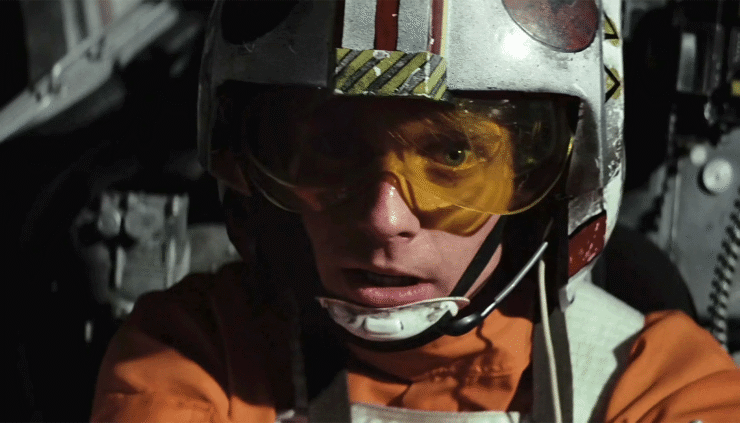
“‘A long time ago in a galaxy far, far way,’” my friend Julia once told me, “is just another way of saying ‘once upon a time.’” We had found ourselves embroiled in some online discourse concerning the genre of Star Wars. Was it science fiction? Space opera? Western? War story? The truth, we realized, was that Star Wars could be all of those things—and more—at once. But before it was anything else, Star Wars was a fairy tale.1
This debate mattered (insofar as online pop culture discourse ever really matters) because our awareness of genre informs our understanding of a text. We’re a pattern-seeking species, and our understanding of a story’s genre is a kind of pattern-recognition—one which allows us to anticipate and contextualize certain archetypes, motifs, and conventions within a narrative. Princess Leia’s holographic plea for help is compelling to us in part because we’ve been told other stories in which daring knights must rescue beautiful princesses. When Leia’s military acumen and unladylike temper are later revealed, we’re delighted because it subverts the pattern we’ve come to expect—she’s hardly a damsel in distress. We hold our breaths as Luke deactivates his targeting computer in the trenches of the Death Star because we know (but must see to truly believe) that a fairy tale promises eucatastrophe, as Tolkien described it: that “sudden joyous ‘turn’” towards a happy ending.
So genre—as a framework or a lens, not a rigid set of rules—matters. And within this framework, Star Wars, as a transmedial mythmaking project, is unwieldy. There’s simply so much of it. We’re dealing with decades of prequels, sequels, comics, novels, video games, and television shows; the visions of countless writers, directors, animators, and editors; a collaboration that spans fifty years. Star Wars started as a fairy tale, molded by Joseph Campbell’s monomyth and its influence on George Lucas early in the development of A New Hope, but it didn’t stay that way forever. It makes sense, then, that different parts of the Star Wars canon require different frameworks. In order to understand Star Wars, we must be conscious of the ways in which it utilizes (and sometimes transcends) all of its many genres.
This explains, I think, the tension that underpinned the fandom’s reception of the 2023 live action show Ahsoka. If Star Wars started as a fairy tale, Ahsoka takes that framework to its logical conclusion. And fairy tales are wondrous and enchanting—but they’re also very weird.

In her essay “Fairy Tale is Form; Form is Fairy Tale,” Kate Bernheimer expounds upon four oft-overlooked formal elements of fairy tales. “Flatness, abstraction, intuitive logic, and magical realism,” Bernheimer writes, “…comprise the hard logic of [fairy] tales…” These classical elements chafe against modern sensibilities; as Bernheimer points out, flatness of character “violates a technical rule writers are often taught in beginning writing classes: that a character’s psychological depth is crucial to a story” and that abstraction violates “ye olde ‘show don’t tell’ rule.”
And yet, the staying power of fairy tales is testament to their richness, their elegance, and their beauty. Fairy tales move us and enchant us because of these now-unconventional formal elements, not in spite of them. But as Bernheimer reminds us, “a critical underappreciation of the art of fairy tales sometimes leads to the misinterpretation of these beautifully deliberate gesturesas rather unfortunate accidents…”
If you come to Ahsoka expecting a political drama like its contemporaneous release, Andor, or even an action/adventure series in the style of Indiana Jones, you’ll likely be disappointed. It’s not that Ahsoka lacks those elements, exactly—one of the first scenes of the show follows the titular protagonist as she liberates a star map from an ancient ruin in a Jones-esque sequence, and there’s plenty of New Republic politicking across the first season’s eight episodes—but rather that these genres don’t sufficiently contextualize the series. Instead, we’re better served by a different lens. Ahsoka is at its best when we read it as a fairy tale.
Within this context, some of Ahsoka’s narrative “bugs” become “features” instead. The show’s logic is associative rather than linear, relying upon atmosphere, aesthetics, and allusions to guide the audience’s experience of the text. The series is steeped in normalized magic, from the Witches of Dathomir, whose crumbling temple Ahsoka pillages on the planet Arcana (here, ruins of towering statues recall imagery from Peter Jackson’s Lord of the Rings trilogy, another clear cinematic touchstone for showrunner Dave Filoni) to the hyperspace-traversing ancient space whales known as purrgil, within which (yes, within) Ahsoka and her allies catch a ride to a distant galaxy.
When we understand Ahsoka within the framework of the fairy tale genre, the lacunae left by narrative leaps and the “nighttime logic” that propels portions of the show serve to enrich our experience rather than disrupt it. Other familiar motifs become apparent. We recognize Macbeth’s weird sisters in the Dathomirian witches who guide the series’ antagonists, the mysterious dark knight Marrok as a trapped spirit or a golem, glints of Arthuriana and Norse mythology in the antagonists Shin Hati and Baylan Skoll, faerie in the strange and distant moors of the extragalactic planet Peridea. These touchstones lend texture and weight to the weave of Ahsoka’s narrative.

This understanding of genre is always key. Grade Andor on A New Hope’s curve, and the series—otherwise an unparalleled critical success—is a failure. A New Hope, after all, is an epic that is consciously imbued with religious themes and monomythic motifs (and, yes, political messaging—though this is perhaps secondary to the film’s spiritual objectives). Andor shares little of its sweeping sense of the mystical and religious, its awareness of archetypal figures, its attempt to “intentionally recreate myths,” as George Lucas once put it. Yet we recognize Andor’s achievements because we intuitively recognize the series not as an epic but as a spy thriller and a political drama—two genres which, because of their perceived realism, possess more cultural capital than fantasy or fairy tale. We grade Andor on the right curve.
When we expand our horizons to embrace and enjoy other, less “serious” genres, our appreciation for the entire Star Wars canon only grows. Take, for instance, the 2024 Disney+ release Skeleton Crew, which I believe is criminally underrated (or perhaps under-viewed. If more people had seen Skeleton Crew, I have no doubt that they would have rated it highly).
Skeleton Crew follows the (mis)adventures of four ordinary children from an isolated planet on the edge of the galaxy who are shunted into open space when they discover an ancient space craft. It’s a perfect adventure tale in Star Wars garb, following in the tradition of Treasure Island (and the 2002 adaptation Treasure Planet), Peter Pan, and movies like E.T., Indiana Jones, and The Goonies. Jude Law plays a perfectly charismatic, perfectly conniving pirate named Jod Na Nawood, whose motives shift like an oil slick as he shepherds the children across a perilous galaxy. The show is funny, colorful, energetic, and at times deeply moving—as emotionally rewarding as The Clone Wars’ final season and as technically impressive as Andor. It bears all the hallmarks of a classic adventure story: there are treasure hunts and hidden maps, swashbuckling allies and treacherous villains, cunning plans and daring escapes. It is one of the greatest installments in the Star Wars canon as of late, and it works because it’s so firmly grounded in the rich literary and cinematic traditions of the adventure genre.
The same is true for Andor and Ahsoka, each of which succeed in their commitment to their given genres—something we can only recognize when we acknowledge and embrace the right genre framework to contextualize each show. This is why it’s so essential that we resist the urge to hierarchize—to privilege realism over fabulism, political drama over fantasy romp or action-adventure. When we elevate Andor but overlook Skeleton Crew, we lose something substantial. We miss the bigger picture. Each genre contributes to the glittering mosaic that is the Star Wars canon; each offers a new angle, a new atmosphere, a new texture to the galaxy far, far away. We must grade each project on the right curve, and we must recognize that each curve—each genre—offers something unique and essential.
- I know this is true because George Lucas says that’s what he set out to create—or at least that he wanted to make movies that set standards and communicated social values, and he turned to folklore, fairy tales, and mythology to guide that work. Then he came across Joseph Campbell’s The Hero With a Thousand Faces. Lucas’ early drafts of what would become A New Hope already shared many of the elements of the “hero’s journey” that Campbell claimed (though not without controversy) underpinned folkloric and religious stories from around the world, so Lucas rewrote the next few drafts of the script to intentionally make use of those motifs. ↩︎
