







Last week marked the 70th anniversary of The Lion, The Witch and the Wardrobe, and the first anniversary of this column! Many thanks to everyone for creating the wonderful and interesting community that’s been building around the comments here over the last year.
The Lion, the Witch, and the Wardrobe tells us in the final chapter that our main characters—Peter, Susan, Edmund, and Lucy—grew to be adults in Narnia, and lived their lives as kings and queens. This all takes place in the space of a few paragraphs, and though it’s referred to often enough in other books, the “Golden Age of Narnia” mostly unfolds between the stories recounted in the books, not within them.
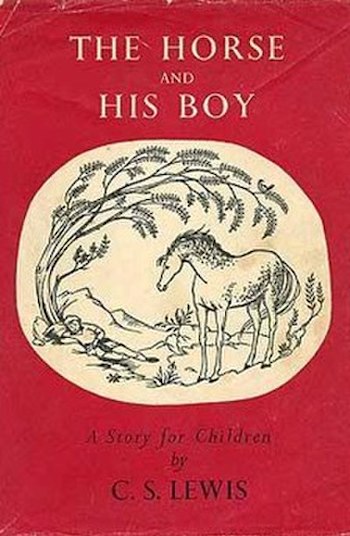
Except in The Horse and His Boy, where we see the siblings (save Peter) as royal adults in Narnia. It’s a fun and inventive bit, giving us a little flavor for what we missed of the larger stories through our former heroes’ generous cameos in this tale.
Not only do we see a bit of their Narnian adventures, but this is also the oldest we see the kids in the Chronicles. The Pevensies enter Narnia in 1940, when they are (roughly) 13, 12, 10, and 8 years old. They arrive in Narnian year 1000 and stay there as the Kings and Queens of Cair Paravel for fifteen years, when they follow the white stag back to Earth, arriving at the very hour they left…and finding themselves to be children again. The Horse and His Boy takes place in the penultimate year of their reign, 1014, when Peter is 27, Susan 26, Edmund 24, and Lucy 22. The last book of the series, The Last Battle takes place in 2555 (Narnia time)/1949 (Earth time), and our dear Susan finds herself orphaned and without siblings as a 21-year-old, still younger than she had been in Narnia.
As a refresher, The Lion the Witch and the Wardrobe tells us:
And they themselves grew and changed as the years passed over them. And Peter became a tall and deep-chested man and a great warrior, and he was called King Peter the Magnificent. And Susan grew into a tall and gracious woman with black hair that fell almost to her feet and the Kings of the countries beyond the sea began to send ambassadors asking for her hand in marriage. And she was called Queen Susan the Gentle. Edmund was a graver and quieter man than Peter, and great in council and judgment. He was called King Edmund the Just. But as for Lucy, she was always gay and golden-haired, and all Princes in those parts desired her to be their Queen, and her own people called her Queen Lucy the Valiant.
As always, Lewis doesn’t let consistency get in the way of the story he’s telling, and we’ll notice that the Pevensies courtly flavor of speaking comes and goes a bit. But overall, Lewis more-or-less sticks to his Wardrobe description of the kids when it comes time to write The Horse and His Boy.
Let’s start with the High King himself, Peter, who doesn’t appear in this book because he’s off killing giants. We’re told Peter has defeated the Tisroc “a dozen times over” in the previous years. He’s still involved in matters of state and the various ceremonies required of him. Tumnus tells Shasta (thinking he’s Corin) that Peter has promised to knight the boy himself in a few years. Even his enemies think highly of him. Rabadash says Peter is a man of “prudence and understanding” and of “high honour.” We’re told that the Golden Age Peter and his siblings have brought to Narnia leaves the woodland creatures feeling “safe and happy” and maybe even a bit careless. He’s also instructed Lucy that she’s not to carry her magic cordial around all the time, but to save it for special need in battle. Overall, we don’t get much more about Peter than what we’re told at the end of Wardrobe.
Our first sight of Lucy shows us “a fair-haired lady with a very merry face who wore a helmet and mail shirt and carried a bow across her shoulder and a quiver full of arrows at her side.” Lucy does what she pleases, and that includes firing arrows at the enemies when at war. She joins Edmund in making the plans for battle…she seems to be treated as a valuable member of the army and treated with respect as someone who ranks only below the High King himself. We’re told she’s “as good as a man” or “at any rate as good as a boy.” (Though these comments come from Prince Corin, who is portrayed as someone with a good heart but questionable judgment. It certainly seems that others see Lucy—as Queen of Narnia—as rather more important than just any man.)
Any time there’s trouble, people come to Lucy for help. She’s the first person the talking beasts suggest should be told the news of the impending attack from the Calormenes, and when Aravis needs help getting settled, it’s Lucy who is called upon. She and Aravis hit it off at once and Lucy has not only prepared her apartment, she also sets out to help Aravis get her clothes and get her bedroom and boudoir (a sort of sitting room) all set up as well as “all the sort of things girls do talk about on such an occasion” which I can only imagine is Lewis’s shorthand for, “I don’t know what else they would have talked about, but they certainly did talk about it.”
Buy the Book
Over the Woodward Wall
No doubt Lucy was entertaining at a meal, too, because King Lune sits her at his right hand and Aravis on his left, and when she gives him council regarding Rabadash, he listens to her. She’s not a bit terrified of Rabadash, and thinks that his terrible faces are because he’s feeling ill. And at the great feast at the end of the tale, it’s Lucy whose story is most popular and in demand, even though everyone has heard it before. In other words, Lucy is more-or-less perfect like always and definitely Lewis’s favorite.
Edmund, interestingly, has the largest presence in this book. He shows real deference to Susan’s preference on whether to marry Rabadash, and when she says she’s come to realize he’s a terrible guy, not only agrees but runs the guy down as well, basically saying “he was never good enough for you.” He’s shrewd—he’s quick to make sure there’s no spy listening in on them—and the first to recognize that Rabadash isn’t going to let them go quietly when Susan rejects his offer of marriage.
Edmund also has the clearest picture of Rabadash among the Narnians. Edmund has already recognized Rabadash as someone who’s not used to being crossed. Edmund has wisely avoided giving any answer for Susan, but he also floated a trial balloon of how Rabadash would respond to a “no”…and recognizes the prince’s response as both “angry and dangerous.”
I couldn’t help but laugh at Edmund’s response to Susan’s (very reasonable) question about whether Rabadash might try to force her into marriage. Edmund replies, “Wife: or slave, which is worse.” I’m not sure if this is meant as a denouncement of slavery, a condemnation of Rabadash, or a reflection of Lewis’s thoughts on marriage, but whatever it is Edmund’s heart at least shines through: he wants something better than Rabadash’s intentions for his sister, and he’s going to make sure she gets it.
Edmund has a clear picture of the politics as well as the potential for war. On the other hand, he keeps everyone focused on the most important challenge: escaping Tashbaan with their lives. The Tisroc knows to keep Edmund alive, too, and when he presses Rabadash on this part of his plan, Rabadash tells the Tisroc he’s planning to use “ten men” to disarm and restrain Edmund. He’s a well-respected fighter.
Edmund made me laugh a second time when, later, he’s the one who tells everyone to dismount “for a halt and a morsel.” I hope the old boy managed to pack along some Turkish Delight when they headed north.
The king has a gentle way with others because of his own history, too. When Shasta desperately assures Edmund he’s not a traitor, he puts a hand on Shasta’s head and tells him, “I know now that you were no traitor,” but advises that he should work harder not to eavesdrop if he wants to avoid that appearance. Even the evil Rabadash is seen as worthy of a second chance from Edmund’s point of view: “Even a traitor may mend. I have known one that did,” he says, and then, Lewis tells us that Edmund “looked very thoughtful.” I love that after all these years Edmund is still remorseful for his actions, and that remorse causes him to be kind and forgiving to those around him.
King Edmund is wise, too, wanting to keep Corin out of battle (and getting increasingly angry at the boy as he causes trouble). He’s an amazing fighter (he lops someone’s head off in this book, which I hope he gets counseling for back in Britain). He’s chivalrous, too. When Rabadash is caught on the wall, Edmund plans to let him back down so they can keep a fair fight going, even though Rabadash ambushed them. All in all, we meet the best sort of transformed person, and it’s no surprise that he’s gentle and kind with his cousin in a future adventure (which is a little confusing, as that’s The Voyage of the Dawn Treader, two books back in the reader’s past and two books forward in Edmund’s future).
Then we come to Susan, and the Susan we see in this book is going to be important when we get to The Last Battle. We are told in Wardrobe that she became a gracious and gentle woman, and I think we can see that in The Horse and His Boy. She sees something good in Rabadash when he visits Narnia, or she wouldn’t have come to visit him. When Corin sneaks out she’s so distressed and worried about him that her “eyes are red with weeping.”
She’s the “most beautiful lady” Shasta has ever seen—Lewis always tells us how beautiful Susan is—but she’s also consistently portrayed as caring and kind. She’s been close with Corin ever since his own mother died, and she was worried not only for him but also for others who would be hurt by his actions…his father, and even the kingdom of Archenland.
She’s quick to own the blame for bringing them to Tashbaan, and admits to being deceived by Rabadash, who seemed wonderful both in and out of battle during his time in Narnia. Here he has “shown another face” and she’s ready to be on her way. She’s also quick to sense the moods of others, and when she sees Edmund’s face change as he considers the situation she gets up and goes to him…she cares deeply about the people around her.
Susan takes the blame rather too much, I think, for being deceived by someone who had evil intentions, but no doubt it’s that she gives people the benefit of the doubt. She sobs when she remembers their last happy day in Cair Paravel, when the moles were planting an orchard for them (a fun reference to Prince Caspian…our poor heroes won’t see that orchard in its maturity for a thousand years).
Poor Susan alters between sex object and motherly figure, depending on whose point of view we have. She swoops in as the motherly best friend for dear Corin when his mother dies. Corin goes after someone from making a “beastly joke” about her. Rabadash apparently describes her at length in a way that Lewis says “would not look at all nice in print.”
She is, as Corin later describes her, “an ordinary grown-up lady.” She’s great with a bow but never goes to war. I don’t think that Lewis means this to reflect poorly on Susan…it’s not much different than she has been presented in other stories: “Beautiful Susan who tends to be mothering, is quick to apologize, and kind-hearted.” It’s interesting to compare her to Aravis, who is also in a bad situation because of a marriage proposal, and takes it upon herself to solve the problem for herself. Susan keeps saying it is her fault but as soon as they get to Narnia she heads off to the castle and doesn’t even come out for the battle. Of course, Rabadash has threatened to force her into marriage (the only clear reference to sexual violence in the Narnia books that I can recall) and/or make her a slave, so it seems reasonable that she might prefer to be as far from Rabadash as possible, even after he’s been captured (she doesn’t appear at the feast, and doesn’t see Aslan appear and give Rabadash his punishment).
It’s unfortunate that in their 15 years reigning in Cair Paravel this is the best glimpse we get of the Pevensies’ lives, but I’m sure Lewis would say that we should make those stories ourselves should we care to see them. Thus ends the one adventure we have of King Peter the Magnificent, Queen Susan the Gentle, King Edmund the Just, and Queen Lucy the Valiant. A year after this particular adventure they were told that a white stag had returned to Narnia, and they set out to catch it. They came upon a lantern in the middle of the forest, and a strange foreboding came over them all, and it was Queen Susan who said, let’s turn back.
But King Peter said, we never turn back from something we’ve set out to achieve, whether a battle or a feast or an act of justice.
Queen Lucy said they would be shamed if they turned back because of fear or foreboding.
King Edmund said he so strongly desired to understand this sign that he wouldn’t turn back for the richest jewel in Narnia or the isles.
And Queen Susan said, in the name of Aslan, if that is what you all want, then I’ll come, too, and we’ll take whatever adventure befalls us.
So they appeared, children again, in the old Professor’s house.
It was 1940, and they had another nine years before all but Susan would climb onto that train…six years less than they had spent adventuring together, once upon a time, in Narnia.
 Matt Mikalatos is the author of the YA fantasy The Crescent Stone. You can follow him on Twitter or connect on Facebook.

Aravis has arrived in Archenland with nothing but the clothes she’s standing in. She’s been intent on reaching ‘the North’ now she’s facing the question of what she’s going to do there. King Lune has offered his restored son’s friend a home and Lucy sets herself to making the girl feel welcome and at home. Hence the comforting discussion over rooms to live in and Aravis’ other necessities. There is apparently no lady heading Lune’s court and Lucy steps into the role which will likely become Aravis’in due course.
Of course Susan doesn’t ride to battle. Queen Susan the Gentle only does so at great need, which this isn’t. Edmund and Lucy have got this. And somebody should be at Cair Paravel to look after the kingdom and keep things safe for the woodland folk.
I’m EXTREMELY interested in your take on The Problem of Susan, when we get to the Last Battle. I imagine (if only to heighten the suspense) that’ll be in the final piece before the wrap up.
It’s always been a sticking point for me, her dismissal in the narrative. I’m sure Lewis meant it to be metaphorical for some failing of the “formerly devout” Christians, but it’s always struck me more as highlighting the callousness and failings of devout Christians.
I couldn’t help but laugh at Edmund’s response to Susan’s (very reasonable) question about whether Rabadash might try to force her into marriage. Edmund replies, “Wife: or slave, which is worse.”
I don’t think that’s funny at all. Edmund means it quite literally, and he’s right. A wife, even one taken by force, might be presumed to have some status, to be allowed to live in comfort with some degree of autonomy, even if limited, and would be owed some respect from other members of the court. A slave would have none of that, while still being Rabadash’s to rape whenever he wanted.
“It was 1940, and they had another nine years before all but Susan would climb onto that train…six years less than they had spent adventuring together, once upon a time, in Narnia.”
MAN DON’T DO THAT
😭
@1/princessroxana. Totally. I read the Lucy bit the same way for sure. I sure would have liked to check back in with Susan given the trauma of her role earlier in the novel.
@2/Rdclark5327 I am both excited about and dreading that post. I think we may save it for next-to-last. I think it’s one of those moments that made perfect sense in Lewis’s head and he didn’t quite get it onto the page.
@3/tree_and_leaf. Just to be 100% clear I absolutely do not think sexual assault or rape is funny in any way, and I think your read is a fair one.
@4/zdrakec. Sorry. :( I was really struck when I was doing the math that Susan had more time with them *in* Narnia than she did *after* Narnia.
I think there is something in the name- Swallows and Amazons Susan is also motherly.
Thank you for this. It’s bittersweet.
@5
Don’t worry, I didn’t think you were!
@5 Have you read honorh’s short story “The Queen’s Return“? It’s one of the better takes on finishing Susan’s story where Lewis did not.
@9, while I have a different version of Susan’s reconversion, it happens during the funeral service and end with her embracing and comforting Eustace’s parents. Queen Susan the Gentle knows all about grief, she comforted the wounded in Narnia’s wars and the families of the dead over and over.
The important point imo is that Aslan doesn’t cut her off, she cuts him off. Her head is turned by the temptations offered to a young and exceptionally beautiful woman. She is not rejected, she is never rejected. The choice was and is entirely hers. And Lewis wrote that he expected Susan to get back to Narnia. In her own time and her own way.
As far as “The Problem of Susan,” IMO it’s just that her story isn’t over. Clearly she had been clashing with her siblings before they died, and was not acting like a “Friend of Narnia” at home, but she DIDN’T DIE. Therefore, she has the rest of her life to return to the fold. And Aslan wouldn’t abandon her, especially once she’s alone on Earth. And since no one gets to hear other peoples’ stories, it’s reasonable that the dead Pevensies wouldn’t know Susan’s fate, and therefore couldn’t speak to it in Last Battle.
@9 Adderbane
I had not seen that one before, and now my face is all wet…
“We’re told she’s “as good as a man” or “at any rate as good as a boy.””
That’s big of you, CS.
Lewis reminds one of Dickens in that he can imagine girls before puberty (Lucy, Jill) as people, but can’t stop thinking of post-puberty girls/women in a rigidly gendered way. Of course, Lewis can be said to have had a better excuse than Dickens, as he seems to have had much less knowledge of women. Perhaps he should have read an essay by his friend and fellow Christian, Dorothy L Sayers: “Are women people?” (*spoiler alert* – indeed they are)
well noticed, Matt, that the Pevensies’ stilted English at the end of TLTWATW gives way to more colloquial English in THAHB. It would have been weird to be slammed back into wartime England as a child, with 15 years of adulthood under your belt to remember.
@13 That statement should have been: “That’s big of you, Corin.”
It is often useful to draw a distinction between the views of an author, and the views of a pre-teen character.
Aslan wouldn’t abandon her
Hysterical laughter. Aslan killed every being in Narnia in book 7 – down to the smallest microbe living in the deepest corner of Bism. “But wait! The good ones went to Better!Narnia!” you say.
And the “bad” ones were tortured for eternity. Aslan, as written through the seven books, is mean and capricious. Only because the author is on his side do we get the “oh Aslan is really good” narrative.
@15, Sometimes it’s not worth trying to address fallacies.
Aslan killed no one. He saved those who were willing to be saved, including non-believers. As usual people’s own choices drive the plot.
Has there been a definite agreement among Lewis scholars (and/or readers) that the Pevensies’ reign lasted exactly 15 years? Lewis doesn’t state a number and I always felt their reign must have lasted longer than that. Peter as “a tall and deep-chested man and a great warrior” for only, what, 6 or 7 years until age 27 … somehow that doesn’t feel right to me. Your rundown of Edmund’s good adult qualities, however, is excellent.
@10: She is not rejected, she is never rejected. That’s a matter of interpretation; she and Peter are later told they’ve aged out and can’t come back. I get that there’s a theological argument for this, but ISTM that’s only one side of the argument. honorh’s treatment is interesting, but buys into Lewis’s debatable worldview.
@13, I always read this statement by Corin as a typical sentiment spoken by a prepubescent child. Seeing as Lucy is pretty much perfect in all aspects, it certainly isn’t a view Lewis takes himself.
@15, Yes everyone dies at the end of the 7th book but as Aslan said in the The Silver Chair “Yes,” said the Lion in a very quiet voice, almost (Jill thought) as if he were laughing. “He has died. Most people have, you know. Even I have. There are very few who haven’t.” Life is horror movie–none of us are getting out of here alive.
@9, Thanks for sharing that, best part of my day!
And Matt, another fantastic essay. It is heartening to see how far Edmund has come. It gives hope to us all.
And I do love how we see in these books that Lewis has a “type” of girl he quite likes. They are spirited, feisty, intelligent, feminine, but not particularly interested in “girly” things. It’s obvious that when we are told that Aravis likes dogs, hunting and arrows and things that these are much more engaging to Lewis himself than other more feminine things. Such things were a closed book to Lewis in a locked library in a faraway land. And it’s nice to know that he ended up marrying a feisty intelligent woman in the end. I don’t know Joy’s thoughts on hunting or arrows however.
@19: Life is horror movie–none of us are getting out of here alive.
Very true. However, we are referring to a being who deliberately committed mass-murder. Aslan didn’t have to wipe out the Narnia-verse. Yet he did. So everybody wound up dead, like they would have done without Aslan’s intervention, but they didn’t get to have kids or a legacy that reached beyond them – because of Aslan’s intervention.
Of course, we’re getting into the “if God is good and all-powerful, why do bad things happen?” question. Epicurus’s reply is still good, 2300+ years later:
It’s free will. It means God is not in control. We are. Basically He picks up the pieces.
@20: both of your grievances are merely a misunderstanding of omnipotence and holiness. This might not be the place, but I would certainly say this:
God isn’t like us, he’s better. That’s his whole thing. He always does whatever is going to bring the most glory to himself. He also generously allows people the freedom to make choices, whether righteous or unrighteous. Why do bad things happen? Because we live in a world saturated with sin. Why will Jesús return and end the world? Because of mercy – the same reason there was a global flood several thousand years ago. The sinfulness becomes unbearable and it’s time for something else.
Humans, animals, microorganisms – the story of the world isn’t really about any of us. We don’t inherently deserve a chance to do anything in life; we deserve death and punishment for sin. It’s all about God. And his love. And his glory.
Hmm, I never really thought about it this way, but maybe after being threatened with basically sexual assault and enslavement, Susan turned her back on Narnia with good reason. It’s not all fun and talking animals for her. I know I would never have wanted to return.
@21: It’s free will. It means God is not in control.
But Aslan freely chose to destroy Narnia. How can this be just?
@19 I know that Joy used to use a gun to frighten trespassers away from the Kilns, although not with any intent to actually hit them.
@24: that’s absolutely not what free will means.
Simply put, Aslan created Narnia. It is his to do with as he pleases. That is omnipotence. Your concept of justice is irrelevant compared to his. That is holiness.
Aslan is Lewis’ creation. So it would be reasonable to say that the ideas about justice that Lewis displays can, and should, be examined.
@24, that’s not Christian theology I know. What I meant was free will means we, not God are responsible for the evil we do and the consequences
@28, True, but Aslan does not seem to care much about letting people choose anything. He really is the main character of the Narnia books.
@28: free will means that humans have the freedom to choose their actions. It absolutely does not mean that God is not in control.
@17/Tehanu.
Ah, the timeline.
So here’s the thing, Lewis wrote up a timeline, which you can see reproduced here. There are multiple things here not represented in the text of the novels themselves. There are also a number of things that *don’t quite make sense* given this or that thing said in the books, to which I can only say that Lewis did not care about continuity in the same way the spec-fic community has come to care about it (for instance, Reepicheep’s height changes dramatically between Prince Caspian and Dawn Treader).
But yes, according to Lewis it was 15 years in Narnia on that first adventure.
Wow! I did not expect a conversation about free will vs. determinism and the justice or lack thereof of Aslan’s actions to come up here.
I’ve been pretty committed in this series to sticking to the books we’re in or have already covered, but this is certainly a conversation worth investing in when we get to the Last Battle (for me, I mean, you are free of course to talk about it all you want whenever you like) . Remind me if it looks like I’m not going after it.
Worlds end. And no one purchased an extended support contract so……
Aslan is acting out Christian (I suppose Anglican) theology and is in the tole of the Christian god; indeed, except for the fact that this is fiction, he would be / is the Christian god. So, sure, argue with that. See if you can persuade him to turn the sun back on.
There is of course a tendency for a god to do just what would happen apparently if the god didn’t exist. They tell you that what you don’t know is that if the god didn’t exist then nothing else would exist either. Well okay but…
There also is a tendency for gods to make rules for you to follow that don’t apply to gods, only to ordinary folks.
Gods is gods. Take it or leave it.
By their own rules they may be playing fair. But like cops – if they aren’t then there is not much that you can do about it.
Well, she’s the only one of the four monarchs in Cair Paravel at the time. Peter is fighting the giants on the northern border, Susan and Edmund are still at sea on the Splendor Hyaline.
You could interpret it as a question- Lewis once wrote that a medieval knight would undertake any task, no matter how formidable, which his lady asked of him- an attitude that he said many modern women still think quite appropriate, as any man who has spent an afternoon shopping with one will attest.
However, it appears that in this case Edmund seems to differentiate the two, and regards being a slave as worse. Notice that Rabadash says that he will still marry her and make her children his legitimate heirs, though she will learn a “sharp lesson first.”
@34: I suppose there’s always Bierce’s definition of marriage in The Devil’s Dictionary: ” a relationshoip consisting of a master, a mistress, and two slaves, making, in all, two.”
As for those medieval knights, I’m reminded of Sir Gawain and Dame Ragnell, and the apparently baffling question, “What do women want?”
Sir Gawain and Lady Ragnell
You could also interpret the “wife or slave” comment as a piece of Othering: “These heathen foreigners, they treat their wives like slaves anyway, unlike the men of our own enlightened land.” The sort of thing that’s still heard sometimes (“She had nothing to say… Maybe she wasn’t allowed to have anything to say. You tell me.”)
@32: I’ve yet to see a discussion of the Narnia books which doesn’t evolve into an argument about the justice or lack thereof of Aslan’s actions.
@@@@@ various defenders of Lewis’ attitude towards girls and women
one of the reasons for the existence of the Suck Fairy is authors’ tendency to reflect contemporary attitudes when writing SFF, which is intended to be or promoted as timeless or exploring the future. When later readers don’t share these attitudes, they damage the work to some extent. As screamingly obvious examples, see the attitude towards smoking (as a sign of civilization) in the Fuzzy books, or the forced conversion of Shylock in The Merchant of Venice, which modern audiences find shocking and offensive (not SFF, I know, but the product of a writer often incorrectly called “timeless”). Anybody want to take up the fact that a co-religionist who Lewis knew (Sayers) advocated different attitudes?
@@@@@ various defenders of the justice of Aslan/Jesus/God in killing the world he made
Making Aslan slightly less vengeful to his own creation than Noah’s God seems like doubtful progress, and discounts the love of the creator for the created. Also a poor argument for Christianity IMHO. Comments here show that mileage on this varies, of course.
And the condescension in some comments (“you misunderstand”) seems unlikely to convince, if convincing was indeed the aim.
Aslan doesn’t “destroy” Narnia out of “vengeance” in The Last Battle. “All worlds draw to an end,” and it’s simply Narnia’s turn.
Of course the timeline is absurdly compressed; this is fiction and the author wants to keep the series to a manageable size and have most of the same characters persist from one book to another, but he also wants to include a simulacrum of the Creation story and of the Last Judgment.
The inclusion of “the end of the story” is no kind of shock or surprise to any reasonably instructed Christian from Lewis’s faith tradition. The Apostle’s Creed, repeated at every service of Morning and Evening Prayer in the Church of England, ends with the words, “… and he shall come again, in glory, to judge both the quick [living] and the dead: whose Kingdom shall have no end. … And I believe in the Holy Ghost … the Resurrection of the Body, and the Life Everlasting.” It’s the essential last chapter of the story, without which the story is incomplete.
Creation is finite and mortal — “Heaven and earth shall pass away” — but Aslan’s Country contains all worlds and nothing valuable from them is ever lost. Far from being an act of cruelty on Aslan’s part, the drawing of Narnia from Shadowlands into the perfect life of Aslan’s country is his ultimate gift of mercy, life and love.
Can I say, respectfully, that I don’t think it is useful to debate Christian eschatology in this context. The Christian beliefs (which anyone is entitled to find peculiar, unpleasant, illogical or whatever) are the basis of the story. I myself am a Christian. But when I read Homer I don’t worry about whether the gods’ actions make sense to me. In SF that assumes the disapearance of religion as a premise I don’t argue about whether I think it could happen. (CS Lewis was a fan of Childhoods End which assumes among other things that Christianity is disproved.) When I read Journey to the West I read up the Buddhist religious ideas which are symbolized in order to understand it, but I don’t worry about the fact that I don’t share them.
On another tack – I didn’t know about Lewis’s timeline. It’s interesting but clearly constructed after the books, as various things just don’t work. Lewis was kind to his readers, who wanted it all laid out, but my view is that you should just go with the flow.