






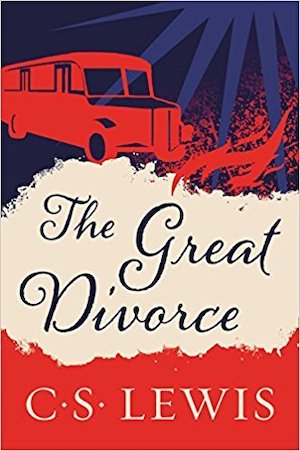
This week in Portland, Oregon, where I live, temperature records were broken multiple times. Portland, typically the home of mild, pleasant summers, was suddenly one of the hottest places on the planet, with the temperature in my back yard reaching 114 degrees Fahrenheit. I couldn’t help but wish for our more typical grey, rainy days. Which, as I sat down to write this article, seemed ironic given that Lewis doesn’t give us a burning Hell with flames and undying worms, but rather a soggy city with roofs that don’t keep out the wet and unpleasant, unhappy people waiting to board a bus.
“Who goes home?”
In other words, Who goes to Hell? Who goes to Heaven? Who gets in? Who’s out?
Is there such a place as Hell, really? Is Heaven real? Can a loving God send people to Hell? Can loving people truly enjoy Heaven if some of their loved ones are still in Hell? Is purgatory a thing? How does time work? Is love always good?
Those are just a few of the many questions C.S. Lewis tackles in this short book.
Lewis, we’re told, spent almost ten years reflecting on the thoughts that eventually came together to form The Great Divorce. The title is (as Lewis tells us in the preface) a reference to Blake’s The Marriage of Heaven and Hell, though it’s not meant to be antagonistic or even a direct rebuke of Blake, given that Lewis doesn’t “feel at all sure I know what he meant.”
But he does tell us right off the bat that the idea of Heaven and Hell being more or less the same thing, or that there’s never a definitive choice we make between the two of them, is the reason he’s writing the book: “I do not think that all who choose wrong roads perish; but their rescue consists in being put back on the right road.”
If you grew up in the churches I grew up in, you might expect that the pages to follow a statement like that would include a detailed description of exactly which road might be the right one, but Lewis doesn’t do that. Not exactly, anyway.
The story of the Great Divorce follows our narrator (who is, we will discover in time, Lewis himself) as he stands in line for a bus. There are a variety of unpleasant characters in the line, and the bus station is in a grey and mildly unpleasant city. Anyone who pleases can get on the bus—there’s plenty of room—and it is headed directly from this city on a supernatural journey to Heaven (sort of) and away from the city which is Hell (maybe). When Lewis arrives in the Other Place, he’ll be witness to a bevy of souls making decisions about whether to return to the grey city or stay in the pastoral paradise they’ve found themselves in.
Lewis eavesdrops on a variety of conversations, sometimes between the (maybe not) damned, and sometimes between those poor souls and bright, powerful beings which have come from the distant mountains. In time he’s joined by one of those beings himself…a sort of guide for his time, the author and minister George MacDonald, a figure of great importance in Lewis’s own spiritual journey.
The original title of The Great Divorce was, in fact, “Who Goes Home? or The Grand Divorce.” You’ll notice that every chapter seems, more or less, self contained. That’s because the book was originally serialized in an Anglican newspaper called The Guardian. Lewis was Anglican himself, and the chapters of the book were printed weekly starting in late 1944 and through early ’45. The first edition of the book itself was released in November 1945 as The Great Divorce: A Dream.
Lewis doesn’t hide the literary pedigree of this book at all. He makes it abundantly clear that the book is not meant to be taken literally as a statement on what he thinks happens after death. He goes to great pains to make it clear that it’s meant as visionary literature in the tradition of Dante and Bunyan (among many others).
Buy the Book

Comfort Me With Apples
As astonishing as it seems today, Lewis had been on the cover of TIME magazine three years prior to The Great Divorce because of the monstrous popularity of The Screwtape Letters. Walter Hooper and Roger Lancelyn Green, both friends of Lewis, say in their biography that this little book is “undoubtedly a maturer and more serious work than Screwtape.”
There is no question, certainly, that The Great Divorce is a heavier piece of philosophy, and the bits of humor in it are fewer and perhaps more pointed. There are some lovely bits of description, some striking images, and the characters—many of whom appear for a few pages and disappear again—are often compelling.
The literary references are constant. With a casual read there are overt references to Blake, Dante, Bunyan, Charles Williams, Lewis Carroll, Prudentius, George MacDonald, Emanuel Swedenborg, Augustine, Milton, Jeremy Taylor, an unnamed science fiction author (it’s Charles Hall, but Lewis couldn’t remember his name), among others. There are a lot.
And, as is often the case for Lewis, he assumes his readers will pick up on the various resonances and references that he makes less overtly. For instance, he wrote in a letter to William L. Kinter that, “the bus-driver in the Divorce is certainly, and consciously, modeled on the angel at the gates of Dis, just as the meeting of the ‘Tragedian’ with his wife is consciously modeled on that of Dante & Beatrice at the end of Purgatorio: i.e. it is the same predicament, only going wrong. I intended readers to spot these resemblances.”
Okay, I have to admit I didn’t quite get all that, even re-reading as an adult. I haven’t read Dante in detail in quite a while. Still, I did catch that MacDonald takes, essentially, the role of Virgil. But whereas Dante’s great tour of the infernal and celestial kingdoms shows him the results of choices that people made in their lives, Lewis’s tour shows him something quite different: the people making the choice itself, after their deaths.
So, there’s plenty to talk about here.
A few things to be paying attention to as you read:
- The centrality of human choice. You’ll notice that Lewis rejects a few theologies as he goes along, simply because they don’t give enough space for human decisions.
- Pay attention to how Lewis deals with the philosophical ideas of both love and time. They’re key parts of his argument.
- There’s a LOT of Platonic theory of archetypes as we move into the “realness” of almost-Heaven (no doubt partially due to Charles Williams’s influence… note the reference to butterflies, which is almost certainly a reference to Place of the Lion)
- There’s actually a decent amount of Charles Williams in this book… there are some striking similarities to Williams’s Descent Into Hell, and if you have the time to read that one, it’s an interesting comparison.
- There’s a quick scene with Napoleon that is often rewritten and misquoted these days to be Hitler. It’s interesting to read the scene and consider both that this was written late enough that Lewis could have easily made it Hitler, and to recognize that he consciously chose someone a bit more remote in history.
- Note the number of denizens of Hell who specifically reference being Christian. Lewis’s argument about who enters into Heaven is not based on whether they believe a creed (though do note the lengthy conversation with the Christian who doesn’t believe in God or a literal Heaven or Hell).
- Related: pay close attention to the reasons why someone might fail to enter the heavenly kingdom. While several stories connect in some way to “belief” most of them don’t. What keeps someone from entering the heavenly realms?
- There’s a fair bit of metaphor that’s fighting through “pastoral” vs. “urban” settings. There are some little wrinkles in it, but it’s an interesting thing to note.
- Lewis isn’t afraid to hold conflicting theologies, which is on display (and even pointed out) in this book
- Watch very carefully when the characters refer to “home” and where they mean when they say it.
- Note also, it’s a book about heaven in which neither God nor Satan make an appearance.
- And, just for fun, be sure to note that Lewis uses evolution to argue for one of his points in the preface, and also he manages to work in a reference to masturbation. Not exactly what I would expect of a 1940s Christian book!
In Mere Christianity, Lewis wrote that “[e]very time you make a choice you are turning the central part of you, the part of you that chooses…either into a Heavenly creature or into a Hellish creature.” Lewis believed very deeply that we choose who we become, and we choose what happens to us in spiritual realms. I, for one, find that deeply comforting in the world we find ourselves in today.
So as we read The Great Divorce, let’s keep that in mind: Lewis is saying we have a choice. It is ours, and no one can take it from us. One more thing to keep in mind, is how pedestrian Hell seems… how like our everyday lives.
This goes, I think, to one of Lewis’s deeper points: Perhaps we can make a choice today to embrace a better life.
 Matt Mikalatos is the author of the YA fantasy The Crescent Stone. You can follow him on Twitter or connect on Facebook.

I read about half the Narnia books as a kid (found them in my church’s library). But my high school English teacher gave me The Great Divorce as a random gift. She told me I would love it, and she was right. This was my real introduction to Lewis, and I can’t believe how non-Evangelical his theology is here, in retrospect.
Looking forward to this read-through!
The Charles F. Hall story that Lewis couldn’t remember was “The Man Who Lived Backwards” (http://www.isfdb.org/cgi-bin/title.cgi?970840). Trying to figure this out after reading TGD consumed several months of my life. Fortunately (for my sanity), Douglas A. Anderson’s collection Tales Before Narnia came out shortly after my search started, answering that question for me.
@2: Thank you for that info regarding the Hall story.
Hitler would have been too recent a monster to refer to in 1944, since he was living then, and Lewis’ book takes place in the (vague) present (and Lewis wished to present a character in hell who had spent decades in a cycle of blaming others). Napoleon fit the purpose well enough (Napoleon had long standing in Britain as a figure of evil). I’m reminded that Patrick McGoohan wanted to use Hitler as a reference in “The Prisoner” – but ended up with Napoleon too https://mbc1955.wordpress.com/2013/10/28/the-prisoner-episode-15-the-girl-who-was-death-discursion/
It’s a while since I read this, but my enduring memory from it is of the character Sally Smith from Golders Green – a very ordinary-seeming woman in life, not prominent or famous, but someone who just quietly did good, and now shines brightly in heaven.
Most of us don’t do spectacular things, and I really like that reminder that our day-to-day faithfulness matters too.
I’m so glad you’re reading and discussing this! This is pribably my favourite CS Lewis books, and your pieces on The Chronicles of Narnia were excellent, so I’m very much looking forward to your thoughts on it! While I’ve greatly enjoyed Dante (particularly Purgatorio), Inferno always feel vinductive and cruel to me; The Last Divorce comes much closer to how I think about heaven and hell and redemption. The idea that no one is denied heaven, they only refuse it, strikes a particular chord with me.
I definitely did not catch most of the references you mention (unsurprising, as I am completely unfamilar with Pridentius, Charles Williams, Jeremy Taylor, and Swedenborg), so I‘m loking forward to seeing you dig deeper into those as well.
I’ll say, starting out, that one of the differences that strikes between Lewis and Dante is that Dante has detailed categorizations of different sins (including purifucation from the Seven Deadly Sins in Purgatorio), whereas for Lewis in The Great Divorce there is almost only one sin that keeps a person from accepting heaven, and that is Pride. Some of them look like others (Avarice for the Economist, for example), but in the end that one and almost all the others boil down to wanting to be right, or not wanting to admit to having been wrong, or of needing grace or healing.
It’s the imagery I remember most from this story – the bus line, and the ‘hard’ river and the lizard. It is incredibly vivid.
The quote “[e]very time you make a choice you are turning the central part of you, the part of you that chooses…either into a Heavenly creature or into a Hellish creature” makes me think of that classical morality, the kind of Marcus Aurelius shape yourself philosophy which I think influenced a certain branch of Christianity. Very much like Little Women, where Jo especially spends so long wrestling with who she is and who she wants to become. Feels different from the nowadays ‘imagine X and it will be!” both in religion and popular culture.
I remember this story breaking down several ideas I had about heaven and hell. I’m looking forward to reading Matt’s thoughts on both!
@5,
There was at least one similar character let into Heaven in Kipling’s At the Gate, also a woman with ‘a long red list,’ who came in because she had been a nurse, and saved lives.
George McDonald turns up in The Great Divorce – which got me thinking about how many Scottish authors wrote allegories, but also a specific type of allegory. Basically the character is dead/dying and just doesn’t know it yet. The Great Divorce gets an honourable mention because Lewis was Ulster-Scots. More recent examples would be The Bridge by Iain Banks, but the big daddy of them all has to be Lanark by Alisdair Gray. It’s well worth checking out.
@5: See also Twain’s “Extract from Captain Stormfield’s Visit to Heaven” https://www.gutenberg.org/files/1044/1044-h/1044-h.htm which has moments like this:
Being a Christian who also doesn’t believe in heaven or hell, I tend to find myself on the works side of the equation. We should do what is good not out of hope of reward or fear of punishment but simply to follow the example of the Teacher who showed us how good the life the creator gave us can be. Heaven is a place on earth; likewise hell.
The dead can take care of the dead. We can not live for the next world – we can not abandon the pain and suffering of this world to a forlorn hope of a better life in heaven. No, instead I would rather live as if the atheists are right and that this world is all there ever will be.
We must live in the here and now, in the gladness and fullness of heart that being open to God’s love brings. We must open ourselves to the love that comes from all creation for God’s creation is the fullest expression of the that love that exists NOW for each and every person in the world.
Never forget that Jesus healed the eyes of the man born blind right there and then. He did not tell him how great seeing would be in heaven.
To do less than that in our own lives is the real sin. That’s the real hell.
@@@@@ 0 Matt Mikalatos
Lewis, we’re told, spent almost ten years reflecting on the thoughts that eventually came together to form The Great Divorce. The title is (as Lewis tells us in the preface) a reference to Blake’s The Marriage of Heaven and Hell, though it’s not meant to be antagonistic or even a direct rebuke of Blake, given that Lewis doesn’t “feel at all sure I know what he meant.”
I’m seldom sure what Blake is saying myself. Especially in his prophetic works.
But he says it wonderfully!
@@@@@ 0 Matt Mikalatos
The story of The Great Divorce follows our narrator (who is, we will discover in time, Lewis himself) as he stands in line for a bus. There are a variety of unpleasant characters in the line, and the bus station is in a grey and mildly unpleasant city. Anyone who pleases can get on the bus—there’s plenty of room—and it is headed directly from this city on a supernatural journey to Heaven (sort of) and away from the city which is Hell (maybe). When Lewis arrives in the Other Place, he’ll be witness to a bevy of souls making decisions about whether to return to the grey city or stay in the pastoral paradise they’ve found themselves in.
The Tibetan Book of the Dead consists of instructions for the departing soul. It begins optimistically. The soul first perceives the Clear Light of the Void.
A great soul welcomes the Light and enters into it.
A lesser soul fears the light and backs away. Thus dropping to a lower level of awareness. The Light of the Void is less Clear, but he is welcome to enter.
If that is still too much, he backs away again.
Eventually he drops to a level of awareness that does not terrify him. The spiritual condition he abides in shapes his next incarnation.
I doubt Lewis ever heard of the bar do thos grol. But it parallels his suggestion that the shades of the dead chose their postmortem condition.
@11
Thanks! I love that story and thought of it as I read Matt’s article.
This was the first Lewis book I ever read, suggested to me by the youth pastor in eighth grade, so it was (along with The Screwtape Letters) extremely formative for me. I’ve probably read it half a dozen times at different stages of my life, and there are parts I love and parts I have big problems with.
To start with, I remember in the line for the bus there being a couple who leave the line and seem more interested in each other. They could have any number of reasons, but about the only detail Lewis gives is that they seem rather androgynous, and as an adult, I’ve always gotten the impression that they were in some way not cis-het and that that’s why they’re not getting into heaven. Not an unusual opinion for the time, but definitely one I disagree with quite strongly.
I’ve been skimming the C S Lewis read/reread here (without doing the homework). Mostly, I am fascinated by the number of people who read the Narnia books as an explicit part of their religious upbringing. It never occurred to me that adults were handing them to kids for that purpose, because my experience was so completely different.
I was born in the 1950s (in Minnesota USA) in a sub-rosa atheist household. (Yes, that means my parents were vague and we kids were told not to talk about it because it might offend the normies. Try to put yourself into that headspace for an otherwise dull middle-class white family. We seemed so ordinary.) I started reading fantasy (beyond kiddie stuff) at about age 10, and Narnia was a favorite.
I was about 14 when someone told me the books were Christian allegory (I didn’t have the education to recognize it myself). I can still taste the heartbreak, 50 years later. I have tried to read them again, but they are spoiled.
Compared to other things that are read as Christian, it’s good that Lewis intended them to be so. I have many friends who are drawn to various older European belief systems. They (and I) perceive the history of Christianity to be one of repeated cultural appropriation.
An aside: If you want to see Christian cultural appropriation loud and proud, check out the LDS-sponsored “Polynesian Cultural Center” in Hawaii (although you may be a Christian whose tent doesn’t let in Mormons). I visited at age 18 as an anthropology student, and I lapped it up. I visited again at about age 55, and I had a completely different takeaway.
@@@@@ 17, nancymcc
An aside: If you want to see Christian cultural appropriation loud and proud, check out the LDS-sponsored “Polynesian Cultural Center” in Hawaii (although you may be a Christian whose tent doesn’t let in Mormons). I visited at age 18 as an anthropology student, and I lapped it up. I visited again at about age 55, and I had a completely different takeaway.
Another example of Pacific style Christian cultural appropriation is in the film Donovan’s Reef.
Come the Christmas mass, the Three Wise Men turn out to be The King of Polynesia, the Emperor of China, and the King of the United States of America.
Lewis had some very old-fashioned views about sex. I get the impression that for him the only legitimate use of sex was in a committed relationship open to the possibility of having children. In That Hideous Strength Jane is strongly criticized for using contraception and thereby thwarting God’s plans for the birth of a hero.
@19 I think in Mere Christianity, he explicitly says he doesn’t feel qualified to speak on contraception. I don’t know whether that was before or after That Hideous Strength, though I do remember that passage. Will definitely be interesting when we get to either of those books!
@kaci #16: That’s one of his flops, all right. The best I can figure out is that he couldn’t figure out why anybody would be queer in the first place unless it was to get a thrill from freaking the mundanes.
It’s possible to read it as “This particular couple is so into a performance of love that they completely missed their chance at actual love” without the “‘Ewww, cooties” implication, but I don’t think that was how Lewis intended it to be read.
@7: Oh, yes, the lizard! That’s the other image that’s stayed with me: the besetting problem that becomes a strength at last.
I read the Cosmic Trilogy, The Screwtape Letters & The Great Divorce all prior to Tolkien, and I was very fond of all three. I was raised in an Episcopalian (Anglican Communion) household where the ideas of hell, damnation, and even Satan were absolutely rejected by my liberal amillennialist parents. I have no memory of them being mentioned in church, either. Nevertheless, although I was already becoming an atheist, I was entertained by Lewis’ wit. I tried to read Narnia after having read Tolkien (twice), along with the Gormenghast trilogy, The Worm Ouroboros, A Voyage to Arcturus, and the first few volumes of the Ballantine Adult Fantasy series proper. I gave it a few stabs and abandoned it, and to this day I’ve been unable to read it. But I have SUCH fond memories of books like The Great Divorce.
@19: Jane is strongly criticized for using contraception and thereby thwarting God’s plans for the birth of a hero
Without going to look it up, and just dredging up my admittedly faulty memory, I don’t recall that contraception in itself was the issue, but her own expression of shallow ambition. While Mark is the one who is used to typify the pursuit of empty goals, Lewis merely hints at Jane’s, and deliberately refusing the opportunity for childbearing in order to pursue trivial and temporal ambitions is what he was criticizing.
@24 In the book, Merlin is very specifically upset with Jane for using contraception and not producing this hero that had been planned for generations. I also very much question whether “refusing the opportunity for childbearing in order to pursue trivial and temporal ambitions” is something anyone really has standing to criticize in someone else. The world doesn’t have any shortage of people, and while I’m certainly not going to criticize anyone for choosing to have kids, I also think choosing not to is a morally neutral decision. Whether someone’s other goals/ambitions are worthy ones is a separate topic, imo.
@25: 100% what you said.
I do also think it needs pointing out that while Merlin condemns Jane in very harsh terms, he’s not necessarily speaking for Lewis. Merlin is meant to be a man from the 5th century, with the virtues and vices of his culture, and he is wrong at other points in the novel. If any of the characters is Lewis’ avatar, it’s Mr. Fisher-King (aka Ransom), who tells Merlin he is being too harsh. (Merlin even says that Jane deserves to be executed for using contraception and not giving birth to the prophesied hero.) However, while Fisher-King says that Jane doesn’t deserve to die, he never questions the condemnation of contraception and voluntarily childlessness.
Matt, once you finish with Lewis, maybe a series on Charles Williams’ novels? I was obsessed with them as a teen (and had to haunt used bookstores to find them with no internet or Kindle to help me). I re-read them several years ago; many of them haven’t held up well, but then, I loved “That Hideous Strength” as a teen, and now … But not only was Williams important to Lewis, his depiction of “Powers,” both Christian and the Occult, moving in the world and having an impact on human affairs have echoes in current urban fantasy, such as Emma Bull’s “The War for the Oaks.” Most of the novels are super cheap on Kindle. I’d like to hear your take on them as well as the reaction of so many dedicated commentors.
@kaci and Christina: Oh, dear. Obviously I ought to have gone back to read that section in the book before I commented. My apologies for speaking out on a topic I misremembered!
@26 Christina: If any of the characters is Lewis’ avatar, it’s Mr. Fisher-King (aka Ransom)
However, I believe it is known that Lewis loosely based the character of Ransom on his friend, J.R.R. Tolkien—much to Tolkien’s annoyance!
@27/ Cheryl Washer. That’s a fun idea! I happen to have a really nice box set of Williams’s novels, which I can’t remember quite how I came to own.
@17/nancymcc. I visited the cultural center on my Honeymoon, as a matter of fact (I’ve been to Hawaii many times since I was a kid) and was really saddened by it.
The spiritual history of Hawaii, on the other hand, is incredibly fascinating. It’s actually something I’ve spent a lot of time researching and thinking about!
I recently re-read The Great Divorce, and it struck me how similar the Bus is to JK Rowling’s Knight Bus. I’ve read it a few times and I love the descriptions of the world of early morning before dawn, all dewy and fresh. I’ve also been inspired by the character of Sally Smith – an ordinary woman who treated everyone she met as though they were family and simply reflected glory – and by the lizard that turns into the stallion. The satire in TGD is delicious; the philosophy is confusing.