









Many of you will be familiar with the term “the fixed stars.” There are about 6000 stars1 visible in the night sky. Compared to other visible objects in the sky—planets, comets, satellites, incoming ICBMS—the stars appear motionless. However, there is a reason I sometimes post
STARS MOVE!
in large block letters. The reason is simple:
STARS MOVE!
Generally speaking, the stars in our neighbourhood orbit the Milky Way’s centre of mass in more or less the same direction. The catch is those phrases “generally speaking” and “more or less.” Stellar orbits differ; stellar velocities vary from star to star2 by ten or fifteen percent. In our region of space, stars in circular orbits travel at about 230 km/s3; therefore, we’d expect stars near the Sun to have relative velocities of somewhere between 20 to 30 km/s4, or to put it another way, from 1/15,000 to 1/10,000 the speed of light.
As footnotes 3 and 4 make clear, stars are clipping along zippy fast. Why do they appear fixed? Distance and angle. Even the closest stars are light-years away. As well, not all of the relative velocity will be transverse. Put those together and the time it takes the average visible star to move appreciably in the sky is centuries or millennia.
Actually, there are two more complicating factors.
The first is that the visible stars tend to be the exceptionally bright ones, because M, K, and G-class main sequence stars are too dim to be seen at great distances. For example, there are over 130 stars, white dwarfs, brown dwarfs, and sub-brown dwarfs/rogue planets within 20 light-years of the Sun, of which only about 20 are visible. In many cases, the visible stars are also far away; one number I’ve seen is that the median distance to a visible star is just under 200 light-years5—in a region of space where the average separation between stars is about five light-years. Because the average visible star is also far away, it takes longer for it to traverse a degree across the sky.
The other factor is that humans are slapdash biochemical assemblages that shudder into fragments in a handful of decades. Take Barnard’s Star, for example. Barnard’s Star is exceptionally close to the Sun and its velocity with respect to the Sun is exceptionally high. Therefore, its proper motion across our sky is incredibly fast… so incredibly fast it traverses a full degree in only a little under five human lifespans6. Unless there’s some group of humans documenting and recording stellar positions, we’d never notice the stars move. Thus, the notion that the stars are fixed.
Nevertheless, the stars do move with respect to each other. Two stars might find their relative positions differing by a light-year over only the length of time since the invention of the Folsom point.
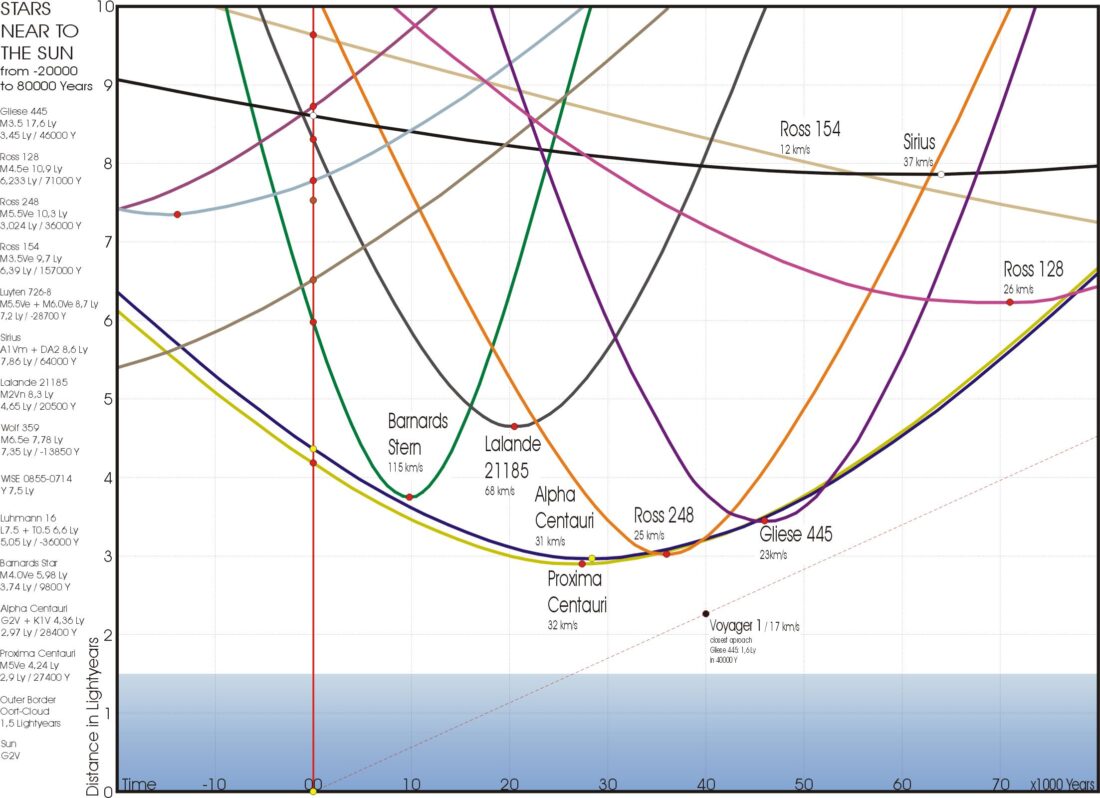
This fact has some interesting implications. Among them, that while Alpha Centauri may be the closest star right now, it wasn’t always, nor will it hold that position for long7. Relative stellar positions evolve over surprisingly short timescales8 and stars have and will come much closer to us than Alpha Centauri’s current four-and-a-bit light-years.
For example, just seventy or eighty millennia ago, Scholz’s Star came within about a light-year of the Sun. No doubt this would have been pretty impressive to our ancestors if only Scholz’s Star weren’t so dim as to be invisible to the unaided eye even when it was on our doorstep. The close encounter had no appreciable effect on the planets of our solar system, but it may have perturbed some Oort cloud comets and dropped them towards us. Something to worry about…in two million years when the comets finally arrive.
More dramatically, Gliese 710 has essentially no traverse velocity, which is to say it is aimed directly at us… almost. That “almost” means it will probably miss us by 10,000 AU or more. Still, close enough9 that even though it is much dimmer than the Sun, it will be brighter than Sirius currently is. Furthermore, its movement across the sky will be noticeable even over so short a time as a human lifespan. What an astonishing sight it will be… in 1.3 million years.
Have I mentioned the universe does not use timescales convenient to humans?
Still, SF is full of galactic polities that last thousands or even millions of years. For such states, the distances between systems will be ever changing, mandating a never-ending process of updating star maps.
So please remember, when writing about such entities, that STARS MOVE.
- Or there were, prior to light pollution masking many of them. ↩︎
- With some exceptions, such as stars whose orbits around the galactic centre of mass are highly eccentric, stars that were violently ejected from their systems, remnants of cannibalized galaxies in retrograde orbits, and so on. Why so disordered? The Milky Way is thought to be just under 14 billion years old. It’s only rotated about sixty times since formation, not enough time for gravitational interactions to merge or eject stuff with weird orbits, plus it is still young enough for new systems to form, age, and die in messy ways. ↩︎
- Non-metric users: That’s about 6,000 times faster than Nolan Ryan’s best fastball. ↩︎
- Non-metric users: That’s about 5 to 8 trillion times as fast as hair grows. ↩︎
- Non-metric users: A light-year is about 2×10^17 times the length of your appendix. ↩︎
- Barnard’s Star’s proper motion is high enough that we’d expect the keen-eyed astronomers of the distant past to have noted it… if Barnard’s Star weren’t so dim that it was not documented on photographic plates until the 19th century, and not characterized by Barnard until 1916. ↩︎
- So, if you’re setting your story a billion years hence, don’t mention that Alpha Centauri is still the nearest star. There’s only a 50% possibility that it will even be on the same side of the Milky Way by then. ↩︎
- Too bad that you’ve made the lifestyle choice to belong to a species that only lives 70 or 80 years. Unless I have readers I don’t know about. ↩︎
- Gliese 710’s relative velocity to the Sun is fairly low, so not only will it be close enough to affect the orbits of comets in the Oort cloud, it will have lots of time in which to do so. As previously mentioned, it takes about two million years for distant Oort cloud objects to fall into the inner system, so we can ignore this possibility for 3.3 million years or so. ↩︎

A more convenient measurement to Alpha Centauri:
2.3905e+16 Smoots.
… plus an ear, no doubt.
An odd coincidence: assuming Niven’s Ringworld has the usual relative velocity wrt the Sun, the system it is in could have been right next to Sol when it was built.
In one of the Foundation stories, a character (Ducem Barr, maybe?) uses the fact that stars move; he claims that his star charts are old enough that he’s a bit lost when he arrives in an inner sector of the Empire.
Having just re-read the Foundation series, I was going to use the example in Foundation’s Edge where Trevize proves the legends of Gaia must be of recent origin because they refer to a constellation in the form of a regular pentagon which would only have achieved that shape in the previous century. Asimov may have underestimated the actual timeframe for such an effect (he gives actual numbers but I haven’t checked to see if they make sense), but at least he used it.
The time frame might be shorter if the planet observing the constellation was closer to the galactic center than we are, since the stars closer in would be closer together and would orbit the galactic center faster, so they’d presumably change sky position more rapidly than they do out here in the mid-disk.
It’s even more complicated than that! If he uses his current observed positions of his target stars, light travel time makes their positions outdated. A star 1000 light years away would be off by 1000 year’s worth of motion if he were to instantaneously go there. A finite travel time compounds that difference!
The change in angular position of nearby stars against the more distant stellar background (so-called “proper motion”) was discovered by Sir Edmund Halley (of comet fame) in 1718 when he compared the positions of some of the brightest stars to those recorded by Hipparchus, circa 130 BCE. This gave Halley a baseline of about 1850 years of stellar movement.