






I didn’t read any romance books growing up. Or at least, not anything that would today be categorized as Romance, with a capital R. As an immigrant child I mostly read books chosen for me by my parents, who were keen to make sure I retained the language we spoke at home and who didn’t always have a lot of available books to choose from, in the pre-digital age.
I did read a lot of science fiction and a lot of historical fiction, among other things: Asimov, Sheckley, Bradbury, Dumas, Sabatini, Jules Verne (all of whom I read in translation). In almost every genre, works by male authors tend to be considered the “classics” and “mandatory reads,” so perhaps that was why I read relatively few women authors. And perhaps that’s why now, as an adult, it’s particularly glaring to me that books categorized as Romance, overwhelmingly written by women, are so often shunned from the spotlight of mainstream SF/F, no matter how many science fiction or fantasy elements they contain.
So, let me tell you about KJ Charles, an author you should check out if you haven’t already, if you enjoy fantasy books.
In my experience, people who’ve read at least two of Charles’ books (she’s published about twenty of them) have a tendency to then read extensive swaths of her backlist. Her novels provide something rare in the literary market even today, in 2018: well-researched historical, fantastical fiction that features love stories between queer people.
Genres are flawed, porous constructs, and many stories live in between the established categories or straddle several of them, which doesn’t make a bookseller’s job very easy. The reason we recommend a book by saying “it’s X genre” is that it’s a shortcut to saying: “it’s the sort of thing you like.”
So, to be clear, if we had to pick just one box to put Charles’ books in, that box would read “Romance” with a capital R. The focus of the stories is always a relationship between two people, and that relationship ends happily, for various values of “happy,” every time. But many books that are considered primarily SF/F are also centered on relationships, and many of those relationships also end happily—for example, Jacqueline Carey’s Kushiel’s Dart, Zen Cho’s Sorcerer to the Crown, and Gail Carriger’s Soulless (the last two even take place in settings similar to Charles’).
Buy the Book
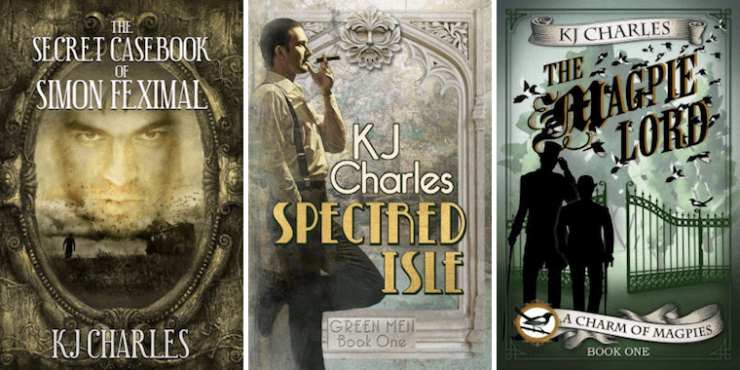
The Secret Casebook of Simon Feximal
The Secret Casebook of Simon Feximal is a pastiche/tribute/alternative universe version of Sherlock Holmes, an ever-popular form of reinventing the cultural canon. (It’s been most recently explored in SF/F by Claire O’Dell in A Study in Honor and Aliette de Bodard in The Tea Master and the Detective.)
Simon Feximal is a somewhat gruff, eccentric but brilliant ghost hunter at the very end of the 19th century in London. His main aim is to help people, and he frequently saves them from mysterious, unexplained spells of bad luck, or solves bizarre murder cases, but you wouldn’t know it from his introverted nature. Robert Caldwell is a journalist who initially meets Feximal when he needs help with a haunted mansion that Caldwell inherits from a distant relative. After a few other run-ins, they begin a relationship that lasts for over twenty years. Caldwell, forced out of his original career, becomes Feximal’s chronicler, writing stories about his exploits much the same way Watson did with Holmes.
But Charles’ book isn’t a collection of those stories. Instead it’s the “secret” casebook, the one Robert Caldwell was unable to commit to print and ordered be published only after his death, containing the censored bits, missing scenes, and subtext made explicit from a fictional larger body of work. In Charles’ book, Caldwell can finally express the real truth of his life: that he solved supernatural mysteries not with his dear friend but with his lover. That they lived in the same house not because it was convenient, but because they were a couple.
While the book begins as a very obvious Sherlock Holmes pastiche, it also builds a supernatural world—in a way, it’s as if all the red herrings in Sherlock’s cases that pointed to spirits and spells and ghosts were real in this universe. Feximal’s backstory is quite different from Holmes’: adopted as a boy by an occultist who already had a daughter, he and his sister were subjected to cruel experimentation that left them with different superpowers. One of Caldwell’s “censored” stories concerns tracking down Feximal’s “father,” barred from further occult business, and begging for his help in saving Simon’s life.
The price for this help requires Caldwell to make sacrifices, and one of the conditions is that Feximal and Caldwell have to be in close proximity to each other for the rest of their lives. But of course, forcing the two together isn’t really a punishment—something no one realizes and works to the heroes’ advantage.
Charles often uses the fact that gay people had to hide much of their lives in 19th century England to complicate her plots and demonstrate how secrecy and cultural erasure could occasionally be a blessing…but often were a curse.
Buy the Book
Spectered Isle
In Spectered Isle, Charles returns to the same universe, now an England dealing with the aftermath of the first World War, in which the government forced occultists, including women and men too old for the draft, to aid in Britain’s war effort. In the supernatural arms race England lost the vast majority of its “powerful” people, after too many summonings of unnatural forces have shredded the veil separating our world from the beyond. While in Feximal’s stories ghosts are rare and difficult to summon, in Spectered Isle England is teeming with supernatural activity and many things that shouldn’t be possible, or were never possible before, suddenly are.
The changes reflected in the post-war social order, with many noble families losing their fortunes and England undergoing a social shift, also affect the occult world. Having brought occultists under government control in the name of king and country, Whitehall now wants to consolidate that power and reform the occult world, turning a network of unofficial connections into a centralized government office that handles occult business and tells everyone what to do.
At the center of this attempted power grab are two traitors. Randolph Glyde, scion of an ancient English family that’s produced the guardians of various English sites of supernatural power and protection (such as Camlet Mote) for many centuries, and Saul Lazenby, an Oxford archeologist and former soldier.
Glyde abandoned his family at the end of the war and refused to aid in further occult warfare; after their deaths, he ends up carrying all their collective supernatural responsibilities by himself. Lazenby was stationed far from home and had a secret affair with a local man who then passed on information about Lazenby’s garrison to the Ottomans who wiped them all out. Lazenby, the only survivor, was dishonorably discharged, spent two years in prison and returned to an England where no one would hire him to so much as sweep the streets.
Spectered Isle introduces the Green Men, a collection of people with supernatural powers, some inherited and some thrust upon them, who attempt to sort out their own lives and priorities while attempting to protect England from everything from fen-grendels to vastly powerful, vengeful spirits bent on destroying London. These include soldiers who endured experimentation during WWI and have become “abominations” (complete with occasionally appearing tentacles) as well as Feximal and Caldwell’s adopted children, who are either born with abilities or acquire them to help carry on the cause.
The wonderful thing about Charles’ writing is that it’s grounded in a very mundane, well-researched atmosphere, where British society is complex and layered and the weight of history is felt throughout. But at the same time her stories are whimsical and cheerful, dealing with people who’ve been through terrible things but still find a way to carry on, reconciling not only their secret superpowers but their queerness with the social norms of the age.
That said, if you’d like a world less about ghosts and mythological creatures, preferring one that deals with more “proper” magic and its politics and philosophy in the style of Jonathan Strange & Mr Norrell, there’s always Charles’ other supernatural universe, the Charm of Magpies series.
Buy the Book
The Magpie Lord
Published in 2013, it’s difficult not to see the influence of Susanna Clarke in the first book, The Magpie Lord, in particular. In this universe some people are born with magical abilities which are broadly connected to natural elements, like being able to manipulate air or water. But magic is also a craft that can be learned and honed, and has been known to the government forever. The legendary practitioner known as “The Magpie Lord” codified its use and established a magical “police” called the justiciary to work as part of the government, keeping an eye on magic users to make sure that their powers don’t cause serious harm.
The exploration of this universe across the five books of the series (as well as several free short stories and one novella) deals with questions about how powerful but extremely rare magic users should be handled. The first few books focus on justiciar Stephen Day, whose family was ruined by their association with a powerful noble who held a terrible grudge. Stephen considers himself a competent magic user who’s spent a long time studying and perfecting his craft, but his job as a magical cop feels like a daily uphill battle. The department is barely budgeted and the job requires frequently risking his life and hoping he’s stronger than other, often far more privileged practitioners.
In Stephen’s eyes, the justiciary is the country’s only line of defense against people who have enough money to be tempted by absolute power, who can use their magical abilities to take over the government or subjugate innocent people. As magical energy always has to be drawn from somewhere, practitioners are forever tempted to draw it from ordinary humans, in a sort of cannibalism that eventually does end with the victim wasting away to nothing.
In later books, however, other protagonists offer a very different view. Jonah Pastern, who first shows up in Stephen’s stories as a clever antagonist and later gets his own narrative, was an orphan boy with the ability to manipulate air and therefore essentially fly. He was found early by the justiciary, who turned him over to a couple of practitioners who were supposed to teach him better control over his powers and bring him into the larger magical community.
Instead, his foster parents used Jonah as unpaid labor and never bothered to educate him at all. Coupled with the fact that he was illiterate (and, it is implied, dyslexic), there was no recourse for him, as was the case for many orphan children in the late 19th century who found themselves with no social safety net beyond the kindness of strangers.
Jonah eventually builds a life for himself, but that life is predicated on stealing and conning people using his powers—something that eventually attracts the justiciary’s attention. Since Jonah is now an adult, the justiciary opts for punishment rather than reform. Jonah’s sentence is that his Achilles tendons will be cut, “hobbling” him in both the magical and the physical sense.
The person on Jonah’s trail and eager to administer the punishment? Stephen Day. In the eyes of someone who comes from the opposite of privilege, Stephen appears to be a terrifyingly powerful practitioner who’s used to acting as judge, jury, and executioner. All Stephen has to do is consult a few colleagues, for example his boss Esther Gold, to decide someone’s fate. Since magical powers are so rare and the Magpie Lord gave justiciars absolute authority (as an alternative to practitioners avenging their own grievances or dispensing mob justice) the government is content to let people like Stephen decide who should be injured for life, and who should be killed.
Buy the Book
Rag and Bone
In Rag and Bone, we find another part of the puzzle: a practitioner named Crispin who was unwittingly the apprentice of a warlock—a practitioner turned “cannibal”—and now that his master has been killed by the justiciary, Crispin’s fate is in question. If he can prove that he can use magic productively, as it should be used, before Stephen Day retires and Esther Gold goes on maternity leave, he can be released into the world. If not, he’ll likely be executed.
Crispin’s boyfriend is Ned Hall, a Londoner of African descent, and together they have to save the city while the justiciary is busy with bigger problems. It serves to further underscore how much the magical community is terrible at taking care of vulnerable people—perhaps even more so than the British government, because it’s forced to operate in secret. Terrible things can happen to someone when keeping their essential nature from the population at large is a major priority. That’s true for magic as it is for queerness.
In this series in particular, Charles constantly underscores how the need to maintain secrecy could often complicate an otherwise uncomplicated life, or make a tricky situation untenable.
For example, Stephen Day’s partner is Lucien Vaudrey, the new Lord Crane, unknowingly a descendant of the Magpie Lord himself, though born without any magic capabilities, who spent most of his life in exile in Shanghai as his father’s disappointing second son. One of the ways to transfer magical energy is through bodily fluids. And as Crane is an enormous source of such energy, being a descendant of the Magpie Lord, Stephen quickly starts drawing more and more of it simply by having sex with him regularly. This presents a problem, as Stephen’s justiciary colleagues notice the change and wonder where his immense power is coming from. If relationships between men weren’t illegal, Stephen could publicly explain what was happening. But as it is, Stephen has to keep the relationship secret and get into further and further trouble, as suspicions about him being a warlock begin to mount.
Charles’ books blend history and magic in relatively unusual ways for mainstream SF/F. The focus on queer relationships allows her to highlight how systems of oppression can sometimes be “beneficial” (in giving the protagonists a secret no one knows about, something their enemies don’t anticipate), but mostly complicate magical lives and make everything more dangerous in a setting that’s firmly grounded in real history.
So, why isn’t Charles better known in SF/F circles? Maybe we don’t always have to pick a single box to put a story in. Maybe we should make room and try stories that use the tropes of our genre even if they’re primarily capital-R books. Maybe now that you know more about KJ Charles, you’ll check out her work? But even if you don’t, or you find that it’s not to your liking, I hope I’ve at least introduced you to a different kind of fantasy than what you’re used to.
Marina Berlin is an author, poet and media critic who grew up speaking three languages in a city by the sea. Her writing has appeared in Vice, IGN, The Los Angeles Review of Books, Strange Horizons, and other venues. You can read some of her stories and poems on her website or read her opinions about your favorite book/movie/TV show on Twitter @berlin_marina.

Thank you for this excellent investigation of one of my favorite authors! Two little corrections: Feximal’s last vowel is an A, and Stephen Day’s lover’s name is Lucien Vaudrey, Lord Crane.
Typos corrected–thanks!
Three guesses, one word, starts with “h”, rhymes with “tomophobia”.
But thanks for covering these. I loved the Charm of Magpies series.
^^^What @crane said above. Also utterly absent is author Anna Butler’s space opera series that starts with Gyrfalcon and whose fifth and final book was published this year. Its protagonist is a bisexual man who has a long-term affair with a woman and whose true love is a man. Too gay for straights, too straight for gay men, it’s sad to see it erased from the general SFnal conversation.
I agree with @crane and will add that SFF is reeeeeeally resistant to admitting that SFF romance, of any variety, is part of the genre. I’m so excited to see Tor featuring KJ Charles’s work — I love her worldbuilding so so much.
I’m a big fan of Charles for historically-grounded, relationship-based stories. Since many SFF fans also like straight historicals (“straight” in the sense of no fantastical elements, not “straight” in terms of sexuality, which they are not) you might check out her other series and standalone books as well as the ones reviewed here. I’m especially fond of The Society of Gentlemen series for it’s straightforward look at class issues as well as romance, and Think of England for spies along with its romance, and Henchmen of Zenda for a swashbuckling alternate view at an old favorite.
We must include Henchman of Zenda, a perfect example of the historical pastiche, turning the Prisoner of Zenda, a book which I love despite its incredibly old fashioned nature and serious flaws, into an enormously more fun book from the inside out and with a vivid romance at its heart.
What @3 and @5 said. Romance is still seen as something lesser, less serious, something to be sneered at. It doesn’t only effect Charles: Jordan L. Hawk’s Whyborne & Griffin series – excellent historical fantasy – A.M. Daily’s post-apo sci-fi in the Lacuna Chronicles, the aforementioned Anna Butler, the dystopic techno-thrillers of Manna Francis’ The Administration series (okay, those can be bit depressing to read in the current political climate)… ETA: also Jenn Burke’s and Kelly Jensen’s Chaos Station series, military sci-fi/space opera.
There are so many good contributions to SFF that get erased because they focus on relationships and feature *gasp* more or less explicit queer sex.
i love KJ Charles. Really fun and engaging reads. I also grew up in a former Soviet Union household so gay romance was out of left field for me, but I love it. I even got my mom to read it! She grew up in Soviet Union, so for someone like her to be open to reading erotic scenes involving two men is just unheard of. And I do get frustrated with my husband because he definitely thinks what I read is not sci fi and I told him , believe me I’ve read way more sci fi than you ever have.
I adore KJ Charles’s writing, if for nothing else than the explicit consent twined through all the narratives. The lovely magic, focus on historical accuracy, fully fleshed (heh) characters, and wonderful dialogue just add to the fun.
To add to the list of queer Romances SF/F fans would appreciate, I add Daughter of Mystery, The Mystic Marriage and Mother of Souls (novels) as well as “Three Nights at the Opera” (short story) and “Gifts Tell Truth” (Novelette) by Heather Rose Jones. Her Alpennia series has incredible worldbuilding, all kinds of different relationships between women, and my favorite genre–Fantasy of Manners.
Bujold’s Sharing Knife series gets overlooked a little because it’s a romance as much as a fantasy.
@noblehunter Sharing Knife was my first Bujold. Now she’s one of my favorite authors.
Some additional suggestions for queer SFF romance:
Verania series by TJ Klune (comic fantasy)
Gravitational Attraction by Angel Martinez (space opera)
Tournament of Losers (or anything else) by Megan Derr (high fantasy, urban fantasy, etc.)
Rescues and the Rhyssa by TS Porter
I love KJ Charles! In addition to the strengths noted above, her style is note-perfect. So many people try to write Holmes pastiches without being able to control their syntax, but she never stumbles.
Seconding the rec for Heather Rose Jones and Alpennia. Ruritanian politics, romance, and excellent worldbuilding–her use of music as a channel for magic is very cool.
Thanks for mentioning Anna Butler. I’d never heard of her, but I’m going to check her out!
@12 The worst part of Sharing Knife is every time I listen to it, I want to write the same sort of thing but gayer. Nothing like aspiring to match one of the most decorated authors in SF.
ugh, y’all are just adding to my already huge TBR pile as i haven’t heard of any of these! buut, lynn flewelling’s nightrunner series for elves and thieves with a tiny thread of romance between the two main characters, and saber and shadow by sm stirling and shirley meyer for fantasy romance
I didn’t read “Romance” until I was in my twenty’s. It started with some historical fiction by Catherine Coulter and J.D. Robb the future NYC mysteries by Nora Roberts. I did add a few Daniel Steel’s because I wanted to see what the Lifetime movies left out. I also got into Paranormal Romance and a read several different series in that genre. These will be added to my series I should check out after I move list.
Thank you for the tip! I hadn’t read Charles, but I’ll pick up a copy at Powell’s when I visit this Christmas.
The Ha’penny series by Jo Walton is a magnificent alternative history featuring gay protagonists. I wouldn’t call it a romance exactly, but there is a deep love story mixed with detective story and revolution against a Britain that collaborated with Nazis instead of fighting them.
I’d also say that if you read and loved C L Polk’s Witchmark (which blended history, fantasy, and queer romance), many of the books mentioned here likely will be enjoyable reads.
I’m thrilled to see Tor and other mainstream SFF publishers becoming more open to LGBTQIA content.
Six years ago, I couldn’t even sub a M/M space opera to Tor, and no agents would look at it. I found other outlets, but it’s great to see the Big Five stop ignoring queer content. It’s always been there (Diane Duane, Jane Fancher, and Melissa Scott come to mind) but many mainstream readers ran off when there was a hint of non-straight Romance.
I absolutely LOVE capital-R SFF. Totally unashamedly and simply because it’s about the only place I can see LGBTQ SFF of any kind.
Incidentally, Lord of Magpies popped up in my Amazon suggestions last week… you can probably guess where I’ll be for the next couple of days!
Why have I not heard of this author? Putting this on my Christmas wishlist, thank you!
Also, since someone mentioned Sherlock Holmes pastiche: everyone stop what you’re doing and read The Warlock Holmes series. You can thank me after.
A couple years ago, I picked up The Magpie Lord on a whim, and I ended up reading it in one sitting. I then devoured Charles’s backlist (shorter than it is now, but still a hefty amount of books) in maybe three days. Which is something I don’t ever do. I absolutely think she’s one of the best writers out there right now, from her characterization, to her prose, her dialogue, her plots. It’s great to see her work highlighted here.
(As for other queer fantasy, someone above mentioned it but I kind of grew up on Lynn Flewelling’s Nightrunner series & while they didn’t quite hold up to a reread as an adult the way I remembered them, I have to recommend them)
Nightrunner, check. Warlock Holmes, check.
I love queer f/sf, but I steer clear of female writers who write in the m/m romance genre. I’m by no means a hater – readers should enjoy whatever they enjoy – but I find those books patronizing and offensive on several levels. Gay men aren’t pets for women to idealize and fantasize about, for one thing, and real queer relationships are rarely based on the butch/femme heteronormative roles so common in romance fiction. Also, all the m/m fiction I’ve seen gets the sex wrong. Really, really wrong.
That said, I certainly have read female writers who “get” gay men. Pat Nell Warren is the classic example, but Bernardine Evaristo’s Mr Loverman was also a lovely book.
My question is: which camp does Charles follow? Are her queer characters objectified and sexualized for the titillation of a mostly female readership? Or is an attempt made to craft recognizable human chracters who are also queer?