






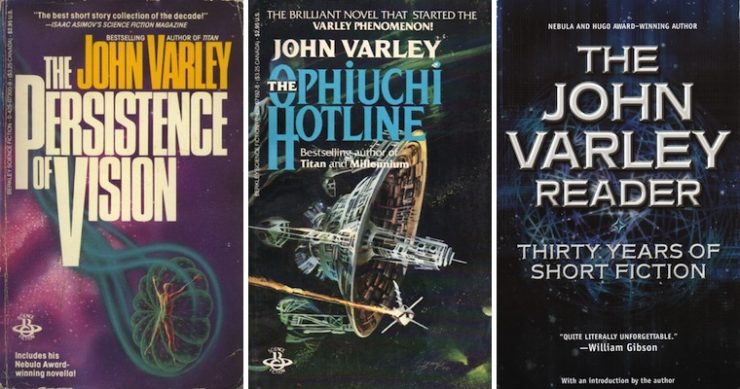
Between 1974 and 1980, John Varley wrote thirteen stories and one novel in the classic Eight Worlds setting. These worlds do not include Earth, which has been seized by aliens. Humans on the Moon and Mars survived and prospered. Humans have spread across the Solar System (with the exception of alien-owned Jupiter and Earth). The human past has been marked by a calamitous discontinuity (the Invasion and the struggle to survive the aftermath), but their present is, for the most part, technologically sophisticated, peaceful, stable, and prosperous.
Peace and prosperity sound like they’re good things, but perhaps not for authors. What kind of plots can be imagined if the standard plot drivers are off the table? How does one tell stories in a setting that, while not a utopia, can see utopia at a distance ? The premise seems unpromising, but thirteen stories and a novel argue that one can write absorbing narratives in just such a setting. So how did Varley square this particular circle?
The thirteen stories are:
- “Beatnik Bayou”
- “The Black Hole Passes”
- “Equinoctial”
- “The Funhouse Effect”
- “Good-bye Robinson Crusoe”
- “Gotta Sing, Gotta Dance”
- “In the Bowl”
- “Lollipop and the Tar Baby”
- “Options”
- “Overdrawn at the Memory Bank”
- “The Phantom of Kansas”
- “Picnic on Nearside”
- “Retrograde Summer”
The lone novel was The Ophiuchi Hotline.
Let’s start with the outlier:
“The Black Hole Passes” is a human-versus-nature tale. Given that humans are forced to live on worlds that would kill them deader than doornails if their machines break down, you might expect that such perils would be common plot points. They are uncommon, however, because Eight Worlds’ technology is very, very good. The null-suit in particular is an all-purpose protection. A null-suited Eight Worlder can wander on the surface of Venus as if it were Algonquin Park . This story explores the uncommon case of an event that could kill an Eight Worlder (and worse, play havoc with his love life).
“Options” is also an outlier in that it’s set in a time when the ability to switch between male and female bodies cheaply and conveniently has become the New Thing. Rather than exploring a world where such procedures are a commonplace choice (Varley does that in the other Eight World stories), it explores what happens immediately after the introduction of a socially disruptive technology.
One might think of The Ophiuchi Hotline and “The Phantom of Kansas” as crime fiction. In the first, the protagonist is snatched from the brink of execution because a criminal mastermind (who believes they are the saviour of mankind) wants to recruit her for their organization. In the second, an artist wakes to discover he has been murdered, not once but several times. Cloning + memory records permit serial incarnations, but all the same, our hero would prefer not to be murdered again. He needs to find out who’s doing the killing and why.
Both “Beatnik Bayou” and “Lollipop and the Tar Baby” address the theme of inter-generational conflict. In “Beatnik,” a teacher-student relationship goes sour; in “Lollipop” a child gradually realizes that their parent does not have their best interests at heart. One could make a case that Lollipop belongs in the crime category (or that I should learn how to use Venn diagrams), except I am not sure the scheme is illegal. It might be marginally legal.
Artistic differences drive the plots of “Equinoctial” and “Gotta Sing, Gotta Dance.” Aesthetic disputes may seem harmless enough…but consider the Paris reception of Le Sacre du printemps. Removing issues like hunger or housing doesn’t make passion vanish. It just changes the focus of passion.
What drives a surprisingly high fraction (almost half) of the classic Eight Worlds stories? Holidays. Wealth and leisure mean having time to fill. If there is anything that the Eight Worlders love more than tourism, it’s getting into wacky complications thanks to their travels. “The Funhouse Effect,” “Goodbye, Robinson Crusoe,” “In the Bowl,” “Overdrawn at the Memory Bank,” “Picnic on Nearside,” and “Retrograde Summer” all involve tourism.
SF authors seem to prefer plots in which survival and safety are at stake. Those are the first two needs in Maslow’s hierarchy of needs (physiological, safety, love/belonging, esteem, and self-actualization).
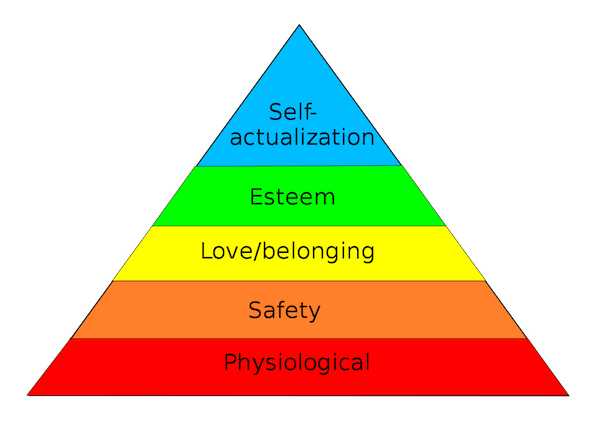
Those needs are the base of the pyramid. If you don’t satisfy those, you cannot meet any of the higher needs. If your plot hinges on those basic needs, you’ve got high stakes and possibly a gripping narrative.
Varley, though, has imagined a world in which survival and safety are rarely at stake. His characters need love, esteem, and self-actualization, and suffer if those are lacking. He is a good enough writer to have turned those needs into absorbing narratives. This isn’t a common choice: consider, for example, Banks’ Culture novels. Although the Culture is a utopia, Banks hardly ever set his stories there. Instead, he preferred stories set outside the Culture, stories that often involve Special Circumstances. It is easy to write about citizens of utopias if they head outside the utopia to have fun. Varley’s choice is a bold one but the resulting classic Eight World stories stand as examples of how a writer can overcome the handicap of having set their stories in a nightmarish future of peace and prosperity.
Not many authors have duplicated Varley’s feat in the classic Eight Worlds stories. But a few have. Who? Well, that’s another essay.
1: Why aren’t the Eight Worlds a utopia? In my opinion, widespread illiteracy is a minus. Also, adults perving on tweens is both frequent and accepted, something I would like to encounter in SF a lot less frequently than I actually do.
2: Even close approaches to the Sun are survivable. Null-suits are reflective. They do diddly-squat about gravity, however, so try not to fall into any black holes.
In the words of Wikipedia editor TexasAndroid, prolific book reviewer and perennial Darwin Award nominee James Davis Nicoll is of “questionable notability.” His work has appeared in Publishers Weekly and Romantic Times as well as on his own websites, James Nicoll Reviews and Young People Read Old SFF (where he is assisted by editor Karen Lofstrom and web person Adrienne L. Travis). He is surprisingly flammable.


Nice overview James! I loved The Ophiuchi Hotline when I read it and only not being a short story fan has kept me from checking out the short stories. I know there is some subtle (or perhaps not so subtle) discrepencies, but do you not also consider Steel Beach and The Golden Globe as part of the eight worlds series?
Hmmm… there are 2 more not quite 8 worlds novels ‘Steel Beach’ and ‘golden globe’ but because they are not quite the same universe, the intense irritation in the reader thus engendered makes it difficult to say if they are any good or not!
“Irontown Blues” is going to be out in a few weeks, so it’s nice to be talking about Varley.
There are enough differences between the original run of stories and the Metal Trilogy that I find it’s useful to think of them as similar but different settings. 8W, V2 has a lot more focus on existential threats than V1 did, for example. If brain-taping and cloning are a big part of the Metal trilogy, I don’t remember it (I think an unsuccessful example pops up in Steel Beach.). And Anna-Louis Bach is now an Eight Worlder, even though her setting and 8W, V1 are incompatible from details of history to the technology available. Bach isn’t old enough to be pre-invasion but in Bagatelle, contact with Earth is commonplace (plus one of the primary assumptions of the Bagatelleverse is fusion never works out but cheap breeder reactors do, with a side-order of “fissionable materials easy for terrorists to get their hands on.”
3:
It’s almost as though someone wrote a review of Irontown Blues and wanted to provide context….
Thank you for the overview, James. I’ll have to add this series to the reading list for my For Your Safety stories.
@@.-@:
I’ve always felt that the Anna-Louis Bach universe were spiritually part of the same universe as the 8 worlds stories (just set in the past before the aliens came and destroyed Earth). Even if the historical details don’t quite jibe, they feel very similar.
Really? The ALB stories struck me as much more pessimistic than the 8W.
The Bach stories really are very similar in tone, call them v0 of 8w. The Barbie Murders in particular is about the same things as the later ones.
“A word about Anna-Louise Bach. She is not actually a part of the Eight Worlds stories. Some critics have assumed she is, and I suppose she might somehow fit in between today and the alien invasion, in a time when we have established large cities on the moon but before the time, two hundred years or so from today, when the bulk of the Eight Worlds stories take place. But I never thought of her that way.
No, it was simply a matter of every once in a while I would come up with a darker story idea. A situation the police should handle. The Eight Worlds is a semi-utopian environment—and by that, I mean not perfect, because I don’t believe in such a thing, but a place and time that is better in many ways than the world we have today. So when I had a story that was too nasty for those rascals in the Eight Worlds, I handed it to the unfortunate Anna-Louise. Thus I created her career, in no particular order, through half a dozen stories from her days as a probationary patrolwoman up to the chief of police of the Lunar community of New Dresden. Several of them are in this book, including one rescued from a state of suspended animation.”
The John Varley Reader, intro to The Barbie Murders
And yet I deny that the author knows what the hell he actually wrote, because it’s hard to distinguish this from a pre-Invasion moon with similar tech trajectory, *and* we know that Varley made the v2 setting because he couldn’t remember what he’d done in v1.
IIRC there was a letter in Galaxy from Varley on this point back in the 1970s, when he was writing the 8W, V1 and the ALB stories and in it, he was quite explicit that they are different settings.
Hi James, a question for you related to this: I’ve generally been frustrated by my inability to find anything else out there that hits the same sweet spots as Varley’s The Ophiuchi Hotline in sci-fi with its ‘grand tour of the solar system’ set-up with the exception of Swanwick’s Vacuum Flowers and Sterling’s Schismatrix Plus. Have you come across anything else that shares similarities with these books that I ought to check out?
Thx
Charles Sheffield had a loosely connected future history (or a bunch of future histories that shared details): the Proteus stories, the McAndrew stories, and the Sewer series and possibly the Web Between the Worlds seemed to me to be in one setting. It’s not as upbeat as the Varley (no Invasion but Earth is always on the edge of Malthusian collapse) but it shares many of the same features as the 8W: form change, long interplanetary journeys, a curious ubiquity of industrially useful black holes….
Charles Stross’ Glasshouse is a Varleyesque novel. Not interplanetary, though.
I think the other John Varley novels are sufficiently Varley-esque too (specifically the Gaea trilogy, Titan, Wizard and Demon)
I’m pretty sure that I recall the Golden Gypsy being mentioned in Steel Beach, which does suggest a connection between the Bach stories and 8W V.2.
@5: Ah. There are no coincidences.
Not a book, but the RPG Eclipse Phase is quite Varleyesque. Earth is trashed, humanity wanders around the Solar System uploading and downloading their minds into whatever. Not quite as utopian as the Eight Worlds setting.
Dulac3 and JamesDavisNicoll,
I see we’re all fishing in the same pond for the same fish, and found the same ones. Here are a few that I didn’t see called out.
The Quantum Thief and sequels. It sprawls over the Solar system, has some neat cultures and is a lot of fun. Folks may disagree.
I see the Sheffield stuff, but the closest in my opinion are Cold As Ice and The Ganymede Club (I don’t mention the third one). Earth/Luna is out of the picture courtesy of a war and everything else is developing nicely after it, even if it isn’t as safe as Varley’s 8 Worlds.
Anyone else got anything?
And James? Looking forward to the review you hinted at.
I wonder if John McLoughlin’s The Helix and the Sword would scratch the right itch? It’s set almost 6000 years after the extinction of humans on Earth, in a solar system colonized by means of advanced biotech to the point of an incipient Malthusian collapse. In no sense utopian, of course.
dulac3 : The three novels you mentioned are some of my favorites, but admittedly there aren’t many like them. James mentioned Sheffield; he’s one of my past favorites as well, but just not weird and twisted enough to truly join their ranks. His mindset isn’t “punk” enough, I guess you could say. Alexander Jablokov’s Deepdrive could fit the bill.
Sight of Proteus is probably as close to weird as Sheffield got. Biofeedback = voluntary shapeshifting is pretty peculiar.
“In the first, the protagonist is snatched from the brink of execution […].”
So… the near-utopian state kills its citizens? Or is it a mafia execution?
@23: Yes, there are executions in the 8 Worlds universe – the hero of Ophiuchi Hotline is sentenced to death for a crime (experimentation with the human genome) which would not be capital crimes in the present day. On the other hand, murder is not a capital crime in the 8 Worlds, since everyone has backups (if I recall correctly, murder is considered a significant property crime).
@24/AndyLove: Thanks! That makes me wonder what an execution is in this context – is it final, or does it mean the backup takes over?
@25: “Execution” in this context includes deletion of all backups.
I absolutely love John Varley! Steel Beach is one of my favorite novels ever. Like you said, everyone’s needs are met as far as survival and basic needs are concerned, and it really explores what else humanity needs besides that. The idea of a community in space with an infinite amount of things to do having a society (and AI) with a boredom/depression problem blew my mind when I first read it. Anyway, thanks for the write up! I may have to go back and do some JV rereading now! It’s been too long!
Another thing that distinguished the original 8W from the metal trilogy: tight, focused writing. Ophiuchi Hotline is 200 pages, not 600, and a much better book for that.