







Welcome back to the Lovecraft reread, in which two modern Mythos writers get girl cooties all over old Howard’s sandbox, from those who inspired him to those who were inspired in turn.
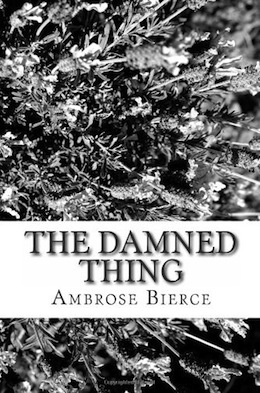
Today we’re looking at Ambrose Bierce’s “The Damned Thing,” first published in Tales From New York Town Topics in December 1893. Spoilers ahead.
Summary
In a cabin in an unnamed American wilderness, nine men have gathered. Seven, farmers and woodsmen, sit against the wall. One reads a worn account book, squinting in the light of a single candle. The ninth lies on a table within the reach of their arms, should any of them wish to touch a dead man. No one speaks, but from outside comes the chorus of the nighttime wilderness, coyotes and birds and insects.
A tenth man, William Harker, arrives. His clothing, though dusty from travel, sets him apart as a city dweller. The coroner (who has pocketed the account book) informs the newcomer that their business must be completed that night. He questions Harker closely about Hugh Morgan, whose corpse lies before them. Harker answers that he came to hunt and fish with his friend — also to study Morgan’s character, for Harker is a journalist and a writer of stories. He’s written one about Morgan’s death, which he witnessed—but he must publish it as fiction, not news, for it is incredible.
After the coroner swears him in, Harker reads the story aloud. He and Morgan are quail-hunting at sunrise. They come to a field of wild oats. At a little distance some animal thrashes in the brush. A deer? Too bad they haven’t brought rifles, only shotguns loaded for quail. Even so, the clearly agitated Morgan raises his weapon. Could it be real trouble, a bear? But Morgan, trembling, declares it’s “that Damned Thing.”
As revealed by the movement of the brush, the still-unseen beast is moving straight toward them. Morgan fires both barrels. The beast screams. Morgan drops his gun and flees. The same instant Harker’s knocked to the ground by something soft and heavy — and still unseen. He hears Morgan cry out in agony; mingling with his voice are “hoarse savage sounds as one hears from fighting dogs. Harker gets to his feet and watches his friend struggle with — nothing. And yet pieces of Morgan’s body keep disappearing, as if blotted out by the body of his antagonist.
Before Harker can reach him, Morgan’s dead, and the brush is again in motion, in a beeline for neighboring woods.
The coroner rises and pulls a sheet back from the naked corpse, revealing a body bruised and shredded, throat torn out. He then displays Morgan’s tattered and blood-stiffened clothing. There is no more evidence — what say the jurors? The foreman wants first to inquire what asylum Mr. Harker escaped from. Harker flushes, but stays long enough to ask the coroner for the account book, Morgan’s diary. The coroner says it’s not pertinent, and retains it. The jury deliberates briefly, then delivers their verdict: the “remains come to their death at the hands of a mountain lion, but some of us thinks, all the same, they had fits.”
Though never put in evidence, Morgan’s diary may cast light on his death, if only through the fourth wall. Morgan writes about the strange behavior of his dog, who seems to sniff out something unseen and then runs off at top speed. One night he watches stars above a ridge disappear a few at a time, as if blotted out by something passing — another something he can’t see. He watches from cover all night, gun in hand, and still sees nothing; morning shows him fresh footprints. If his experiences are real, he’ll go mad; if they aren’t he’s mad already. The suspense is intolerable, but Morgan won’t be driven off his own land. Instead he’ll invite his level-headed friend Harker to visit.
A later entry outlines Morgan’s sudden epiphany that as there are sounds beyond the hearing of human ears, so there must be colors beyond the sight of human eyes, such as the “actinic” rays chemists have discovered at either end of the solar spectrum. So he’s not mad — there are simply colors he can’t see, and, God help him, the Damned Thing is of such a color!
What’s Cyclopean: Extravasated blood.
The Degenerate Dutch: Bierce makes much of the rural jurors’ semi-literacy.
Mythos Making: “Colors we cannot see.” Horrors invisible to the human eye are always predatory, of course. It seems like these abilities would be at least as adaptive for prey animals—why are there no invisible guinea pigs?
Libronomicon: Written documents include Morgan’s infodump diary, and Harker’s “fictional” article that needs to be dispatched to the newspaper on a really tight timeline.
Madness Takes Its Toll: One juror asks from what asylum Harker has escaped. The coroner dutifully passes on the question.
Ruthanna’s Commentary
Snark is an all-too-rare quality in weird fiction. I suppose it interferes with the pure dark mood that horror writers strive to produce. Certainly this story produced fewer shivers than snickers. I’m okay with this. Though not so okay that I won’t snark a little in return.
“I sometimes write stories.” “I sometimes read them.” Clearly Bierce isn’t above the occasional authorial insert. Or above humor—at either his own or others’ expense. Every character in the story has their turn as the fool, with the possible exception of Morgan. Though taking your friend out to hunt snarks without explanation isn’t the brightest decision in the world, Bierce leaves the deceased as a source of pure infodump rather than an opportunity for mockery.
The influence on Lovecraft is clear, for the conclusion of “Damned Thing” is the premise for several of his stories: there are things beyond the bounds of human perception, and they are terrifying. The color out of space, the things from beyond, the unnamable monster invoked by Randolph Carter, the hound (as well as Frank Belknap Long’s Hounds)—all have ancestry in Bierce’s Thing. Lovecraft, though, takes this idea far beyond Bierce. For Bierce, the mere fact of things beyond human perception is sufficient revelation.
Morgan’s explanations refer directly to those parts of the electromagnetic spectrum insensible to human vision. They are, in fact, the dramatic reveal at the very end. I thought that perhaps the story was inspired by recent discoveries. It’s 1893; do you know where your wavelengths are? But no, infrared and ultraviolet were discovered in 1800 and 1801, respectively; Bierce just drew on them to pull a scientific veneer over an invisible monster. By this point researchers were presumably aware that such things are visible, just inadequately perceived. This makes the punchline less than impressive to the modern reader. “OMG, the monster is ultraviolet-colored.” Yes, and so are any number of birds and butterflies, but you can still see them. The described effect—something occludes the objects behind it, but you still can’t see the occlusion—is creepily paradoxical. The explanation helps no things.
I wonder how much of this story’s effect was insufficient at the time, and how much is simply lost to a modern reader who can buy an ultraviolet light at the pet store and cheap infrared glasses at the toy shop. Our invisible world is accessible with only a little effort. Part of Lovecraft’s own genius was the ability to make horror more—rather than less—terrifying with comprehension.
The Color—the most fully developed of Lovecraft’s imperceptibles, suffers a little when Miskatonic’s instruments both pick up a signal and show it to be incomprehensibly inhuman. But the effects of that incomprehensibility, the ways they insinuate themselves into plants and minds, overcome that barrier. Those effects, and not the pseudo-scientific explanation, carry the story’s weight.
One commonality between “Damned Thing” and Lovecraft is the way the story’s told. Although we don’t have one of Howard’s overarching first-person-nameless narrators, we do have the story witnessed at second- and third-hand: Morgan’s diary, Harker’s testimony, all found texts and official statements. And then the coroner, a weird fiction type even if we never get his direct perspective. He’s the one who withholds the diary, with its terrible ultraviolet revelation, from witnesses and judges alike. He knows, of course, that there are Things Man Was Not Meant to Know—or at least, Things Rural Jurors Were Not Meant to Know Lest They Make Me Late for Dinner.
Anne’s Commentary
We’re surrounded every second by invisible creatures, for the simple reason that they’re too small for us to see them with the proverbial naked eye (so, an eye with a microscope is well-dressed?) You know, everything from omnipresent bacteria and viruses to those dust mites that stalk the crumpled linen of our beds like Imperial Walkers. But are unseen-because-tiny things scary? I don’t think so, though their effects on us can be. You know again—allergies, disease, really ripe body odor.
Whole dimensions of life may swarm beyond the space we occupy, but as long as we avoid metaphysical drugs and magical eyeglasses and portal-skipping, their denizens should remain invisible to us and hence only intellectually scary. If that.
It’s the things we should be able to see, because they’re big enough and roaming our own plane of existence, that terrify us. Sure, humans can also hear and smell, taste and touch, but vision is our dominant sense, often our first line of defense. Invisible beings don’t play fair, because for us SEEING is believing. In this story, Morgan wonders if dogs can SEE with their noses — that is, whether their brains can translate smells into images. I wonder if a dog would even have to translate odor into picture to run scared, as smell is the dominant canine sense. To cheat a dog, wouldn’t a monster have to be scentless? Dog: So, I see something freaky, but without a signature odor, can it be REAL?
The Damned Thing’s real enough to put a shredded body on the table. It occupies space, blotting things out with its bulk, shifting vegetation, leaving tracks. So, in this limited sense, it’s visible. By implication, as it were. It smells, as Morgan’s dog can attest. It can be heard when it deigns to bellow. It can be felt, as Harker finds out when it bowls him over. I guess it would have a taste, were you foolish enough to take a bite out of it. Morgan tries to explain it via science, not superstition. Okay, chemists say there are colors beyond the range of unassisted human vision. Say the DT is a lovely shade of infrared or ultraviolet. That would mean it reflects wavelengths of light we can’t see. Hence invisible.
Or would it be? It can’t be reflecting the intermediate wavelengths of red and orange and yellow, green and blue and purple, in whatever combination, or we’d see it. If it’s reflecting only invisible colors and absorbing the visible rainbow, wouldn’t we see it as BLACK, a shadow-being?
There’s also refraction to factor in, as Wells attempts to do in The Invisible Man. But I’m not going there now, for fear the technical overload would worsen my pollen-headache.
Supernatural explanations, shrugging off physics as we know it, are easier. Bierce doesn’t go there. The Damned Thing could be a ghost. We all know ghosts are frequently the opposite of good children, to be heard but not seen. It could be a demon, endowed with magical powers. Getting toward Lovecraftian pseudoscience, it could be a THING from OUTSIDE, where the laws are different, like “Dunwich Horror’s” invisible Yog-Sothoth spawn or whatever spectral food processor pureed poor Abdul Alhazred before horrified spectators.
In the end, “The Damned Thing” strikes me as a bit of shivery fun, based on the notion that an earthly beast could be monochromatic (or multichromatic only in the humanly-invisible spectra) and so remain unseen. The atmosphere is nice, with the unseen (!) but noisy soundtrack of night creatures. The coroner has a couple of high snark moments, perfectly timed, with which he deflates that city-slick journalist Harker. The coroner is cool. I wonder what he’ll do with Morgan’s diary, whether he may have a whole collection of artifacts from the victims of the Damned Thing. Whether the Damned Thing’s actually a locally tolerated or even favored beast, which coroner and jurors protect through feigned incredulity and some variation of that verdict of mountain lion and/or fits.
Hey, it just occurred to me. What about a little Invisible-Monsters-Lovecraft-Knew-And-Admired series? Fitz-James O’Brien’s “What Was It?” and Guy de Maupassant’s “The Horla” come at once to mind as antecedents to the DT.
DT, heh. I’m surprised my friend the coroner didn’t make a little joke about Damned Things and delirium tremens sharing initials….
Next week, British adventurers meet the denizens of Y’ha-nthlei in Kim Newman’s “The Big Fish.” You can find it in the Cthulhu 2000 anthology or in Newman’s own The Secret Files of the Diogenes Club.
Ruthanna Emrys’s neo-Lovecraftian novelette “The Litany of Earth” is available on Tor.com, along with the more recent but distinctly non-Lovecraftian “Seven Commentaries on an Imperfect Land” and “The Deepest Rift.” Winter Tide, a novel continuing Aphra Marsh’s story from “Litany,” will be available from the Tor.com imprint on April 4, 2017. Ruthanna can frequently be found online on Twitter and Livejournal, and offline in a mysterious manor house with her large, chaotic household—mostly mammalian—outside Washington DC.
Anne M. Pillsworth’s short story. “The Madonna of the Abattoir” appears on Tor.com. Her first novel, Summoned, is available from Tor Teen along with the recently released sequel Fathomless. She lives in Edgewood, a Victorian trolley car suburb of Providence, Rhode Island, uncomfortably near Joseph Curwen’s underground laboratory.

It’s easy to see why Lovecraft enjoyed this story, an effective treatment of the old invisible monster theme. (An invisible monsters series would be fun: Bierce’s pseudoscience was his way of distinguishing his monster from O’Brien’s.)
Lovecraft on Bierce: from, as almost always, “Supernatural Horror in Literature”:
“Closer to real greatness was the eccentric and saturnine journalist Ambrose Bierce, born in 1842; who likewise entered the Civil War, but survived to write some immortal tales and to disappear in 1913 in as great a cloud of mystery as any he ever evoked from his nightmare fancy. Bierce was a satirist and pamphleteer of note, but the bulk of his artistic reputation must rest upon his grim and savage short stories; a large number of which deal with the Civil War and form the most vivid and realistic expression which that conflict has yet received in fiction. Virtually all of Bierce’s tales are tales of horror; and whilst many of them treat only of the physical and psychological horrors within Nature, a substantial proportion admit the malignly supernatural and form a leading element in America’s fund of weird literature. …
… Bierce’s work is in general somewhat uneven. Many of the stories are obviously mechanical, and marred by a jaunty and commonplacely artificial style derived from journalistic models; but the grim malevolence stalking through all of them is unmistakable, and several stand out as permanent mountain-peaks of American weird writing. …
… “The Damned Thing”, frequently copied in popular anthologies, chronicles the hideous devastations of an invisible entity that waddles and flounders on the hills and in the wheatfields by night and day. …
… Bierce seldom realises the atmospheric possibilities of his themes as vividly as Poe; and much of his work contains a certain touch of naiveté, prosaic angularity, or early-American provincialism which contrasts somewhat with the efforts of later horror-masters. Nevertheless the genuineness and artistry of his dark intimations are always unmistakable, so that his greatness is in no danger of eclipse. As arranged in his definitively collected works, Bierce’s weird tales occur mainly in two volumes, Can Such Things Be? and In the Midst of Life. The former, indeed, is almost wholly given over to the supernatural.”
(I agree with Lovecraft that “The Death of Halpin Frayser” is Bierce’s best but it takes less time to analyse “The Damned Thing”, useful in a week of alarums and excursions and wonderful Palencar covers. Lovecraft does not discuss “An Inhabitant of Carcosa”, one of the inspirations for The King in Yellow.)
Weird Tales: September 1923, though there’s little else of interest there save one of Lovecraft’s letters.
Excerpts taken from The Devil’s Dictionary: of potential interest to Lovecraftians:
GENEALOGY, n. An account of one’s descent from an ancestor who did not particularly care to trace his own.
GHOUL, n. A demon addicted to the reprehensible habit of devouring the dead. The existence of ghouls has been disputed by that class of controversialists who are more concerned to deprive the world of comforting beliefs than to give it anything good in their place.
GRAVE, n. A place in which the dead are laid to await the coming of the medical student.
MYTHOLOGY, n. The body of a primitive people’s beliefs concerning its origin, early history, heroes, deities and so forth, as distinguished from the true accounts which it invents later.
PESSIMISM, n. A philosophy forced upon the convictions of the observer by the disheartening prevalence of the optimist with his scarecrow hope and his unsightly smile.
REALITY, n. The dream of a mad philosopher. That which would remain in the cupel if one should assay a phantom. The nucleus of a vacuum.
SORCERY, n. The ancient prototype and forerunner of political influence. It was, however, deemed less respectable and sometimes was punished by torture and death.
THEOSOPHY, n. An ancient faith having all the certitude of religion and all the mystery of science. The modern Theosophist holds, with the Buddhists, that we live an incalculable number of times on this earth, in as many several bodies, because one life is not long enough for our complete spiritual development; that is, a single lifetime does not suffice for us to become as wise and good as we choose to wish to become. To be absolutely wise and good—that is perfection; and the Theosophist is so keen-sighted as to have observed that everything desirous of improvement eventually attains perfection. Less competent observers are disposed to except cats, which seem neither wiser nor better than they were last year. The greatest and fattest of recent Theosophists was the late Madame Blavatsky, who had no cat.
“The Big Fish”: can additionally be found in The Book of Cthulhu II and Shadows Over Innsmouth.
For me, this isn’t really one of Bierce’s better works. In fact, it feels more like the outline of a much longer piece. But the influences on HPL are very clear.
I think Bierce could only write without snark if he was dealing with the Civil War.
My guess is that the newspaper didn’t have a ridiculously tight deadline, but that Harker was worried that the coroner might slap a gag order on him or otherwise prevent him from filing his story. Better to send it off first.
As for Ruthanna’s invisible guinea pigs, obviously they’re out their. But how would we notice them? It’s those invisible apex predators that eventually make themselves perceptible. The depredations of those lower down the food chain always get put down to slugs or something that wanders by in the night.
The “snark” in this story also extends to the chapter titles. The opening chapter, describing the coroner’s inquest, is titled, “One Does Not Always Eat What Is On The Table.” The next chapter, in which the mutilated corpse is revealed, is titled, “A Man Though Naked May Be in Rags.”
“It seems like these abilities would be at least as adaptive for prey animals—why are there no invisible guinea pigs?”
How would we know? :)
Anne said what I had concluded some decades ago, that an object which reflected no visible rays yet was solid, would be black. You guys going to do a Machen story one of these days?
TIL Arthur Machen created the Predator.
@@.-@: it’s the invisible elephants which would be the real problem.
Personally, even the first time I read it, a much younger critter, and saw mention of the creature obscuring wheat or the limbs of the attacked man, I immediately thought LIGHT DOES NOT WORK THAT WAY!!
If the hand is obscured, what of the scenery behind it? If the grass is obscured, what of the stalks behind them? What does you see when you look at the “obscured” limb, or plant? Do you see the scenery behind it? If the image of the scenery passes through the beast, why not the image of the hand? If neither image passes, what are you seeing? A black spot? If so, why is not the whole critter, as observed already, a black blot? A white spot? That too, is something we _see_.
My personal explanation is not that the critter is visible only in ultraviolet or whatever, but that it is a full-blown Lovecraftian abomination – something so alien, that the brain simply refuses to interpret it : it’s not that it is invisible or that light is passing through it in selective frequencies, it simply is creating a void in our visual field, where the brain’s visual center essentially throws up it’s metaphorical hands in despair. People who encounter it remember it as invisible, because there is simply no usable visual information we can remember.
I hadn’t encountered this story before, and I loved it. I personally thought Bierce’s arch tone worked well here, because this is a story whose interest lies as much in what it doesn’t tell us as what it does. I’m inclined to agree somewhat with Bruce Munro @7; I think Morgan’s supposition of non-visible wavelengths is wrong. This isn’t like the expert spectral analysis conducted of the Colour from Outer Space, after all; it’s just one non-professional’s theorising from limited observations.
If it’s even that; I came away from the story wondering if the coroner suspected Harker of murdering Morgan and writing the journal entries himself as some sort of outre alibi. Did he believe any of Harker’s or Morgan’s story, or did he only release Harker because he lacked the evidence for a conviction? (If Harker’s liberty was at stake, that could be another reason for him to hurry his story off ASAP.) When the jurors state that Morgan was killed by a mountain lion, did they believe their own words? We’re told that the jurors being shown Morgan’s rended effects had ‘seen this before’. Had they seen the same items when helping the coroner collect and lay out the body? Had they seen the remains of people killed by mountain lions at other times and believed this another of the same? Or is Morgan not the first person in the area the Damned Thing has taken out?
The one Lovecraft story that I was surprised you didn’t mention in relation to the Damned Thing was “The Dunwich Horror”. Harker refers to Morgan as being a bit of an oddball, but then this detail doesn’t really go anywhere. Did Bierce simply forget about this point in the course of writing, or is it not coincidence that the Damned Thing is after Morgan personally?
I rather suspect the Thing bends light a la the Predator or that new camo technology the US military is working on. It’s just the radius of the light-bending field is somewhat larger than its own body, so objects near it become enveloped as well.
After thinking about this a little, I suspect that what Bierce was envisioning was that the creature was transparent in the visible wavelengths, sort of like a sheet of glass. If he’d written this a few years later, he probably would have had it be visible at x-ray wavelengths. Of course, there’s no reason to suppose that there are wavelengths at which it reflects. Lovecraft’s less than visible beings have better explanations, but he has a couple of decades more science to work with.
@9: that would work for the obscured limbs, but not the stars.
“The Big Fish”, eh? I think I read that one in Cthulhu 2000 but I can’t remember anything about it, which may not be a good sign.
All of my nitpicking science-nerd alarms went off when I read this story as a kid— it’s not just that light doesn’t work that way, the conceptual flaw isn’t one that Bierce would’ve needed any science to understand, it’s more like he just hasn’t really thought through what “blotted out” means… like, you can’t see the guy when he’s behind the Thing, and you can’t see the stars, but you can still see the ground behind the guy? And yet… in some way I couldn’t figure out back then (because I was pretty literal-minded), the story still worked, it was still scary. Partly it’s just the beautiful, atmospheric prose, and the feeling of stillness and loss… like even though there’s monster action in it, everything’s over and done with and no one but Harker and the reader really cares. It’s also got this very anti-Lovecraftian limited scope to it— there’s not an army of these creatures waiting to destroy the world, there’s just the one thing, it lives out in the middle of nowhere, just doing more or less what an invisible bear would do— but its existence is enough to make this one guy miserable and crazy.
I think Bierce also gets away with his not-very-well-explained invisibility premise by tying it to a really nicely described bit of real-world experience:
I’ve had pretty much the same thing happen. Just a brief mistake in perception, not even an optical illusion really, but it’s freaky to realize that you could be so wrong about what you were looking at, and it leaves a kind of lingering paranoia about normal-looking scenes.
@5: I think that the Machen story on the list is “The White People”.
The “occluded vision” description does come across as strange and difficult to justify scientifically. But a glitch in image processing per @7 seems almost plausible. Many such glitches exist and can create odd optical illusions; people are mostly conditioned to overlook these. For an example close to home, can you see your nose? (I can, but only with one eye shut.) My impression is that the Damned Thing is a bit like a desert mirage – it causes some sort of refraction or other distortion of visible light, and the brain constructs a dangerously incorrect picture from that weird signal.
As for invisible predators (Predators?) or prey, I doubt that either makes much sense when so many creatures rely primarily on smell or hearing. Perhaps if invisibility turned out to be metabolically cheap? But most predators and prey get by with some lightweight camouflage. Invisibility might actually be most functionally useful as a strategic threat cum combat strategy (“fight me and you’ll lose”), but that sort of ability is most beneficial when you advertise it (think skunks or rattlesnakes). So being invisible (thus hard to recognize) might undermine being invisible (thus not to be messed with). Might make most sense as some sort of “apex scavenger” – have some distinctive call or scent, use it to chase dogs or mountain lions or whatever away from their kills.
Perhaps the perceptual distortion itself is the strategic threat–being in the uncanny valley is a signal that “you can’t know what threat I offer, don’t even try.” Advertised by the instinctive emotional reaction to the distortion, like the way a rattler’s rattle makes you freeze even if you’ve never heard it before. (Or at least, it had that effect on me, in spite of liking snakes and being aware that the snake in question was both caged and de-venomed.)
So many things get more interesting with a little less technobabble.
Fun experiment to try at home: stare at a bookshelf or counter with some objects on it. Hold out your hand in front of you so that it blots out one of those objects. Now, start moving your hand towards your nose… The perceptual effect is odd, but eventually my hands fuzzes out and I arrive at an “occlusion” (as my human brain tries to glue separate left and right images together). Drop my hand, and the shelf abruptly “gets wider”, and the objects in the blind spot reappear.
I was always curious as to what the Thing would have looked like if it was visible. I always kind of imagined it as something like the “Monster from the Id” towards the end of Forbidden Planet.
Incidentally, this story was one of my favorites from a Gothic lit class I took in college, but while I think it’s effectively creepy, I don’t think it’s nearly as creepy as the real life fact that Ambrose Bierce disappeared and was never heard from again. To this day, no one knows what happened to him.