






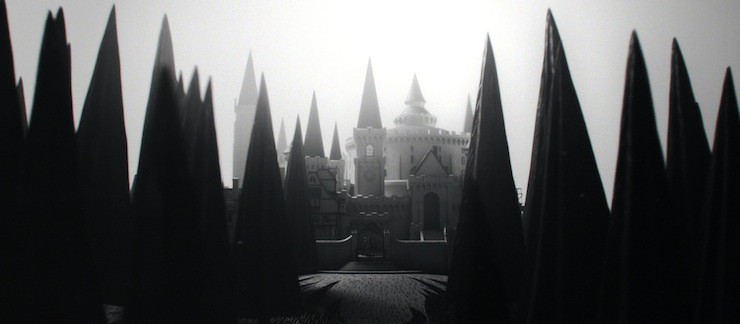
We now have a nice long story as background on the Potterverse North American wizarding school, Ilvermorny. But how does it all break down? Fans have been concerned about how this tale would unfold, following some upset over Rowling’s “History of Magic in North America” piece, but this is the first substantial glimpse we’ve been given into the more recent magical system in the United States and history of the school.
So let’s do this.
Here are the basics of the story:
The saga begins in the early 17th century, where a pureblood witch named Isolt Sayre (b. 1603) lives in County Kerry, Ireland with her family. Her parents are murdered, and she is spirited away by her aunt, one Gormlaith Gaunt. (Yup, that Gaunt family. The one that eventually leads to Voldemort.) It turns out that her aunt is the one responsible for the death of her parents, and is keen on raising her niece away from all Muggles and Mudbloods. Isolt hears her aunt’s stories about Hogwarts and desperately wishes to go, but is kept away due to Gormlaith’s fear of any kind of egalitarian influence. Eventually, Isolt steals her aunt’s wand (barred from having her own) and her mother’s old Gordian Knot brooch and flees. She disguises herself as a boy and gets on board the Mayflower, heading to the New World. Upon arriving in North America, she heads into the mountains, aware that her fellows passengers won’t take kindly to a witch in their midst.
In the forest, she saves the life of a Pukwudgie, a creature that “carries poison arrows” and generally dislikes humans. This particular one begrudgingly decides that he owes Isolt a life debt for the rescue (she cursed a Hidebehind that was trying to eat him), but won’t tell her his name–so Isolt takes to calling him William, after her father. The two form a strange friendship, and Isolt finds out about the other magical creatures in North America from him. She meets a Horned Serpent and feels strangely connected to it, and even fancies that she can hear it speak to her. Eventually, it tells her “Until I am a part of your family, your family is doomed.”
One day, Isolt and William come across a family–a mother, father, and their two sons–being attacked by the same Hidebehind. They dispatch the creature and Isolt discovers that the parents are dead, but their two boys are still alive, barely. William has no interest in helping them, but Isolt insists that if he aids her, she’ll consider his life debt repaid. When they get the boys back to her shelter, she tells William off, and he leaves. The boys, Chadwick and Webster Boot, turn out to be from a magical family, and Isolt nurses them back to health. Intending to bury Chadwick and Webster’s parents properly, Isolt heads back to the site of the attack, only to find that they have already been laid to rest by a young Muggle man named James Steward–he arrived from England on the same ship with the Boot family, and had gone looking for them, coming across their bodies instead. He notes the remnants of one of the parent’s wands and picks it up, causing it to backfire and knock him into a tree. He is unconscious, so Isolt decides to take him to her shelter as well. James is unavoidably exposed to magic as a result, but helps take care of the boys, and eventually builds Isolt a house on top of Mount Greylock. She names it Ilvermorny, after her old family home.
Isolt and James eventually marry and raise the Boot boys as their own sons. Isolt tells them stories about Hogwarts, and Chadwick and Webster are hypnotized by the notion. Isolt promises that once they each turn eleven, she will find them wands and they will start their own magic school. The boys decide it should be based off Hogwarts, leading to the idea of four houses (but Webster goes against the idea of names for houses, since he doesn’t believe a house called “Webster Boot” could ever win anything). They end up selecting local magical creatures for house names, and each pick one; Chadwick chooses the Thunderbird, Webster the Wampus, Isolt the Horned Serpent, and James the Pukwudgie (the only creature he had any real knowledge of from Isolt’s stories about William).
Before Chadwick’s eleventh birthday, Isolt has a dream where she shaves a piece of horn off the Horned Serpent. She wakes and heads down to the creek, finding the serpent ready and willing to fulfill the vision. On return, she asks James to fashion a piece of ash wood around it, giving Chadwick his promised wand. Webster eventually gets one as well. James and Isolt have their own children eventually–twin daughters named Martha and Rionach, after both of their mothers. Others begin to hear about the school and attend, though there are no boarders staying overnight. Native American wizards arrive to learn wand magic, and offer to teach their own techniques in exchange.
Gormlaith eventually tracks Isolt down when she hears of Ilvermorny school, and puts a powerful sleeping enchantment on Isolt and James in the night. Then she puts a deactivating spell on Isolt’s wand (which happens to be the wand of Salazar Slytherin himself), thinking to destroy their home and take their girls. But she doesn’t know about Chadwick and Webster, now 16 and 14, who leap to defend their family. Isolt and James eventually wake when they hear the cries of their twin girls, and Isolt rushes downstairs to help the boys fight off Gormlaith–only to find that her wand is useless. When Gormlaith has the whole family cornered, Isolt calls the name of her father in a panic, and William the Pukwudgie appears, hitting the aunt with one of his poison arrows and killing her. James is ecstatic to meet William and shakes his hand, telling him how glad he is to have named one of the Ilvermorny houses after him. With that, William decides to stay and brings other Pukwudgies on staff at the school, demanding a hefty sum of gold for their services as both security and maintenance.
Isolt buries Slytherin’s wand next to the school and a snakewood tree grows up in its place, one that cannot be pruned, but offers leaves with medicinal properties. As the school’s reputation grows, more students join. More teachers are hired, the cottage grows into a castle, and it eventually becomes a boarding school. Isolt and James are joint Headmasters who live to be well over 100, and the Boot boys thrive, one of them moving back to England. Their daughter Martha turns out to be a Squib and marries the brother of a friend from the Pocomtuc tribe. Rionach never marries, but teaches Defense Against the Dark Arts at the school. (The whole family is unaware that there are more Gaunts over in England.) There is always a Pukwudgie on staff named William who claims that he is not the original, but he leaves flowers by Isolt’s statue on her birthday every year.
Important school info:
- The school robes are blue and cranberry. Blue for Isolt who always wished to attend Hogwarts and get Sorted into Ravenclaw, cranberry for James’s favorite pie.
- The four houses are said to represent parts of the witch or wizard, as well as personality types. Horned Serpent is the Mind, which favors scholars; Wampus is the Body, which favors warriors; Pukwudgie is the Heart, which favors healers; Thunderbird is the Soul, which favors adventurers.
- Sorting at Ilvermorny works as follows: the student stands on a Gordian Knot at the center of the opening chamber. Carvings of each house creature can be found on the wall, and they move if they select the student. If more than one house selects a student, then the student themselves gets to pick their house. About once a decade, all four houses pick the same student. (Seraphina Picquery, President of the Magical Congress of the United States of America from 1920-1928, was one such student, and chose Horned Serpent.)
- Students receive their wands at school, after their sorting, due to very strict adherence to the Statute of Secrecy in the United States. They must leave their wands at school on vacations, and are only permitted to take them upon coming of age at seventeen.
- The school has a reputation for being more democratic and non-elitist when compared to other wizarding schools across the globe.
Thoughts:
I was reticent about this whole thing, and really nervous about these additions to the world, and I… kinda love this. It works incredibly well with the world that Rowling already has in place, and adds some fascinating ideas to her mythos. Primarily: a descendent of Salazar Slytherin is responsible for the North American magic school.
Can. Can we just. Oof. Wow.
This is an incredibly important addition to this world, dismantling the idea of Slytherin, his house, and his affinity for serpents as immediate qualifiers for “badness.” Because that’s what the Potter books always communicated; Slytherin was a pureblood hate monger, Slytherin house was full of bad eggs who all turned to the Dark Arts, being a Parselmouth was evil, and having any kind of connection to snakes was clearly a bad thing.
And here is Isolt Sayre. A Slytherin descendent who marries a Muggle (sorry, No-Maj), whose affinity for snakes allows her adopted sons to practice magic, who refuses to adhere to the Gaunt family rhetoric, and establishes a school that has a reputation for being democratic. When we think of a generation of Slytherins who have the ability to move beyond the tiny box they are often placed in–this is it. It’s her. She’s the one. Granted, she wanted to be a Ravenclaw, but the potential for greatness in Slytherin house is right here. After all, Slytherin house is often defined by its ambition, and this woman wanted to attend Hogwarts so bad that she literally created her own and turned it into one of the greatest wizarding schools in the world. It doesn’t really get much more ambitious than that.
It means something that the founders of the North American school are essentially a found family. Four people who might never have met and formed this unit once unseen circumstances threw them all together. And one of the founders is a Muggle. Imagine what that means to the Muggleborn students, to know that one of the original headmasters of the school couldn’t do a bit of magic. What a comfort that must be, and how welcoming.
The idea of the school being founded as this small family project and just growing is so effective, and prevents a lot of awfulness that could have resulted if the school had been this grand establishing imperialistic move on the part of new settlers. Instead, we have a center for learning where magic-users who never learned with wands are able to form an exchange of sorts. (This is also similar to the true arc of U.S. history, though often the exchanges between North America’s native population and European settlers were unbalanced in terms of what each side gained.) The school embraced every form of magical learning to broaden its scope, and is likely better for it, having become an organized institution after years of DIY teaching. More choices are placed in student hands as well, right from the sorting, with the ability to choose if you’re selected by more than one house.
Given U.S. history, it makes perfect sense that the school is modeled in part on Hogwarts; the United States has always leaned heavily on certain aspects of its British foundations, both cultures in perpetual conversation with one another even to this day. The given backstory makes this a logical root for Ilvermorny, but perhaps it is even more logical to find the places where the school diverges, as American sensibility often dictates a certain desire to distinguish oneself through “uniqueness,” i.e. choice.
Rowling makes a point of explaining that the Pukwudgies are a distant ancestor of goblins, and there are a few similarities they share in temperament and philosophy, including their lack of concern–or outright hostility–towards human affairs. But this means that, as opposed to Hogwarts, Ilvermorny employs a magical workforce that is paid and came to the school voluntarily, which is heartening to say the least.
In terms of her real world resources, all of the magical creatures that Rowling references are part of Native American mythology, and Mount Greylock is a real mountain in Adams, Massachusetts. Isolt’s ancestor Morrigan is also a well known figure in Irish mythology. Isolt’s own name is likely a reference to Iseult (or Isolde) of Arthurian legend. And the Boot boys do have at least one likely descendent that we see at Hogwarts during Harry’s time: Terry Boot, Ravenclaw and member of Dumbledore’s Army.
All of Rowling’s themes are alive and well in this story, including the benefit of corporation and understanding, and of course, love being the most potent force in the world–Isolt and James only wake from Gormlaith’s sleeping curse at the sound of their daughters’ crying, as the curse “like Gormlaith herself, took no account of the power of love.” Also, we get the Potterverse’s usual trademark sense of humor; Isolt picks one of the school colors because she always wanted to be a Ravenclaw, but James’s color pick is due to his love of cranberry pie.
REPEAT: ONE OF THE SCHOOL COLORS IS PIE. (Is this the part where I start chanting “U.S.A.!” obnoxiously? It feels like that part.) <33333
There is still plenty of room for fans to theorize and flesh out this area of the wizarding world, but this is a fascinating place to start. We have to assume that some of this information will serve as useful background for the upcoming film (at the very least, it seems likely that we’ll meet President Seraphina Picquery given the time frame). But that still offers endless possibilities: will we get to see the school? How much of it? How about that special Slytherin tree with medicinal properties? Will we get to meet William? And what’s it like for No-Majs in this society, one where the primary school on the continent had a respected No-Maj founder?
We can only guess, but this is an intriguing start to a brand new side of Rowling’s world.
Emmet Asher-Perrin is now weirdly proud to have been sorted into Horned Serpent on Pottermore. You can bug her on Twitter and Tumblr, and read more of her work here and elsewhere.

Isn’t that President Seraphina Picquery in the trailers and the latest featurette, the one with the fancy hat?
Also:
Did you mean “cooperation” here?
I got Wampus and I’m thrilled Ilvermorny is located at the peak of Mount Greylock. I could see it from my dorm room at Massachusetts College of Liberal Arts!
Rowling, Rowling, Rowling — it’s cranberry juice and pumpkin pie.
I’ve eaten cranberry pie – it’s pretty good :)
A couple of things I noticed:
Wand Lore in Decline:
What’s up with wand technology? It’s not just that they’re not getting more powerful it seems that knowledge of how to make wands has actually gotten worse over time. It’s not just the Elder Wand, with this story we now have a few examples of wands of ‘exceptional power’ (specifically the horned serpent wands Isolde creates for her sons). Not only that, we also learn that Salazar Slytherin somehow added security features to his wand. If that’s possible why not other enhancements. Given how many wizards are killed in battle by being disarmed you’d think somebody would give some thought to figuring out how to enchant a wand to automatically return to its owner.
Further evidence of the decline in wand technology is the fact that despite having had actual possession of the Elder Wand it seems that Gregorovitch didn’t figure out what made it special as there’s no evidence that he created any wands of comparable power. Compare him to Isolde who, despite having been homeschooled by a bigot and having no special training in wand lore, was able to pretty much independently master the technology and improve upon it.
Divination: Not So Useless
I know that we have the prophecy as a big example of legitimate divination in the original series, but beyond that divination as a subject gets a pretty bad wrap in books. Professor Trelawney is pretty much a fraud as she’s not even aware of any of the actual foresight she possesses (whether it be the prophecies or her apparently accurate cartomancy). The only other real practitioners we see are the centaurs. We don’t really learn about the mechanics of how their fortune telling works but it comes across more like epistemology than actual divination. Plus many of them (in my view) are portrayed as jerks.*
But then in this story we seem to get several examples of characters having prophetic dreams and it goes by without much comment. Not sure what to make of it other than to say that it stuck out to me.
*Emily wrote very persuasively and often about the fraught nature of the wizarding community’s relationship with other sentient races, but it didn’t overcome my issues with the centaurs. In my view, none of the legitimate issues they had with the wizarding world writ large justified their treatment of Ron, Harry, and Hermione and the end of OOTP.
North American Wizard / No-Maj Relations:
I’ve so far gotten a mixed picture of how wizard / no-maj relations in North America compare to wizard / muggle relations in the UK. On the one hand, we have a lot of evidence that prejudice within the North American wizarding community is not as big an issue as it is in the UK. One of Ilvermorny’s founders was a No-Maj, they seem to have good relations with the Native American wizards (not sure if they’re completely integrated but it sounds like they could be), they pay the Pukwudgies, and so on. On the other hand, while British wizards seem bemused by muggles the North American wizards seem far more wary of the non-wizards all around them. If I remember correctly at one point wizard/no-maj relationships were outlawed. I believe some of this is attributed to the whole Salem Witch Trial thing but I think it’s an interesting contrast.
Also I’m not a fan of No-Maj as a word.
Seraphina Picquery
We are definitely going to meet Seraphina in the movie. I’m wondering if she’s a villain or antagonist at least based on a not so flattering description of her wand as taking “to Dark magic like a vampire to blood.” Anyway, here she is:
Regarding “cranberry juice and pumpkin pie”…we are making sure to bear in mind that James Steward is a 17th century Brit, not a 21st century American, right?
A few interesting tidbits regarding American wizardry:
Isolt Sayre’s masculine cover name (Elias Story) comes from an actual Mayflower passenger .
Mount Greylock: It was quite an inspiration for 19th century American writers. Hawthorne, Melville, Henry David Thoreau, Oliver Wendell Holmes, and William Cullen Bryant all visited it. It will be fun to see if any fan-writers take that up as a theme.
The Hidebehind: Glad to see that this guy made it in. It’s quite possibly the creepiest creature in American folklore.
It must be that, with the increase in population over the years, that Ilvermorny is under a magical spell and can no longer be discerned by us muggles. I understand that, many years ago, when the classic “Thunderbolt” ski trail was cut on Mt. Greylock that occasionally a Williams College student might get a glimpse of the school (and, long before the ski trail, William Cullen Bryant may well have seen it while he was a Williams undergraduate).
So want to see a story where someone is murdered at Ilvermorny, and a visiting Oliver Wendell Holmes (who was both a writer and a medical doctor and was also the source of Sherlock Holmes’ surname) gets involved…..Perhaps a mysterious corpse turns up and the visiting Dr Holmes is asked to assist with the autopsy….and then discovers the hidden wizarding school and has to do a bit of amateur detective work….
I always thought that Xavier’s School for Gifted Youngsters was the American Hogwarts. I’m gonna stick with this.
I was sorted into Thuderbird house. I enjoyed the story, I just wish J.K. Rowling would write a book about this. I’d love to read more about Ilvermorny.
Reading the story now, it’s fantastic to get back into this world.
Also, I was amused to fnote Gormlaith’s alias when travelling to the New World was Richard Sayre, one of the villains in Stephen King’s Dark Towers (servant of the Crimson King, leader of the Low Men, CEO of Sombra Corporation).
I love this story. Looking forward to FBAWTFT.
I got sorted into Wampus, but Horned Snake was very close.
I got sorted into Thunderbird House, which surprised me because I’m Ravenclaw at Hogwarts. Love the additional information on wizarding and magic in the New World. Wonder if my Mayflower ancestor knew he was traveling with a wizard. I’m really looking forward to the new movie and to reading (and eventually seeing) “Cursed Child”.
I had so many similar thoughts – loved the ‘Slytherin tree’ with medicinal properties, and also the fact that one of the colors was based on pie. Love it!
But really, I really think the dynamic is just bound to be different, having a Muggle – not a muggle born wizard, but a Muggle – as a headmaster, and I really enjoy that they worked cooperatively with the Native tribes. The democratic, cooperative spirit is kind of the best of what America could have to offer and could be.
I also really love ‘found families’ so I loved reading about how they all came together and created a family after various tragedies. Possibly because I am very fond of my biological family so I always like hearing about being creating their own if they weren’t so lucky.
i have never felt prouder to be a Slytherin
Also im so excited about this new chapter for us as fans, i can barely type :)
I chose to be a Pukwudgie because none of the four houses blinked at my request to entering the fascinating boarding school. As a No-Maj I am founding my own magical school far away in a land where magic traps the ice of Mahoutokoro . As a solar panel where I get energy from the smallest attendance in the history of magic I intend to reverse the course of DNA equality. I might have a great heart, but I’m growing a brain. And yes, the technology of wands are wearing off. Goodbye to brooms and welcome to the most used object here in Taiwan. Magic flies with my left hand. Yes, somebody forgot to learn the trick of apparition…
Longtime obsessor over the HP Re-Read, first-time commenter.
I was fascinated by the idea of Ilvermorny since I first heard about it, and I’m REALLY looking forward to seeing where it goes. Also, I wanna try cranberry pie now. Sounds tart but tasty.
I’m a Gryffindor at Hogwarts but I think it’d be awesome to be a Thunderbird at Ilvermorny.
Also, Markus – Xavier’s is closer to military school. Much as I love the X-Men, much as I wanted to be an X-Man when I was 11 (IRONY ALERT!!!), the X-Men only ever REALLY learn how to use their powers to fight.
That’s it.
Because everyone from bigoted government agents with giant robot armies to mutant supremacists to extradimensional media moguls to demon sorcerers wants to kill and/or exploit you when you’re a mutant. And if your powers don’t have immediately-recognizable combat applications (i.e. Cypher, Longshot, Prodigy, early-days Elixir), then you better prepare for some SERIOUS hand-to-hand training or else hope there’s a random superpowerful alien buddy around to conveniently Gestalt with you.
Not a lot of room for humanitarian work as an X-Man.
Hogwarts (and Ilvermorny) therefore offer a lot more to prospective students than just ‘learn how to punch people with your powers’. Plus as a wizard, you automatically have more options open to you than you would as a mutant, unles you’re a Scarlet Witch, Storm, or Jean Grey who’s won the superpower lottery.
…wow, I have OPINIONS. Sorry about that.
Despite Isolt’s ancestry, I’ll still say this…heirs of Slytherin, abusing magic and causing trouble…for the last thousand years :) :) :). The Gormlaith Gaunt fits in the family tradition all too well, so to speak (but hey even ‘ancient noble House of Blacks’ had his good side, ‘white sheep’ Regulus and Sirius). I like the fact that a muggle was co-founder of the school as well, and he shaped wands! Yeah! :)