






A man and his unusual partner set out to assassinate a tyrant and bring down an empire.
Short story | 6,470 words
And then we were in Tau-Sants, washing in on the foamy overflow of its quantic canal. I caught and tamed my breath while the city assembled itself above us: habitat layers of living wood, jutting bunkers of chimera iron, skyports suspended in the dusk overhead like decahedral clouds. A soft and insistent rain tapped at my upturned face.
“Think I came here on holidays once,” Kurkuma said, rolling over and sloshing to her feet. Her left arm had preceded her; I saw it flopping a little farther on. “It rained then, too. Rotten luck.”
“We won’t be here long,” I said, hauling myself upright. I felt for the blueprint, found it safe in its subcutaneous pouch. “They say this gunsmith is the very best.”
I took two steps, adjusting to the air and gravity, then plucked Kurkuma’s limb from the gurgling foam and handed it over. Ganglia slurped from her empty shoulder socket to meet it, and she was whole.
“Off we go, then,” she said.
Tau-Sants was a membranous place. Even as we moved farther from the quantic canal, deeper into the city, I saw plentiful evidence of disjointment: electric staircases ending mid-step or erupting from doorless bulwarks, rain-slick reflections of buildings that did not exist.
“It has a certain charm,” I said. “The liminality.”
“It’s all wet,” Kurkuma said.
Apart from the war bunkers, there was little evidence of Dynastic incursion. The city sat along a particularly volatile stretch of the quantic canal; such instability was unappealing to a regime enforced through algorithmic brutality. That was likely why our sympathetic gunsmith had made it his home.
Two streets from our destination we came across a corpse. It was curled around the base of a lamptree, coated in squirming pale pupae. Pedestrians parted easily around it.
“Haven’t seen one of these in a while,” I said. “I suppose they don’t conscript the dead here.”
Kurkuma didn’t reply. Her eyes were shivering in their sockets, unfocused, and I realized she was sifting her memories, something she’d begun to do more frequently in recent days. I let my gaze linger on the corpse until its necrogram appeared: I mourn who I was with you. And below it: This artist has obtained proper licensing for public decomposition.
Kurkuma’s body had gotten ahead of me; I trotted to catch up.
The gunsmith worked in the air, renting a disused skyport above the city’s Old Casque. Gravity pins kept the structure perfectly still, but the ferry cables, dangling from its underside like intestine ejected, swayed and rolled. The decahedral hull glowed dull orange with waste heat, turning the rain to wreaths of steam.
Kurkuma returned just as we reached the ferry cables. “Did I miss anything?” she asked, eyes sharpening.
“Disjointed architecture, dead artist.”
“Seen both before,” she said. “I’m getting hungry. You?”
I touched my numb abdomen. “Maybe once we get the blueprint out.”
“There was one place here,” she said, seizing the nearest of the cables. “I remember they did a good marrowcake—”
“Do you have an appointment?”
Kurkuma dropped the cable as her other hand leapt forward, unsheathing its razor. The tip of her blade stopped just short of a miniature throat: the voice had emanated from a tiny figure clinging to the cable, a homunculus with spindly piston limbs and an oversized head.
“Modular combat scythe,” the homunculus said. “Vanadium-niobium blade. Integrated nerve conduit.” Its body was simplistic but its face was all too human, fully textured with a proud, broad nose and black wrinkle-webbed eyes. “Do you have an appointment?”
I had barred both hands across my stomach when the automaton startled us, as if to further protect the blueprint. I returned them to my coat pockets. “No appointment,” I said. “But our employer is in urgent need, and willing to pay a high premium.”
“And what does your employer need?” the homunculus asked.
Kurkuma retracted her razor, gave a feral grin, and answered truthfully. “A gun that ends the Dynasty.”
“Oh,” the homunculus said, black eyes widening.
It was not a standard request: the Dynasty had spread so inexorably along the quantic canal that many viewed its eventual victory as predetermined, inevitable as the heat death of the universe. Even our employer, who was as close to a god as any person or machine I had encountered, some nights confessed despair to me of ever halting its slow march.
But now that the blueprint was in hand, or rather in gut, all things were possible.
“My curiosity’s piqued,” the homunculus said. “Come right up.”
The ferry cables wrapped us tight and winched us skyward through a prickling mist. The homunculus served as our escort, swinging from the ends like a mechanical gibbon. I took the occasion to press my graphene-skinned hand to Kurkuma’s and speak by electricity.
It would be better not to mention the nature of the weapon in free air, I said. The Dynasty seeds its mites everywhere, and you know as well as I do—
“Quickest way to get an appointment,” Kurkuma interrupted, by sound again. “I don’t like this place. I want to get to the real job.”
You know as well as I do who might be following us.
“I hope she is,” Kurkuma said. Her arm spasmed in its socket. “I hope the cunt is. Something specifically unlikable about her.”
But she had not pronounced the name of the Dynasty’s bloodhound aloud, and only the most fearsome predators inspire taboo variance.
The bottom of the skyport stretched open to welcome us, cleaving the mist. We ascended through the door in silence.
The gunsmith’s atelier was a clockwork labyrinth, tightly wound. Osseous cabinets, shoulder-high, filled every square meter of space. Some were sealed shut; those open bristled with various tools of human destruction. I saw antimatter chekhovs, elegant flicker-pistols, fetal bioguns growing in ornate canisters.
The homunculus led the way, skipping easily through the thicket while we squeezed along behind. “Come in, come in,” it sang in stereo with another, nearly identical voice. “I’m just finishing something.”
Kurkuma lingered at a brutal gray wedge of a weapon, perhaps a compact sonic rifle. “It could be a business expense,” she pointed out.
“Real business first,” I said.
We rounded a rack of smartbombs and found the gunsmith. He was long-armed, languid, couched in the epicenter of his many forges and fabricators like an orb spider in its web. His face exactly matched that of the homunculus, except for his eyes, which had been scooped out and replaced with medusoid sensory bundles that swiveled to greet us.
“A gun that ends the Dynasty, is it?” He spoke in concert with the homunculus as it clambered up his body and perched on his shoulder, making him a beast with two heads. “My name is Hout. Is an exchange of names important to you? Please, please, have a seat.”
“Skinner,” I said.
“Kurkuma,” Kurkuma said.
Two stools wheeled over to us; Kurkuma brushed the dust off hers before she sat. I made myself comfortable, then opened my dress suit at the waist, exposing the dotted indigo line tattooed across my stomach. Kurkuma reached across with her razor and slit me open.
Hout the gunsmith flinched. Kurkuma made a great show of digging around inside my gut, smiling an innocent smile, until the blueprint came free. It was smaller than I suspected, a knuckle-sized bulb of gray-white brain, grown from my own cell template to avoid detection in transit. She passed it to him without bothering to wipe away the blood and mucus.
“Handle it carefully, please,” I said, stapling myself shut. “There are no other copies.”
Hout held it up to his face, scanning it with his sensory stalks while the homunculus watched with its bright black eyes. A long shudder went through his body. “Who designed this?”
“They wished to remain anonymous,” I said. “Will you build it?”
“Wished,” Hout echoed. “Are they dead, by any chance?”
Kurkuma retracted her razor more quickly than necessary, flicking a dribble of my blood off the end of the blade. “Very.”
A droplet struck the gunsmith’s cheekbone, but this time there was no flinching. The homunculus wiped it away with its tiny fist as the both of them spoke. “Then I want credit for it. I want to be the one who goes down in history.”
“Our employer is amenable to that,” I said.
“Good. Good. Perhaps you already know—” Hout and his homunculus paused, heads tilting in unison. “The design of this gun is such that it can only be fired once. I assume one of you two will do it.”
I nodded.
“I’ll need to know which,” Hout said, one of his sensory stalks bouncing between us, “before I fashion the trigger.”
I felt Kurkuma’s gaze on me as I answered. “That hasn’t been decided yet.”
“Well, the trigger’s the final touch.” Hout seized a nearby canister, yanked out the half-grown biogun and tossed it aside. Gently, reverently, he lowered the blueprint down in its place. “So, so, so,” he murmured. “Just let me know within the next six hours, please.”
We left Hout to his work and descended into the city. Kurkuma had tired of the perpetual rain; she rented a black umbrella that paddled through the air above our heads. It marked us as outsiders, and partially obscured my view, but it meant she was planning to stay conscious.
I appreciated that. Walking beside an automated body somehow always feels lonelier than walking alone.
“Time to call the boss?” she asked.
“Best wait till we’re nearer the canal,” I said. “More interference. Harder for eavesdroppers.”
Our umbrella rippled, and a bioluminescent map appeared on its underside with a route to the canal highlighted. Eavesdroppers came in many forms; we would have to gut its memory.
“What’s the weather tomorrow?” Kurkuma asked, speaking to the umbrella now.
Chromatophoric clouds drifted across the map, discharging animated streaks of blue.
“Who the fuck would ever want to live here?” she asked.
Population statistics scrolled down the membrane.
“I’ll slice you up, you cheeky umbrella,” Kurkuma said, but in the affectionate way she once used to threaten me.
In its first iteration, Tau-Sants had been a city of industry. Its old bones were all iron and grime, exposed here and there in the form of an autofac-turned-alehouse, a derelict reactor chimney festooned in night-blooming flowers. More modern constructions lined the canal: enormous wooden cubes composed of smaller ones, some of which dis- and reappeared depending on the angle of my head.
We found a bench that proved to be fully corporeal when we sat down. Its living wood was inscribed with an emergency procedure, poetically rendered, to be followed in the event of a quantic surge. A roof grew over our heads, so Kurkuma scoured the umbrella’s user memory and sent it on. I took a fresh callpod from my pocket.
“Keep a careful watch, please, Kurkuma. If she guesses our destination, she’ll be emerging where we did.”
Kurkuma gave a sardonic salute. “Yeah. Say hello to the boss for me.”
I opened the callpod. The privacy membrane bubbled around my head and our employer’s voice came through a minute later, only slightly distorted.
“How are things going, then?” the Heretic asked.
“The blueprint was delivered. The gunsmith estimates a six-hour build.”
“Good, good. And how do you like Tau-Sants? Beautiful, isn’t it?”
“Bit rainy,” I said, out of loyalty to Kurkuma.
“Of course it’s fucking rainy. There’s an ice ring breaking up in the exosphere. Did you not read any tourist materials?”
“I didn’t prioritize it, no.”
“Well, six hours is enough to see a few sights. You should enjoy yourselves. After this, you know, things get perilous again.”
“Sooner, maybe.”
The Heretic’s voice lowered. “Sooner?”
I hesitated either from an atavistic fear of their displeasure, or from a freshly evolved fear of speaking our pursuer into existence. “The Banshee found us in Dunvor,” I confessed. “Our escape was vanishingly narrow, and I believe she took enough flesh off Kurkuma to track us here.”
“Fuck! Fuck. Kurkuma was faffing about, wasn’t she? Tell me the truth, Skinner. She’s been unstable since the day she slopped out of the exowomb. I iterated her too late.”
“We’ve been cautious,” I said. “But the Banshee is tenacious.”
“The Banshee is a stain and a crime.” The Heretic’s anger turned from hot to cold. “A repugnance and a mockery. The Dynasty deserves to be destroyed for her creation alone.” They paused. “She’s a real cunt now, as well.”
“Kurkuma feels the same.” I inhaled, staring through the window, watching Tau-Sants’ nocturnal awakening. “The gunsmith needs to know who’ll pull the trigger.”
“I thought that was pretty fucking obvious. You, Skinner, are valuable in a variety of ways. Kurkuma’s only valuable in matters of death. It’s what she was made for.”
It was the expected answer, but I still felt a heaviness in my stomach that could no longer be explained by pericardial cargo. The Heretic had been part of the Dynasty long ago, before a great rift and schism, and they knew the pain of separation well. Maybe that was why they passed it down to me.
“All right, then,” I said.
“All right,” our employer echoed. “Anything else?”
“No.”
“Good. Keep me availed of any unexpected developments.” Their voice began to fade. “Goodbye, Skinner.”
“Goodbye, Heretic.”
The privacy membrane popped and the callpod denatured in my lap, turned to trickling granules. I brushed them off my knees and turned to Kurkuma, who’d draped both arms along the back of the bench.
“Let’s get that marrowcake,” I said.
She beamed.
We walked until we found an automaton chef barnacled to the rusty exterior of a war bunker. Its whirring marionette arms had put a childish gleam in Kurkuma’s eye, and the pictogram seemed familiar to her—but the marrowcake was incorrect.
“This can’t be the place,” she said after just one bite. “Too stodgy. Awful structure.”
“Maybe you were less particular back then,” I said, peeling the grease paper off mine. My stomach had expanded again, reclaiming the space the blueprint and its subcutaneous pocket had taken up, and the waft of spice set it gurgling.
“I was more particular,” she said. “The whole holiday, it was the only thing I would eat.” She crammed the rest of the wedge into her mouth, swallowed, then asked the question at last. “So, who’s the triggerman?”
I felt the same sensation I had on the call, as if my chest were calving glaciers of dirty ice. “Hasn’t decided. Said to call again in a few hours.”
“Oh,” she said. “Odd.” She pressed her greasy fingertips to her shirt, which licked them clean with its tiny rasping tongues, then held them up to the perpetual rain, mimicking the shape of a gun. “We all know I’m a better shot than you.”
“The percentages suggest otherwise.”
“Those percentages are skewed,” Kurkuma said as we traversed an amoebic bridge that crept forward beneath our boots. “Because I take the more difficult shots.”
“Which is something the best triggermen never need to do,” I said around the last of the marrowcake.
Kurkuma jostled my shoulder. “I’d knock you off this bridge,” she said. “Except at this point you can’t get any more sodden.”
“I might climb out drier, even.”
Her eyes gleamed the way they used to gleam, and I tried to match her smile.
“Even drunk, I’m a better shot than you,” she said. “Let’s stop off at the alehouse.”
We stopped off at the alehouse, which was dark and empty enough to count as lying low. The interior had multifaceted walls and floors, gear-driven, to create a crude impression of non-Euclidean space. We approached the bar as if marching toward a distant mountain until all at once we bumped against the cold metal edge.
“Overly thematic decor,” Kurkuma said as two stools sprouted up for us. “We know we’re on the quantic canal. We came here by quantic canal. There’s no need to rub our faces in it.”
“Once you get drunk, will you tell me what happened on your holiday here?”
I pushed my graphene thumb to the bartop and ordered the first round. There were only a few other patrons scattered along the bar; one with their scabby head plugged into a rusted dream machine, none particularly conversant.
“I don’t need a specific trauma to loathe a wet, boring city,” Kurkuma said. “But yes. Probably.”
Our identical ales arrived in metal mugs, overflowing foam. We began how we always began: me taking the first sip from her drink, her taking the first sip from mine, a vestigial joke from earlier easier days.
“Oh, no,” she gurgled, swilling the ale in her mouth. “This is yours. My apologies, Skinner.”
“And this must be yours,” I gurgled back. “So sorry, so sorry, Kurkuma.”
We spat the ale back out into our respective mugs, then swapped them, clanked them, and drank them. The taste of the alcohol analog carried memories: the two of us in dozens of places not dissimilar to this one, pre-job or post-job, bracing for or reeling from horrible things that always made perfect sense once the Heretic explained them.
I used to think Kurkuma was unaffected by the violence, that it flowed off her hydrophobic back. But it is possible to both crave and fear something.
“Few more and I’ll start liking Tau-Sants,” she said into her dregs. “Start finding the rain atmospheric and all.”
Few more, I thought, and I would tell her about the trigger. About what I’d seen when I glimpsed the gun’s blueprint. About the many possible varieties of recoil. I would maybe even tell her who she was.
“Rain’s atmospheric by definition,” I said, finishing my drink.
She pretended to leave, rolling her eyes back so I could see only white and capillary, then pushed her thumb to the bartop and ordered another round. It arrived just as a Dynasty patroller, armed and armored, came ambling in from the rain.
“Ah, fuck,” Kurkuma said.
They wore the customary mask of Untarnished Regret, a beautiful thing that wept endlessly. The rest of the uniform was simplistic: a rugged jumpsuit in Dynasty red, black boots, an inert club hanging from a holster. The patroller had rolled up their sleeves, exposing scarred and brawny forearms, and they walked with a slight limp.
They approached the bar haltingly, disoriented by the perspective trickery, which meant it was not their usual haunt. Kurkuma pressed her graphene-skinned hand to mine and spoke by electricity. Saw them from the bridge. Maybe they saw me back. Followed us.
I rewound my eyes to the moment we crossed over the canal, and this time caught a peripheral glimpse of red moving down below. I had been distracted by the matter of the trigger, and had not taken notice. If I had, I would have insisted on returning to Hout’s, which was almost certainly why Kurkuma had not informed me.
We’ll drink quickly, I decided, shifting the weight on my hip. Then leave slowly.
The patroller seemed equally unhurried. They sank onto their stool, gazed idly around the room, ordered something that arrived in a small ceramic crater wafting chartreuse steam. Their mask rearranged to form mouthparts.
Such a stupid-looking uniform, Kurkuma said, swilling her ale. All those little pockets.
I mostly deferred to her in matters of fashion, but when the patroller turned I could not help but admire the mask. Metallic tears leaked from its carved eyeholes, down grooves in the marble cheeks, to be recycled by pores and pumps in the jutting jaw. The patroller’s gaze slid down the bar, skipped over the emaciated dreamer, and fixed on us.
“You Tausanti?” they asked, and their mask provided a subsonic crafted to tremble flesh and induce compliance.
Kill quickly, leave quickly, Kurkuma voted.
Hold, I vetoed, adjusting my coat.
“Nobody’s been Tausanti for ages,” Kurkuma said aloud, disdainful. “It’s either Taui, or Santi, or a smaller clade.”
She’d read the tourist materials after all, perhaps inspired by our umbrella. I tried not to choke on my last swig of ale.
“So you are Tausanti,” the patroller erred, gleeful. They leaned closer. “You know any good spots for clonefucking?”
I saw the telltale wriggle of Kurkuma’s razor readying to unsheathe. “I recommend the Langton Ant,” I intervened, pointing with my mug. “Straight diagonal from here, cutting across the canal. Good and cheap. No biofilters, though.” I looked to Kurkuma. “Shall we?”
“Shall we fucking ever,” Kurkuma said, sliding her empty beside mine.
“Goodnight,” I said, though the patroller’s head was tipped back; likely they were flitting through the Ant’s nocturnal offerings.
We were off our stools and nearly away when they pivoted. “Wait,” they said, and it was not the subsonic that made my skin crawl, but the stiff angle of their neck, the contorted posture they’d adopted.
I looked into the dark eyeholes of their mask, and saw darker matter trying to emerge.
“Found you,” the Banshee whispered.
The patroller’s face imploded, cracking the mask in two, and I caught a glimpse of gleaming bone and wet tendon as a human jaw split, reshuffled, extended into tooth-tipped whips that flew for my throat. Kurkuma cut one down in the air; the other clapped to my cheek, digging through skin and into fat.
I discharged the weapon at my hip, and there was a nauseating sound as it shattered the patroller’s skeleton. Their body seemed to jerk in all directions at once. Then they toppled to the floor with their jumpsuit sprouting pinkish shards of bone, their skull coming apart. I tore the toothed appendage free from my cheek.
“Skinner, you bastard,” Kurkuma said, observing the brutal gray wedge I held in my other hand. “I was going to buy that.”
“It was meant to be a present,” I said, then nodded to the patroller’s fleshruins. “She won’t be long coming now that she’s scented us.”
“We’re not leaving without the gun,” Kurkuma said.
“No,” I agreed. “But the timing will be molecularly tight.”
“To the gunsmith’s?”
“Quickly.”
The other drinkers had fled the bar already, leaving only the dreamer, smiling softly, and their rusty machine.
We hurried through dark, rain-slick streets toward the Old Casque, and the liminality of Tau-Sants had lost its charm. Each crux of disjointed architecture threatened ambush by the Banshee. The skyports overhead, which were swathed in yellowish biolamp, seemed predatory eyes.
“I should have told you I saw a patroller,” Kurkuma puffed. “I know.”
I heard the Heretic’s voice in my head: unstable since the day she slopped out of the exowomb.
But I had kept far larger secrets from her.
“It’s irrelevant now.” We loped past an ancient reactor chimney, now monument: it was difficult to say if the carved figures crouched at the illuminated base were lifting or being crushed by it. “She might have found us in any number of ways.”
“You can tell me when I’ve fucked up, Skinner.”
“You’ve fucked up, Kurkuma.”
“Cheers.”
Two streets from our destination, something was different: a dark stain at the base of a lamptree, a conspicuous absence. The dead artist had reached the limit of their public decomposition license and been cleared away.
Or.
I retrieved the sonic rifle from my hip just before the corpse came stalking around the corner. It was shedding its hungry pupae; they dropped to the pavement with small wet plops as the Banshee’s reconfiguration squeezed them out. The corpse’s rib cage had sprung free and the exposed bones were changing, coated now with a gleaming black coral that hummed and vibrated in the night air.
She had always been a quick study. I fired anyway, and the rebounding sound wave, flattened and dispersed, barely shivered my teeth. The corpse swayed on its feet, then reached into its exploded body, working one lung like a bellows. It exhaled a cloud of mold when it spoke.
“We came here on holidays once,” the Banshee said. “Remember that, Skinner?” The corpse’s hands split into pincers. “Let’s have the blueprint, now.”
Kurkuma came from nowhere, slashing the corpse’s legs out from under it. A pincer flailed at her jugular; she whirled underneath, drove her razor wrist-deep into the corpse’s flabby armpit. I saw the opening, reversed the sonic rifle in my hand, and swung it like a club. The oscillating exoskeleton crunched inward.
Kurkuma finished matters with her boot, three savage kicks that turned its head to pulp. When she looked up, her face was contorted. “What did she mean by that bit about the holiday?” Her voice was ragged. “What the fuck did she mean by that?”
The Heretic would have lied to her; I no longer could. “She was you, once,” I said. “I’ll tell you the rest when we reach Hout.”
She shuddered, retracted her razor, eyes haunted. I took a last glimpse at the corpse, enough to trigger its necrogram: I mourn who I was with you.
We ran.
The gunsmith’s atelier bore no biolamp, but the waste heat from its furnaces made it glow like an ember in the stormy sky. The homunculus was not below to greet us, which I took to mean Hout needed all available hands at this stage of the build. As we ascended the cables, a more sinister alternative gnawed at me: that the Banshee had somehow preempted us, that we would find her inside picking the doll to pieces while the gunsmith wept and blubbered.
The gnawing worsened when the bottom of the skyport opened to reveal total darkness. Even distracted by the recent revelation, Kurkuma felt my unease. She placed her hands to her eye sockets and waggled her fingers.
“Sensory stalks, remember? He probably works in infrared.”
We detached ourselves from the ferry cables and made our way through the spiral of weapon cabinets. Kurkuma was correct, of course: Hout was back in the center of his web, hands moving as nimbly and precisely in the shadow as they had in the light.
“I work in many spectra,” he said, but his homunculus scuttled out from a corner and opened a shutter for our benefit, admitting the nightscape glow of the city. “Have you come to observe?”
“Our pursuer has tracked us to Tau-Sants,” I said. “So, to whatever extent you may be able to speed the building process—please do so.”
“Who’s your pursuer?” Hout asked.
“The Banshee,” Kurkuma said, so simply and fearlessly my throat ached. “The Banshee is coming. So me and Skinner are going to gear up, and you’re going to finish that fucking gun.”
Hout trembled slightly, but did not pause in his work. Kurkuma gave me a look, to assure me she hadn’t forgotten the explanation owed, then jerked her head toward the weapons cabinets. I followed, and began things with a question.
“How long have we known each other, Kurkuma?”
I’d rehearsed the words so many times in my mind. In the air they sounded deathly artificial.
Kurkuma had already found and donned a war-harness; she was strapping smartbombs wherever they fit. “Half our lives.” She glared. “Is what I thought, anyway.”
“That was true of your previous iteration,” I said. “But you, specifically, were grown three months ago – not long after the Heretic tracked down the blueprint. We knew things would get perilous. We needed you back.”
“Back,” Kurkuma echoed. “Because I didn’t turn out so well the first time.” Her face was red and twitching. “I knew the Banshee used to be one of ours. You could have said she was me.”
“She’s not you.”
The words came out in a snarl, and I felt something burning through my chest like a coronal ejection—anger, one of those emotions I thought the Heretic had pared fully away. Kurkuma stared a moment, derailed by the outburst.
“But I could become her,” she said slowly. “I already did. The boss wouldn’t take a risk like that.” She looked down at a row of flicker-pistols, then across to where Hout and homunculus worked in frantic unison. Realization crept onto her face. “The gun that ends the Dynasty can only be fired once, yeah? What happens to the person holding it?”
“The very same sort of death that is dealt to the target,” Hout said distractedly. “Thought you knew.”
Kurkuma laughed then, a helpless, fractured laugh. She looked at me as if we were strangers. It was in that moment of irreparable hurt that I made my decision.
“Stay alert,” I said. “She’ll be here soon.”
I handed her the sonic rifle, scarred now from when I used it as a bludgeon, and reached into my pocket for a callpod. The privacy membrane bloomed around my head, cold and staticky. The Heretic picked up at once.
“Unexpected developments, then?”
“A change of plans,” I said, bracing myself for the mutiny. “I fire the gun.”
The Heretic’s answer came furiously loud, trembling the membrane. “The fuck you will, Skinner! What the fuck’s gotten into you? I decide the triggerman, and Kurkuma is the triggerman.”
“Too late,” I lied, burying my fear, trying to speak how Kurkuma would. “The trigger’s already been built. I’m the one who ends the Dynasty. I’m the one who goes down in history.”
Silence, for a moment, then the Heretic spoke in a softly brutal voice. “You don’t give a fuck about history. You’re trying to save her again, and you can’t fucking save people, Skinner. It’s not your line of work.” They made a noise in their throat, something between rage and disgust. “I’m going to come set things right, now,” they growled. “Even if I have to chop off your arms and stick them in Kurkuma’s sockets.”
The call ended and the privacy membrane shriveled away. I went to the shutter, where Kurkuma was peering down across the rainy city through the scope of her weapon.
“More secrets?” she asked flatly.
“Not from you,” I said.
I touched my graphene hand to hers and told her the plan in such a way that no Dynasty motes or gunsmiths or umbrellas could eavesdrop. She blinked twice. Grimaced twice. Finally, slowly, she nodded.
“All right,” she said. “Yeah. About time we did some heresy of our own.”
Movement caught my eye through the open shutter. One of the cubic buildings along the canal was warping and flickering far beyond its usual borders. Its neighbor vanished, reappeared inside out. I recalled the wooden bench, the threat of quantic surge.
Then the canal erupted, flinging electromagnetic vapor into the night sky, the sort of violent rerouting accomplished only by Dynasty dams and stocks.
The Banshee had arrived first.
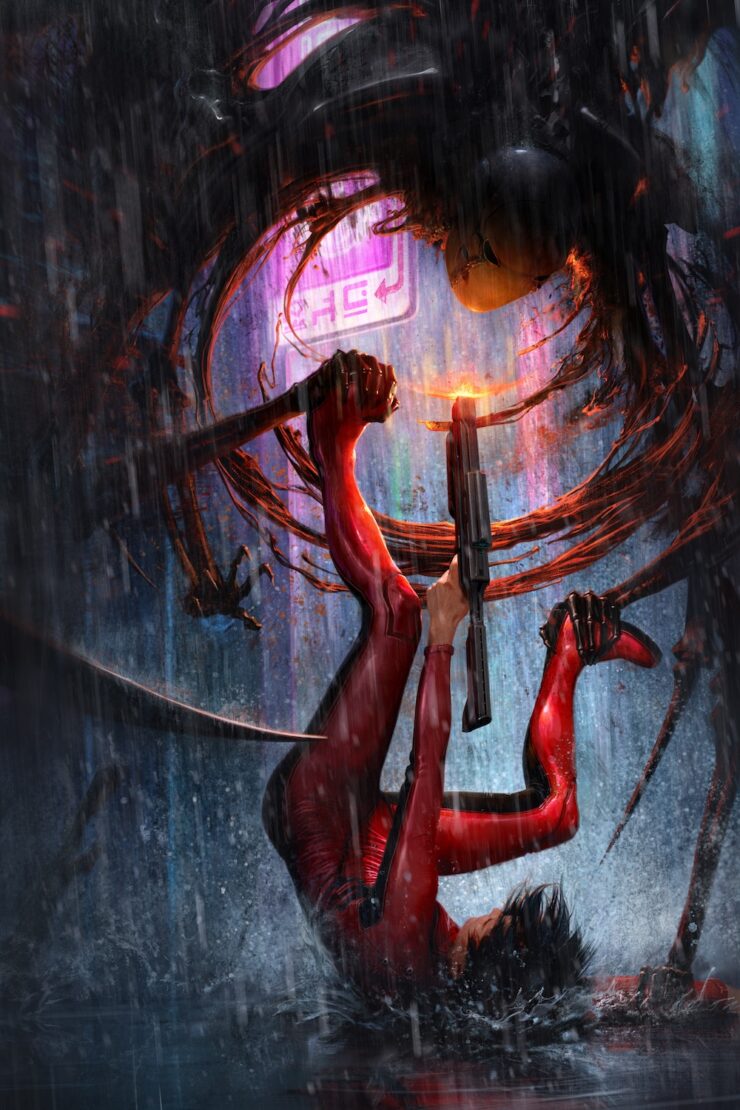
She rose from the foaming canal like a nightmare, climbing into the sky on crystalline wings, garbed in her ever-growing maelstrom of flesh and machinery. The disjointed architecture of Tau-Sants seemed to shrink and shudder below her; the few denizens still roaming the streets fled by instinct to the war bunkers.
“She’s faster than last time,” Kurkuma said, grudging.
“Hout?” I called as the Banshee beat her way toward us, shedding charged particles with each wing stroke.
“The gun’s not ready.” His voice quavered in stereo. “You need to keep her away from me.”
“We’ll endeavor,” I said. “In the meanwhile, we’ve made our decision on the trigger.” I looked across to Kurkuma. “My partner will fire it.”
Hout’s eyestalks twitched. “Some flesh, then, please.”
His homunculus cleared a space on the worktable; Kurkuma plopped down her arm entire. “Found a better one in the weapon cabinets,” she said. “Charge it to the Heretic.”
The gunsmith gave a croaky laugh, I think because he realized that he was fatally embroiled, that he would be astronomically lucky to survive what followed, much less turn a profit. I loaded a war-harness of my own while Kurkuma attached her new arm: a sturdy club of muscle splitting into a half-dozen combat tentacles.
“Suits you,” I said, grabbing hold of a ferry cable.
“Feels like I don’t know you now,” she said, doing the same. “If I changed into her in the missing years, you must have changed some, too.”
“Some,” I agreed. “Sadder. Stranger.”
“Wetter,” she said, with just a ghost of her old feral grin.
The cables dropped us out the bottom of the skyport, then swung us in a long graceful arc through the atmospheric rain and deposited us on the roof. The Banshee approached like a singularity. I armed a smartbomb, took aim, and heard her voice in my head:
“I can tell you miss me.”
My smartbomb shrieked wide, distracted by the ferrite chaff she sloughed from her orbit, but Kurkuma had hurled six and one found its way, a Fibonacci ribbon that spiraled through the maelstrom and punched into the Banshee’s true body with a burst of blood and steam.
She barely slowed. I slung the rest of my smartbombs into the air, mostly to unencumber myself, and drew my flicker-pistols. Kurkuma was alternating sonic bursts with seething antimatter, an unbroken stream of entropy that could have vaporized a Dynasty voidship. Shattered lumps of flesh and machine fell away, showering Tau-Sants with bits of the Banshee’s shifting cloak.
She flew faster. The flicker-pistols drilled holes in the sky but she swept through them, not caring for the neat cylinders of flesh she left behind; she sealed the wounds as swiftly as they appeared. Kurkuma focused fire on her wings, peppering them with hungry biogun quills—but the wings were hungrier, membranes darkening, absorbing the barrage.
It was over the moment her feet touched the rooftop. One wing became a molecule scythe, so narrow I saw nothing but a small blossom of gore as it lopped me off at the knee, and as I fell I felt her hand pat my cheek—familiar, until she dug her thumb through my eye. Even after years of pain, the pain was shocking.
I heard Kurkuma’s razor unsheathe, the clang of a parry, a grunt. Then she hit the ground beside me, and when I reached for her I touched a hard slick splinter of bone.
“Fuck.” Her voice was dazed. “Hurts.”
“Where’s the blueprint, Skinner?” the Banshee asked from above me. She ran a finger along my abdomen, finding the fresh scar tissue. “The Dynasty’s quite intrigued by it. Not every day someone designs a gun that can kill the Heretic.”
The rain pattering my face, plumbing my ruined eye socket, suddenly stopped.
“Well,” said a voice that normally came by callpod. “This is an even more spectacular cock-up than I anticipated.”
I watched through a black-red blur as our employer strolled into existence, as small and slight as the Banshee was awful and extravagant, wearing a nondescript face not dissimilar to the one they gave me.
“Have to do everything myself, don’t I,” they said. “Every little thing. I’m quite fucking disappointed in you, Skinner.”
The Heretic stepped, the Banshee lunged, and they met like binary suns colliding. The combat was fought on a dozen planes, impossible to track. I saw limbs as fractal knives and bacteria swollen to the size of attack animals and mathematical ghosts devouring each other. I saw the Banshee quailing, faltering.
“Skinner,” Kurkuma choked. “It’s ready.”
I craned my head. Hout’s homunculus had clambered up the ferry cable to crouch at the edge of the skyport, watching the madness through wide black eyes. Cradled in its tiny hands, a simple, copper-colored thing: the gun that could have ended the Dynasty.
“Has to be you,” Kurkuma said. “I can’t move.”
I was pouring proteins into the stump of my leg, regrowing as quickly as I could, but for now I crawled. The rain was falling sometimes down, sometimes up, drawing spilled blood into the sky in rosy globules. The rooftop was slippery with both.
The homunculus met me halfway, placing the gun I could not fire into my trembling hand. “Patrollers are coming through the canal,” Hout said. “I left with the blueprint. We need to get it somewhere safe. Can your employer—”
I seized the homunculus by its neck and flung it off the edge. Then, with the gun tucked against my body, I crawled back to Kurkuma. Past Kurkuma.
To the opposite end of the skyport, where our employer had done what we couldn’t. The Banshee was pinioned to the rooftop, the membrane of her wings speared through by jagged fragments of her own crystalline bones.
“Was turning coat worth it, Kurkuma?” the Heretic asked the Banshee, using her old name at last. “Was it really fucking worth it? All these alterations, and you’re still an insect. And I’m going to pluck you apart like an insect.”
There was a reason I feared the Heretic. But I crawled on, unimportant, unseen, as the vivisection began in earnest. The Banshee writhed and cursed and wailed. I crawled until her outsplayed hand was within my reach.
“Present for you,” I said, to the Banshee and to whatever trace of Kurkuma lingered in her.
“Out of the fucking way, Skinner,” the Heretic said.
I helped her grip the gun, but she pulled the trigger alone.
The report sounded like a huff of air, a short sharp laugh, and then neither of them existed. The fingers of my left hand, which I’d been pulling backward, away from the discharge, were gone to the second knuckle. The gun was gone entirely.
I splayed out over the edge, blinking my freshly regrown eye. Tau-Sants had earned the Dynasty’s interest at last, and patrollers were spreading outward from the flooded canal in an implacable red swarm. Somewhere down there, Hout was trying to slip undetected through the chaos.
“Just us, now.” Kurkuma staggered up beside me, wounds knitting themselves together with slurps and sighs. “Us against the whole fucking Dynasty.”
“I often wondered if that’s how the old Kurkuma felt before she joined them. If she felt—crushed by inevitability.” I looked over the empty rooftop. “And that was with the Heretic on our side.”
“I think I’ll like it better this way,” she said. “No more secrets.”
I decided to divulge the last of mine. “I was the one who needed you back,” I said. “I had to beg the Heretic to regrow you. I had to beg and beg, because I didn’t know who I was without you.”
She snorted. “That sort of thing is pretty fucking liminal, Skinner.” But she draped her regrown arm over my shoulder. “Hout took off, yeah? We catch up, we get him and the blueprint into the canal. Then we try again somewhere else.”
“Yes,” I said, flexing my embryonic foot. “Yes. Nearly ready.”
We lay side by side for a minute, breathing slow, reassembling ourselves beneath the rain as best we knew how.
“In the Hours Preceding the Fall of Tau-Sants” copyright © 2026 by Rich Larson
Art copyright © 2026 by Tommy Arnold
Buy the Book
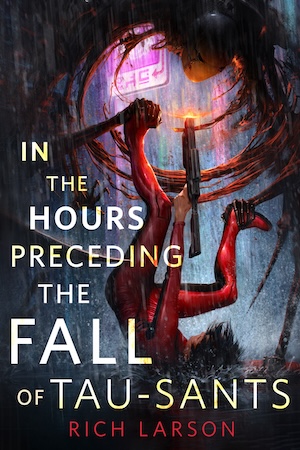
In the Hours Preceding the Fall of Tau-Sants

Pretty good!