






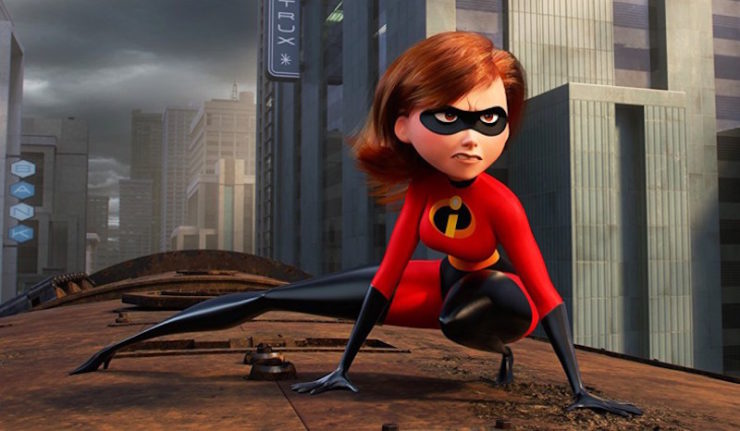
I don’t know if Disney•Pixar’s Incredibles 2 is the best superhero movie this year (I mean, Black Panther) but it is the first time this year that as I walked through the theater to leave, I seriously considered ducking into the 10pm showing and watching it all over again immediately. It also has the greatest action I’ve ever seen in a super hero movie—the only thing that even comes close is the opening of X2, with Nightcrawler bamfing through the White House. The action sequences are breathtaking in the sense that I literally held my breath during a couple of them. And again, as a hardbitten, cynical movie critic I tend to spend my movie time watching myself watch the movie, gauging audience reactions, analyzing themes. Here I was just…happy.
And yet! There were also enough messy, contradictory ideas built into the film that I was able to think about it, too.
Before we go below the cut: The first few paragraphs of this review are non-spoiler, but I do go into a bit more depth later on. I’ll warn you before we get into spoiler territory. Also, and more important: there are flashing lights and hypnotic screens in the film that might be triggering if you have epilepsy, so please be cautious if you need to.
So to begin with the basics! Incredibles 2 is preceded by “Bao,” an adorable short that plays on the same family reconciliation themes that infuse the adventures of the Parrs. This might be one of the weirdest Pixar shorts, and it’s also their best ode to food since Ratatouille.
The plot of Incredibles 2 is something of a retread of the last film: superhero-ing is still considered an illegal activity, so much of the action has to be illicit. There are a few groups that want to make supers socially acceptable again, and they bet on Helen Parr’s competence as Elastigirl to convince people that the government is mistaken. The main plot arc features one super-true-believer trying to create a grassroots movement to change the anti-super laws, and their confidence in Elastigirl is more than rewarded, as she proves to be a genuinely great hero, acting out of a genuine concern for people, and the belief that it’s her responsibility to make the world a better place. This is far more than just Mr. Incredible’s mid-life crisis from the first movie. My one quibble with The Incredibles was that because it was satirizing ’50s culture and sitcom tropes, it occasionally played up rigid gender norms—like when a superheroine uses her super strength to punch a civilian she thinks is the Other Woman. Here though, Helen gets most of those truly great action set pieces. We get to see that she’s resourceful, quick-thinking, absolutely determined. It’s a fun irony that someone whose power is stretching is absolutely inflexible when it comes to her moral core. She also works with multiple other women, providing not just support to her own super-daughter, but being revealed as an inspiration to women in many fields, and becoming a mentor to a younger female hero.
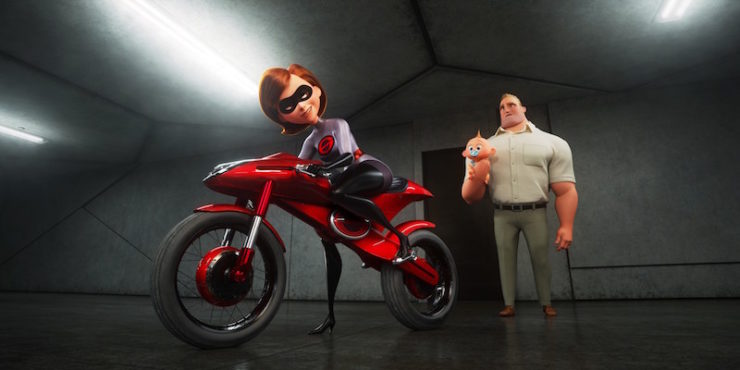
Meanwhile Mr. Incredible’s weaknesses are fully exploited. The caper in this film isn’t going to be solved by a bunch of punching, it needs Helen’s finesse and subtlety. Instead he has to live up to the awesome line from the last film, and embrace the fact that his family is his greatest adventure. Learning how to be there for Dash and apologize to Violet might not seem like flashy hero stuff, but it’s actually more important for his kids to know their dad will be there for them. The film does an excellent job of balancing more sitcom humor with the real exhaustion and elation that comes with caring for children full time. And finally, in another excellent continuation of the last film, Frozone gets to be much more than the BFF/sidekick he was last time. Here he’s a leading member of a new super team, he has his own fans clamoring for his autograph, he gets one of the best hero moments, and he also gets some of the funniest lines in the film—one of which can be read as a riff on Infinity War.
When the film begins the kids are three months into being told that they can be heroes, so they’re still pretty shaky. Violet gets to show a bit more initiative, and Dash still mostly just runs fast, but he also gets some good comic bits. The two best parts of the movie, predictably, are Jack-Jack and Edna Mode. Jack-Jack is used beautifully, each newly revealed power more terrifying and fun than the last. This is also truly an innovation on the last film. If The Incredibles was about superheroes in the suburbs, I2 builds on that to show us how difficult it is to parent a super-child who not only can’t control his abilities, but has no interest in doing so. When he gets mad, he bursts into flame. When he gets scared, he goes into another dimension. The logic is inarguable, and you can’t exactly make him stop. So how do you parent that? How do you work with his abilities rather than against them?
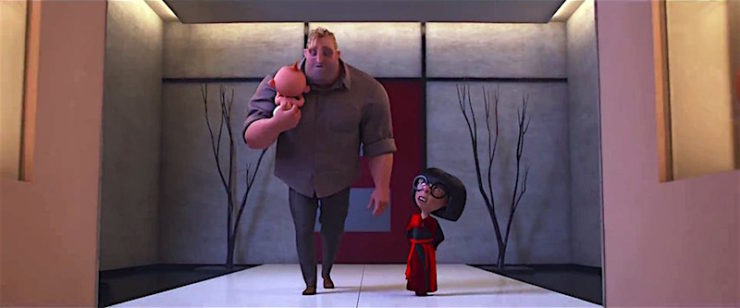
And then there’s Edna. I don’t want to say too much, because if you haven’t seen it yet I would never spoil it for you, darling. She was perfect in the last movie, and she’s even better here. My only problem is that she isn’t in the movie enough, but she’s like caviar–you really should only have a little. I should also mention that at the screening I saw, people not only applauded as the film began (which I don’t think I’ve ever seen in New York?) but there was an explosion of applause and whistling for Edna. As there should be.
OK. We’ve covered the bases, but now I want to dig into what the film is about, and to do that I gotta talk about villains, and to that I gotta spoil everything. So duck on out of here if you haven’t seen the film.
I know some people think The Incredibles is an ode to Objectivism. (True genius is punished by mediocrity, participation trophies are mocked, and while in hiding, the family is even saddled with the name Parr—i.e. at par, average, mediocre, etc.) Much like Invasion of the Body Snatchers and A Wrinkle in Time could be read as either anti-communist, or anti-anti-communist hysteria, I tend to read it as pro-creativity and anti-conformity. What I also saw in The Incredibles, which was shockingly prescient for 2004, was a critique of the laserlike nerd rage that is currently slicing through fandoms large and small. Mr. Incredible didn’t do exactly what super fan Buddy wanted, so Buddy poured a ton of money and energy into becoming Syndrome, a hateful whiny manbaby, and made it his mission to ruin supers for everybody…you know, instead of just accepting Mr. Incredible’s “No,” making his own path, and becoming a science hero, as he clearly had the skill to do. He was also willing to murder a woman and pair of children (whom, as far as he knew, were all ordinary civilians) and fridge his own girlfriend to turn Mr. Incredible into a gritty reboot of himself. I have no doubt that a few years later he would have simply doxxed and SWATted all the supers instead of luring them to Nomanisan Island. (Which, um, by the way? There’s another strike against Objectivism.)
I think Incredibles 2 continues both of these themes. There is plenty of stuff about how the government just doesn’t work in general, and doesn’t understand heroism specifically, which leads to the idea that the common man has to be sold superheroes, and given a palatable image of friendly neighborhood demigods, which leads us into the film’s true theme.
When The Incredibles premiered in 2004, it launched itself into a world where James Gunn’s first dark superhero deconstruction, The Specials, had come out to very little attention in 2000, and M. Night Shyamalan’s superhero deconstruction, Unbreakable, came out to too much attention, only becoming a cult film later. Bryan Singer had directed two X-Men movies, and Brett Ratner hadn’t yet kicked the franchise in the stomach. Sam Raimi had directed the first two Spider-Man films—Spiderman 2 had only come out a few months earlier, and Emo Peter Parker had not yet kicked the franchise in the stomach. From Hell, League of Extraordinary Gentlemen, Hellboy, and the Blade films were all marketed more as gothy horror-adjacent movies rather than “superhero” movies. Ang Lee’s take on The Hulk was… not embraced. But it got off easy compared to Ben Affleck’s attempt at Daredevil.
Buy the Book
Vicious
And that was pretty much it?
Constantine hit theaters the following year, with comics fans rejecting the film for casting Keanu Reeves, and the rest of America just being confused because Urban Fantasy wasn’t really a thing yet. Four months later, Batman Begins launched Christopher Nolan’s gritty reboot of Batman. And it was only a month after that that Fantastic Four came out—The Incredibles, with their Fantastic Four-esque powers, were released into a world where only the crappy Roger Corman quartet had hit screens. And people had never met either the Chris Evans’ Johnny Storm nor the Michael B. Jordan Johnny Storm. Iron Man was still four years away from saving Robert Downey Jr.’s career. Samuel L. Jackson was still four years away from walking into Tony Stark’s living room and announcing the Avengers Initiative. The MCU didn’t exist yet, and the concept of watching (at least) two superhero movies a year was unimaginable. And speaking of Mr. Jackson…
Nick Fury? Falcon? War Machine? Black Panther? Shuri? Nakia? General Okoye?
Nope. If you wanted a Black superhero—but you didn’t want a Goth Dampiel—you had Frozone.
I still remember explaining to friends of mine that, no, The Incredibles’ deconstruction of the superhero mythos, while awesome, wasn’t that revolutionary—a book called Watchmen did it in 1986. Our innocent eyes were still five years out from witnessing Zack Snyder’s violent Randian blimp sex.
No Heath Ledger Joker, no X-Men retcon, no Logan, no Deadpool, no Super, no Kick Ass, no Henry Cavill CGI upper lip, no Batffleck, no Wonder Woman, no Netflix/Marvel hybrid shows, no Agents of S.H.I.E.L.D., no Agent Carter, no Runaways, no Cloak & Dagger, no whomever I’m missing here. (I know I’m missing people/shows here.) No ongoing battle between Marvel and Star Wars for box office supremacy—which has since been rendered moot by Disney buying both of them.
Now just look through that list of stuff that didn’t exist yet. Comics fans knew a lot of these characters, but they weren’t yet the mainstream cultural juggernaut that they’ve become. So I think it’s extremely interesting that this film bundles two ideas together to create a villain: the charge that we’ve all become too dependent on screens and passive forms of entertainment, and that we’ve entrusted our safety to superheroes. (Which, I have to say, I admire the eggs on Brad Bird to blast superhero films in the middle of his own superhero film.) The real conflict in this film is between Win Deavor and his sister Evelyn.
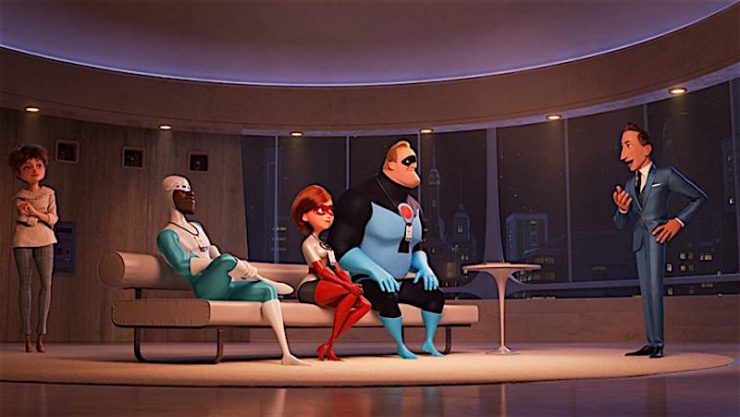
Win, who’s expanded the family holdings through his tech company, wants to fund the campaign to bring superheroes back, thus outsourcing human safety. His sister, the company designer, seems to want to promote Elastigirl as a form of feminist solidarity. As we learn early on, she’s actually using an evil persona called “Screenslaver” to scare people away from both their dependence on screens and passive entertainment, and heroes. And, as in Black Panther, the villain here is not exactly, um, wrong? But like Killmonger, Evelyn Deavor is only too willing to allow innocents to take the fall for her revolution. While Win’s shiny happy reliance on heroes isn’t healthy, her utter callousness toward the people she’s claiming to want to “help” shows us that she doesn’t really have the moral core to create a better future. And while tying these two ideas together may seem like a stretch worthy of Elastigirl herself, the more I’ve thought about it, the more it worked for me.
Obviously on the surface, the whole “let’s not depend on superheroes” thing only seems to work in the high tech alt-’60s wonderland of The Incredibles, or as a commentary on the DCU and MCU. But once we dig even slightly into our own world, we can see that we have largely outsourced our morality and eloquence and sense of outrage at injustice—we express our horror at atrocity via memes, jokes, mis-attributed quotes passed along from email forwards to Facebook shares. We’ve outsourced our research to Snopes. We like and retweet other people’s reports on injustice as though we’re actually doing something.
We rely on the vague hope that eventually the information will get passed along to the right hero or conscientious government official, or, I don’t know, Buddha, and that that person will act on the tip. And please understand that when I say “we” I’m goddamn including “me” in that—I’ve done more than my share of sharing.
What the Incredibles pointed out, both in their first screen outing and their latest one, is that we can’t rely on that. If Win and Evelyn’s parents had taken care of themselves and dashed for the saferoom, they would have lived. If Helen hadn’t taken it upon herself to go rescue her husband, Syndrome probably would have killed him. (I know, her initial call is what got him caught in the lair, but I don’t think he was making it off that island regardless.) If the kids hadn’t taken the initiative to step up and rescue their parents, everyone on the boat, plus all of the New Urbem citizens in the vicinity of the harbor, would have died in the boat crash.
And I know I’m maybe muddling the message here by taking moral advice from a cartoon, but I think this is the biggest argument against Randian thinking here: it’s on us to be the heroes. It’s on us to recognize when the government is enacting unfair laws, and to work to change those laws—maybe not through creating portals through spacetime or running at lightspeed, but Win Deavor’s path of grassroots organizing and education seemed to work pretty well. By the end of the film people have been poked enough to realize that they are allowing themselves to be too passive, and they’ve recognized that they’ve been unfair to the supers. A whole new team of powered people have come out of hiding, and will hopefully be able to live better, more fulfilling lives in a society that values their gifts. The Incredibles have once again bonded through hero-ing as a family. Brad Bird has expanded his original story into a universe that could tell a lot more stories, and inspire a lot more heroism.
Leah Schnelbach thinks we can all be heroes, even i just for today. Come monologue with her on Twitter!

“And I know I’m maybe muddling the message here by taking moral advice from a cartoon”
I think it’s completely legitimate to get moral advice from fiction. To me, The Incredibles — and books/films/comics/television in general — are just as valid as the Bible or Quran. Hell, even reality television can be seen as cautionary tales (i.e., don’t be like those people).
“(I know, her initial call is what got him caught in the lair, but I don’t think he was making it off that island regardless.)”
Forget off the island, how’s he getting out of that room without getting caught? Was he going to open up the lava wall and have that, somehow, go unnoticed?
Certainly a worthy story as a successor to the original. Many great moments: in Helen and Evelyn’s conversations, both pre- and post-reveal of the antagonist. Bob’s manifesto about how he’s just going to power through and become a super dad (because that’s his go-to strategy), epic raccoon showdown, and more.
I was somewhat amused that Win Deavor really looked for all the world like a young Walt Disney (not surprisingly given the source production House of Mouse, but it seemed pretty obvious to me.)
Win’s speech on the boat as they were signing seems a very much a blatant analogy of LGBTQIA+ rights (in many places in the world, considered against local law), also maybe the current climate concerning immigration and who belongs where. The supers are considered “illegal” even though they are born with these powers–this is who they are, they didn’t ask for this, nor can they change it. But they can be allowed to live their lives–and use their abilities–without fear of government censorship and imprisonment.
The potshots at politicians being scared and confused by good people doing the right thing just because it’s the right thing, and Screenslaver being wealthy so will likely only get a slap on the wrist and released from prison early, were also laser-pointed commentary.
I like Void. I wanted a little more of some of the other new heroes, but time and story space, and she was a good choice for the “face” of the new hero group. Frozone being the only PoC hero we really get (besides very briefly with some of the ambassadors, and none of them have speaking lines) is probably the strangest aspect of this, given Win’s attempts to branch out and find heroes from all over. We also still don’t see Frozone’s wife (though that’s a familiar running gag to have the offscreen presence).
I figured one or both the Deavors to be the villain early on–the plot was predictable and a bit formulaic, but in the right ways, I think; it mirrored the previous film well, and the main draw of The Incredibles is the character relationships and interactions, and learning how to not only be super, but a family.
@@.-@: It was fairly obvious who the villain was going to be as soon as she was introduced- after all, her name is ‘Evil endeavour’!
@@.-@ Krushauer was a PoC hero; Helectrix wasn’t seen close up enough for me to tell (might have been lily-white, might not have been), and both were voiced by a PoC, Phil LaMarr. Still not a lot, but more significant than the ones with the ambassadors.
Great movie, for all the reasons enumerated above. It is very rare for a sequel to rank right up there with the original, but this one did. And any chance to see more of Edna is appreciated.
I thought there was waaay too much Jack-Jack in this one, but I get it, the little kids love this stuff.
Regarding the moral questions the movie raises, am I the only one bothered by everyone’s acceptance of Rick Dicker’s memory wipes (aside from the one little complaint that he was sloppy about erasing violet from her crush’s memory)? Talk about violating personal boundaries. Not cool, Dicker, not cool.
Well, the government’s use of memory technology I believe is originally just a fun homage to Men in Black and other secret government organization tropes. However it was actually quite nice that they portrayed the impact that actually has. Violet already felt invisible in the first movie. Having the kid not only forget their date that she finally had confidence to setup, but seemingly forget that he even knew her in passing would have just thrown up that whole sensation in her face again. It’s kind of plays out like over-the-top teen drama but it really isn’t in this case.
As far as any life lessons from the movie. In the U.S., We the People are the government. Those people in Washington are EMPLOYEES. As the EMPLOYER, you vote and that hires all those people just as President Trump talked about in his inaugural. This movie reinforces the reality of the deep state and insiders in Washington who have come to act as rulers and believe they should be the government. This is a complex topic for an animated movie in itself but is matched by the overall topic of enhanced people and what the unenhanced will do when enhanced people exist. Of course, the X-Men have delt with this from the start .The catch is we are now only about 20 or so years from having actual enhanced people so the topic is now very real.
I’m not sure that Screenslaver’s rant was genuine, and not just a convenient theme to create a distraction. The goal was never ‘eliminate screens’, it was revenge against supers. Its just like accusing millennial of foolishness for wasting money on avocado toast.
I enjoyed the film, but I most enjoyed the character moments as the opposition plot was the same as the last one. Smart person has a bad super’s related incident in their youth that drives them to plot revenge, using acting as a patron to a super as a part of their plot. I’m getting kinda tired of the unusually smart people turn evil trope.
I thought of Mr. Incredible as a Rust Belt dad who has lost his job, so the family has been thrust against its will into a female breadwinner/male homemaker situation. In real life, the result is often alcoholism, drug abuse, and suicide; but the film takes a more optimistic view, and he rises to the occasion. (And so does she: in a real life example, when Jane Wyman‘s career took off, while hubby Ronald Reagan’s tanked, she dumped him.)
Though it’s never stated explicitly, the audience intuitively grasps the reason — call it sexism or realism — that Elastigirl is chosen to be the public face of the superhero rehabilitation movement. It’s like Iceland choosing a female-dominated government after excessive risk-taking took down its banking system in 2008.
I had initially been worried about how they would play up the ‘bumbling dad’ stereotype but I think they did a good job – Bob is still ultimately a competent father, but they also don’t downplay that it’s way harder than it looks.
I don’t know if I’m in a minority or not but I actually think Jack Jack is the weakest point of the film – not that there’s a ton of internal logic in these movies, but he just seems over the top powerful, and it’s mostly played for gags or whatever the plot demands at the moment – of course he has a power that fits. (With the exception of his relationship with Edna which was just PERFECT and I want to see more of that frenzied night!)
I like your take on Buddy/the original Incredibles, btw – and I kind of chuckled at Buddy trying to make a ‘gritty reboot’ of Mr. Incredible.
Regarding this movie:
I have to admit that while it was pretty obvious to me from the start that one (or both) of the Deavors was going to be behind it all (given that they run a telecommunications company and the whole thing is based on hijacking screens) in a way it was a twist to me that Winston really was – despite fitting the stereotypical slimy exec trope – basically exactly what he seemed (and even risks his own life to save the other ambassadors and supers at the end). He is somebody who actually looks up to the heroes and wasn’t trying to either subvert them or staging all the crises for PR purposes. I wish we had more of that, actually – the supers inspiring normal people to be heroic. (Supergirl and Spider-Man are two of my favorite examples of this…) And as you mention, in our world this involves more than just fancy powers or dazzling heroics.
Because Evelyn does have a certain point. That said, her grief over her father is ab it misplaced. I have to admit, my first question is, “Why didn’t he call the police, who exist to handle exactly these types of thing, instead of vigelantes?” But even if he had, he would have been shot. My second question was, “Why the heck didn’t he just put the phones IN THE SAFE ROOM?”. There is certainly a discussion to be had regarding what we rely on for safety (which could also apply to any group we give that kind of responsibility to, not just supers. Does relying on the police make us ‘weak’? Should we all just have our own guns an defend our own homes?).
The other, potentially more interesting topic, is her rant about ‘trust’. Why SHOULD we trust the supers? In a way it’s similar to what the Avengers or X-Men bring up. Just because they have super-powers doesn’t mean they are good. And again, this can be applied to groups like the police as we see in our own day. How do we empower these types to do their job, but also keep them accountable? In some ways, brainwashed though they were (and it seemed pretty easy to do so), I feel like their chilling speech about taking over would have given more people pause about changing the law. At least in our current society, I could see a lot more fear/paranoia taking over (similar to what I see in arguments against refugee, asuylum seekers and immigrants) as an excuse to keep them illegal.
Granted, that’s all a little deep for a kid’s movie but I would have liked a little more on that – but I still liked the movie, and I also liked that Helen ends up saving her in the end.
@11 – I don’t know – when she’s not ‘in custome’, Evelyn also goes on a bit of a rant about how people prefer ‘ease’ above all else, so I can see some of that playing into her real philosophy of people who rely on other things, prefer to live vicariously, etc.
@13 – I’m not sure I follow. It seemed pretty clear that Elastigirl was picked because she causes less collateral damage by the numbers. Unless you’re saying that in itself was a sex-focused trope?
@14: Yeah, I (finally!) saw this last night, and liked it a lot, and to me the biggest “twist” was that Winston wasn’t in on it with his sister. In fact, for a while I was entertaining the possibility that the “burglars” who killed the parents were actually Winston & Evelyn, but I suppose that would’ve been a bridge too far for a Pixar movie.
Finally saw it last night! I had a good time, it was funny and I enjoyed, but if I have to actually think about the message, I found it less solid than the first one and that other Pixar films.
The good things: I liked that the film started right after the ending of the last one and that it show that things weren’t simply solved and that superheroes could actually make things more complicated, I like the opportunity to show Helen’s personality (the cynic or believer), Jack-Jack and Edna were the best, I second the petition to have a short about their moment together and the color of the sky during the train scene was simply breathtaking.
Having said that, it was extremely obvious for me that Elastigirl shouldn’t trust the Deavors. I have to admit I thought Will was the fake one, and that he wanted to control or use the superhero camera to get in rich in some way.
About Evelyn, I don’t think she actually believed what Screenslaver said, in the end, her motivation was personal (parent’s death) more than a critique to passivity, technology or media. At first, I was impressed that brought a point like that in a family film and in our times, but then it went nowhere.
About the illegality of superheroes, I think it wasn’t really solved at the end. What people saw were superheroes hurting people and then stopping, how can they be sure of their intentions? It’s exactly what Will said, people don’t have access to the information.
About gender and family, the question of the young female superhero with powers to go to another dimension (not sure if she is the Void the review mentions or Voyager, I saw the film dubbed and it was “Viajera”) wasn’t really answered (How Helen balanced her personal life and superhero duty?). In the end, she is returning to be the family carer.
Also, I don’t agree with the reviewer that the message of the film is to call people to be less passive, at the end, everyone who saved the day were super. It would have been nice to show regular citizens being inspired by them to do more.
P.S.: Wow, the Bao short was too weird, tbh.
What is the moral of the story ?