







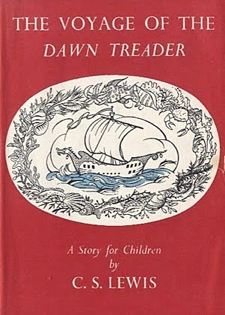
The Voyage of the Dawn Treader has perhaps the greatest starting sentence to any of the Narnia books:
There once was a boy named Eustace Clarence Scrubb, and he almost deserved it.
My pity is immediately roused, however much that pity is about to get tried in the next couple of chapters.
Eustace Scrubb is the child of decidedly modern parents that C.S. Lewis thoroughly disapproved of. (They don’t sound as bad to me, except for the whole not drinking alcohol part and the weird underwear, but tastes differ.) Convinced that such childrearing would invariably produce awful children, Lewis in turn inflicted Eustace upon young readers: arrogant, whiny, cowardly, and fond of dead beetles, he is atrocious even by the standards of British children’s literature, skilled at creating portraits of atrocious children. (I don’t know why the British tend to be better at this than other nationalities, but they do seem to have a gift for it.)
And yet, he features in one of the most delightful of the Narnia books, a glorious tale of sailing into the (literally) sweet unknown, however much it may be marred or perfected (depending upon your tastes) by the ending.
(By the way, if any person reading this post is coming to it with knowledge only of the recent film, I can only say… liberties were taken. Vast liberties. So try to put much of the film aside for now.)
When Dawn Treader opens, Edmund and Lucy are facing a terrible time living with their annoying cousin and desperate to get back to Narnia, even if it means only losing a few minutes of time in England (that wacky time difference between magical worlds and our world again). Making matters worse, they even have a Narnian ship in a painting to look at, but not get to—until, that is, the painting sorta comes alive and drags them and Eustace into Narnia.
This time, they are not in Narnia to rescue the land or restore the proper king to his throne, but rather, to go on a cruise. Now, this is fantasy, even if said cruise gets interrupted by hurricanes, invisible bouncing dwarfs, nightmares, and water that kindly turns things into gold but will also easily kill you.
This is also a tale of temptation and self knowledge—not a new theme for the Narnia stories, which began with a child willing to turn over his siblings to a witch for the chance to eat more candy, but here handled more subtly. Nearly every island is some sort of test for someone: leadership and strategy for Caspian on the Lone Islands with the slave dealers; vanity and self-esteem for Lucy on the island of the invisible one-legged dwarfs; shame and self-knowledge for Eustace on the Dragon Island.
To digress about Lucy’s test for a moment. She is first tempted by a spell to make her beautiful beyond the lot of mortals, which apparently would lead to automatic war (or a suspicion that in preparing to write this book Lewis spent far too much time reading Homer, whichever) but, moving past that, does give in to the temptation to listen to what her friends say about her behind her back. As is the typical literary fate of eavesdroppers, she doesn’t like what she hears. And here’s where I part ways with Lewis: Aslan tells Lucy that she has misjudged the friend, who is only weak, suggesting that had Lucy not overheard the conversation, they could have remained friends, and she was wrong to eavesdrop. She might have been wrong (okay, yes, she was wrong). But isn’t it better for Lucy to know the truth? (I even seem to recall a Biblical quote or two on the subject.) Does she really want to have the sort of friend that will betray her so easily? After all, a similar betrayal nearly got her and her siblings killed just a couple of books ago.
The more interesting story is probably that of Eustace and his transformation into a greedy dragon, and his very painful transformation via skin removal and baptism into a regular boy again. But I find I don’t have much to say about it except to say that Lewis does seem to have a very real idea of what it is like to find that you are a burden and a nuisance no matter how hard you are trying, and how very hard it is to try to be likeable when you really don’t know how. As difficult as it probably is to identify with Eustace in the first chapters of this book (and particularly through his diary, which although amusing has a very adult tone—I didn’t know any kid who talked like that), here, he becomes someone all too easy for many children to identify with.
Which is good, because, alas, other than that adorable mouse of chivalry, Reepicheep, most of the other characters are fairly bland. Caspian, in particular, is even more bland than he was in his eponymous book, with only a few unexpected moments of pouting to distinguish him from anyone else. Unfortunately, these moments occur in a book filled with pouting, making them, well, undistinguishable. But if the characters are unusually bland for a Narnia book, Dawn Treader held me spellbound—even in the end.
Here, Lewis tries to abandon the book’s implicit Christianity for a more explicit one, having Aslan appear to the children in the form of a Lamb, with a nice capital letter for emphasis, and Aslan explaining to the children that he also lives in our world, only under a different name. I say, “tries,” because as a child reader who had completely understood the implications of Aslan’s sacrifice in The Lion, the Witch and the Wardrobe, here, I assumed that he meant that our world also had talking lions. I was tremendously excited (and terribly disappointed afterwards). As an adult, I find this more explicable, but also more intrusive: a jolt of our world into Narnia, rather than allowing the delight of that final fantastical voyage to linger.
Aslan’s next statement, though, is the truly problematic one: that Lucy, Edmund and Eustace have been summoned to Narnia solely for the purpose of getting to know him there, so they will know him a little better here. To which I can only say, what? Even if we are going with my (severely incorrect) idea that our world is filled with magical talking lions, surely these kids could have found easier ways to find them?
But more to the point, this statement seems to contradict the entire point of the earlier two books: that the children have been brought into Narnia to help save Narnia. (Admittedly, in Dawn Treader none of the three kids seem to do a lot of saving, unless you count Lucy turning the Dufflepods visible and Edmund explaining to Caspian just why a pool of water that turns things to gold and deserting your country are kinda bad things.) Why exactly should Narnia be used as a spiritual testing ground? And why these kids, instead of others? So that they could become evangelicals back on our world? And if that was the plan, how exactly was that supposed to work, given what is going to happen to them in four short books before they have the chance to convert anyone?
I suppose, if we stretch the point, we could argue that they were chosen since they knew the narrator of the books, who could then be trusted—despite being an adult—to spread the message, to allow other children to get to know Christ through Aslan. But this is a stretch. Aslan’s statement seems breathlessly unfair to the Narnians (Hi, cute little talking animals! I could have rescued you guys much sooner, but I needed to introduce some kids to Christianity! Sorry for all that old and missing Christmas stuff!) and not all that fair to the children, either.
And as much as I disliked hearing that the older children could not return to Narnia in Prince Caspian, I like it even less here, mostly because that injunction does not include Eustace, who throughout the book has come across as older as his cousins. His transformation into a dragon appears to have restored some of his childhood, but not all: he is still cautious, questioning, and, well, not all that young. (In fact the dragon transformation seems to have considerably matured him.) Indeed, if Lewis’ timeline is to believed, he is only one year younger than Lucy, who is about ten in this tale.
But perhaps that is part of the underlying point: Lewis, as literary critic and religious apologist, was well aware that the world is not fair, or at the very least does not seem fair. This was a point he would later touch on in later Narnian books, particularly The Horse and His Boy, about the nature of perceived and very real misfortune.
And none of this takes away from the very real fun of the voyage itself, or of Lewis’ abilities to sketch out a plausible underwater culture of mermaids and sea-peoples in a few sentences, or of the sheer poetry in his descriptions of the last chapters. Not to mention the joy of dragons and talking stars, of drinking water that is almost light, of sailing into the very ends of the world.
Mari Ness previously discussed some of her concerns with using Narnia as an instructional and testing ground for British children. She lives in central Florida.

I hope it is ok to quote you so I can describe my problems with the movie without swearing. You summed it up nicely.
I always saw Eustace as one of those overly mature children, with a fake mask learned from his parents. But I did not realize he was only a year younger than Lucy. I don’t think age has as much to do with being able to return to Narnia. It is more about maturity of faith, which Lucy and Edmund both lacked at the end of Caspian, though not as much as in the beginning. Both younger Penvensies learn they can be heroic on their own in Dawn Treader.
Great article and I hope more about the Chronicles are coming.
I’d be interested in hearing a theologian discuss this book. I like seeing a secular opinion of the book as a fantasy story/fairy tale, but I’d also like the contrast of a deeper look at the religious allegory here.
Lewis uses these stories to illustrate somewhat difficult theological concepts in simple and elegant ways. The story of Eustace as a dragon is much more complex than just a baptism, and is a great expression of the Christian concept of repentance.
As for the problem presented by the post author: “Aslan’s next statement, though, is the truly problematic one: that Lucy, Edmund and Eustace have been summoned to Narnia solely for the purpose of getting to know him there, so they will know him a little better here.”
Again, this is allegory. The path to knowing the Divine is very individual. Why these two kids? Why this path? Well, from a religious point of view, one gets the sense that God/Christ/Aslan customizes the path to perfectly suit the individual. The religious experience for a Christian is not as much about saving the whales or feeding the poor (though a good Christian will take care of the planet and our brothers and sisters on it) as it is about coming to know Jesus. That’s the point here, I think.
Anyway, there’s much more to this that I’m not terribly qualified to speak on. I’m not trying to convert anyone or “evangelize” here; I just think the Christian context opens up the author’s intent.
There’s also a lot of insight from the Planet Narnia perspective – I mentioned this before on a previous post. Dawn Treader is in the spirit of the Sun, Sol Invictus, Apollo. So it’s neat to see lots of reference to gold, dragons, and generosity.
Thanks for the good work on these reviews/recaps.
Not to give offense, but I always saw the Scrubbs as being an attack on and caricature of Mormons. In particular, placing them as other and different, with the child needing to repent of what he was and become like the Pevensies.
As a result, this has always been my LEAST favorite of the Narnia books. I like most of the rest, but can not enjoy this one with that standing so vividly. I read it once (If I have started, it seems almost like quitting to stop, though I can do so under extreme duress) and then never again.
The island at the end of the world, Caspian, Lucy and Reepicheep were well done though.
This is my absolute favorite book in the series. I’m wondering if I’m the only one who refuses to watch the movies because they’ll spoil the books? I’m afraid that if I watched the movies, then the next time I read the books I’ll be getting the movies images stuck in my head (instead of my own). I haven’t watched any of the Lord of the Rings movies either for this same reason.
@TorSaric25 – I never saw any Mormon parallel with the Scrubbs/Eustace. I always thought of it as much more universal. Basically we’re _all_ dragons … who need Christ’s forgiveness/cleansing/change of heart … deep down – not just surface level (Rom 3:10 ff, Psalm 51). Of course Edmund went through the same thing, just different circumstances, like @El Zarcho mentions.
@mari Ness – thanks for the article! I never really noticed the individual trial aspect of the islands before.
re: Aslan’s statement – I guess I always just thought of it as more abstract … basically Lewis explaining why he wrote the books.
A nit on this statement: So that they could become evangelicals back on our world?
Lewis has been adopted post-mortem by evangelicals (at least in America–I don’t know about Britain), but he was not considered an evangelical in his lifetime, and his religious preferences for high-church Anglicanism ran counter to the low-church non-denominationalism that defines evangelicals. In particular his views on Purgatory (which he believed in) and Biblical inerrancy (which he didn’t) were very different from the evangelical mainstream.
Now, on to the book. This is not one of my favorite Narnia books (that would be The Magicians Nephew), but Eustace’s transformation into a dragon and back has to be my single favorite episode in all of the Narnia books.
Not to give offense, but I always saw the Scrubbs as being an attack on and caricature of Mormons.
I really can’t see where you got this from: I thought the Scrubbs were pretty clearly intended to be classic rationalist thinkers in the style of George Bernard Shaw. Approving of collecting beetles and disapproving of fairytales and chivalry were fairly standard for the atheist scientists often taken as the academic opposition of English literature dons like Lewis. (Putting the Scrubbs in Cambridge rather than Oxford was presumably a little dig at the opposition from an Oxford loyalist).
To Mari: what’s your thinking on the England timeline here? When I read it, I certainly assumed that it was set after the war was over, but I’ve seen references to a Lewis timeline setting it in 1942. (My thinking: Mr Pevensie on a lecture tour; Mrs Pevensie taking her first holiday in ten years; being able to take Susan with them; none of these can be reconciled with braving U-boats at the height of the Batlle of the Atlantic).
(continued)
@TorSaric25, I doubt that the Mormon comparison was meant by Lewis, because there are so few Mormons in Britain, and I don’t believe there is a single explicit reference to Mormons anywhere in Lewis’s writings. I could be wrong, though!
Really, I see the Scrubbs as Lewis’s version of today’s “helicopter parents: humorless, ostentatiously up-to-date, eager to embrace all the latest parenting fads. These are the sort of people who want to redact Huckleberry Finn for fear that exposure to the n-word will forever taint the soul of their flawless offspring.
I think it was the teetotalism and “special kind of underwear” that sounded Mormon. In fact, Lewis is drawing on Nesbit here. The Eustace Scrubb (“and he almost deserved it”) thing is based on E. Nesbit’s gentle take-down of faddy folks, as embodied by one “Eustace Sandal” (Nesbit speaking in the voice of Oswald Bastable):
“Father knows a man called Eustace Sandal. I do not know how to express his inside soul, but I have heard Father say he means well. He is a vegetarian and a Primitive Social Something, and an all-wooler, and things like that, and he is really as good as he can stick, only most awfully dull. I believe he eats bread-and-milk from choice. Well, he has great magnificent dreams about all the things you can do for other people, and he wants to distill cultivatedness into the sort of peoplewho live in Model Workmen’s Dwellings, and teach them to live up to better things. This is what he says. So he gives concerts in Camberwell, and places like that, and curates come from far and near, to sing about Bold Bandaleros and the Song of the Bow, and people who have escaped being curates give comic recitings, and he is sure that it does everyone good, and ‘gives them glimpses of the Life Beautiful.’ He said that. Oswald heard him with his own trustworthy ears. Anyway, the people enjoy the concerts no end, and that’s the great thing.”
As a member of the Fabian Society, Nesbit no doubt knew an awful lot of people like this (even George Bernard Shaw, though by no means a dull fellow, was a vegetarian and — at least for a time — an all-wooler).
The children end up visiting Mr. Sandal’s sister’s house (“She was like him, only more so in every way”) and complain about its being so very plain: “There were only about six pictures — all of a brownish colour.” Very much like Lucy and Edmund’s opinion of their aunt and uncle’s house.
Y’all are probably right in that he didn’t mean it that way. My comment was somewhat stronger than I meant it to be. But though it may not have been intended, it seemed like it was when I first read the book. I really like Lewis’s books in general, but it just turned me off the book when I was younger and I’ve never really gotten past that.
I am unfamiliar with British culture, and was very much so when I first read it. I have read little to none about Shaw or Nesbit. I keep up reasonably well with current american political theory and classical liberalism, but socialist theory has never interested me in the slightest.
@HelenS Thank you for that quote and commentary. You’re probably right.
Sorry if I came across too strong! My understanding was that he had some interaction (and theological disagreements) as he wrote his apologetic work, and maybe that predisposed me to see what wasn’t there. Still hard to get past a strong emotional reaction from a first read, so I’ll probably not pick it up again, though.
Thanks to all who responded.
I always assumed Lucy and Edmund were brought to Narnia to save the world in the first two books, and it was just this time that they were brought there for their own spiritual development. As a reward, sort of.
If you want to go into who explicit Lewis was with his Christian message in this book, you completely missed out on Eustace’s transforamation into a dragon. Satan has always been connected to the image of a dragon, a selfish, hoarding being with evil intent. The fact that Eustace himself became, as you said, a “greedy dragon,” and that Aslan, as the image of Christ, had to come save him through removal of sin, pardon, skin, and convert him back into the proper form, screams of Christianity and salvation.
I always think of Voyage as being a sort of cheater book, where the author rather gleefully gets away without providing any actual plot. But I liked that — I’d much rather have a frankly episodic book than have a plot lugged in because, well, you have to Save the World again or it won’t be a Real Book.
Doesn’t the narrator say near the beginning “long ago in the war years”? That seems to me to rule out 1942. If the children were evacuated relatively late, say in the spring of 1941, perhaps Lucy was eight or so then, which would make her thirteen in 1946. But I don’t think we can count on Lewis to be very good with dates.
There’s another possibility at
http://www.imdb.com/title/tt0980970/faq:
“Book Answer 2: The second viewpoint makes the assumption that the statement in VDT about LWW being “long ago in the war years” should be taken as in-universe canon, and that we should thus work backwards from there to calculate the dates of the other books. However, with such an assumption, it is difficult to make the “long ago in the war years” statement fit with the stated time lapses between stories, and with the time frame of real world events, in particular The Blitz, which lasted from September 1940 to May 1941. In order to reconcile this problem, one can take into consideration the idea that the evacuation in LWW was during the Summer, as Lucy told Tumnus this upon their first meeting. There was only one time when the bombs fell in London in the Summer months and that was in 1944. If they were part of the final evacuations, that would push the timeline up four years, and would allow VDT to be set in the post-war years, giving an approximate date of August 1946 (1 year after the end of WWII)”
When I read it at 12, I probably hewed to the prevailing wisdom about eavesdropping being wrong. But as one who had been beset with phony “friends”, I think I wasn’t entirely sure, and now I know I’m not entirely sure. I decided to respect people’s privacy, and also that if someone was saying bad things about me I would rather not know, but I still agree with Mari Ness on this scene. I still don’t think it was quite kosher to eavesdrop like that, but I don’t know what I would have wanted Lucy to do now that she knew one of her friends was bogus.
I had read some criticism saying that the part where Caspian wants go east and has to be convinced to stay and rule, was inspired by an English King who abdicated to marry an American woman. That made me just a wee bit uncomfortable too–what if one can never really be happy with the role that a culture has saddled one with because of the circumstances of one’s birth? Same thing with Shasta/Cor not having any choice in his destiny. I am not sure I would saddle any being with an ill-fitting life, even to save a world.
That said, “The Dark Island” was/is a genuinely scary episode!
Thanks for another great Narnia post! It’s nice to hear someone else’s thoughts on the series, and these commenters have provided some not inconsiderable tidbits themselves.
Just wondering, though – I haven’t gone to see the movie of Dawn Treader yet, and despite having enjoyed movies one and two, am now apprehensive at the ‘liberties’ that were taken by Walden Media. How far from the original story do they go? Or is it that they cut stuff out in favor of new plot? I imagine they must have changed the ending at least a little bit. Anyone able to give (semi-)spoiler-free advice?
My spoiler free advice would be: avoid the movie like the plague. The Voyage of the Dawn Treader is my favorite Narnia book. I saw the first movie at the El Capitan Theatre in Hollywood and enjoyed it immensely. (The snow in the theater, the icicles hanging over the concession stand, and the live statue of Mr. Tumnus were icing on the cake; I actually liked the movie itself, too.) This movie was horrible. (Except for the art direction. The ship and the clothes were pretty good.)
I’m also not a huge fan of the movie. Your mileage may vary though…I have a friend who’s much more a Lewis/Narnia fan than I, and she loved the movie!! I think she may have been going in with lower expectations though. I was always a bit apprehensive of them making Voyage a movie simply because well…there isn’t a typical “movie plot” in the book! I figured they’d invent some evil menace, and sure enough…they did. And while I thought they got the general “feel” of the book pretty well nailed(imagery and characters were great!), they also failed miserably at hitting some of the highlights of the book, in my opinion. Rather than adding some stupid script-writer’s inventions, they could have actually – I don’t know – shown Eustace’s dragon transformation?? Like was mentioned above, Eustace’s dragon transformation and the events that ensued was the highlight of the books for me. And the movie did not do it proper justice. On the other hand, I much enjoyed the actor who played Eustace.
And oops sorry, now I’ve gone into a movie-rant!!
But about the book, I do so love this book. Along with Silver Chair, this has been my favorite of the series. Just a delightful adventure!! Eustace is definitely my favorite character(as odd as that sounds!) and is probably the reason why I love it so much. If it had just been Lucy and Edmund and Caspian…I probably would have found it rather boring. But Eustace’s journey catapults the book into another plane, making it a most enjoyable read. Also…all the fun island adventures were a pure joy to read – reading this as a child who loved to make-believe such adventures, I just soaked it in.
@junefaramore – Interesting idea about the maturity of faith, but that brings me back to the problems of Prince Caspian – surely both Edmund and Lucy showed a stronger, more mature faith than Peter and Susan, who start by showing disbelief, and have to see in order to believe? Or are you suggesting that by learning about doubt, Peter and Susan gained that maturity, which Edmund and Lucy never did? Not that they really doubt much in this book.
@El Zarcho – I guess my real question is, why put all of Narnia at risk just so four children can come to their own self-realization about Jesus, given that opportunities to grow and deepen in faith are not exactly lacking on this world?
But you’re right – I’m not a theologian, so I may well be missing various nuances here. I do think that Eustace’s story is an ideal adult baptism, including, as it does, redemption, self-awareness, repentance, and literal shedding of sins followed by the immersion of water. From that aspect, it’s interesting that Lewis, who would have certainly been familiar with the practice of infant baptism in the Catholic, Anglican and Methodist faiths that he was in regular contact with, chose to show a more aware, nearly adult baptism.
@TorSaric25 – I have to agree with others here that I never got a particularly Mormon vibe off the Scrubbs, mostly because, well, yes, the underwear, but Mormons are hardly the only religious group to abstain from alcohol. With that said, although I honestly don’t know much about the number of Mormons in England in the post-war period, Lewis did marry an American woman and could very well have learned about Mormons from her. I don’t know if he did or didn’t.
@matt1616 – You may well find your mental images of the books changed after watching the first two movies. I think it’s safe to say this will not happen with the third movie, except, very possibly, with the Dufflepud scenes, and that’s arguable.
@jaspax – Right. I was using “evangelical” not in the sense of the contemporary Evangelical branches of Christianity or contemporary evangelical churches, but in the original sense from the early Christian and later periods – of Christians tasked with spreading the good news or gospel, or “evangelicals.” This is also how Lewis used the word.
@Azara – Lewis’ timeline places the book in the middle of World War II, which immediately begs the question of why Peter is studying instead of getting drafted and how Susan got to America in 1942 and just what the Pevensies were thinking taking one kid to the safety of the U.S. while leaving their younger kids behind. I know that’s the interpretation the movie took, but I just don’t get that feeling from the book. In my head the book takes place in 1946.
@HelenS – Edith Nesbit definitely knew many people like this; her biographer suggests that she and George Bernard Shaw had an affair, and she interacted with several others in this social circle.
And back to @TorSaric25 – Oh, but Edith Nesbit had a FASCINATING life. Even if you aren’t interested in Socialists, she did the gamit of premarital sex (in Victorian times, gasp, gasp!) and had an open marriage and affairs with all kinds of interesting people all while writing cheery books and helping to found children’s fantasy literature. She’s well worth looking up even if her last biographer tended to irritate me.
@JoeNotCharles – And, see, that makes me irked about the ending of Prince Caspian all over again. I have no problem with rewarding Lucy and Edmund for twice saving Narnia, but why don’t Peter and Susan also rewarded? Ok, granted, Susan didn’t exactly contribute as much as the others, but, still! Peter!
@ErickG – This is where my own bias towards dragons as really cool and awesome fabulous monsters comes into play, but you’re right, and Lewis probably also had some thought of St. George and the Dragon, where the Dragon definitely plays the more satanic role, in mind.
@HelenS – I just checked, and the narrator in the American edition of Dawn Treader, at least (my copy is the Collier Books/Macmillan edition from the 1970s, and I don’t know how much this was altered from the British edition) doesn’t mention the war years. It does say that although Susan completely sucked at school, she got to go to America while her younger siblings with considerably better grades had to stay in England with the annoying relatives because it was too expensive to take them to America. The war years are just mentioned in Wardrobe.
The movie kept the war setting, presumably to provide continuity with the first two films.
@angiportus – Huh. I never heard of this as a response to Edward VIII and Wallis Simpson before – I would think Caspian’s story is actually a bit closer to that of George VI, who reluctantly stepped up to his royal duties after his brother abdicated. After all, Edward VIII did kinda the exact opposite of Caspian here – he decided to just go with what he wanted to do.
But I don’t really see a close parallel with any historical event. I don’t know how interested Lewis was in the whole Wallis Simpson saga, although he himself was to marry a divorced American woman shortly after completing the Narnia series (and I think you can see Joy Gresham’s influence in the next two Narnia books, which present far more independent, liberated and physically capable girls) so it’s possible that the saga was on his mind.
@jcrunch. The movie. Hmm.
Well, I really liked Reepicheep. He managed to be both utterly cute and utterly suave and chivalrous, and I thought the voicing was great.
But, in terms of changes from the book: [SPOILERS]
The biggest change is that someone decided the movie needed an overall DARK SCARY THREAT, changing the theme from individual tests of temptation to WE MUST GO DESTROY THE EVIL SCARY ISLAND, which, er. Also there’s some nonsense about gathering seven swords together, which has the unfortunate result of dragging the movie away from a thoughtful take on morality, choices and redemption to standard cheesy fantasy movie fare. Also, for some reason Edmund is all resentful of Caspian and constantly trying to push his authority, whatever.
It’s especially aggravating since portions of the film are really well done — Reepicheep is great, the ship looks gorgeous, I liked Lucy’s scenes, I liked the bits where Eustace became a dragon (although SonofThunder is correct to note that the movie robbed this bit of all of the moral gravity in the book and didn’t spend enough time on the transformation/redemption.) And I thought the very last scenes were fine. It’s more the middle of the movie that flops.
@Sonofthunder – I wanted more dragon, too! Come on, what’s CGI for if not to show us that scene?
The description of Eustices family not drinking alchol and wearing “special underwear” tends to make me think “Mormon” in the context of being a reader in the US who grew up within a few miles of Palmyra. But their description of being socially liberal/modern, such as having Eustice call them by their first names, doesn’t really fit that.
My final take on Eustice’s family is that Lewis seems to have thrown together a bunch of “modern” ideas that he didn’t care for – vegtarianism, not smoking, kids calling parents by their first name, dogs and cats sleeping together, etc. to create a sort of strawman “modern family.” In much the same way that he threw together various mythologies to create Narnia, without worrying about being consistant with either actual mythology or his own worldbuilding.
It’s like a pointalist painting – stand back and admire from a distance, but if you look too close, it is just a bunch of colored dots and makes no sense.
Anyone care to comment on Neil Gaiman’s theory (as laid out in “One Life Furnished in Early Moorcock” that Eustace’s transformation was an allegory for the conversion of St. Paul?
Mari, 17
Yes, in my head the book takes place in 1946 too.
While I still love the book, something that bothered me when I was a child now makes me quite angry with Lewis – the way that Ramandu’s daughter is never given a name. She’s described in the end as marrying Caspian and “she became a great queen and the mother and grandmother of great kings” but she never gets a name of her own. This disturbs me particularly because it’s clear in the book that Lewis is quite conscious of the power of names, beginning with Eustace Clarence Scrubb in the very first sentence. Twice in the book character’s names are introduced as a way to humanise them: the magician is a scary unknown until Aslan greets him as Coriakin, and the sailor who stayed behind at Aslan’s table is also particularized with a name “His name was Pittencream and he stayed on the Island of the Star”.
Obviously, a book which has an all-male ship’s crew searching for seven male lords is bound to have mostly male characters, but, outside the crew and thelords, the slaver Pug, the governor Gumpas, Coriakin and Ramandu all get both names and voices. Setting aside the characters from our world (Lucy, Susan, Alberta and the two friends Lucy overhears), there is, by my count, one sole occurence of a name for any female character from the Narnian world: in the middle of the monologue from the Chief Duffer, he mentions his daughter Clipsie reading the original spell. In the whole book, Ramandu’s daughter is the only local female character who gets to say anything at all: there’s such an imbalance between her nameless voice and the parade of male characters who get both names and speech that I really wonder what Lewis thought he was doing.
It’s almost as if Lewis, writing children’s books, made a conscious effort to keep the numbers of boys and girls balanced, when dealing with the viewpoint characters from our world, but defaulted to an almost all-male cast for the lesser characters.
Have another look at Prince Caspian: lots of Old Narnians have names, but as far as I can see they’re all male. Where Caspian’s tutor is dignified with the title of Doctor Cornelius, his old nurse is just called Nurse, and the only female Old Narnian who actually gets anything to say is the nameless Hag. Among the Telmarines, Queen Prunaprismia gets a name and a description, but the only speaking parts for women are a bare six lines of dialogue for a prissy teacher Miss Prizzle, her pupil Gwendolyn, and later an unnamed (surprise, surprise) more sympathetic teacher.
That’s one reason I found The Horse and His Boy so refreshing – Aravis and Hwin are local female characters who get both names and voices, and are actually an important part of the story.
To the various “could have been a Mormon reference” commenters – I came up with that theory also, a while back, and discussed it on rec.arts.sf.written, and got schooled a bit: it’s not a Mormon reference. It is indeed a reference to the modernist “free-thinkers” of the time, and they did have special underwear, but for logical/health reasons, not religious ones – special ‘support’ underwear, Jaeger’s. (In a thread from Sept 2008, “Why didn’t Susan appear in the Last Battle?”, including post
< [email protected] > .)
To the “how bad could the movie BE?” commenters – well. Worse than you might think. I posted an Instant Review at the end of 2010, at
< slrnihls9a.s3p.dbd@gatekeeper.vic.com > , but it’s got some spoilery bits.
Hmmm. First, the HTML link I added gets silently and invisibly and completely stripped when I preview; second, the angle-brackets that I’ve SPECIFICALLY coded as ampersand-{g,l}t so that they DON’T get turned into angle-brackets and then interpreted as code, get TURNED INTO ANGLE BRACKETS in what I’m supposed to have WRITTEN at the bottom, defeating the actual purpose and causing me to HAVE TO re-edit that AFTER previewing? Bad Tor.com! Fix that! Don’t CHANGE the text someone has put in in the comment box, ever! Especially without notifying the commenter you’ve done so! No cookie for you!
–Dave, incensed about having to make five different tries to get the comment I WANTED to post, to post
What I loved about The Voyage of the Dawn Treader, was that it was an imrama, a sea voyage throught the unknown into the bewilderingly amazing …
When I was somewhat younger than I am now, I read a story about a man named Maelduin, who went on a sea voyage to find and kill the man who had murdered his father. They ran into any number of islands where the unexpected happened, and then the expected – they lost someone on that island. By when Maelduin finally arrived at the island where his fathers murderer lived, he couldn’t kill him because he had matured through the medium of all these unworldly experiences, and so forgave him.
The book is an imrama; it sounds like I had better avoid the plague like the movie … whoops, that was supposed to read, “avoid the book like the plague …”
@Azara – You know, until your comment, I didn’t even realize that my favorite Narnia books – Wardrobe, Silver Chair, and The Horse and His Boy – just happen to be the ones featuring women or girls as secondary characters with speaking parts? Wardrobe not only has a female antagonist, but Mrs. Beaver. Silver Chair has another female antagonist, plus the various giantesses, however annoying Jill finds them. The Horse and His Boy has Aravis’s friend, and of course Susan and Lucy in supporting roles. The only other Narnia book with that many female secondary characters is The Magician’s Nephew, which alas also has the scene where the principal male characters are all drawn off to the side by Aslan so that they can determine what to do next.
But I wouldn’t have noticed this if you hadn’t pointed it out. And even in the above books, the secondary characters are definitely out of balance, and mostly male.
@David DeLaney – my Html skills are, alas, non existent, especially on this site!
@gorbag – Do you happen to remember the title of that book/story?
The Voyage of Maelduin is a mediaeval story in Old Irish: see http://en.wikipedia.org/wiki/M%C3%A1el_D%C3%BAin
A Victorian translation (now public domain) can be found at: http://www.archive.org/details/oldcelticromanc00joycgoog
My last post seems to have been swallowed by the spam filter. (Reminder to self: don’t bother trying to include live links in future).
The Voyage of Maelduin is a mediaeval story in Old Irish,
http://en.wikipedia.org/wiki/M%C3%A1el_D%C3%BAin. There’s a Victorian translation which is now in the public domain and can be found at
http://www.archive.org/stream/oldcelticromance00joycuoft#page/112/mode/2up
Thanks, Azara
Yes, that Victorian translation rings true, though I last read the Voyage of Maelduin in 1975 … :) I think though, that the text I read was somewhat bowdlerized, since I found it in the Childrens Library of the Public Library where I was living back then … I just wish that the archive site had it available in a downloadable PDF format as well as online jpg …
And I have a correction to make: corrigendum: I think I will avoid the movie like the plague …
(and also, I remember reading back then a book of tales from the Sami/Lapland, or maybe Karelia or Finland proper – or maybe even Urt or Mordvin, I don’t remember precisely) that had a wonderful story about a man going off on snowshoes to hunt, and falling through a snow bank into a wizard’s cave, and being held there against his will, finally escaping and killing the wizard through the powers that he had learnt/stolen from the wizard while under his control. I have been looking for that book ever since, but since I don’t remember too much about it, have had a signal lack of success … (censored, censored, censored – snort of rage … :) :)
I want to read Lucy’s story from Coriakin’s magic book!
“It was about a cup and a sword and a tree and a green hill, I know that much. But I can’t remember and what shall I do?”
And she never could remember, and ever since that day what Lucy means by a good story is a story which reminds her of the forgotten story in the Magician’s Book.
@mari
I would say both Edmund and Lucy have a more impetuous sort of faith in the first two books and aquire their tempering in this one, where they don’t have the doubters to keep them in check and have to do it for themselves.
This is in response to a comment regarding Peter not immediately being drafted/enlisting in the army in World War II instead of studying. I think that this may be a sort of reference to J.R.R. Tolkien who was, as most people interested in Lewis know, a friend of C.S. Lewis. Tolkien took his time about joining the army in World War I because he wanted to finish his courses at the university first. I believe that there was a special program at the university allowing that. As for vegetarianism, etc. , this is one of the areas that annoy me personally because someone acting as a control freak and telling someone that they must either eat meat or be vegetarian etc – someone trying to micromanage someone’s personal life when their choices do not harm them or anyone else offends and irritates me immensely. As for alcohol, I believe most Christians would abstain from it except occasionally socially. I also find it hard not to laugh when a Christian smokes and then talks about the body being a temple of the Holy Spirit although i must admit I make a sort of sentimental exception for Tolkien’s pipe as it seems homelike and cozy. Also regarding vegetarianism, read Romans 14:2-5.