






June was a much better month in which I got a second vaccination and things started easing up a bit. I even got out of the apartment sometimes, and I saw some friends in small numbers and out of doors, and at the end of the month I went to Gaspésie with friends for a few days, which was wonderful. I also read some great books! I read eighteen books altogether, in a range of genres, and here they are.
The Ex Talk, Rachel Lynn Solomon (2021)
A contemporary romance novel about people who start a podcast. Did I read this because I was starting a podcast? Maybe! It was pretty good, with themes of deception and openness. I liked the characters. A few years ago I remember a friend complaining you never see an Asian hero in a normal romance novel—well, things have improved. This was a fun fast read.
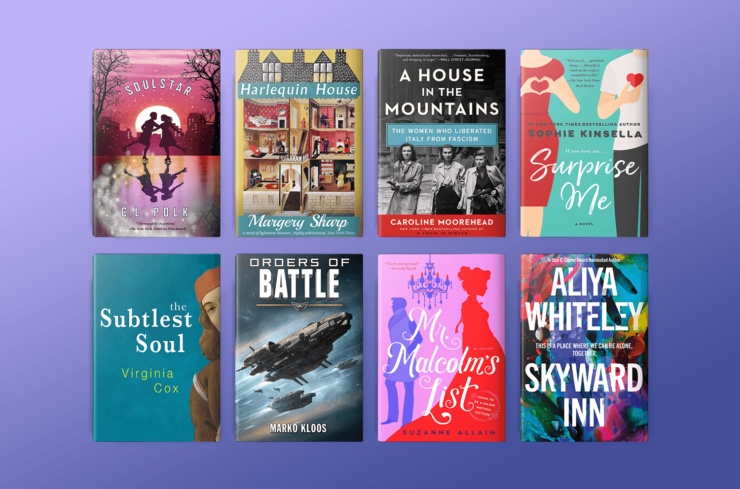
Harlequin House, Margery Sharp (1944)
Absolutely delightful Sharp about… about… well, it’s an implausible fairy tale about a middle-aged man who looks at things sideways and some just grown-up siblings trying to find a way to live, and it’s about class and work and expectations and chosen family, though I doubt Sharp would have seen it in those terms. It’s a very unconventional book. This is the last of the recent Furrowed Middlebrow batch of Sharps, if they were to republish some more I’d be grateful. There’s nobody like her.
Skyward Inn, Aliya Whiteley (2021)
This book made me think about how little we talk about the mood of a book, and yet how important it is. It’s work we often expect the cover to do, set the mood and tone, and when we complain about covers often what’s wrong is that they’re failing us in this. Skyward Inn isn’t going to be well served by any flap cover blurb or synopsis, and it took me a while to stop being disconcerted by it not being what I had expected and settle down to what it was instead.
This is a very good book drenched in melancholic muted shades, blurring into mist and bog. It’s a book about liminality, about humans and aliens, about a devolved part of Britain and another planet, about colonialism, about change, about dissolving into each other and losing solid ground. It’s well written, if not especially original in plot, but the mood of it makes it very different from anything else like this I can think of. I did not much enjoy the experience of reading it, but I admire it a lot and I’m glad it’s there.
The Lady in the Palazzo: At Home in Umbria, Marlena de Blasi (2006)
I loved de Blasi’s first two volumes of memoir with food, and this third one is even better. They are trying to buy a house in Orvieto and have a dinner party in it, and that’s what they’re trying to do for the whole length of this wonderful book, and every chapter was a treat to read. She’s so good at writing about people and places and food, and it’s all so real and I love it.
Orders of Battle, Marko Kloos (2020)
The latest in the Lanky series from Kloos, do not start here! But it is well worth starting at the beginning and reading your way through to this one if you enjoy military SF even a bit. I did not think this series had anywhere further to go, but lo, how wrong I was. This is fun, and it’s got (as always) great combat scenes (very few people write great combat scenes) and even if I have guessed a thing the characters have not, that doesn’t matter—I am invested and I want more. Undemanding but very enjoyable.
Surprise Me, Sophie Kinsella (2018)
Chick lit, in which a married couple in their thirties with kids are told they have a life expectancy of another sixty or seventy years and decide to try to make their marriage more fun since it’s going to last that long, with complex and hilarious results. This is really a story of a woman growing up in her thirties because she missed doing it the first time.
The Lady’s Not For Burning, Christopher Fry (1949)
Play, read aloud in our Caterpillars of the Commonwealth weekly Saturday evening playreading session. Now we’ve gone through all of Shakespeare we’re branching out; I guess I haven’t been listing the plays here because I don’t generally put them on Goodreads, but I did with this. I’d not read this before, and my only experience of it was characters talking about it in Pamela Dean’s Tam Lin. (People who wonder if I am still taking book recommendations from characters in books: You bet I am!) I loved it to bits. It’s very very funny and very clever, and it’s set in a very imaginary Middle Ages in England. It’s the story of a woman people want to burn as a witch and a man who is asking to be hanged. Not genre, absolutely wonderful, amazing poetry, just all around great. I had to keep muting to laugh, and it made me laugh so loudly people down on the street were turning to look.
Soulstar, C.L. Polk (2021)
Third of the Kingston trilogy. It’s interesting and unusual that the first book gives us a fantasy world and reveals its problems, and the second and third book are about the slow gritty practical process of initiating change in a parliamentary system.
The Subtlest Soul, Virginia Cox (2013)
A historical novel about a made-up character around the edges of the Borgias. The author has read a lot of the same research books that I have. She makes Machiavelli surprisingly Machiavellian for no reason. Unfortunately the book is weirdly homophobic, not in a period way. And it was longer than it needed to be. Mostly I am not the audience for this book. I keep being asked for good historical fiction in this period and I keep trying to find some, and this is better than most… but still not really recommended.
Winds of the Steppe: Walking the Silk Road from Central Asia to China, Bernard Ollivier (2003)
Volume 3, the record of the last two years of Ollivier’s long walk from Istanbul to Xi’an, in which he goes through deserts, reconsiders the whole enterprise, and feels isolated by language. Again, read them in order, but they are well worth reading. I loved these and am sorry they are over.
Butterfly, Kathleen Thompson Norris (1923)
Wonderful, new Norris ebooks, more please. What I love about Kathleen Thompson Norris is that I absolutely cannot predict her plots. She may start off, as here, with two sisters with musical talent in a small town in Pennsylvania, and you cannot predict where she will go with it, even from halfway through. She’s a good enough writer on a sentence level, but her real skill is evoking people in situations, complex webs of characters. I guess this counts as genre romance for 1923. And it’s a 1923 that starts five years after the end of the Great War as you’d expect but time keeps on going and a bunch of years happen that are in imaginary time of 1923 going on and lasting for years without anything changing socially or economically or politically.
The Three Taverns, Edwin Arlington Robinson (1920)
There are some very beautiful and some very odd poems in this collection, not least the long one about Lazarus. He’s definitely the kind of poet where it’s worth seeking out more than the examples you see anthologised.
One Way or Another, Portia MacIntosh (2012)
First novel by a writer whose more recent novel I enjoyed last month. This one was pretty thin stuff, not recommended. I’ll give her another try though.
A Half-Built Garden, Ruthanna Emrys (2022)
First contact story set in a future the narrator likes a lot better than I do. This is a significant book that’s coming out next year that I was fortunate enough to read early. It’s probably best described as thought provoking—it’s an interesting and fully considered complex future full of different things, and then there are aliens. (The aliens are great.) I would not want to live in this world, I would not make any of the choices the characters make, I sometimes wanted to shake the narrator, but I was completely engaged with the narrative, couldn’t put it down, and complained about it to anyone who would listen. I can’t wait for it to come out so I can have conversations with more people about it. Ruthanna Emrys has been doing fascinating work for some time, but I think this is the book that will get her the major recognition she deserves.
A House in the Mountains: The Women Who Liberated Italy From Fascism, Caroline Moorehead (2019)
The final volume in Moorehead’s Resistance Quartet, non-fiction books about women resisting fascism. This one was great but grim, and the happy ending of destroying fascism was muted by the way the women were ignored and forgotten later. This is a long, readable, detailed and excellent book that elucidates a difficult subject.
One Thing Leading To Another, Sylvia Townsend Warner (1985)
Bath book. Collection of Warner’s weaker short stories that she left uncollected in her lifetime. None of them were terrible, but none of them had that amazing concentration and focus that her good work has.
Mr. Malcolm’s List, Suzanne Allain (2009)
Regency romance with a cute idea but too little understanding of the period to make it work. The whole horror of the life of an upper- or middle-class woman in Regency and Victorian England is that she could not support herself, and if she did take a job to support herself (governess, companion) she forfeited her class status. If you don’t understand that, you don’t understand the constraints and then everything becomes arbitrary. It’s all actually about economics—if you can’t understand this you can’t see why Charlotte Lucas (or indeed Lydia) make the compromises and choices they do. If you don’t get this at all and have a heroine like the one here, the whole confection falls flat.
The Art of Happiness, Emilie du Châtelet (1779)
A little volume by the translator of Newton about how to be happy as a woman in Ancien Regime France. Fascinating, strange, and a little sad.
Jo Walton is a science fiction and fantasy writer. She’s published two collections of Tor.com pieces, three poetry collections, a short story collection and fifteen novels, including the Hugo- and Nebula-winning Among Others. Her novel Lent was published by Tor in May 2019, and her most recent novel, Or What You Will, was released in July 2020. She reads a lot, and blogs about it here irregularly. She comes from Wales but lives in Montreal. She plans to live to be 99 and write a book every year.

I love these every month.
I semi-recently read David Bodanis’s meticulously researched Passionate Minds, about Émilie du Châtelet and her romance/collaboration with Voltaire, which was riveting. I’d love to see some of her own words (or at least the Modern English translation), so The Art of Happiness is duly noted!
I look forward to these columns every month, and this one is the great fun I’ve come to expect. My TBR list always grows, too.
Where’s the best place to start with Margery Sharp?
I think Harlequin House may be my favorite of the Furrowed Middlebrow Sharp reprints, though they are all welcome! Sharp’s interest in people who are perfectly nice but set aslant from the conventional world is really on display here …
Hooray for vaccination! Thanks for the nudge last month that got me to finally read Piranesi. Such a lovely book. In these chaotic times, I would like to spend some time in the House, too.
I started reading Catherine Aird and E.C.R. Lorac this past month- in a classic mystery mood.
Terry — a good places to start Sharp are Britannia Mews or The Eye of Love.
1: Bodaris’s Passionate Minds is just wonderful. It’s one of my favourite examples of a non-fiction book you can give to practically any SF reader and they’ll love it.
I read the Kloos as well and liked it. I also read the first two books in the new Kloos new series (starting with Aftershocks), which was both different from the Lanky books and really well done so far.
RobM: yes, I’ve been loving those, and am looking forward to the third coming out soon.
10th August. I’m looking forward to it too.
Thanks to last month’s post, I will probably finally get around to reading Piranesi… if I can tear myself away from the sheer fun of the Sophie Kinsella books.
@0, thank you for the Margery Sharp recommendation! I’ve been slowly reading through her books over the last month. if your library system has the Hoopla app, they have several more Sharp novels available for free. Not sure how much overlap there is with the Furrowed Middlebrow reprints, but they might have some you haven’t read yet.
They have The Nutmeg Tree, Something Light, The Eye of Love, Martha in Paris, Martha, Eric, and George, The Flowering Thorn, The Innocents, The Gypsy in the Parlour, and Cluny Brown.
Thanks for another v interesting column. There are always a mixture of books that you make me want to read, others that I probably never will, and the odd one that I have read.
I’m curious to start with Margery Sharp, but the ebook prices on Amazon UK are ridiculous! £10 or £15 for single books from Open Road Media, although there are a couple of £15 omnibus volumes containing 3 or 4 books. I refuse to pay paperback or hardback prices for ebooks.
@bluejo, re the Borgias, have you read Samuel Shellabarger’s Prince of Foxes (1947)? It was one of my favorites as a young teen, but I haven’t reread it in decades and am now thinking I should.
@1 @0, if you’re interested in Du Chatelet, I recommend Judith Zinsser’s biography, Emilie Du Chatelet: Daring Genius of the Enlightenment. Zinsser Isabel Bour also edited an excellent collection of Du Chatelet’s writings, Selected Philosophical and Scientific Writings, though I find most of what’s collected there much less interesting than the Du Chatelet enthusiasts generally do. R
No, I haven’t read that, or even heard of it before.
@bluejo Shellabarger is great at the swashing and buckling and intrigue. One of the best midcentury historical novelists, I think. I read him at the same age that I read Anya Seton’s books, though they’re quite different, of course. I think Shellabarger planted the seeds of a taste that I would fulfill with Dorothy Dunnett when I was a bit older.
A film was made of Prince of Foxes with Orson Wells and Tyrone Power, but the book is, in my recollection, much better. Shellabarger was a historian and knew his stuff, and as I recall wrote a tightly-structured plot. I’ll be curious to go back to it with mature eyes, and I’d be interested to hear what you think of it if you add it to a future month’s list.
Oh, The Lady’s Not For Burning! For decades I have been haunted by memories of seeing a production of it in the 70’s on PBS with Kenneth Branagh and Cherie Lunghi. Sadly, there are only bits of it available online. This play should be performed more often.
@bluejo,
When you first started posting Reading Lists, I wondered if it was worth including the books in mentioned my “Jo Walton’s Tor.com postings” web site ( http://www.michaelcross.me.uk/jowalton/ ); I decided not to, as they were
mostly only single paragraphs, and it would be a lot of work for me to handle them.
Recently I wanted to see what books by a certain author you’d included in Reading Lists, and thought a bit harder about it how I could do it. I realised that I could automate a lot of the extra work, so I’ve done the work just (so far) for two of the columns, those from June & July 2021. If you like what you see, I’ll add the details for all the Reading List columns.
I’ve tagged the generated Reading List entry posts with a series of ‘RLE’, that way you can list all the Reading Lists entries chronologically in a single page, by going to the Series.page and clicking on ‘RLE’.
I hope you, and others, will find this enhancement useful. Please let me know what you think.
NB One side effect of the way I’ve done it, is that the Posts count in the page header is inflated by the number of Reading List reviews; if you want to get the true number of actual columns, go to the Series page, find the number of posts in the RLE series and subtract that from the inflated number, eg
Posts count = 919, RLE series length = 50, so actual posts = (919 – 50) 869!
Jo, thank you for the guidance on Margery Sharp. Britannia Mews is now resident on my Kindle!
“It’s all actually about economics—if you can’t understand this you can’t see why Charlotte Lucas (or indeed Lydia) make the compromises and choices they do.”
Bingo. Austen shows, as Auden famously said. “The amorous effect of brass”.
OP: The Lady’s Not For Burning
Oh, my…is that ever a blast from the past! I actually performed (or more accurately: “appeared”) in my college production of that play—which I had entirely forgotten until I saw the title. Thanks for your reminder.
Well, I am coming to this so late that Jo will likely not even see this comment, but . . .
Cecelia Holland is one of my very favorite writers of historical fiction (or any other fiction), and her novel City of God can also be described as “A historical novel about a made-up character around the edges of the Borgias.” I highly recommend it if you are still looking for good historical fiction in this period.
We’re ready for that talk about A Half-Built Garden, Jo!