






As October began we went back into condition red lockdown, not allowed to see anyone outside the household and not allowed to go anywhere except the grocery store. I’ve hardly been out of the apartment this month. But I have been able to read, thank goodness, and I have read twenty-one books.
A Dream of Italy, Nicky Pellegrino (2020) This is the one where a number of people get the chance to buy houses in a dying town in Italy for one euro each. This was almost too much wish fulfillment even for me, but no, I ate it up with a spoon. There’s a gay Australian couple, and an older woman artist, and a younger woman who has an unfulilling job and an unfulfilling partner, and they all go to Italy and then everything is OK. These books are published as genre romance, but they’re not quite; what Pellegrino is all about is loving descriptions of Italy. You either want it or you don’t, but comfort reading is comforting.
A Florence Diary, Diana Athill (2016) In 1949, right after WWII, Diana Athill and her cousin went to Florence. It was her first trip abroad, and this is her diary. Recommended to me by a librarian friend when I said all I wanted to read was books where people went to Italy and it was all right—this was sparser than I’d been hoping, but I did enjoy it.
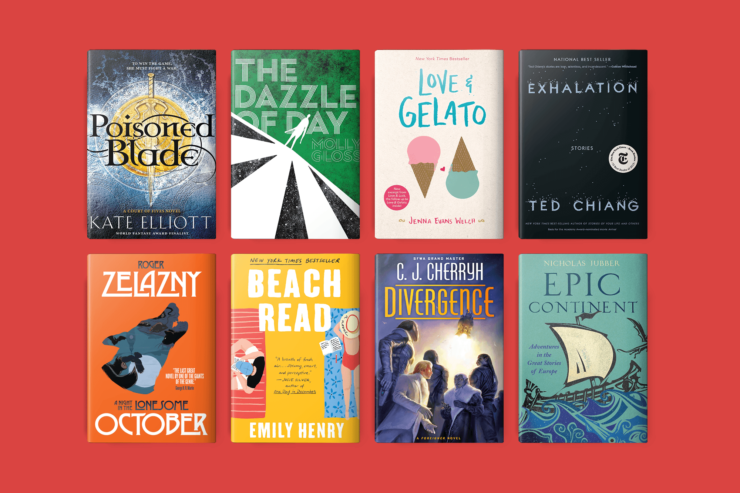
Exhalation: Stories, Ted Chiang (2019) What a terrific powerful collection of stories. I’d read almost all of them before, but they were great to read again. If you want to know where SF is right now, look no further. Chiang has everything, good stories, good characters, and thought-provoking philosophical ideas. Seems like his plan is to keep on writing some of the best, most thought-provoking short stuff in the genre. Just terrific.
The Correspondence of Madame, Princess Palatine, and Marie-Adelaide of Savoy edited by Elizabeth Charlotte von Pfalz (Victorian edition and translation of early eighteenth-century letters) It’s interesting what a long shadow the guillotine casts backwards, because reading these letters from around 1700, I kept longing for somebody to come and cut these terrible people’s heads off. It’s impossible to read about the French aristocracy being awful without having this anachronistic desire— they were going to keep it up for the whole century before anyone did anything about it. The wonder is not that they got guillotined, it’s that they managed to keep their heads on for so long. Madame, Princess Palatine, was a German princess married to Louis XIV’s brother (I think) who wrote incessant letters to her family back in Germany full of vitriol and gossip.
Poisoned Blade, Kate Elliott(2016) Sequel to Court of Fives, so do not start here. Normally when people say something is a middle book they mean not much happened. This had the opposite issue; almost too much happened, at an almost too breakneck pace. The first book sets up the world and the culture and the history and the characters, and this book pulls it all apart and increases the stakes massively, with hints of something wider. Very good on the numinous, and also real solid characters. But read the first one first.
Three’s Company, Alfred Duggan (1958) Re-read, bath book. This is a historical novel about Lepidus, the lacklustre third member of Rome’s Second Triumvirate, and how he stumbles through his life and Rome’s cut-throat politics trying to do the right thing and keep to the proper Roman traditions, even though it’s very hard.
The Pillars of the House, Charlotte M. Yonge (1873) Charlotte M. Yonge wrote many many books that were immensely popular in her own day and are almost forgotten now. This one is immensely long. It’s about a family of 13 children whose parents die and the 17-year-old twin daughters and 16-year-old son bring up all the rest. There are many adventures of the relatively plausible kind, many friends whose stories weave in and out, many romances, marriages (happy and unhappy), many more children born, one explosion on a train, one case of sunstroke, a boating accident—it doesn’t matter. I love this book and won’t hear a word against it.
It covers decades of in-book time and weeks of actual reading time, and I came to really care about these characters and what happens to them. It’s glancingly racist (better than its own time, much worse than ours) with one n-word used by a bad character to an admirable half-Mexican character. It’s—I could write a whole book on Yonge’s feminism and how weird it is. It’s actually truly excellent on disability—more than one disabled character, different disabilities, dealt with as real and part of the normal world. I’m not sure her medical descriptions hold up at all, but she’s great on disability inclusion. What I’d give an actual content warning for is imperialism; we have entirely unexamined missionaries and the Indian army.
It is set, like all Yonge, in a universe in which not just Christianity but the specific beliefs of the Anglican church are rules of the universe, and where dying well can be a happy ending. The thing that makes it work is that Yonge is unflinching about the fail condition, and she really does treat it as the way the world works. It’s Moral Fiction, but not in the way so much of it is awful, because everything really is the consequence of the actions of the characters and the characters are complex. If you want something really long and immersive, not comforting—anyone can die at any time—and utterly alien in its sensibilities, I recommend this. So glad I hadn’t read this one before so it was there for me when I needed it.
Why Be Happy When You Could Be Normal, Jeanette Winterson (2011) This is a memoir which somebody recommended to me ages ago saying it was in some way like Among Others. It was going cheap on the Kindle and I bought it. It was excellent, but I wasn’t expecting it to be so alarming—I had to increase the speed I was reading it to have it finished and not fall asleep reading it and have nightmares. Very honest, open, real, memoir of growing up as an adopted child with a very strange mother. It is like AO in one way, in that it’s about digging your way out with a spoon and the spoon is books.
Feeling Sorry For Celia, Jaclyn Moriarty (2000) I listened to this read aloud in our daily Discord regular reading. It was new to me, though not to others. It’s YA, and quirky in that it’s epistolary and in addition to letters to and from real people the protagonist gets letters from, for example, The Young Romance Organization and they’re imaginary letters. Fun, especially with Gretchen doing the voices.
The Duke Who Didn’t, Courtney Milan (2020) A feel-good romance about a Chinese girl making sauce and finding true love in Victorian England. You know that t-shirt that says “Your existence isn’t impossible, it’s merely very unlikely?” Milan’s characters are like that, and since characters of colour get totally absolutely and utterly left out of most modern books set in nineteenth-century England (though you do see them glancingly racistly on the edges of actual Victorian novels), it’s just fine for Milan to pack them all in and redress the balance a bit. This book is a delight, readable, fun, unexpected, empowering and smart in ways that are rare in any genre. Not my favourite Milan, that’s still Trade Me, but excellent.
The Dazzle of Day, Molly Gloss (1997) Re-read. I’d forgotten the plague and the suicide and the general melancholic mood of this and only remembered the new family structures and the method of telling the story by cycling through the points of view. This is a generation starship book with solid characters and worldbuilding. It’s doing Quakers in Space in a totally plausible way, and it’s really about how things go on, imperfectly, and not how you expected, but they go on and get somewhere. Really excellent book, but not as upbeat as I want right now.
Love & Gelato, Jenna Evans Welch (2016) YA romance about a girl going to Italy after her mother dies and finding out her family secrets while falling in love. Set in Florence. Has people using Vespas and cars to get around in the historic centre where you actually have to walk, but other details are right, including the secret bakery. Meh.
Savages, Romans, and Despots: Thinking About Others from Montaigne to Herder, Robert Launay (2019) Fascinating non-fiction book about how Europeans looked at what was not Europe between the late sixteenth century and the late eighteenth. Very interesting, full of detail, and so very not at all what one would expect from a superficial view. So much of what we know of history is blurred by the huge weight of the nineteenth century both as “default history,” as if how they did it is how things always were, and as the gatekeepers to what came before. This book is an excellent corrective. Also readable and accessible. Great book for worldbuilding.
When in Rome, Nicky Pellegrino (2012) Bath book. Lovely novel about a family whose mother is a prostitute in Rome and how they grow up, focusing on the oldest sister who manages to make her crush on movie idol Mario Lanza into a job in which she grows away from her family. There is a romance, and also this is a book looking back from the end of life to a long life well lived, but the romance isn’t the focus. Lovely Rome, lovely food, and also a very enjoyable book. Also, I started off buying Pellegrino in 99-cent ebooks, moved up to full price ebooks, and bought this one as a paperback because there wasn’t an ebook.
Divergence, C.J. Cherryh (2020) Volume 21 of the Atevi books, do NOT start here. I know I said I was going to quit with volume 20, but I…bought this as soon as it came out and read it pretty soon too. Nothing happens, really, but there’s Cajeiri and Ilisidi and Jago and a train, and if you’ve already read the previous 20 volumes you might as well keep on hanging out with your friends on a train in the Marid.
One Summer in Positano/It Was Always You, Georgie Capron (2017) Chick Lit novel set in Ital, though there’s a large chunk of it set in London in the middle. Fairly good, though incredibly predictable. The alternate title gives it all away.
Epic Continent: Adventures in the Great Stories of Europe, Nicholas Jubber (2019) This is a weird kind of travel book, in which Jubber visits the scenes of The Odyssey, the Kosovo Epic, The Song of Roland, the Völsunga saga, Beowulf, and Burnt Njál’s saga, talking to people about the stories, visiting sites, meeting people, seeing how the stories relate to the places now, and what European culture is. It’s a better idea than it is a book, and I had times of thinking, “This is not how I would write this book!” but it’s an interesting journey.
As always in a travel book the narrator is a protagonist, and there’s a lot of Jubber here. He’s cautiously open, he’s very concerned about Brexit and about the plight of refugees, who he wants really hard to identify in positive ways. Not a great book, but I’m not sorry I read it. It might be better for someone less familiar with the books? I’m all in favour of this in theory, but the practice was slightly disappointing.
Beach Read, Emily Henry (2020) Recommended by friends, this is an actually good romance novel about a woman who writes romance and a guy who writes gloomy hip fiction and how they try to write each other’s kind of book and fall in love. I raced through this, even though it is set on Lake Michigan and not in Italy and doesn’t even have any food in it. Shallow but fun.
Living in a Foreign Language: A Memoir of Food, Wine, and Love in Italy, Michael Tucker (2007) Amazon suggested I might like this one, and it was half right. Tucker’s some kind of minor movie actor who bought a house in Umbria and ate a lot of food. That’s this book. He thinks he’s cuter than he is, but it was entertaining enough and he’s certainly positive about Italy and food.
The Question of Hu, Jonathan D. Spence (2011) Fascinating non-fiction account of a Chinese guy called Hu who travelled to France with a Jesuit in the mid-eighteenth century and then returned to China. Real microhistory, very well done, excellent detail, solid research and extremely readable narrative.
A Night in the Lonesome October, Roger Zelazny (1993) Re-read. The Scintillation Discord group read this aloud all month, with seven of us taking turns to read one daily diary entry per day at 10pm every night throughout the month, with about another ten people listening, some of whom had read the book before and some who had not. This is the perfect way to experience this book, which otherwise goes by too fast. As always, Zelazny is clever—sometimes a little too clever—and poetic, and this is one of the few books with a dog POV that works. Sherlock Holmes! Cthulhu! Frankenstein! I recommend doing this with your own group of friends next October, preferably in a cafe or bar.
Jo Walton is a science fiction and fantasy writer. She’s published two collections of Tor.com pieces, three poetry collections, a short story collection and fourteen novels, including the Hugo- and Nebula-winning Among Others. Her previous novel, Lent, was published by Tor in May 2019, and her fifteenth novel, Or What You Will, came out on July 7, 2020. She reads a lot, and blogs about it here irregularly. She comes from Wales but lives in Montreal. She plans to live to be 99 and write a book every year.

That’s exactly how I feel about the Foreigner books. I have put the last several down saying “Nothing happened in this book.” Whereupon someone else says “But you’re still reading them.” Yes, yes I am.
Still, I do wish that, having dropped her latest big bombshell (was it 4 books ago?), she’d let the explosion happen.
As usual, I really enjoy this column. Several good recommendations.
About Milan, I appreciate she actually has a sense of time and adresses the issues of the Victorian era. I usually can’t place most of modern historical romances that seem to be written in one era, but have manners and social interactions of another and fashion and events of yet another. I have to admit some of her character views are too modern, but the representation of diversity is accurate and, sadly, still rare in the genre.
Big Alfred Duggan fan, one of the few authors I recommend to anyone with any interest in history/historical fiction. And the only other historical novelist I am aware of that blends (albeit very dark) humour into his books.* I’ve not read all his novels yet as I’m taking my time working my through them in published order. Three’s Company is, I would say, a good introduction to his work, or God and My Right (about Thomas a Beckett) if you prefer mediaeval history to Classical Roman.
*Patrick O’Brian is the other. I’m sure there are more. Georgette Heyer?
Why Be Happy When You Could Be Normal, Jeanette Winterson
I read this book together with my wife (out loud) on a trip and we both loved it. This was five stars. (I wish I liked her more recent stuff as much.)
I was really hoping for a big event happening in Divergence – the last two should have been slimmed down to a single volume. While it’s interesting to see the development of a young alien mind, and there are some great Macchiavellian bits of diplomacy here, it seems like too much setup. C’mon, let’s let the kids from space run wild, or have a return of the space manatees (that’s not what they are), or some external event to shake up the status quo.
@5 She’s doing multiple points of view now, so why not see some of what’s happening on the ship from Jase’s point of view? Or follow the events on the doubtless still-disturbed station as well as those on the ground? And, yes, the Kyo are still out there, and they left open the possibility of meeting at their station.
And as for big events:
And, yet, I do keep reading it because Ilisidi! And Jago and Banichi and Cenedi, but mostly Ilisidi!
Edit: Also, A Night in the Lonesome October is the best Halloween book, bar none!
*Edit because I forgot the “the” in Night in… and we can’t have that! Why aren’t there ebook and audio versions of this?? I want every format possible.
It has been ages since I’ve read “Lonesome October”, the edition with the very misleading cover. I have no idea of the problematic elements would overwhelm the cleverness, but it’s worth seeing.
Thanks for posting this, I now have a list of things to read, though I’ll probably start with the Courtney Milan.
Jeanette Winterson sounds interesting (I liked Oranges, but haven’t read anything else by her). The title is great and would probably be enough to attract me, but with your recommendation it certainly goes to my TBR file.
Now I’m imagining a Second Triumvirate sitcom with Jack Klugman as Antony, Tony Randall as Octavian, and Al Molinaro as Lepidus.
I’ve tried to read A Night in the Lonesome October one chapter a day before and failed, just gave in and read through it all. Finally was able to do it this year by finding somebody else to read it with who hadn’t ever read it before. When we were together, I’d read it aloud (except for the really long chapters, been ages since I read to somebody else and terribly out of practice) or we’d read together and then she’d ask questions and I’d avoid answering them. I can’t imagine why there isn’t a co-op board game out there for this already and have already invited people over next October to do a Murder-Mystery/LARP event and try to capture the fun with even more friends (luckily, I’ve got months to figure out the logistics of “how” to run it).
Thank you, Jo, for this column. I look forward to it every month. It inspires me to dive deeper into my own reading.
Quick correction – you left out a Roman numeral when naming King Louis XIV. Madame the Princess Palatine was married to Louis XIV’s, not Louis IV’s, brother, Phillippe the duke of Orleans, who, incidentally, was gay, despite the fact that he married twice and had five children (three with his first wife, two with his second the Princess Palatine.) The man knew his duty. His homosexuality was accepted and encouraged because it made him less of a threat to the throne to his brother the king. Another example of how the nobility had an entirely different set of rules?
@11: Thank you–fixed! As someone who *may* have eagerly marathoned all three seasons of Versailles at some point, I probably should have caught that :)
I thought Divergence was surprisingly interesting, because so much of the plot revolves around love(?) among the atevi.
We’ve been told repeatedly that atevi emotions are not human emotions, and that atevi neither like nor love other people. Instead, they feel man’chi, an emotional drive which is literally alien to humans. Bren spends the first few books in the series repeating these facts to himself, making himself look ridiculous by telling various atevi that he likes them (“I am not a salad!”), and finally seems to reconcile himself to the atevi worldview at which point all of this fades into the background.
But Divergence contains: Atevi parents in a panic because their daughter has gone missing. A young atevi couple making eyes at each other while all the adults in the room strongly counsel them that this is not a good idea. (Bren even finds himself thinking of them as young lovers, and then fiercely reminds himself that you can’t even say “young lovers” in any atevi language.) Tabini telling Cajeiri how he came to be in a permanent marriage to Damiri, which sounds an awful lot like, “I fell madly in love with her and when she told me she was going to leave if I didn’t commit, I threw aside all political consideration and married her. And I’ve never regretted it since, even if it’s objectively a bloody stupid match politically.”
What I’m saying is that there are atevi acting like they’re in love all over this book, and it doesn’t feel like it can be a coincidence. But in her usual style, Cherryh seems to be letting the reader try to figure out what it all means.
Are all these cases just false cognates for love–atevi acting in ways that look to human eyes as if they are motivated by personal affection, but which are actually entirely driven by alien emotions? Or is this evidence that Bren and the human scientific consensus is flat out wrong about atevi, and they’re actually emotionally pretty similar to humans?
The early books tell us that human/atevi first contact went bad in the War of the Landing, because of mutual incomprehension of each other’s emotional landscapes. But more recent books have given us more information on that war, and it looks less motivated by emotional understanding and more by humans dropping into a complex political environment, making alliances without thinking about how they were affecting the balance of power, and getting burned badly. (Goodness knows that’s never happened in actual human history.)
The atevi have always felt like a mashup of various Orientalist tropes of East and South Asian cultures: Their design sense feels East Asian, their food South Asian, the assassin’s guild are ninja with the serial numbers filed off, and so on. The human island of Mospheira feels a lot like Japan, geographically, including a Mt. Fuji equivalent. I’ve wondered for ages if Cherryh read a few bad samurai dramas like Clavell’s Shogun, declared that the only way this makes sense is if you assume all the Asians in the story are literally aliens, and then went and wrote that story. Now I’m wondering if she’s making a comment on our human willingness to overstate cultural differences and to view people of other cultures as fundamentally incomprehensible.
I’ve had these thoughts about the series for a while, but it feels like Divergence is really making atevi emotion a theme. And I just noticed that title…Divergence. Or Convergence?
Thanks once again, Jo, for sharing your reading. I’m always happy to see a new post from you.
All the previous Atevi books came in sets (5 3-piece, 2 2-piece). Is Divergence a standalone, or does it leave matters hanging to be resolved in another book? (I hate reading only the first third or half of a story, and have a section of my TBR bookcases reserved for incomplete sets.)
Chip: Divergence follows directly on from the one before which was in no way a completion of anything, and this is another piece. I agree that to start with they came in sets, but this has been less and less the case in recent volumes. It has volume completion — but they all do to some extent, Cherryh is the master of “a happy ending depends on when you stop”.
The only Charlotte Yonge book I have is The Little Duke, which seems aimed at a somewhat younger age than The Pillars of the House. Is there any other Yonge you’d recommend? Maybe slightly shorter than Pillars?
I might have to get the Michael Tucker book. I don’t know about movies but I remember him fondly from LA Law back in the late 80s/early 90s. Oh dang I just looked him up and he and Jill Eikenberry (also on LA Law) have been married since 1973??!? Wow.
Jo: The travel books remind me of one I read years ago which you might enjoy (if you haven’t read it already)
It’s a 2003 book by Tony Perrottet, published under two different titles — Pagan Holiday and Route 66 AD, though both share the same subtitle: On the Trail of Ancient Roman Tourists.
The Roman Empire was sufficiently large and stable to allow for tourism, and wealthy Romans had a travel circuit through Italy, Greece and Turkey comparable to the Grand Tour of later centuries.
The author is a modern travel writer who decides to follow this route. Some sites remain popular, others are more obscure. He interweaves his modern experience with accounts of historic travellers.
I found it fascinating, and if you haven’t already read it, I recommend it.
Nice to see that Cherryh keeps at work. If someone does not know about Downbelow Station, that book is awesome. Then, Rimrunners, with Merchanter’s Luck in between for background (but you can be fine without).