





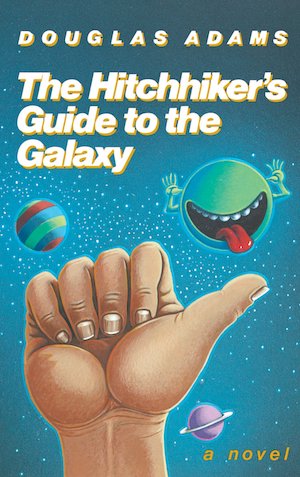
In this bi-weekly series reviewing classic science fiction and fantasy books, Alan Brown looks at the front lines and frontiers of the field; books about soldiers and spacers, scientists and engineers, explorers and adventurers. Stories full of what Shakespeare used to refer to as “alarums and excursions”: battles, chases, clashes, and the stuff of excitement.
Adventure is often presented as serious business, but also benefits from being treated with a light touch. Humor can go a long way toward adding spice to any narrative. And when humor becomes the main dish, it can be a joy to behold. A perfect example is Douglas Adams’ The Hitchhiker’s Guide to the Galaxy, one of the best-loved books in the pantheon of great science fiction. It has plenty of adventure, doom, destruction, narrow escapes, megastructures, innovative technology, a bit of romance, and lots and lots of jokes, puns, and absurd situations. Everything a science fiction reader would want, especially if they are willing to be heard laughing out loud while they read.
Sometime in the 1980s, I was on a long drive on a Saturday evening, and stumbled onto an NPR radio dramatization of The Empire Strikes Back. Up until then, I had thought radio plays were a lost art form. And by the end of the episode, I was smitten. I bought cassette tapes of the Star Wars dramatizations, and then went looking for other full cast audio dramas. One of the first I found was The Hitchhiker’s Guide to the Galaxy. I listened to it so often I wore those tapes out, and over the years, collected the entire series on compact discs, which I still listen to today. While the series is available in a variety of media, the radio dramatization is still my favorite.
The Hitchhiker’s Guide to the Galaxy series, in all its forms, has become nearly ubiquitous in current society. Quotes from the books pop up where you least expect them. Especially among science fiction fans, phrases like “don’t forget your towel,” “42,” or “so long, and thanks for all the fish,” get a knowing smile whenever they are dropped into conversations.
About the Author
Douglas Adams (1952-2001) was an English author, primarily known for his humor and satire. He is most widely known as writer of the Hitchhiker’s Guide to the Galaxy series, which was inspired by a real world “Hitch-hiker’s Guide to Europe.” The story started as a BBC radio drama that first appeared in 1978, and grew into a whole series of radio dramas, a “trilogy” of five books, a six-part BBC television mini-series, comic books, a computer game, and a major motion picture.
Before making his name with Hitchhikers, Adams was noticed as a gifted author even during his school days. He contributed material to the Monty Python troupe, and did odd jobs to make ends meet while facing many rejections. He worked on Doctor Who as a script editor and writer, and wrote three series for the program.
Adams is also known for the adventures of Dirk Gently, a “holistic detective,” whose adventures (some of which were based on unused material he wrote for Doctor Who) were chronicled in books, radio dramas, and a television series. Unfortunately for his many fans, he was not prolific, and often suffered from writer’s block.
Appearances of the Guide in Various Media
In its original form, The Hitchhiker’s Guide to the Galaxy was a radio series in 12 parts appearing from 1978 to 1980. It was later collected on long-playing records, audio cassettes, and then compact discs. Other sequel series were released, first on radio, and then as recordings. In the end, there were five collections, released on discs as The Hitchhiker’s Guide to the Galaxy: Primary Phase, Secondary Phase, The Tertiary Phase, Quandary Phase, and Quintessential Phase. A sixth collection, Hexagonal Phase, was later released based on the sequel written after Adams’ death by Eoin Colfer. The dry wit, stream-of-consciousness pacing, and the excellent casts made these radio plays a big success.
The five books, of what was called a “trilogy” even after it grew past three titles, include The Hitchhiker’s Guide to the Galaxy (1979); The Restaurant at the End of the Universe (1980); Life, the Universe and Everything (1982); So Long, and Thanks for All the Fish (1985); and Mostly Harmless (1992). The books have sold more than 14 million copies world-wide, both separately and in omnibus editions. A sixth Hitchhiker book, And Another Thing…, was later written by Eoin Colfer. The books did a great job of translating the radio scripts into prose, with many of the descriptions and marginal materials being just as entertaining as the dialogue.
The original story was also presented in stage performances shortly after the radio episodes appeared. BBC released a six-episode television series in 1981 that featured some of the actors from the radio version (I must confess that I have never seen this iteration of the story).
A movie version was released by Disney in 2005, with a script Douglas Adams wrote before his death (and co-written by Karey Kirkpatrick), directed by Garth Jennings, and starring Martin Freeman as Arthur Dent, Mos Def as Ford Prefect, Sam Rockwell as Zaphod Beeblebrox, Zooey Deschanel as Trillian, Alan Rickman as Marvin the Android, and Stephen Fry as the voice of the Book. This excellent core cast was supplemented by an equally talented array of actors in supporting roles. The film received a mixed but mostly positive reception from critics, and was relatively successful financially, but did not earn enough to warrant a sequel.
The existence of a Hitchhiker’s Disney movie meant that, thanks to the Disney marketing machine, there were toys being sold, and like many geeks, I love my toys. I ended up with two. One is a rather bemused-looking Arthur Dent action figure, the only action figure I own that wears a bathrobe and carries a towel. The other is an Arthur Dent yarn doll, based on a scene where the Improbability Drive turned everyone onboard into yarn (and where Arthur found yarn stuck between his teeth even after he returned to his normal form). This is truly the most improbable movie souvenir I’ve ever seen.
The Hitchhiker’s Guide to the Galaxy
The book opens with Arthur Dent trying to prevent a construction crew from destroying his house to make way for a new automobile bypass, having missed the bureaucracy’s feeble attempts to give him proper notice this was occurring. His friend and drinking buddy, Ford Prefect, shows up and takes him to the pub for a few drinks, telling him not to worry about his house. Arthur does not realize it yet, but Ford is actually an alien from the vicinity of Betelgeuse, a traveling contributor to a book called The Hitchhiker’s Guide to the Galaxy, who has been stranded on Earth without a ride for fifteen years. And a Vogon Constructor Fleet arrives, about to destroy the Earth as part of construction of a hyperspace bypass.
Those who are not familiar with the book will probably find this bald recap horrifying. How could the destruction of the entire human race be a subject of comedy? Yet those who have read the book will tell you the unfolding of these events is filled with wry humor. Adams has a knack for taking the most intimidating events, even the end of the whole universe, and making them laugh out loud funny.
Meanwhile Zaphod Beeblebrox, the two-headed, three-armed President of the Imperial Galactic Government, along with his girlfriend Trillian, is stealing the most innovative spaceship in the galaxy, the Heart of Gold, a ship powered by the mysterious Improbability Drive.
Ford and Arthur find themselves in the bowels of the Vogon flagship; their Dentrassis cooks received an electronic hitchhiking signal from Ford, took pity on him, and beamed him up. Ford introduces Arthur to The Hitchhiker’s Guide to the Galaxy, and the book’s entry on Earth, recently expanded from “harmless” to “mostly harmless.” The two are detected by the Vogons, captured, and forced to listen to the Vogon Captain’s poetry, which is far more awful than you might think. When they try to compliment the Captain, he sees through their lies, throws them out of the airlock, and their survival is improbable.
Remember that Improbability Drive, though? The Heart of Gold just happens along to rescue them in a nick of time. Ford and Arthur are led to the bridge by Marvin the Android, a robot equipped with an experimental personality program, and who complains (not for the only time), “I’ve got this terrible pain in all the diodes down my left hand side…” Another of the deeply depressed Marvin’s frequent refrains is, “Life, don’t talk to me about life.” Ford and Arthur find that not only were they improbably rescued, but Ford and Zaphod are childhood friends, and Arthur knows Trillian (aka Tricia MacMillan) from a party before the destruction of Earth, and recognizes Zaphod (aka Phil) as the man who plucked her away just as Arthur was feeling an attraction. Before long, the Heart of Gold heads out because Zaphod is looking for the lost planet of Magrathea, home of a race of people who built custom planets, but who disappeared into suspended animation to wait out a galactic economic downturn (a story eventually related to Arthur by a fjord-making specialist named Slartibartfast). They hear the story of the massive computer Deep Thought that took millions of years to develop the answer “42” to the “answer to the ultimate question of life, the universe and everything.” And about the planet-sized computer built by mice to figure out what that darned question was, and why the answer was “42.” And how that planet-sized computer relates to our main characters.
Throughout, the book is punctuated by entries from The Hitchhiker’s Guide to the Galaxy, which is actually an interactive computer tablet; for the time the book was written, a rather insightful prediction of future electronic devices. There are lots of authors who use imaginary documents to introduce exposition into the narrative, but Adams is the only author I know who makes those expository lumps as entertaining, if not more entertaining, than the rest of the book. And a careful reader will realize there are all sorts of little clues dropped into the exposition, things that do not appear important at first, but become a big part of the story.
In preparing this review, I both read the book, and listened to the first collection of radio episodes. And even though I was visiting them for perhaps the tenth or eleventh time, I found things I had missed, jokes that struck me differently, and a new appreciation for the genius of Douglas Adams, and just how special this unique work really is. Somehow, amid all the destruction, and the jokes, and the zany meaningless of everything that happens, as the characters muddle through as best they can, Douglas always ends up making me feel good about life, and about being human.
Final Thoughts
Good comedy is hard to create, and science fiction comedy is even harder. Science fiction fans like their wit well supported by scientific knowledge and speculation, even if that information is then twisted into fantasy for comedic effect. Douglas Adams was a master of mixing whimsy and pathos to create something both compelling and laugh-out-loud funny. If you haven’t encountered The Hitchhiker’s Guide to the Galaxy in any of its myriad forms, I recommend you do so as soon as possible. And those who have read the books should listen to the radio plays and vice versa. Every iteration of the story has its own charms that makes it worth a visit.
I’d love to hear what all of you think of the tale. What are your favorite quotes, your favorite bits and scenes, and favorite forms of the story? And what other science fiction humor would you recommend to others?
Alan Brown has been a science fiction fan for over five decades, especially fiction that deals with science, military matters, exploration and adventure.


It is very, very rare for anything to make me laugh to the point of hurting my ribs, but Douglas Adams managed it more than once. Still re-read periodically.
(Neal Stephenson is also capable of doing entertaining infodumps, by the way.)
Loved these books. The first one came out when I was in high school. A modern author would take twice as many pages to be half as funny.
The TV series was on PBS when I was in high school and it was a lot of fun. It was shot on film, so they presumably could rescan it in hd, or even 4k.
While it is practically heresy to deny the importance of Hitchhiker’s Guide in science fiction, after several reads I started to feel rather depressed about it. Maybe the Britishness of it allows some to detach a bit, but I realized that Arthur Dent is the author’s punching bag. Everybody gets something out of their adventures. Arthur Dent loses everything he has, repeatedly. He’s even targeted for assassination by himself from another timeline because of how much that one lost. If Arthur isn’t allowed to even wallow in mediocrity with company, it isn’t worth laughing at his despair.
Also, not certain how purposeful it was, but the Scrabble tiles spelled out “What is six times nine?” if I recall. That isn’t 42
@3
6 times 9 is 42 if you’re using base 13. Douglas Adams confirmed that this was not intentional.
@@.-@ – So now I know. And knowing is half the reading ;-)
I plowed through the series almost 20 years ago, when I was in high school; I’ve pretty much always liked sci-fi, and became increasingly aware that British humour appeals to me easily. I should reread them! And it’s finally occurred to me that I never listened to the radio plays. Going to look into rectifying that. No excuse not to, especially given how much of Welcome to Night Vale I’ve listened to.
I made my spouse a cake for a certain birthday inscribed “Life, the universe and everything”.
@@@@@#2: The BBC TV series has already been digitally scanned. It’s on Hulu.
@1 I know what you mean. As I was writing that line about Adams making expository lumps entertaining, I was thinking, “The only other writer who comes close is Neal Stephenson.”
Typo – I believe it’s Slartibartfast”, not “Startibartfast”. Unless that was his name at the beginning of the fjord project.
Adams also co-authored Last Chance to See, with Mark Carwardine, a book about his encounters with animals on the brink of extinction. It’s written with his usual humour, despite being a depressing topic, but it ends with likening the biodiversity crisis to the story of the Sybelline Books, which is a damned good metaphor but not cheering. I wonder what he’d think of the way things are today, when I look at the IUCN Red List.
He also co-authored The Meaning of Liff with John Lloyd. This is a dictionary of words that don’t exist, but should (they used odd English place names), and I have found it very useful.
@10 – Typo fixed, thanks!
I heard of the radio series when it was on the Hugo ballot 42(*) years ago — but it wasn’t findable in the US and got swamped in the voting by Superman. (Poor Christopher Reeve had to accept the award in the UK, in front of an obviously partisan audience.) I couldn’t even hear it at the Worldcon because the room where it was playing was beyond jammed; I had to wait for NPR to carry it in 1981, and loved it. (I may have been primed by growing up on Gilbert & Sullivan, which has some of the same sense of the absurd.) I can still recite chunks of the Book’s insertions; I can’t point to specific bits I loved, possibly because it’s a story rather than just gags thrown together.
I’m also a fan of Dirk Gently’s Holistic Detective Agency (the book — I haven’t heard anything interesting about the TV series). My favorite passage is actually in the sequel — the section describing the sty Dirk lives in, ending “…Hercules, if he had seen that room, probably would have returned in half an hour armed with a navigable river.” — but the favorite moment was when I finally twigged that most of the first book was in an alternate universe (not a spoiler — more-alert readers would have spotted the blatant clue near the beginning) and saw the result of shifting to our time track.
@3: ISTM that Arthur is far from the story’s only punching bag — and in the later books he does get some element of satisfaction.
(*) @0 — was that deliberate?
Ah, good times driving around NZ with the radio series playing in the car on CD. I particularly remember where I was when I found out who bruised their arm.
As I recall I started with the TV series, moved on to the books and eventually heard the radio play. The movie stunk on ice except for the memorable line, “Leave this to me, I’m British, I know how to queue!”
For me, this book series is second only to the Discworld series in quantity of quotable quotes — witty, wise, and/or weird. The occasional apocalyptic themes were the creepiest parts to me, especially the Flying Cocktail Party of Doom (ny description of it) in, I think, the third book. But they were outshone by the supernova bursts of pure magnificent randomness that even Discworld seldom rivaled.
One invaluable addition to every Hitchhiker’s Guide fan library is the collection of radio play scripts, published in 1985. Not only do they include the material edited out of the broadcasts, but Mr. Adams adds his own comments and background information about many of the famous (or infamous) comic bits. The story about the whale and the pot of petunias (“Oh no, not again.”) is an amazing analysis of how Mr. Adams deconstructed some basic entertainment cliches and did so in a way that earned him both the admiration and ire of his audience.
Arthur is not the only character an author has used as a punching bag. Consider poor Miles Vorkosigan. He didn’t even leave the womb before Ms. Bujold started to pile the woes upon him.
I first read “The Hitchhiker’s Guide to the Galaxy” on a school trip to Lubbock. For someone from Marfa in the decades before Amazon, a trip to a Big City Shopping Mall (for someone from Marfa, Lubbock qualifies as a Big City) was a big deal, and a significant number of us hit B. Dalton’s and Waldenbooks as a matter of course. I devoured HGttG that evening at the hotel and, when we hit the mall a second time the next day before leaving, I bought “Restaurant at the End of the Universe,” then newly released in paperback, and read it on the bus trip home. It was college before I found out that the reason I’d had such an urge to read large portions of the book aloud to people was that the words had in fact been mostly written to be read aloud, on radio.
Too many bits of the book to quote here so I’ll instead cite my favorite radio bit that didn’t make the transition to the novels. It’s a followup to the Three Phases of Civilization joke that did make the cut, and concerns the three phases of warfare: Retribution, Anticipation, and Diplomacy.
Retribution: I’m going to kill you because you killed my brother.
Anticipation: I’m going to kill you because I killed your brother.
Diplomacy: I’m going to kill my brother, then kill you on the pretext that your brother did it.
@3: Arthur fares better in (some of) the books than in the original radio play; for instance, in the original radio play Zaphod Beeblebrox IV agrees that tea is stupid and Arthur is just a brainless ape descendant; in the RatEotU book ZB4 approves of Eddie and the Nutrimatic trying to make tea, and Arthur winds up with the best tea he’s ever tasted.
I suspect that Arthur is partly an author self-insert and that the degree to which he’s treated as a punching bag closely correlates with Douglas Adams’ bouts of depression. You see a marked improvement over time, especially by “So Long and Thanks for All the Fish” — and then “Mostly Harmless” gets written during an exceptionally bad patch and wipes out the gains. (That’s the one I did actually throw against the wall after I read the ending, and never quite forgave Adams for.)
As for “six times nine,” the joke is that the Golgafrinchans’ arrival corrupts the software, as it were, and causes the ultimate output to be faulty. Adams was actually a bit upset to learn that six times nine is equal to 42 in base 13, as that somewhat spoiled the joke.
@18, I feel that both Arthur and Ford are sides of Adams. I think part of Adams wanted to be the carefree Ford, cool “worldly” hitchhiker, but another part of him recognized that he was more akin to the eternally baffled and abused Arthur. And Zaphod represented all those people who things seem to come so easy to and were completely unearned.
The chapter headings for Jasper fforde ‘s Thursday Next are also very funny.
I remember encountering HHGTTG on the radio when it first aired way back when; I taped the show off the air to listen to over and over. When the film was released it was embarrassing to be able to mouth the dialogue 30 seconds ahead of the soundtrack. And I went to the stage performance at the Rainbow Theatre in Islington with a university friend – I still have my (unopened) can of everything (possibly the programme as well unless my sister chucked it out).
Ah, the heady days of of living away from home for the first time post-university. OK, I had my younger sister dumped on me while she was doing her ‘A’ levels but she went home during school holidays and I had the flat to myself.
@3: The base 13 is unintentional, but the math error IS. It’s a hint that the program was messed up due to outside influences.
Hitchhikers is one of the first two “adult” sci-fi novels I ever owned. I can’t be more specific, because I was given it and another novel (Anne McCaffrey’s The White Dragon) at the exact same time. First or second, it’s still a favorite.
Mr Brown. I would highly advise watching the BBC tv show. If for nothing else than the performances. Simon Jones is amazing as Dent. Voice talent’s don’t always translate to on-screen acting, but Jones wide-eyed astonishment at everything is a delight. And Peter Jones (a lot of Jones’s) reprised the voice of the book, but the animations they made for the book entries are worth seeling alone. You can find them on Youtube by themselves if you like.
My only complaint with the series is the overall lack of original content. I can’t think of anything unique to the TV series. But it has been a while since I last watched.
Also, just to be pedantic, the planet was built “for” the mice. Not “by” the mice.
I heard the HHGTTG when it was first aired and while I’ve read the books once, I’m always drawn back to the original radio show which is such a brilliant concept, was a revelation for the BBC Radiophonic Workshop, which ensures to today. I’ve got the CDs to keep me company now.
I feel the second radio series (after they leave the Restaurant) is overlooked. It’s my favourite. It looks at how interglactic (shoe) economics works (badly), how to incentivise middle class people with pills, how puppet governments rule. Zaphod’s radio encounter with the Total Perspective Vortex is gold. The radio show to me is a perfect work. I now look on the world around me through a Douglas Adams lens and thank him for that. He left us too soon.
@24 There is some wickedly perceptive social commentary in that whole “shoe” episode. Adams could find the humor in the grimmest situation, and there is nothing more futile or meaningless than a run-away consumer economy.
His description of the ships of the Vogon destructor fleet hanging in the sky the way bricks don’t is my favorite.
First heard the radio series in the early ’80s. I taped it off the air and listened to it many times on car trips. Massively useful. It’s one of the things I can quote from with nauseating (to others) frequency. I found the books disappointing in comparison even though the content was substantially the same. The TV series was much worse.
The bit where the whale is falling, and says to himself, ‘What’s that rushing up to meet me? What shall I call it? Ground! I think I’ll call it ground!’ is one of the most tragic passages in all literature.
I love Douglas Adams. I can remember where I was when I heard the awful news about his death, and I cried. So many glorious memories around those books, not least the discovery, driving through an unfamiliar part of the city, that Hotblack Desiato is actually a London estate agent.
Much missed. As is Terry.
Alan@17: Ah, but Miles is extremely capable of punching back, and is allowed to. Poor Arthur is utterly at the mercy of fate.
@@.-@ – If I recall, Adams’s response when asked if this was intentional was “No one writes jokes in base 13.”
“Not again”
I would respectfully disagree that the radio drama is the ultimate/best form of the story – those are superseded by “The Original Hitchhiker Radio Scripts” – with extensive commentary by Douglas Adams. Highly recommended for any fan.
This must be Thursday.
I never could get the hand of Thursdays.
I read the books first (HG2TG came out when I was finishing high school), and they’ve always been part of my world and worldview.
I particularly love when Adams plays with the words.
Maybe the best:
“What’s so bad about being drunk?”
“You ask a glass of water.”
It took me a half-dozen rereards of those sentences before I could parse it to comprehend the intended meaning. Incredible!
Oh! And don’t overlook the Infocom text game. I didn’t play video games much outside an arcade, but I dug into that with a passion. It fleshes out gags that were throwaways originally – I’m looking at you, Bugblatter Beast of Tra’al! And the party where Arthur met Truman only to have Phil ruin it is amazing.
“Take tea”
“Non-tea dropped”
“You know, it’s at times like this, when I’m trapped in a Vogon airlock with a man from Betelgeuse, and I’m about to die of asphyxiation in deep space, that I really wish I’d listened to what my mother told me when I was young.”
“Why, what did she tell you?”
“I don’t know, I didn’t listen.”
Awesome series, original two series of the radio play remains my favourite.
Saw the tv series first on PBS. Love the books. For many years I had a boss who was a science fiction fan. When she would come to me and say she had a question, I would answer “42” before she got her question out.
I stumbled across this in my late teens, largely due to the TV series, and then went back to listen to the radio show. I still quote it to this day, and I agree that the radio scripts are worth having for a fan.
To be accurate, Marvin the Android was played by Warwick Davis in the movie. The *voice* of Marvin the Android was played by Alan Rickman (who did an amazing job bringing the personality to life).
Mr. Davis did a wonderful job though, conveying emotion through body movements. His contribution shouldn’t be overlooked.
I’ll offer a shoutout to the computer game “Starship Titanic,” which is currently available on Steam, along with a free PDF of the in-flight magazine. It’s based on a brief passage from “Life, the Universe and Everything.”
I’ve had the chance to attend some science educator workshops at the Jet Propulsion Laboratory and at Caltech where rather complex diagrams and equations were written up on whiteboards by the rooms’ previous occupants. I couldn’t help myself – I had to write “= 42” at the bottom of the boards. I felt justified because someone had painted the logo from the Hitchhiker’s Guide (the green guy with arms) on the sidewalk leading to Caltech campus from the parking garage.
I recommend the audiobook version of Dirk Gently’s Holistic Detective Agency, which stars Martin Freeman. Professor Chronitis is still my favorite character and the lengths he will go to for a simple magic trick. And I do wish Adams had attempted to write the missing second half of Kubla Khan. It would have been fun to see his take on it . . .
If only Adams could have completed the Salmon of a Doubt. The part about the rhino in the pool was priceless.
Before he wrote “Good Omens,” “Neverwhere,” or even “The Sandman,” Neil Gaiman wrote the marvelous “Don’t Panic: The Official Hitchhiker’s Guide to the Galaxy Companion,” which covers all of the various H2G2 iterations — radio, books, TV, stage plays, film, etc. — as well as Adams’ other projects. It’s been updated periodically, but I’m not parting with my precious 1988 paperback version.
Couple general replies:
* the Hitch-hiker LPs were actually completely redone versions of the first two radio series, with new sound effects and all original music except for “Journey of the sorceror”, which was the Eagles song re-recorded for copyright reasons. Most if not all of the radio series cast returned for the LPs, but the plots are different after the first few “Fits”. Basically every different version of H2G2 has some different scenes from all the others.
* the BBC TV series is good, and in some parts even better than the radio series, but it doesn’t quite have the magic of the original, mainly because the reader’s imagination is much better at creating the visual dimension of the story than the very limited production budget for the TV show.
* there were two separate Dirk Gently tv series. BBC did a four-parter based loosely on the first book, then much later BBC America did two seasons that are almost completely different except the name of the main character. The first season of BBC America’s version starts off on the wrong foot but soon hits a good stride. I never made it thru the first episode of season two.
* I highly recommend the Dirk audio books with Adams reading the unabridged text. He could have been a very good voice actor if the writing thing hadn’t worked out. He obviously knows exactly how and when to lean into the really good bits, so the spoken words you hear are very close to the mental “image” you’d get from reading the books.
* there are also audiobooks of the BBC radio series for both Dirk books. They’re okay, but a lot of the quirkiness from the novels doesn’t come across in a voice-play format, and a lot of the action that the book conveys with words has to be done by clunky dialog. Still worth a listen.
* the later H2G2 radio series are…they seemed pretty tired to me. Actors a quarter century older trying to reinhabit the same characters that are supposed to be a lot younger. I wish they’d used younger actors, just to make the characters more believable.
* in the H2G2 movie, the Vogons were extra-wonderful, much better than the TV show. John Malkovich was great. Hard pass on the rest. It would have benefited from an almost totally different plot, the way the second Dirk series did it. Same general idea, but a lot fewer places where the original jokes and story points have already been done umpteen times. The best parts of the movie are the new plot points. Bless you.
* I bailed on Colfer’s book after the second chapter. These were not the same characters. They were Colfer characters with the same names as characters in H2G2, dropping selected quotes and names to make them seem like the same people. They weren’t.
@36 My husband and I do that to each other all the time.
I am most familiar with the books. I saw the movie when it came out, and was disappointed in everything but Mos Def.
The best of HG2TG? Anything Marvin. I knew from almost his first words, leading Ford and Arthur to the command deck. “Brain the size of a planet and this is probably the most challenging thing I’ll get to do today.” But the best part was his success as a defense for the Heart of Gold. Remember the robot boarder that accidentally killed itself because it got so angry at Marvin’s description of how he was treated? Or the computer brain of an enemy ship that committed suicide rather than listen to Marvin state his world view? Genius.