







When Chinese science fiction film The Wandering Earth appeared in U.S. theaters earlier this year, very few people saw it, but just about all of them liked it. Critics lamented that this movie, which grossed nearly as much as Avengers: Endgame worldwide, received only a few days’ booking in the more discerning arthouses and the most diverse big-city multiplexes. Now that The Wandering Earth has made its way to Netflix, it has a new chance to find a wider audience. Many lesser films have thrived on the streaming service—let’s hope Netflix helps this movie find the American viewership it deserves.
The Wandering Earth is adapted from a novella—though some say it’s more a long short story—by Liu Cixin, author of The Three-Body Problem. Since this particular work isn’t yet available in English translation, I can’t vouch for the faithfulness of the adaptation. I can merely express my admiration at Liu’s audacity in fitting such a large story into such a small space.
Let’s summarize: In the nearish future, sometime after 2044, it’s discovered that the sun is expanding and will destroy Earth within a century or so. To prevent this, the nations of the world form the United Earth Government and construct 10,000 gigantic rocket boosters that will allow the Earth to exit the solar system. Each of the boosters is so huge that an entire underground city can fit below it. This is fortunate, since moving away from the sun will put the Earth into another Ice Age, while stopping planetary rotation to ensure navigability will cause superstorms that will destroy much of the world’s population. The 4.2-light-year voyage to a new solar system, during which the planet will eventually reach half the speed of light, will take 2,500 years. Throughout, most of humanity will remain underground, though elevators to the surface will continue to run: workers in “thermal suits” must mine the fuel that will power the enormous boosters. A few more humans live off-planet on a space station that accompanies the Earth; their tours of duty, some of them spent in suspended animation, last upwards of fifteen years.
Buy the Book
The Redemption of Time
Just as some journeys of a thousand miles go awry at the first step, the Wandering Earth’s trip runs into trouble early. The story proper begins seventeen years into the millennia-long expedition, on the day that Earth begins its approach to Jupiter, which it will use as a gravity slingshot. It’s an eventful day for the Wandering Earth Project, and an even more significant one for a frustrated young man named Liu Qi. He has spent almost his entire life below ground with his adopted sister, Duoduo, and his grandfather Zi’ang, who works on the surface driving the huge trucks that transport the ore that keeps the local rocket booster running. Liu Qi’s father, Liu Peiqiang, is due to return from fifteen years aboard the space station, but Liu Qi would rather visit the surface of the planet than reunite with the absent father he resents, so he arranges to take Duoduo on a tour of the surface.
Of course the day Liu Qi plays truant and Liu Peiqiang prepares his return to Earth is also the day that an energy spike from Jupiter takes several thousand rockets offline, spurs worldwide earthquakes, splits a tectonic plate or two, and sucks much of Earth’s remaining atmosphere into space. Liu Qi, Duoduo, and Zi’ang on Earth and Liu Peiqiang on the space station find themselves drafted into the global effort to save the planet before Earth vanishes into Jupiter’s clouds. There’s a desperate race across a collapsing landscape, a perilous ascent of a crumbling building, a deadly spacewalk, a plane crash, and more. Aside from the space station A.I., which does cruel things to keep humanity alive, there’s no real villain: the subzero temperatures of Earth, the vacuum of space, and the gravity of Jupiter pose sufficient threat.
The Wandering Earth shows the world coming together against an apocalyptic threat; it’s true that the Chinese protagonists ultimately save the day, just as Americans tend to ride to the rescue in Hollywood films, but the damage that Jupiter inflicts affects the whole world. So the film makes it clear that people of every race and nationality have worked together to avoid extinction; the United Earth is genuinely united. For all the sacrifice the Wandering Earth Project entailed—there are only 3.5 billion people left on this future planet—the international themes are stirring. We see other rescue crews at work and hear them interacting in their native languages; an emotional highlight is a conversation between a Chinese astronaut and his Russian comrade. They dream that their descendants, millennia hence, will fish together on the unfrozen waters of Lake Baikal. Alas, the sole significant English speaker is a villainous computer.
This international strain extends to The Wandering Earth’s plotting and production design, much of which is reminiscent of previous science fiction films. There are visual and thematic parallels to Interstellar; the frozen surface with its skyscraping glaciers calls to mind The Day After Tomorrow and Snowpiercer; the cramped underground city could be the Mars of Total Recall, though the grand elevators to the surface are on loan from Akira or Neon Genesis Evangelion. There’s a spacewalk sequence that wouldn’t be out of place in Gravity and a sinister A.I. with the camera face, the dubious sanity, and the chilling matter-of-factness of 2001’s HAL. And for those with a deep knowledge of mediocre films, the central idea of moving the Earth with rockets summons up memories of the 1962 Japanese film Gorath, a lesser effort from frequent Godzilla director Honda Ishiro.
Buy the Book
Supernova Era
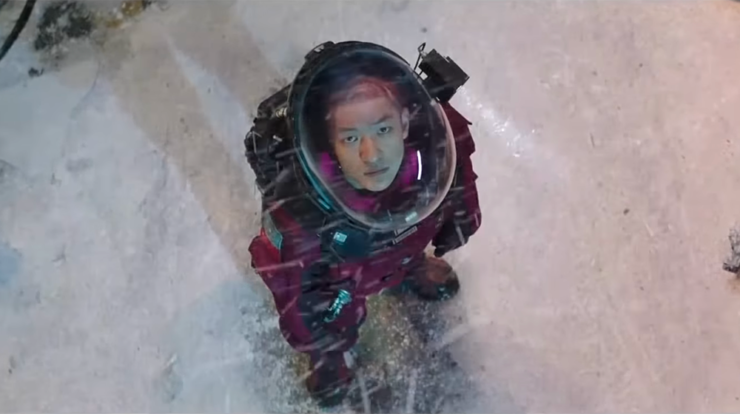
But it’s not the homages and echoes, as accomplished as they are, that I’ll remember from The Wandering Earth. No, what will stick with me are the abundant flashes of originality. To give just one example, towards the end of the film, Liu Qi stands on a sea of ice in a bright red spacesuit. (The Wandering Earth, unlike many recent Hollywood blockbusters, does not fear vibrant colors.) The upper body of a whale, caught mid-leap in the cataclysm that froze the world, dominates the middle ground. The sky fills most of the frame; instead of the blue of Earth’s atmosphere or the black of space, Jupiter’s roiling storms, looking close enough to touch, fill the air above Liu Qi’s head. It’s as striking an image as I’ve seen in a science fiction film, and there are several such moments in The Wandering Earth. This is a movie to thrill and stir the most jaded SF fan.
A final note: Netflix, in its wisdom, defaults The Wandering Earth to an English dub, but the original Mandarin soundtrack is also available, as are English subtitles. Though the subtitles are the slightest bit stilted and deserved a few more rounds of editing, I suggest that Anglophone viewers watch the movie in its original language, with its actors’ voices intact.
The Wandering Earth is one of the best big screen adventures I’ve seen in years, and if you have a Netflix account, you can watch it tonight. I urge you to tune in.
Matt Keeley reads too much and watches too many movies. You can find him on Twitter at @mattkeeley.

i’m not familiar with this, but looks pretty good
“Since this particular work isn’t yet available in English translation”
Is there a separate work beyond the story that’s a part of the collection available on Amazon and elsewhere? If not, you should definitely pick it up. Another case of the book being better than the movie!
I’m gonna say this, then slither back into the outer darkness of my own misery: the movie has a politely organized slaughter that it doesn’t discuss.
So, humanity has to live in underground cities, and there’s a lottery to see who gets in. The movie gives a lot of weight to the lottery pass the grandfather gets, and we see riot cops holding back people to get in. The pretty obvious take away is that not everybody gets in.
The idea that stuck with me, and jarred me so bad I stopped watching, was that the world government would use it as a chance to exterminate all the troublemakers. It’s not like the old countries went away. The starting underground city is thoroughly in the vein of modern China, touched by the confines of its new existence.
So, the old countries aren’t gone, which mean the old bigotries aren’t gone. I’m saying there’s not much chance you’d find a Uighur in the under cities. By that same token, I’d imagine the majority of America’s under cities as pallid by default. And considering the rising conservative tide, only the most closeted would survive.
It’d be an easy sell. For anyone who falls outside heteronormativity, there’d be talking heads saying ” we need to have babies” and a lot of people would accept that as “pragmatic”. And if the lotteries are weighted towards certain ethnic groups, the city’s are heavily fortified with soldiers and checkpoints.
It’s supposed to be hopeful, but I can’t stop thinking about the genocide that makes it possible.
Wow, did we watch the same movie??? This was so bad it almost physically hurt. Reminds me of watching movies from the 60’s where characters are streotypes and caricatures. At least they didn’t have a useless female character that just screamed all the time… Oh wait, they did. Or hogwash science like some inane anomalous gravity waves from a toaster or a planet (toaster would have made more sense). Or why exactly did the kids dad not communicate with his son for all those years? They have world wide walkie talkies, couldn’t he hop on a shuttle bus back to earth? And why exactly did the wandering Earth need a scout? Oh the insanity was neverending. And anyone wonders why this wasn’t watched???
@@.-@ I agree. The visuals and FX were very stunning and epic, but the characters were not lovable. Some side characters were ok, but the teenage boy that was the main character wa just annoying to me. For example If the grandfather was the point of view person for this story I might have liked it more.
There must be a version of this that I haven’t seen that you’re reviewing, because what I saw was beyond awful.
Inane plot, awful characters, repeated stolen concepts from other films (call them homages if it makes you feel better.)
This wasn’t seen by American audiences because it is terrible.
This movie is only proof that the Chinese can make terrible blockbusters too. Every bit of the plot was garbage. And not remotely scientifically feasible. This is a fantasy film at best, not science fiction in any way. But hey, it looked good.
This movie is unwatchable period
It took me 4 Tries to get through it…… after that 1st 2, the next two were out of morbid curiosity and a little self flagellation…
Terrible dialogue dumb scenes : a guy blows off a thousand rounds from a futuristic Gatling gun at ………… Jupiter …in.anger..apparently..
Roland emmerichs special effects guy scored a huge Payday for mediocre quality work……
Loose plot jumps around like a schizo
Just a crap movie tells u how starved China is for any entertainment especially home grown was there an edict that all Chinese had to see this movie…?
Some one send them the matrix or any avengers movie they’ll lose their freekin minds..
“a novella—though some say it’s more a long short story”
Why would this be ambiguous? The definitions are straightforward — if it’s under 7500 words, it’s a short story, while a novella is 17,500-40,000 words (novelettes are in between). I imagine the word count could differ significantly between Chinese and English, but not to that great a degree.
I watched this when it first showed up on Netflix. It was a great looking joke of a movie. When I think of a Chinese-made version of something, this is about what I’d expect for a Chinese-made blockbuster. Comical acting and cool visuals/plot.
Well, the technological backstory seems like a much less realistic Space 1999! (Case in point: if you have rockets that will boost the Earth to half the speed of light, just what is the use of a gravitational slingshot around Jupiter?) But it sounds like the film has other charms, visual at least.
So much of the “science” is just concepts that are meant to sound cool. It’s enjoyable spectacle, but not scientifically literate. Wouldn’t they have been better off building city-sized spacecraft? Perhaps they could’ve saved near everyone, not less than half the world’s population.
What happens to gravity when planetary rotation stops? Would things on the surface float off into space, especially with the atmosphere disappearing? Wouldn’t the massive thrust from the Engines break up the mantle all on their own?
There’s is an English language translation in a 2013 collection of Cixin Liu stories by the same title.
@13/Sunspear: “What happens to gravity when planetary rotation stops? Would things on the surface float off into space, especially with the atmosphere disappearing?”
Whaaaaat??? Gravity isn’t caused by the Earth’s rotation, it’s caused by the attraction between masses. Gravitation is a fundamental force that attracts every mass toward every other mass, though it takes a huge amount of mass like a moon, planet, or star before it become significant. The Earth’s rotation creates a mild centrifugal (outward) force that very slightly cancels out the inward pull of gravity, so stopping its rotation would slightly increase the weight of things at or near the equator, but insignificantly so.
If the Earth’s rotation were stopped abruptly, it would send everything flying eastward at lethally high velocity and the angular momentum would get converted to heat that would melt the crust; but I presume that in the story/movie, it was halted more gradually.
@13 Well, earth’s gravity comes from its own weight, not planetary rotation, unlike spacecrafts. In reality getting a normal gravity on spacecraft is extremely difficult, unlike what you watch on sci-fi films everyday.
I can’t vouch for all the scientific aspects of the film but pushing the whole planet makes much more sense than building spaceships. It provides enough space, fuel, air, water and raw materials to restart everything. And yes earth will keep all the air around it because it provides gravity. There is no way you can carry that using spacecrafts. Just imagine how large does it need to be to store all the water on earth? More importantly, where are you gonna live once you reach you destination? Who’s to say you can even find another planet to make it habitable?
I agree that it is not a well filmed movie, but the scientific side is probably a lot more solid than what you think.
@CLB: you presume incorrectly. The 10,000 plus engines kick in more or less simultaneously, which would cancel the rotation and create massive thrust in one direction, changing the Earth’s axis. This thrust is supposed to last for 500 years. Almost nothing of what’s shown of humans moving on the surface accounts for it. There are sequences that play just like any other thriller.
@15. AS: “The Earth’s atmosphere had disappeared, leaving nothing for the plasma’s glow to diffract against. I saw strange translucent yellow and green crystals scattered across the Earth’s surface. They were made of solid oxygen and nitrogen; our frozen atmosphere.” Cixin Liu. The Wandering Earth: Classic Science Fiction Collection
A translation on the novella has been available for more than a year in a short-story collection of the same name. https://www.amazon.com/Wandering-Earth-Cixin-Liu/dp/1784978515
@16: I don’t think that’s quite right. I’m pretty sure the film explicitly shows a flash-back in which the equatorial “torque” engines were first used to cancel out the rotation before firing up the “thrust” engines. This was one of the few things in the film that made some sense to me, although I don’t recall whether there was any time-scale given for the spin-down maneuver.
Otherwise, well, it wasn’t quite at the level of “but Lord, it wasn’t good”. Some of it was pretty and it hit at least some of the emotional beats it aimed for. But I don’t intend to ever watch it again.
I take it for granted when I watch a Chinese film that I lack context for some of the narrative conventions and tropes. That, combined with translation issues, leaves me a bit confused about the finer points of character motivations and cause and effect at the best of times. I’m OK with that.
But this… triggered “Wait, what?” moments faster than I could process them.
JjjI actually saw this at an AMC cineplex when the film was first released, and I’ll have to say the idea behind this sci-fi story is audacious, and revolutionary; instead of the traditional “find a new habitable planet” to save humanity, how about “turn planet Earth into a maneuverable interstellar spaceship”? Yeah, let’s do it; CGI-VFX for crazy Sci-fi ideas isn’t only for big-budgeted Hollywood productions; let’s break that mold! And wow they did!!! The story does try to present the human aspects of the all the scientific and technical wizardry, a sort of love story, a test of devotion and commitment from the elders to children, and vice-versa, a humanity fraught with societal challenges of living in the confines of the subterranean habitat as the Earth “wanders” away from the comforting yet deadly threat of the red-giant sun, the international effort to save Earth, the hope, despair, and faith in humanity and love – and persistence in face of incredible odds… ultimately though, it’s a crazy and outlandish, and fun to watch Sci-Fi fantasy thriller.
I actually saw this at an AMC cineplex when the film was first released, and I’ll have to say the idea behind this sci-fi story is audacious, and revolutionary; instead of the traditional “find a new habitable planet” to save humanity, how about “turn planet Earth into a maneuverable interstellar spaceship”? Yeah, let’s do it; CGI-VFX for crazy Sci-fi ideas isn’t only for big-budgeted Hollywood productions; let’s break that mold! And wow they did!!! The story does try to present the human aspects of the all the scientific and technical wizardry, a sort of love story, a test of devotion and commitment from the elders to children, and vice-versa, a humanity fraught with societal challenges of living in the confines of the subterranean habitat as the Earth “wanders” away from the comforting yet deadly threat of the red-giant sun, the international effort to save Earth, the hope, despair, and faith in humanity and love – and persistence in face of incredible odds… ultimately though, it’s a crazy and outlandish, and fun to watch Sci-Fi fantasy thriller.
Spoiler alert: movie sucks.
This was above Blade Runner, it wasn’t so much of a thinking movie like Inters, 2001 is a big no no for sci fi, Europa? Call it boring. This movie was pretty decent and I was surprised as it kept us entertained
I’m getting the feeling, from The Three-Body Problem, Ball Lightning and now this, that Liu Cixin specialises in what looks like hard science but is completely impossible. In this case, there is no fuel you could mine from the Earth’s crust that would come close to the performance needed. Also, how do you handle the seismic and tidal effects from applying such huge forces at separate points on the Earth?
As others have said, building spaceships is a much better idea.
Well, I liked it quite a bit. An entirely unscientific panel of my friends on FaceBook liked it, almost without dissent. In fact, it was originally recommended to me in a FaceBook group about movies that often discusses SF films. One of my FB friends took his teenage daughter to see it in the theater and they both really enjoyed it. While the premise is completely impossible (I suspect that the Earth is not cohesive enough to withstand even a gentle push from the rockets, for one thing), the handwavium is more plausible than the incomprehensibly popular series Space 1999 where the Moon goes walkabout, and the visuals are astonishingly effective. Nobody who commented that they disliked it said if they watched the dubbed or subtitled versions. I watched it in Mandarin with subtitles. I’m sorry, but it would never, ever occur to me to watch a dubbed version of anything. I flatly refuse to watch Amazon Prime’s Comrade Detective because it’s only available dubbed. I strongly suspect that it would come across as much dumber if dubbed, even though the subtitles weren’t perfect. Subtitles are rarely perfect, especially if you know a bit of the language like I do with French and Spanish. I often mentally kvetch (“That’s not what they said.”) Nevertheless, subtitles are still light years (pun intended) better than dubbing. I saw it on Netflix. Was it dubbed when it played AMC theaters? I would guess yes, just because so many people don’t realize that it’s a lot easier than they think to cope with subtitles. Even if you’re new to them, after about 10 minutes or so it becomes unconscious. If AMC showed it dubbed, then that was a really dumb move on the part of the distributors. I’ve been happily using subtitles since the French and German sections of The Longest Day in 1962.
Just a reminder of Tor.com’s commenting guidelines: Civil and constructive comments are welcome, rude and dismissive comments have no part in the conversation. You can read the policy in full here.
@26. Bill: I suspect Comrade Detective would be funnier in Romanian. I gave up on it fairly early because it wasn’t as amusing as expected. But the joke is that the show didn’t actually exist in 1980s Romania and the English dubbing is intentionally bad or outright made up; like throwing in Nadia Comaneci when she isn’t in the dialogue because that’s all Americans knew about.
I overall liked Wandering Earth, despite it’s flaws, and have recommended it, but watched it dubbed. I almost never watch dubbed versions, preferring the original voices and performances, but the information was so rapid fire early in the movie that it actually helped to switch to dubbing.
Added: it’s even more of a parody than I thought. Episode 2 has consultants listed that translate to Colonel Smelly Wolf and Captain Rogue Shark.
Added joke: “my friend would like to hear Nadia Comaneci perform her floor routine (on the radio)”
@8, @5 and lots of others. I agree thats it’s is visually spectacular but dire in plot and direction. I watched this on Netflix and had read the the book some time ago.
The movie is a good representation of the novel which I did not like. Sometimes a shallow novel becomes a decent movie or TV show. High Castle is a good example.
Not the case here. An appalling mishaps mash of stories and dei ex machina. Characters with no real point and terrible physics.
I really enjoyed The Wandering Earth. Had some friends over for dinner and netflix one night, and everyone enjoyed it! In fact, i liked it so much, i think i might go watch it again.
The movie is not terrible, but it is a bad adaptation. The original novella is far superior. The ending is 100 times better than the movie.
Read it and you won’t regret.
“I’ll have to say the idea behind this sci-fi story is audacious, and revolutionary; instead of the traditional “find a new habitable planet” to save humanity, how about “turn planet Earth into a maneuverable interstellar spaceship”?”
As in a concept that was seen and out done in EE “Doc” Smith’s Lensman, Jack Williamson’s Legion of Space and Space Battleship Yamato fifty or more years ago?
I can’t remember when Perry Rhodan had a dirigible planet but revolutionary it is not.
@32/Adam: I don’t remember Yamato involving any storylines about moving the Earth. It just turned the titular WWII battleship into a spacecraft, not the entire planet.
@32, @33:
The anime series “Space Battleship Yamato” didn’t turn Earth into a dirigible planet, but in Final Yamato (1983) the water-planet Aquarius, which happens to be sentient and on its own perambulations, is hijacked by the alien Dengil and warped to Earth to flood the place so they can take over. (No, the motivations don’t entirely hold together, why do you ask?) (Commentary at the Cosmo DNA fan site)
James Blish’s “Cities in Flight” series also had a dirigible planet, in the shape of the planet He.
@@@@@ 3 usakar:
I’ll suspend judgment until I watch this movie, but it sounds like mainland China all right. Individual human life disposable in regard to the common good and all that –it’s what they have actually DONE for decades. I’ll watch it, but I’m not holding my breath.
@35/Ashgrove: I’ve seen plenty of American and Japanese apocalyptic films that portrayed the same kind of hard choices for survival — look at When Worlds Collide, where only a handful of survivors could be chosen.
@25 David Evans
I’ve read 3Body and Ball Lightning and I would say that Liu specializes not in hard science fiction but in wouldn’t-it-be-cool-if fiction. He seems to be all about grand concepts but doesn’t stress too much about scientific accuracy. More like he puts in some amount of scientific verisimilitude.
I think many posters are giving this movie a harder time than it deserves. This is the equivalent of something like Armageddon, Independence Day, or any number of recent movies starring Dwayne Johnson. I think it measure up OK by that yardstick.
@37 vinsentient: Yes, definitely worth a watch. But it deserves some criticism because it takes itself seriously, as does the original author. It aspires to authenticity, unlike Rock movies or those other blockbusters.
I read something in the VanderMeers’ Big Book of Science Fiction about the near miss of Earth by an asteroid. That story was far more convincing than any of these films and it was written by HG Wells… over a hundred years ago.
The movie narrows the scope of the story considerably. There’s no journey’s end, unless they’re holding that for the sequel.
Here’s a breakdown of what’s left out even in this early part, from the Locus review:
“Attention to detail is a little bit scattered in other areas of the movie, though, especially near the beginning when so much is presented at once, skipping over explanations of many technical aspects. Why is the sun suddenly expanding? How is there enough fuel to send the planet on an interstellar journey? Is the Earth structurally sound enough to withstand this force? Why are the cities located directly beneath these fusion rockets (arguably the most dangerous place for them to be)? How are the outside scenes so brightly lit when the Earth is now at Jupiter’s orbit? What, exactly, is a gravitational spike?”
the-wandering-earth/locusmag
This is a bad film. It just has so many plot holes. How did a guy that was hanging from a metal tube survive, no idea? Gravitational spikes? It just doesn’t make sense. It got me really dizzy and manage to lose all sense of direction within me. I know its a generic blockbuster, just that it’s Chinese. 3 Body Problem just fell in my reading list. I love Ken Liu, though, even if he just translates it
The movie is “ok”… Loosely related to the original story.
But again, READ THE STORY (it’s short, it’s a novella).
And it is 100 times better than the movie.
@ 36. ChristopherLBennett: True. But the main difference is that the other movies are about dystopian futures, whereas this sounds like business as usual for the Chinese government. They underwent the Cultural Revolution, after all.
@42/Ashgrove: Yeah, and the United States had slavery and the Trail of Tears, and just look at the atrocity our current “government” is inflicting on refugees at the border. We’ve thrown away any right to claim a moral high ground, if we ever had it.
Allowing for a poor translation (I don’t think gravity spike literally means an increase in gravity), I don’t see why people are saying that the science is bad. The only thing that jumps out at me as implausible is igniting Jupiter’s atmosphere in the way they did, but even there I couldn’t say either way without running some simulations first. Plus, Liu Cixin’s sci fi is usually hard enough to be extremely compelling, so I’ll give him the benefit of the doubt here.
However, as others have pointed out, the decision making of the government is abysmal.
Still, this movie was very enjoyable and I wish there were more semi plausible space movies. Too often we get movies which are hyper-realistic to the point of boredom or pretending to be realistic because they used the notion of GR time dilation once. Thanks for the article!
“Everyone loves Cixin Liu, China’s greatest science fiction writer!”
(Five minutes later)
“We regret to inform you that Cixin Liu supports imprisoning ethnic minorities in concentration camps.”
When I brought up the mass internment of Muslim Uighurs—around a million are now in reëducation camps in the northwestern province of Xinjiang—he trotted out the familiar arguments of government-controlled media: “Would you rather that they be hacking away at bodies at train stations and schools in terrorist attacks? If anything, the government is helping their economy and trying to lift them out of poverty.” https://www.newyorker.com/magazine/2019/06/24/liu-cixins-war-of-the-worlds
And, note, doesn’t just support it in a vague theoretical or historical way. He isn’t just saying something like “seventy years ago FDR interned Japanese-Americans, and he was right to do so” or “here’s a fictional scenario in which you have to admit it would be right to introduce slavery to the US again”. He’s looking at a thing that is actually happening in his country right now, and that meets the actual definition of genocide, and saying, “I support this”.
@@@@@ 43 ChristopherLBennett: Nobody’s perfect.
Also, as someone who grew up in a communist country, and lived there a considerable chunk of his adult life, I can assure you that –notwithstanding its obvious faults, and even those not so obvious– this country is edenic compared to that.
I suppose that’s true, in the sense that A. E. Van Vogt’s SF was hard enough to be extremely compelling (to a set of readers of which I am not a part).
@45. ajay: thanks for the link, interesting article. I’ll add this article, just saw today:
Uighur author dies
Liu does seem to toe the party line. Maybe he has to in order to maintain popularity, status, and career, but he comes across as sincere in the New Yorker article.
One detail about his work stood out: Supernova Era springs from the conceit that supernova radiation wipes out all humans older than thirteen. That’s not hard SF. That’s using scientific concepts to set up hypothetical situations or to work out metaphors. It reminded me of poetic conceits, like John Donne saying, “This flea has bitten us both, and our blood has already comingled, so we may as well have sex.”
It does kind of help me understand why I stopped reading the Three-Body trilogy halfway into the second book. It felt like it was becoming about obscure metaphors and I was getting somewhat lost in the forest. Then again, much of the second book was about building an interiority that the aliens can’t spy on, so maybe there a key there to how we’re actually supposed to view his work.
It was a bit of a stretch that the giant planet-pushing rockets lacked an inbuild reignition system. You’re sending your one and only home planet on a dicey maneuver round Jupiter with engines that can only be restarted by folk hauling bombs around on trucks? It just seemed a wee bit of a design flaw.
An interesting essay from China (translated) on The Wandering Earth as an important product of two strands of the Chinese extreme right wing: http://chuangcn.org/2019/08/wandering-earth/
And a thread from a US scientist who remarks “I’m surprised I haven’t seen more critical commentary about race in Chinese films and how Chinese filmmaking is reproducing white supremacist tropes right down to the wimpy tragic mulatto…” and points out that the film’s intensely unpleasant in terms of attitudes towards foreigners, towards the sovereignty of Asian countries other than China, towards Africans and basically everyone who isn’t white or Chinese, towards women…https://twitter.com/IBJIYONGI/status/1169360276371759104
Not entirely surprising; take a look at the cast list of Cixin Liu’s books, and take a shot of vodka for every non-Han Chinese character you find, and you’ll still be sober enough to drive at the end of the trilogy…
Nice movie, could be better.
I remember other stories in which ordinary planets (that orbit around a star) become artificial rogue planets. Ringworld, with the pupetteers homeworld, comes to mind. They were also fleeing something, but it was on a galactic scale, and had much higher technology (inertialess, frictionless drive).
Also the Canadian cartoon Shadow Raiders.
@@@@@ 11
I think the Earth is supposed to reach 0.5% of the speed of light after it slingshots around Jupiter. Slingshot maneuver helps accelerate stuff, like the probe Voyager. So the engines around the Earth’s equator arent capable of accelerating it to 0.5% of the speed of light on their own. The Earth starts moving when the main protagonist is 4 years old and most of the story takes place as they’re nearing Jupiter, when he’s 20. That’s 16 years. So the engines aren’t nowhere near capable of reaching 0.5% of the speed of light on their own.
Jupiter is 43 light minutes away from the Sun. Earth is 8 light minutes. So it takes them 16 years to move around 35 light minutes.
The movie says it’s going to take 2,500 years for the Earth to move 4.2 light years to the nearest star (I’d like to see how they would know how where to park just right in a two star system, like Alpha Centauri). So the Tor author got wrong, it’s not 50% of speed of light, but 0.5%.
@52/Ryamano: “(I’d like to see how they would know how where to park just right in a two star system, like Alpha Centauri)”
The usual way, through math. It’s already well-understood where the stable and habitable orbits around Alpha Centauri A and B would fall.
http://www.solstation.com/stars/alp-cent3.htm
I watched this again and still don’t understand some of the criticism’s of this movie. Nobody complains so strongly about scientific accuracy for big, dumb, Hollywood blockbusters, so why do it for this movie? Complaints about character and motivation I can understand more. To me, this movie is all about the exterior vista shots. They’re amazing and give the movie a sense of wonder that I seldom feel any more in most SF movies.
I also don’t fully agree with complaints that Wandering Earth is solely a collection of SF movie cliches. It might be for Western audiences, but in China, movies as entertainment is a relatively recent phenomenon (I’d put it at somewhere around the turn of the millenium) and even then only a very, very limited number of Hollywood films are approved for release in China every year. This means most of the domestic audience hasn’t seen many of the movies that WE might reference.
My personal complaint about The Wandering Earth is that the resolution comes from an idiot with almost no science education. How can his solution work when it was already considered and discarded by people who are actually able to do the calculations? It reminds me of a Cultural Revolution effort-is-enough attitude that is really distasteful.
But Jupiter hanging in the sky makes up for a it. Really.
@54/vinsentient: A lot of people complain about scientific accuracy in Hollywood blockbusters. There have been whole websites dedicated to doing so. It got to the point that some scientists actually put together a consulting group to work with Hollywood to screw up the science less, which is part of why we’ve gotten more films with relatively decent science over the past few years (e.g. Gravity, Europa Report, Interstellar, The Martian, Life).
@55 CLB
Maybe, but I consider those to be higher brow than the Wandering Earth (except maybe for Life). I’d compare this more to fare like superhero movies, the Terminator, Jurassic Park, Star Wars and Star Trek revivals and so on. I don’t think any of those are any better on the scientific plausibility front.
@vinsentient: “Nobody complains so strongly about scientific accuracy for big, dumb, Hollywood blockbusters, so why do it for this movie?”
Unless I missed it, this site hasn’t done an Ad Astra review. That one had screamingly bad science throughout. Examples: a lone human, apparently without any advanced or alien tech (which would’ve handwaved it) sends pulses from the outer solar system that knocks out tech on Earth, killing thousands. Pitt climbs up the outside of a rocket while it’s taking off in a silo. Not only is he not fried, but he hangs on to the outside rungs without his arms being torn off.
The knocks against Wandering Earth don’t have so much to do with the context of Chinese cinema as with the original author being lauded and marketed in the West as a hard SF writer.
I decided to cancel Netflix for now to balance out re-upping CBS All Access for Star Trek: Picard, and in the last few days before my subscription ran out, I decided to finally watch The Wandering Earth, which has been sitting in my queue for a while since the various reviews and political critiques of it left me unsure of my interest.
Anyway, it’s basically a pretty standard apocalyptic disaster movie in the vein of When Worlds Collide or Gorath or the like, with the same kind of wacky physics and over-the-top destruction and hard moral dilemmas and sacrifices, but made with far more elaborate visual effects and more extreme action than any of those movies. I felt it was a little too much at times, but mostly it was fun, and there were some effective character moments.
As for the problematical politics people talk about, I didn’t think it really came across in the film. It didn’t seem all that nationalist or pro-authoritarian, since the government was seen as heartless and wrong and it was the individual heroes’ defiance of state authority that saved the day — even at the same time that the self-absorbed characters learned to be willing to sacrifice for the good of the whole, so it sort of went both ways. And sure, it had Chinese heroes saving the world, but American movies have American heroes saving the world, Japanese movies have Japanese heroes saving the world, etc. So what else should we expect?
Anyway, China has no monopoly on disaster SF with problematical politics. I once read the two books on which the film When Worlds Collide was based — When Worlds Collide and After Worlds Collide by Philip Wylie and Edwin Balmer — and I found them surprisingly parochial for SF novels. They’re pretty jingoistic, painting America as great and everyone else as either a stereotype, morally challenged, or barbaric. There is a very stereotyped pidgin-speaking Japanese servant who turns out to be a well-educated spy, but he reveals this when he ends up defecting because he’s seen how superior the American Way is. Also there’s a strong Christian undercurrent to the books, implying that these events are another Great Flood, God sending a disaster to cleanse the universe of the wicked and save the virtuous. I got a little tired of the leading lady’s borderline-fanatical speeches about how good and wonderful it was that God was killing off 99.9999 percent of the human race. I still like the George Pal movie, though. Sometimes writers whose politics you hate can still produce worthwhile fiction ideas.
@52/Ryamano: “So the Tor author got wrong, it’s not 50% of speed of light, but 0.5%.”
The subtitles did say 50%. So maybe it was the translators who got it wrong. I agree with the review that the subtitles were stilted and not always well-written.
@54/vinsentient: “My personal complaint about The Wandering Earth is that the resolution comes from an idiot with almost no science education. How can his solution work when it was already considered and discarded by people who are actually able to do the calculations?”
His solution didn’t work, though. His plan failed exactly as predicted, until the father up on the space station decided to do the one thing the government was unwilling to consider and sacrifice the station.