






Lois McMaster Bujold is already one of the greats. She has been nominated for 12 Hugo Awards, and has won for “Best Novel” four times (a tie with Robert Heinlein) for The Vor Game, Barrayar, Mirror Dance, and Paladin of Souls. She was also nominated for eight Nebulas, and has won for Falling Free, The Mountains of Mourning, and Paladin of Souls. She’s won a Mythopoeic Award for The Curse of Chalion, and three Locus Awards—two for Best Science Fiction Novel (Barrayar and Mirror Dance) and one for Best Fantasy Novel (Paladin of Souls).
The true mark of her greatness, however, is her wide-ranging mind and imagination. Having created a massively successful space opera in the Vorkosigan Saga (with a massively popular hero, Miles Vorkosigan) Bujold went on to tackle the fantasy and romance genres as well.
Bujold was born in 1949, and grew up in Ohio (whose landscape later influenced her Sharing Knife series) the daughter of electrical engineer Robert Charles McMaster. McMaster was a professor at Ohio State University, an editor of the monumental Nondestructive Testing Handbook, and, having decided that all that wasn’t enough, became one of the nation’s first television weathermen as well. In addition to influencing his daughter’s love of science fiction, he also may have influenced one of her greatest characters, Miles Vorkosigan. Miles grows up in the shadow of his heroic, royal father, just as Bujold grew up with a father who was world famous in engineering circles. “…Miles’s ‘great man’s son syndrome’, his daunted drive to equal his father’s achievements, owes something to my relationship to my own father.”
As she became more involved in fandom, she joined the Central Ohio Science Fiction Society, and eventually became co-publisher of StarDate, a science fiction fanzine. Her first published story was “Barter,” which came out in Rod Serling’s The Twilight Zone Magazine in March/April 1985.
Bujold wrote her first three books on spec in the 1980s, saying that she wrote them “…very much in isolation from the genre influences of the day. (Stuck in a rural town with two small children and no money, I was pretty much isolated from everything, really.) But what I pulled out of the accumulated contents of my head, somehow, was a universe.” Eventually she published The Warrior’s Apprentice, part of what became the Vorkosigan Saga, with Baen Books in 1986. Since then, she has continued writing stories of the Saga out of chronological order, creating a giant tapestry that (more or less) follows the life of one man, Miles Vorkosigan. Bujold created a vast world for the Saga, in which many individual planets and cultures are connected through a system of wormholes. Having given her series two noble and gifted protagonists in ‘Admiral Viceroy Count Aral Vorkosigan, Former Regent and Prime Minister of Barrayar’ and Commander Cordelia Naismith, who becomes ‘Vicereine Countess Vorkosigan,’ she promptly moved on from them to a far more unlikely protagonist: their son, Miles. Miles, poisoned in utero, has a bone disorder that crooks his spine and weakens his bones. His full height reaches less than 5 feet. What Miles has, however, is a quick wit and almost boundless determination and ambition. He acts as a soldier, a pilot, a con artist, an ambassador, whatever life demands of him, and becomes an even larger-than-life character than his father. Even within the space opera boundaries, Bujold pushed her characters into new genres: in A Civil Campaign: A Comedy of Biology and Manners she uses the conventions of a high-society romance in a nearly Regency style to tell the tale of Miles’ betrothal, while in Diplomatic Immunity Miles becomes the detective in a whodunit.
Bujold also delves into larger class issues in Free Fall, and in Ethan of Athos, she gives us an all-male world, in which homosexuality is the norm and women are an unthinkable Other. Because of this, Bujold is able to show us a society in which “women’s work”—everything from housekeeping to child-rearing to emotional maintenance within a relationship – is simply part of everyone’s work. She also sends one of her characters, the obstetrician Ethan, on a desperate quest that forces him to interact with a woman, the mercenary Elli Quinn. As Jo Walton points out, “It’s interesting that Athos is a Planet of Men, because it’s the only one I know of, and I can think of quite a few examples of Planets of Women.”
Rather than staying in space, however, Bujold has written in several other genres, giving us an epic fantasy in the Chalion series, and a romance-fantasy with The Sharing Knife series. With Chalion, Bujold brought the same meticulous world-building to the project that made her space operas great. Where the worlds of her Vorkosigan Saga are bound together through a system of wormholes, Chalion is a world shot through with magic. Based on Reconquista Spain, The Curse of Chalion gives us a land where political machinations intersect with magic and divinity. Bujold also created a giant theology for the series, planning one book for each of the gods in the pantheon, of which three have been released: The Curse of Chalion, Paladin of Souls, and The Hallowed Hunt. In an interview for Clarkesworld, Bujold said of the series:
Notions for the last two Chalion books have been rattling around in my head for years, but neither has reached critical mass yet. It feels like it’s about time to remake myself as a writer yet again, think of something new and unexpected, but really, the pleasures of slacking loom ever larger.
The Sharing Knife, meanwhile, draws on the 19th Century American frontier, imaging a society of nomadic hunter-gatherers who are left in the wake of the collapse of a high-magic society.
The Encyclopedia of Science Fiction talks about Bujold’s extraordinary world-building:
Bujold’s worlds are realistic and very detailed, yet seemingly conjured out of thin air. There is seldom a trace of the arduous research she must have done to make them. She is a world-builder worthy of putting alongside, say, Tolkien, but more economical than he was. Perhaps the comparison should be with Frank Herbert, but Bujold’s world-building is less melodramatic than his.
And concludes that it is her clear and witty writing style that enables her to embed sophisticated social critique into the traditionally conservative realm of military sci-fi. Bujold has a slightly different take, saying:
The mind of a man is not the sort of broad galactic scope traditional space opera had dealt with, but I found it universe enough for my tale. Which is yet another way my ‘space opera’ ran counter to the expected norms of the genre, and so helped to change them.
Lois McMaster Bujold may have worked her way through all of the genres by now, but if anyone could invent a new one, it would be her.

I would read the phone book, if she wrote it.
Her characters are fully realized, flawed, entrancing humans. Her worlds, complete. She discusses myriad concepts and moral issues in subtle and thought provoking ways. She’s both funny an poignant.
Although I’ve enjoyed all of her series, The Vorkosigan Saga is a masterpiece. I want to know these people, this world, and want it to go on and on.
Please keep writing, Ms. Bujold!!
Her characters are welcome and well formed and I love spending time with them
Tektonica @1, I can only agree. I’m so happy I “found” her / you recommended her to me.
What she did with the Vorkosigan series is amazing. And that each book could truly be read as stand-alone is even more remarkable, though of course, anyone who reads one, will be compelled to go read them all.
does any one know if she is in the process of writing another novel?
@@.-@, maybe about the Komarr Revolt or following Cryoburn? ^^
@@.-@ & 5: I don’t see anything about a full-length Vorkosigan novel in the works but I caught references to a novella featuring Miles, with a novel use for butterbugs… I also recall that there are supposed to be two more Chalion books in the series.
Travyl@3: So glad you liked Bujold.
I haven’t heard anything about more of the Vorkosigan Saga, and the way she left the last one, I don’t know if she will go forward. I would SO love more of Miles. I think he still has room to grow. (Double entrendre intended.)
@3,7: I would like to give the Vorkosigan series a try. Is each book truly stand-alone? Or would you recommend starting with some books over others?
@8: Bujold’s remarks on order are as follows:
http://www.goodreads.com/story/show/293438-the-vorkosigan-saga-reading-order-debate-the-chef-recommends
(I started with Shards of Honor)
@9: Thank you! Most helpful.
Bluejay, I read them in in-world-chronological order and highly recommend it. (Yes, it’s not truly necessary, though Cryoburn should be last, for impact)
Recommended order: (chronological except for Falling Free):
Cordelia’s Honor (Shards of Honor, Barrayar)
Young Miles (Warriors Apprentice, Mountains of Mourning, Vor Game)
Miles Mystery Mayhem (Cetaganda, Ethan of Athos, Labyrinth)
Miles Errant (Borders of infinity, Brothers in Arms, Mirror Dance)
Memory
Miles in Love (Komarr, Civil Campain, Winterfair Gifts)
Miles Mutants and Microbes (Falling Free, Diplomatic Immunity)
Captain Vorpatril’s alliance
Cryoburn
Man, the Vorkosigan saga. There is no series of books I binged on as I binged on that – Old Man’s War and Newsflesh come to mind, but both are dwarfed by the tales of Miles Vorkosigan. And when I finished that binge, I started all over again. First learned about the series when the Humble eBook Bundle had Shards of Honor, and I’m sure I didn’t pay enough for that one. Took a little while to get the hang of it, but I’m glad I stuck with it.
For anyone who hasn’t read any of Bujold’s work: do you like exciting adventures with enough depth to be the proverbial gazing abyss? The answer is yes, and the question is “Should you read it”.
I can also highly recommend the in-universe chronological reading order – it’s not the same experience if you can’t see the characters change and grow.
I didn’t read them in order, and didn’t suffer for it. There are subsets wihtin as travyl has noted and I’d suggest reading those in order (e.g. the Young Miles books). I still haven’t finished Cordelia’s Honour – the prose is a bit Mills and Boon. She definitely got better as she went!
The last I heard, the Miles / butterbug novella had fallen apart over structural issues. I haven’t heard what, if anything, she’s currently working on.
She traditionally does a reading at Dreamhaven Books in Minneapolis, MN, in December. I try to make it – if I do, I should be able to find out more then.
I’ve been dying to know what she’s been working on since CVA was published in late 2012. Not a mention on her blog (and I’ve checked) and no information on wiki or related sites. *crickets*
I want/need to know what direction she is heading in.
p.s. I finally read the Spirit Ring this week – well crafted but, ultimately only ok. Reminded me quite a bit of Guy Kay’s one-off fantasy works.
So many of her fans say nothing about the science in her stories. The converstaion with Vagaan in Barrayar. The worm hole physics in Komarr that is so much like The Cold Equations by Tom Godwin.
The scientific attitude doesn’t matter to science fiction readers any more but Bujold handles it better than most SF writers. Robert J. Sawyer is her competition in that but she does characters better.
I read all her books in the order they were written, because once I had read the first, I couldn’t miss any of the others. She has a way of drawing you into the story that you see from few others in the field. The science is there, but often in such subtle ways that you don’t even realize it. She took one of the most popular military SF characters in the world, turned him into a detective, and made it work, and still the fans cried for more. And put that same character into a humorous romance novel, and again, the fans cried for more. And took her rigorous approach to the world of fantasy, and made that work, too. Her output seems to be slowing down, but even if she stopped tomorrow, she has produced one of the greatest bodies of work in the field.
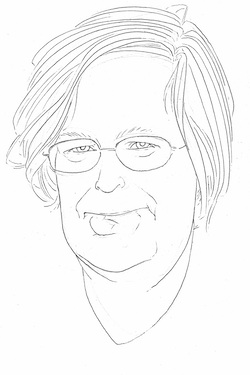
(This is the first time, though, I have to comment on the drawing on the top of one of these articles. That picture does not match the person I have met on a number of occasions.)
I’m a latecomer to Bujold’s work, but I’m an instant convert. The first Vorkosigan book I read was Diplomatic Immunity, which is, cover-to-cover, almost entirely built from elements that previously appeared in earlier installments. I consider it a testament to her writing and world-building that I could come into that cold, with only the vaguest notions of the setting, and not once feel alienated. I got into the characters, setting, and plot immediately.
Update: Bujold has sold a Cordelia-centric novel to Baen for 2016, titled Gentleman Jole and the Red Queen.
Hooray!
Further update – the eARC of Gentleman Jole and the Red Queen is now for sale at Baen. Plus, there is the new novella Penric’s Demon, in the Chalion universe.
Both are, of course, excellent, and not what you’re expecting. But then, Bujold, and when is it anything else with her?
In fact, if you’re impatient, the eARC of _Gentleman Jole_ is available from Baen (and it’s AMAZING). The reviews on Baen’s site are mixed, but if you like romance and exploration of social structures, you’ll like it.
One typo in the story – you mention _Falling Free_, but later you call it _Free Fall_.
If you are really desperate, first four or five chapters of Jole are free on line.
Does anyone know why some (but not all) Baen books have a weird apostrophe display problem in the sample chapters/read online view? Quotation marks come out like this: “ while apostrophes are like this: ’. Gentleman Jole and the Red Queen is fine, as is the ebook of The Beyonders but it’s conspicuous in Mission: Tomorrow and the new Shards of Honor, along with the Andre Norton omnibus series after Deadly Dreams. The actual ebooks are fine.
Tor republishing articles again.
But Bujold is amazing, so it is all good. It seems she does not get the mass amounts of love she fully deserves. People will list there favorite authors. I ask if they have read her, and they go “Yes! I love her!” Yet she is not in their first run of favorites. Why is this?
@27: What do people usually list in the first run? I find people like to list those they perceiver as writing “Serious Literature” first and need extended prodding to relinquish the names of authors they actually read over and over.
@26 – AIUI, that’s a character-set issue. The sample chapters come directly from (IIRC) the .DOC file, and they use MS Smart-quotes, which are not standard ASCII / ANSI characters. So, they get translated to character with the same number in the character set your computer is using for its display. The ebooks have a built-in display character set, which the conversion to includes translating the smartquotes to the relevant character in that set.
Oh, will Jo Walton be reviewing Penric’s Demon? Because I always enjoy her Bujold reviews in particular, and there is always a great discussion/gossip about the books.
@30 – Ursula, that would be very cool – as would a Walton review of _Gentleman Jole_ once it’s out in final form.
Re: Gentleman Jole and the Red Queen. Exploding heads indeed.
I still can’t even think “Count Vorkosigan, Sir.” without crying.
The genius of Chalion is not that she created believable gods, but Gods worth believing in.
@8 Bluejay – Reading order? I recommend starting with Young Miles (Warrior’s Apprentice followed by The Vor Game) or perhaps the second of Cordelia’s books (Barrayar). Shards of Honor is the first book, and it’s worth a read, but it is clearly a first book, and Bujold’s story-telling gets far, far better in later books. Start with the really GOOD ones.
@29: Thankyou.