







If you are of a certain age, let’s say over 30, you have at least some memory of life in the 1990s. This was the end of history, and as the millennium was approaching its conclusion, we were increasingly preoccupied, nay, obsessed with emerging technology, and one in particular: the internet, or as it became known, the World Wide Web.
Beginning in the late 1980s and hitting a peak in 1995, internet mania quickly became easy fodder for Hollywood, and especially a certain kind of Hollywood film: the paranoid thriller. New tech has long been a going concern for filmmakers—the artform is, after all, inevitably a technological one, the product of machines and human creativity coming together. Even within the subgenre of early internet films, though, there exists a rather wide range of takes on what the web could or would do, what it looked like, and where it might all be headed.
There was, for instance, a parallel focus on virtual reality via computers—The Lawnmower Man (1992), Virtuosity (1995), The Thirteenth Floor (1999)—ultimately culminating with The Matrix (1999). At the same time, though, there were films more interested in capturing if not the full reality of the present internet, then at least the on-the-ground allure and anxiety surrounding it.
One of the most frequent ways into both of those feelings was to focus on hackers. As a distinct hacker culture developed, so did a wider mainstream culture awareness of what hackers could do, alongside the aesthetic and behavioural qualities which defined them: anti-authority iconography, numerous aliases, DIY tinkering, and maybe black clothing, tattoos, bleached and dyed hair, and piercings to complete the look. They also tended to be social outcasts, who collectivized around their technical wizardry and pranks.
These films also, certainly, aimed to heighten and exploit ongoing fears around the internet, specifically in terms of security and privacy. The hacker figure was simultaneously emerging as a folk hero and an antisocial menace, depending on one’s perspective or class position, and Hollywood took notice of a new world that offered such a potent blend of zeitgeisty pathos.
These films, focused on the dangers of the ’90s internet, ranged in quality, but there was a fascinating confluence of examples trying to understand what this globalized technoscape would mean for how we lived our lives. Tapping into what the systems could actually do, while usually making attempts to forecast what may be ahead in the near future, was a reliable way to engage with an audience likewise figuring out what online life could be. Were we feeling optimistic?
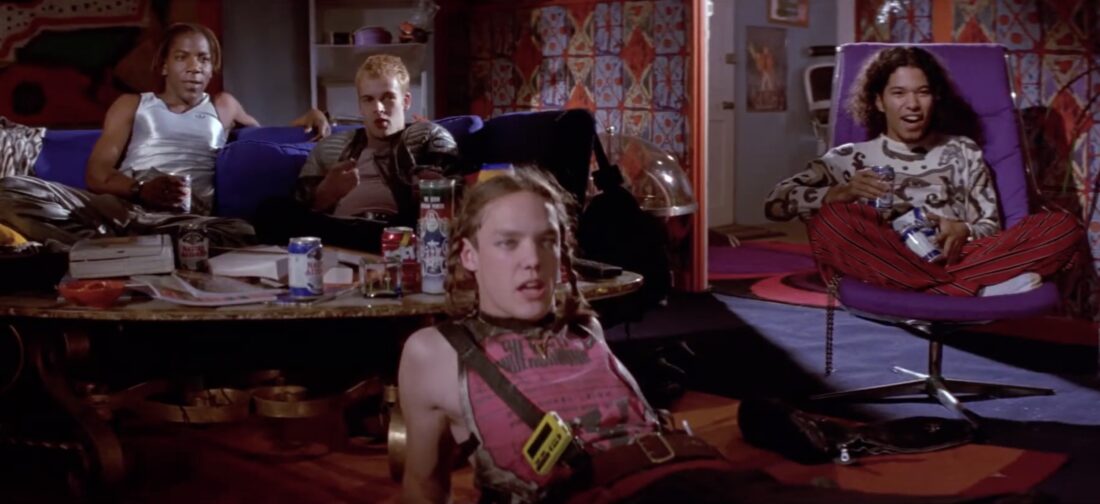
Hackers (1995) is the obvious starting point. Starring Jonny Lee Miller, Angelina Jolie, Matthew Lillard, and others as a ragtag group of teenaged hackers explicitly inspired by the ideals and principles of the Hacker Manifesto, the film was both a reaction to the rising subculture and a surprisingly coherent representation of their apparent value (and threat) to the new digital order.
Fisher Stevens plays the film’s main antagonist, nicknamed The Plague, a computer security expert and former hacker who now works for the megacorporation targeted by the teens. In grand movie villain eloquence, he tells them: “Let me explain the New World Order. Governments and corporations need people like you and me. We are Samurai… the Keyboard Cowboys… and all those other people who have no idea what’s going on are the cattle… Moooo.”
Here, of course, the vast majority of the moviegoing audience is being analogized to the cattle. The film itself is utterly absurd, and most of the visual attempts at representing the online world are hopelessly dated in retrospect, even if tinged by a nostalgic wonder and awe at what could’ve been. As a recent paper by Roberto Dillon argues, mid-90s cinematic hackers were “a symbol of youth, rebellion, and cyberpunk coolness,” aligned “with broader cultural narratives of resistance and self-actualization.” The hackers are quite clearly positioned in the folk hero role, in a way that can almost feel like a lost opportunity. Watching it in 2026, one can’t help but wonder—where are our hacker savant saviors to rescue us from the techno-megacorps?
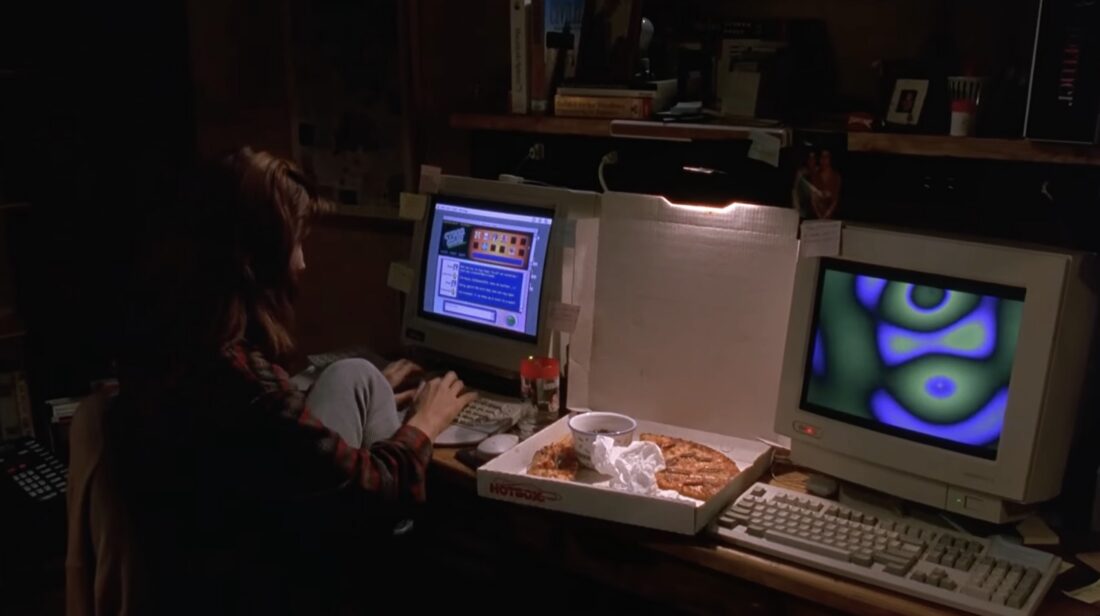
Other films, perhaps most notably The Net (1995), with Sandra Bullock as a computer systems analyst being hunted by cyberterrorists when such a word was still a complete novelty, did take more time in their approach to capturing the actual internet as people knew it, with some prescient stabs at what was around the corner. Consultants were hired to ensure a relative level of authenticity, and even the forecasting was largely kept within reasonable boundaries of the technically possible. This was an opportunity to understand how the internet could simultaneously connect the world, while also demonstrating how easily it could be weaponized. It was also an early example of an internet-focused premise whereby characters routinely trust what the computers are telling them over the human being standing in front of them. Still, though, the idea was very much centered around the internet as a tool that anyone could make use of, for good or for ill, without considering that there may be something about the technology itself that would pose more fundamental problems for society.
An underseen personal favourite is Ghost in the Machine (1993), which is far more abstract and even silly in its digital imaginings, but nevertheless gets at something distinct about the internet age. A serial killer dies, and during an electrical storm, his soul gets uploaded via an MRI machine into a computer (sure). He then gains control over computer networks, and starts to kill everyone surrounding a woman named Terry (Karen Allen), who later teams up with a hacker to fight back. In the end, the killer becomes a virus, and is brought back out into the physical world where Terry can face him head on.
This little film in many ways predicted how the computer age would spread to every other device in our everyday lives. The Internet of Things, as this process came to be known, is the 21st-century promise that everything can be automated into the electrical networked grid, and the result is mass convenience and efficiency. Our domestic lives become seamless experiences of desire and its satisfaction thanks to an interconnected system of data extraction, surveillance, and networked cooperation. We will live in smart homes inside smart neighborhoods inside smart cities, all of which are connected to the same system to ensure complete knowability and trackability—for our benefit, of course, because we get our groceries ordered before we even know we’re out of ketchup and any number of other seemingly utopian things, many of which are tied to what we consume because that’s what is smart about smart technology. The allure of this dream is obvious for capitalism, because it guarantees sustained and dependable consumption that is automated without the kneejerk whims of humans getting in the way. Even if we understand all this, the way these technologies demand our participation and are imposed into every nook and cranny whether we asked for it or not, sometimes the temptation of the ease and convenience can make one give in to the ghost in the machine anyway.
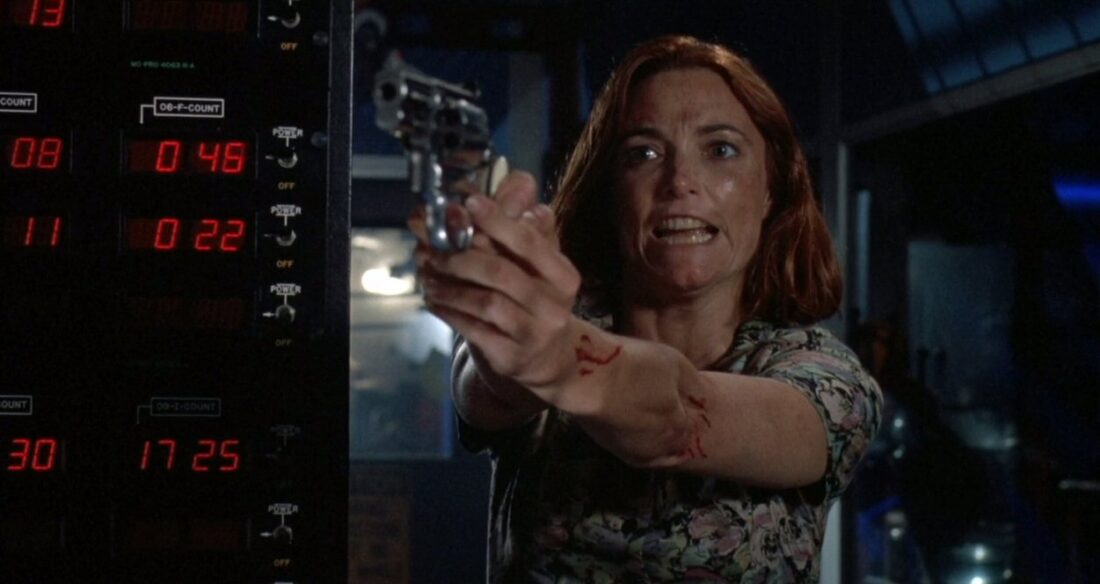
Of course, then, Ghost in the Machine’s mistake is that final-act decision to materialize the virus, to make the menace corporeal and tangible, taking the machinic out of the machine. The problem isn’t the cheesy VFX—that’s part of the film’s quasi-avant-garde charm. The problem is that it returns us to the familiar horror: the man stalking us, physically in our space, threatening in his imposing embodiment. What makes this movie so successful, though, is the reminder throughout the rest of its runtime that there is an inherent and intrinsic danger within mass connectivity, which can otherwise be seen as uniformly benevolent. We can lay the blame on a singular hacker or killer, sure, but the real fear comes from the unknowability of a system that makes decisions without us knowing why or even being able to question them. A microwave, a dishwasher, a telephone, it’s all one and when we give in, we risk giving up.
It’s this balance of techno-optimism and cynicism that marks this era of internet movies. While other films would soon come along to blast open the societal, civilizational transformations of this technological shift (often from outside Hollywood; see Pulse [2001] and Demonlover [2002]), it is these ’90s experiments which tell us much about the mainstream discursive emergence of the internet and, I would argue, about the parallels we can see today in how we talk about generative AI.
In a sense, we can say that these ’90s films were “training” the audience in how to think about the internet, wrapped up in genre conventions and dramatic extrapolation. They were, for better or worse, reflecting people trying to understand how the internet would change their lives. It’s easy enough for the cinema to hijack the fears latent within the unknown, technological or otherwise. To put it plainly, the movies underlined the optimist vs. pessimist binary when it comes to new tech that we are still essentially stuck within today. They trafficked in varying degrees of hysteria, distorting attitudes and ideas about the internet in their own present, which inevitably has some influence on ours. As Dillon puts it, these films and their influence on what came next demonstrates “a culture repeatedly reconfiguring a stable set of symbolic figures to grapple with its own changing anxieties.”
Particularly as blockbuster-level films like the last two Mission: Impossible installments, as well as the latest Tron and Scream films, identify “AI” as the bad guy, it is by repeating the patterns of the ’90s films, literalizing an understandable anxiety about something beyond their control. In the case of Tron: Ares, two tech CEOs are battling to bring the virtual into the physical world, vying for control of AI in the process—the most generous reading of its half-baked story is that AI is okay as long as the good billionaires are in charge. Scream 7, on the other hand, is more interested in using one part of the AI discourse, the threat of sophisticated deepfakes, to help underline the twisty nature of its villain in this septenary outing for the troubled franchise. In any case, “AI” basically operates here as something to easily villainize or to softly gesture at ongoing cultural debates.
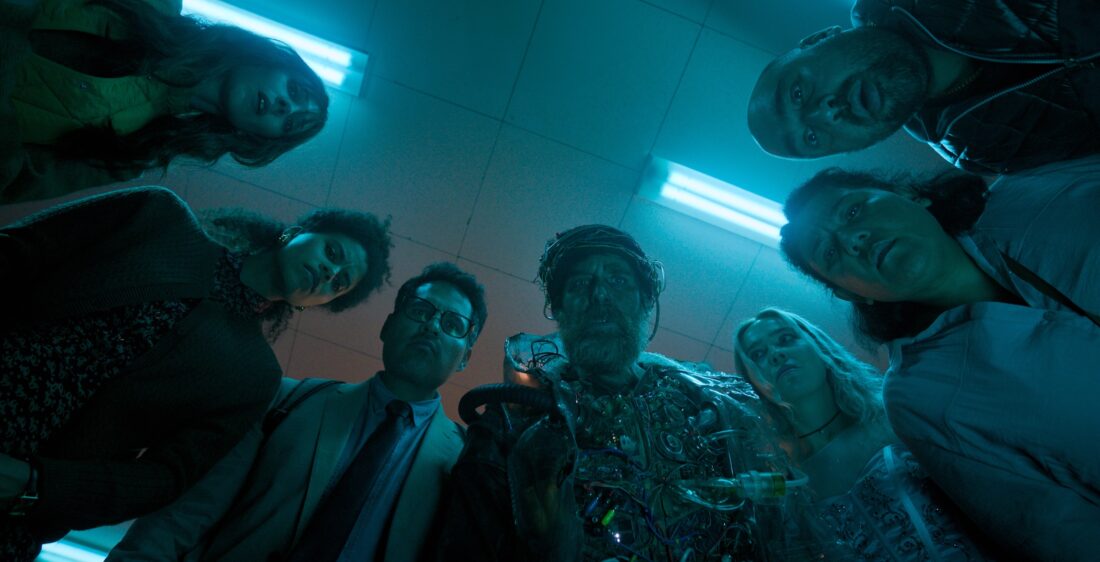
On the one hand, one could see this having the perhaps unintended effect of preparing audiences for scenarios which are frankly impossible (full sentience, for one), which could make smaller incursions into our lives more palatable in comparison. Still, even if I had many issues with, say, Good Luck, Have Fun, Don’t Die, Gore Verbinski’s recent return to the multiplex about a time traveler gathering helpers to destroy a rogue superintelligent AI, I was at the very least charmed by its full-throated rejection of AI’s narrative of inevitability. It reminded me of what was most satisfying about those ’90s films: New tech isn’t something to necessarily be optimistic or pessimistic about, it’s something that can remind us to pay attention to the ways our lives change, especially when it feels like we have no say in the matter. At least at the movies, maybe we do.

“Sneakers”, a Robert Redford movie that came out in 1992, was one of the better computer hacker films. Some aspects of it have aged too well.
There’s a scene in “The Matrix” where Trinity uses an SSH vulnerability to break into a system. It was a real vulnerability that was exploited correctly in the film.
That’s because, except for the magic McGuffin (and unlike Hackers), Sneakers was plausibly accurate. Indeed, two of the characters were based on real people.
I remember seeing the pilot episode (or at least an early episode) of the TV series adaptation of The Net, and I found its premise to be a straw man. It involved a senator or other politician having something ruinous happen to him because of information that was stolen from his computer overnight, and the attitude of the story was “Ooh, technology is so evil because it lets people be victimized like this,” but my reaction was, why didn’t the guy just turn his computer off when he wasn’t using it? If someone gets their house burgled because they leave their front door gaping open, does that mean doors are evil?