







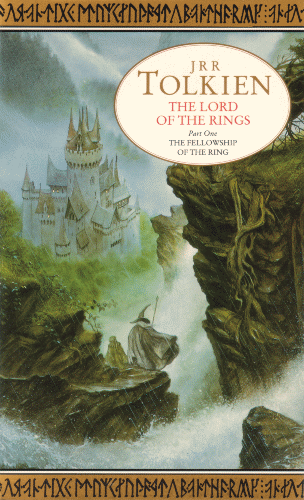
And now for chapter 6 of The Fellowship of the Ring, “The Old Forest.” The usual spoilers and commentary follow.
What Happens
The four hobbits enter the Old Forest. Despite their best efforts, they are unable to make progress in any direction but south and east, leading them to the Withywindle valley. There, a great willow tree sings three of them to sleep: Merry and Pippin are pulled into cracks in the trunk, and Frodo is held under the river by a root. Sam rescues Frodo. After fire fails to convince the tree to release Merry and Pippin, Frodo calls for help. He is answered by Tom Bombadil, who was out to gather lilies for his lady. At Tom’s orders, the tree lets Merry and Pippin out. Tom invites the hobbits to his house, and the chapter ends with the hobbits standing on the threshold.
Comments
The first immediate physical peril faced by the hobbits, and I think it’s significant that it’s not from an obvious servant of the Enemy. Unfortunately I’m not sure what it’s significant of. Yes, it’s showing that there are powers in the world other than those centered around the struggle for the Ring, just as Tom himself is (and the Ents will be, at least at the start), but making this the first near-death experience? Perhaps it’s just that the Nazgul need more time to be built up.
(There is a little hint that Old Man Willow’s actions are unusual: Tom says, “What be you a-thinking of? You should not be waking,” which is probably related to the fall season. There’s only one other fact that would support a conclusion that the Ring is involved: Frodo is pushed into the water, not dragged into the trunk, though he also falls asleep with his back against it. It’s not in the Ring’s interest to be stuck into a tree, after all. However, this is pretty thin stuff to be speculating on.)
* * *
Whenever I feel that I’m giving the re-read short shrift, I do my best to visualize the descriptions (this is not something I do well at any time). I’d never remembered before that the hobbits enter the Forest by a tunnel with a gate, or noticed the way they enter the valley:
The afternoon was wearing away when they scrambled and stumbled into a fold . . . so steep and overhung that it proved impossible to climb out of it again, either forwards or backwards, without leaving their ponies and their baggage behind. . . . They were in a deep dim-lit gully over-arched by trees high above them.
After stumbling along for some way along the stream, they came quite suddenly out of the gloom. As if through a gate they saw the sunlight before them.
Parallelism!
In my initial post, I said that I couldn’t understand how they got into the fold if it was so steep and overhung that they couldn’t get out again. Various people advised me that clearly I hadn’t done enough hiking, which is entirely true.
* * *
I also like the cold, alien quality of the landscape as the hobbits set out from Crickhollow:
The leaves of trees were glistening, and every twig was dripping; the grass was grey with cold dew. Everything was still, and far-away noises seemed near and clear: fowls chattering in a yard, someone closing a door of a distant house.
. . . soon they were riding off into the mist, which seemed to open reluctantly before them and close forbiddingly behind them. After riding for about an hour, slowly and without talking, they saw the Hedge looming suddenly ahead. It was tall and netted over with silver cobwebs.
In general, on re-reading this chapter now, I’m impressed with the way Tolkien conveys the oppressive atmosphere in the Forest.
* * *
Another times-changing bit, the repeated references to the Forest as “queer.” I’m not sure there’s an exact synonym for its use as eerie, strange, bizarre, unnatural; but my default associations with the word are certainly not Tolkien’s.
* * *
Does Sam stay awake because as a gardener, he is sensitive to the wrongness of Old Man Willow (he hears the singing and doesn’t trust it), or because he’s generally thick-headed? Also not a question that can be answered here, I think.
This reminds me of the characterizations in this chapter: Merry is cheerful, practical, and grounded when faced with the challenges of the Old Forest. Sam is fierce in his defense of his companions.
* * *
I’m not happy with the way that Frodo sometimes does plot-significant things without knowing why, such as running along the path crying for help “without any clear idea of why he did so, or what he hoped for.” Either the Valar are meddling, which strikes me as unsatisfactory on a plot/theme level, or the author just couldn’t figure out a better way to get events to fall out as necessary, which strikes me as unsatisfactory on a craft level.
* * *
Tom Bombadil’s introduction begins a trend that I only noticed on this re-read, the tendency for possibly-supernatural events to be described in equivocal terms, usually with the words “as if” or “seemed”:
[Hearing Tom’s song,] Frodo and Sam stood as if enchanted. . . .
“Help!” cried Frodo and Sam running towards him with their hands stretched out.
“Whoa! Whoa! steady there!” cried the old man, holding up one hand, and they stopped short, as if they had been struck stiff.
I am not sure whether this equivocation is a matter of easing us into things, and thus will go away, or if it’s limited to positive supernatural things, or if it’s just a characteristic of the book. If it’s the last, I’m not sure what purpose it serves or what I think of it.
* * *
According to Le Guin, Tom Bombadil speaks metrically, in “free, galloping dactyls and trochees, with tremendous forward impetus.” I am almost entirely meter-deaf, so I’ll take her word for it.
* * *
And we’re back to domestic comforts at the end, though of a stranger sort than Crickhollow (probably less strange than that of the Elves, though).
(The next post may be a bit delayed; I have several articles on Bombadil and Goldberry that I want to read before I tackle the next two chapters, but I will try to get to them promptly.)

I’m curious whether I would still find Tom Bombadil as viscerally irritating as I did when I was a teenager and I last read the books. I suspect I probably would, but am not really motivated enough to do a proper re-read and find out.
I remember the scene with the Willow as being very creepy, though.
I always felt that the Old Forest episode was one of those things that harkened back to Bilbo’s adventures and served as some sort of a “bridge” between The Hobbit and Frodo’s adventures. I liked it, because it was a variation on a familiar theme, it was Mirkwood revisited, and such repetitions work really well in setting up an atmosphere (at least they do with children, and I was 8 when I first read LotR). In both cases, Tolkien used the old concept that being lost in a forest is being lost to this world, entering the Otherworld, the world of the dead (a bit like crossing the river but far gloomier), because if you got lost in one of those ancient Nordic forests, you didn’t really have a chance to get out alive. It’s not just an accident that this adventure ends with the hobbits stumbling into the Barrow-downs (or that Bilbo has to “drown” his companions to get out of Mirkwood).
As for “queer”, words and their meanings can shift in 50-70 years… :) here, it didn’t strike me as odd at all. Neither did the recurring use of “as if”. I think that’s partly because I’m not a native speaker of English and my default associations are not as strong as yours (and, as we’ve mostly been exposed to formal texts, they’re also very, very different). I’d say “as if” has more to do with the age and the style of the text than heralding the supernatural, but I could easily be wrong.
or the author just couldn’t figure out a better way to get events to fall out as necessary, which strikes me as unsatisfactory on a craft level.
I just read it as Frodo panicking, and that is, frankly, the sort of thing one would do. I mean, on the one hand it’s kind of stupid because he doesn’t know anyone is around, but it’s his first desperate situation and he does need help.
Good catch on the parallelism of the gates; I’d forgotten that second gate.
And I agree with your other commenters on the gully: especially with loaded ponies, once they’d gotten them down there, it would be nigh impossible to get them out.
I’m curious whether I would still find Tom Bombadil as viscerally irritating as I did when I was a teenager and I last read the books.
I actually found him much more irritating. On the other hand, if he were to show up in a film, it would be the perfect chance for Paul Reubens to get back into his “Pee Wee Herman” persona.
I just read it as Frodo panicking, and that is, frankly, the sort of thing one would do.
Me, too; although I admit I don’t really remember if there’s a pattern of Frodo doing things like this throughout.
Am I going to have to represent the Bombadil-love? I’ve adored him ever since I managed to get through the whole of LotR, mostly because he doesn’t seem to fit into the established cosmology and really couldn’t care less. It’s the scene where he laughs at the Ring, I think, that does it for me (I can’t remember if that’s in this chapter or the next one).
I admit, though, that it took me five times trying to read Fellowship to make it as far as Bree, so Bombadil was probably what stopped me those first four times.
re: Skwid’s comment: yeah, one of these days I’m going to have to try Tom Bombadil again and see if he still makes my eyes glaze over like he did as a teenager.
I think he still might, though, because (and I mentioned this elsewhere, possibly on your LJ the first time around, Kate) I have this thing about reading poetry. I am a speed-reader by nature, and poetry/song lyrics simply cannot be sped-read (is that the right term?) and still make any sense, for the most part. So it breaks my reading rhythm and irritates me.
Yes, this may be the most shallow reason for disliking a character ever: because he won’t talk prose.
A bit like having kids, it took the hobbits almost two hours to get ready in the morning even though they had most everything packed the night before.
I like Tolkien’s foreshadowing the nature of the forest with the ominous sound the gate makes when it closes (a bit like the sound the tree makes when it swallows Merry and Pippin).
The trees never effect Merry’s mood until the end when he falls asleep against the tree. Up to that point, he is cheerful almost to the point of annoyance.
Every time I’ve read this, I find the direction they want to travel within the forest extremely confusing and spend much time studying the map provided. When reading the map, heading east is the only logical direction for the hobbits to head, so why the continued reference to north? The bridge over the Brandywine is North of the forest, not south.
And wow, faithful Sam is only mentioned when everyone else is about to fall asleep. Almost an entire chapter when he doesn’t speak or act. And I only noticed this time because I loose my characters when I write, too. Good to know I’m not alone.
And Sam, not mentioned in an entire chapter, is the only one that can hear the trees sing. Kate probably has the best reason why. It might also explain his immunity to their lullaby.
Tom Bombadil killed LotR for me. It took me years to force myself to read The Hobbit all the way to the end. Then I started on LotR and I made it until Tom Bombadil. He put me to sleep. I kept trying to read the book, but Tom put me to sleep every time. I eventually gave up on Tolkien and never read LotR, all because of Tom Bombadil.
Good thing we have the movies now. I can enjoy the story without all the Tom Bombadilish parts ruining it for me.
tanguera & kate,
I recall reading somewhere (“Unfinished Tales”?) that in searching for the Shire, Gollum went through Moria, got to the western end but couldn’t get out. The arrival of the Fellowship was a stroke of luck for him. Gollum was able to follow them (probably attracted by the Ring too) and eventually get out. So it may not be canonical, but that looks like what Tolkien intended.
SoonLee@9
Yes.
It’s in “The Hunt for the Ring” (Part Three, Section IV of Unfinished Tales).
Five chapters, and nobody has mentioned “Bored of the Rings” yet? Because, among its many other wonders, it picks up on exactly this point.
“‘This is truly a queer river,’ he thought, as the water lapped at his thighs.”
Doug M.
I thought the whole Forest / Barrowdowns section (no spoilers, don’t worry) was to emphasize the fact that as soon as the hobbits left the Shire they found themselves in terrible danger, not once but twice. In both cases the danger starts with very routine and familiar types of danger, before veering into deadly supernatural terror.
Good catch on the “as if” thing – I had never noticed that, but it’s true that it is very present throughout this section, both at the micro level and at the macro level.
I don’t like Bombadil himself, in part for the same reason as leighdb. Enough with the nonsense already – if I wanted that I’d have gone for Lewis Carroll or Edward Lear. He’s an interesting character to read *about*, on the other hand, somehow independent from the rest of the pantheon. In the final analysis, though, Bombadil needs more dark to him in order to be truly credible. As written, he seems a bit pointless.
You are not alone Jenavera, I also liked and enjoyed Tom Bombadil immensely on first reading (as a teenager) but find him a touch winsome now. I think that for me he operates as an antidote to the creeping pomposity that Tolkien’s writings can suffer from. I don’t have a problem reading his speeches though I suffer terribly with the elvish poetry. I’m not enough of an expert, but I suspect Ursula le Guin in right about the technicalities of the verse and why I, anyway, find it easy. Bombadil remains one of the most interesting characters in LOTR for me and I’m looking forward to Kate and everyone’s comments on the next two chapters.
I think the Old Forest, Bombadil, and Barrow Downs sections fit into the greater story told in the Lord of the Rings. The story isn’t only about a bunch of hobbits and their friends. It’s about the passing of the old world into the new. The old evil is destroyed, the elves leave, the world is diminished.
The story structure in The Lord of the Rings is that of a long journey, both in terms of distance traveled and personal growth and development. And we just happen to glimpse the old world along the way, just before it departs forever.
So, along the way you see the ancient beings still in Middle Earth, such as Elves, Gandalf, and the Numenorians who sided with the Elves. Then you see their antagonist, Sauron who is a servant of the greater evil, Morgoth. But you also see a balrog, an ancient evil not necessarily affiliated with Sauron. And you see ents, barrow wights, and Tom Bombadil, all of whom have their own allegiances.
I think Bombadil is an important part of the story of the old passing into the new, the diminishing of the world as the Elves depart and the Dominion of Men begins.
I’ve always loved Bombadil, but then I practically grew up with this story and I don’t know how I would have reacted to him if I’d read The Lord of the Rings as an adult. He’s absolutely perfect for children, and if memory serves well, at this stage Tolkien still thought The Lord of the Rings would be a book for younger audiences, just like The Hobbit was.
I love Tom Bombadil too. But I wanted to say that while Gandalf goes to visit him on the way home (to leave the hobbits alone to scour the Shire) we don’t see him then, when the tone of the book is much darker. Tolkien had a very good instinct for shifting mode, and recognised that even one “Merry dol” would have been too much on the way home. We have one eruption of Bombadil, and one brief discussion of him (in the Council of Elrond) and that’s all. Yet Tolkien wrote his poetry and clearly thought about him a lot. The view of him we get in the Council, the elvish view, “last as he was first” and all that makes him seem sad and distant. And in the end nobody really knows (because the elves don’t, and Gandalf doesn’t) who he is and what he’s doing in his little bit of land where he is Master.
I also think it may be worth considering that Tolkien several times used the word “rustic” in reference to Tom. I wonder what he means by it, from a hobbit point of view? The text later uses it of Pippin in Minas Tirith, which seems fair enough, but with Tom it’s not rural/urban, because the hobbits are hardly urban. Is Tom’s house more primitive than their own? Hardly, as we are shown it. They themselves aren’t comfortable upstairs. But Tom a country dweller and he’s living without a village or a community, except an animal community — but he’s in touch with Maggot. He’s interested in the doings of the Shire, even if he doesn’t go there. He isn’t a hobbit.
I wonder if Gandalf really is the only one of the Wise to specialise in hobbit-lore.
tapsi: I’d say “as if” has more to do with the age and the style of the text than heralding the supernatural, but I could easily be wrong.
Interesting. Anyone else care to chime in?
cofax, Jenavira: okay, maybe that instance is Frodo panicking, but it seemed to me to be described similiarly to later episodes where he does other plot-correct stuff without knowing why. But fair enough.
and Jenavira, no, there will be lots of people who say they love Bombadil, don’t worry!
Leigh, when Bombadil speaks without line breaks, can you read him? (I find speaking poetry very alien, so I have some sympathy.)
tanguera, I’ve never actually looked at the map in reference to the directions they say they’re going in through the Forest, so I can’t say. But good catch on Sam not being mentioned until everyone else is about to fall asleep; how was *he* feeling, and what did he think, about the Forest and their path until then?
vatdoro, maybe you could just skip right over Bombadil? He’s only in three chapters starting with this one, and all you need to know for plot purposes is that he finds long knives of great specialness for the hobbits to use as swords.
Doug M., I’ve never read _Bored of the Rings_; I suspect it’s not my kind of thing.
riotnrrd, the veering off into supernatural terror is a nice point, thanks. And as far as the discussion over whether Bombadil fits (with nimdok, for instance), I didn’t really come to a conclusion on this last time, but like I said, I’ve got some scholarly articles to chew on now, as well as the comments from last night. But it’s one of the big matters of YMMV about the book, it seems to me.
tapsi, another commenter also said Bombadil was perfect for kids. I’ve been reading this since I was a kid too and I don’t love him, but I also don’t hate him either, so there may be something to that.
Jo: even one “Merry dol” would have been too much on the way home
Quite true, as is the comment about him from an elvish distance.
But searching my illicit-but-handy * e-texts of _LotR_ for “rustic” isn’t getting me references to Bombadil . . . ?
* I have bought at least two editions new in my lifetime, so my conscience is clean.
Another Tom-lover here. Regarding the question whether he fits, though: it’s perhaps significant that he does come from outside the story. The poem ‘The Adventures of Tom Bombadil’ existed before LOTR, and I don’t think it was originally conceived as part of the same legend. That doesn’t mean that his presence doesn’t work in LOTR; but if it works, that is because it reminds us that there are things in the world that don’t fit neatly into patterns, that aren’t justified by their place in the story.
Kate: when Bombadil speaks without line breaks, can you read him? (I find speaking poetry very alien, so I have some sympathy.)
Dunno, it’s been years. If I get a second, I’ll pull out my copy and see, but my vaguely remembered impression is it was only the stanza-ized poetry/song bits that screwed me up.
Neither love nor hate Tom Bombadil. But for me, he’s clearly a remnant of an earlier age. I think he is analogous to Melian in “The Silmarillion” – that Tom is a Maiar, of the same order of being as Sauron, but with self-imposed limits.
There is another hint at the end, when Gandalf leaves the hobbits to clean up the Shire while he visits Tom. Gandalf says that Tom is a moss gathering stone, while he (Gandalf) is a rolling one, but his rolling days are over so he now has something in common with Tom.
The Bombadil verses are comical in tone, echoing the lighter “Hobbit”, but the presence of the character itself is a signpost. There are things in Middle-Earth even the Wise do not (fully) understand, and these imponderables add to the mythic quality of the story. Guess that’s sort of what nimdok says @14.
“Bored of the Rings” was written forty years ago. Much of it — okay, most — was sophomoric even at the time, and large chunks of it have dated so badly they are almost unreadable now. I suspect you’re right, and that it wouldn’t be your thing.
But there’s some wicked satire mixed in, and some bits that can still make my much-older self snicker. The guys who wrote it had read their Tolkein and knew their Middle-Earth.
“Then let us stand in this desolate and obviously dangerous place and spend hours trying to open the door, as night creeps upon us and dramatic tension builds!”
“Oh, for goodness’ sake,” said Spam. He turned to the water. “YOO HOO! Come and eat us!”
Doug M.
Someone once described Bombadil as a “leftover from an earlier cycle of creation”. This works at two levels: he’s a character that Tolkein was playing with long before he wrote tLoTR (or, IMS, even the Hobbit), and then of course he’s the same thing in-book.
Doug M.
@katenepveu – care to post links to any of those scholarly articles on Tom Bombadil?
@tapsi – I read LotR for the first time at age 10 or so, and even then I didn’t like Tom Bombadil (Tom Bombadil-lo!). I think at the time I wanted to be serious and grown-up, and found him embarrassingly childish, while now I find him boringly two-dimensional and unexplained.
@bluejo – interesting how we note many of the same things, and yet reach totally opposite conclusions! I still think appreciation of poetry scattered among prose is the defining factor in whether somebody will love Bombadil or hate him.
Articles:
Investigating the role and origin of Goldberry in Tolkien’s mythology
Fair Lady Goldberry, daughter of the River
Beorn and Tom Bombadil: a tale of two heroes
Bombadil’s role in The Lord of the Rings
More responses later, sick SteelyKid.
I don’t mind Bombadil, though I have no interest in reading The Adventures of Tom Bombadil.
I do think modern and (especially) American readers lack some important context for him, though — namely, the English tradition of nonsense verse. If you didn’t grow up with snarks and runcible spoons, Bombadil will seem simultaneously alien and twee, which is a pretty lethal combination. To an Englishman of 1950, though, he’d already be somewhat familiar — possibly even comforting.
AnotherAndrew: yes, I think to the extent people find that Bombadil works, they tend to do so because of his anomalous position in the story.
SoonLee: much more to come on Bombadil’s place in Middle-earth, watch this space (or, the next space, rather)!
Doug M.: I hadn’t known that Bombadil was from a previous work of Tolkien’s when I started this project. I don’t know whether it changes my opinion, as I go back and forth about interpreting him and the rest of the text in light of just the text or in light of all the associated writings, but it does give me some feel for how important he must’ve been to Tolkien.
DaveT: makes sense to me; I never really got into Lewis Carroll, certainly.
I think the Bombadil section works better when read aloud than just read silently to oneself. (In fact, the whole of LOTR works better for me that way; I’ve listened to it all the way through at least three times, and never successfully read it even once.)
If any of you have heard the Recorded Books version narrated by Rob Inglis, he almost sings even the parts of Bombadil’s dialog that Tolkien runs in prose-style paragraphs.
Does this hold true for anyone else?
@DLP: Yes, I think you have to hear Tom as singing essentially everything he says. My problem with most readings, though, is that they don’t sing it the way I hear it in my head. :-)
Which reminds me: I know a folk tune that works for Sam’s troll song, later in the book. I wonder if it’s the tune Tolkien had in mind…
DLP, DaveT, I don’t hear Tom *singing* because I never hear music when reading, but in preparing the next chapter post I definitely spot the *rhythm* of his speech much more, and it does make him easier to take for me.
Weirdly, I can _almost_ hear Goldberry’s song as music.
I personally found Tom Bombadil to be an enjoyable character, although I could never find a meter that worked for his songs. They were fun in a childish way.
It seemed to me like a jolly old grandparent: Someone who had seen much of what the world had to offer and decided that the seriousness wasn’t for them.
*******
The topic I would like to address more fully is the “equivocation” Kate mentions. If I remember correctly, much of the material regarding Middle Earth was meant to be read as a “translation” of a long-forgotten story from an unfamiliar mythos. The story in this case being the “Red Book” kept by Bilbo, Frodo and others.
With this in mind, it is helpful to remember that the story is being told from the perspective of Hobbits. They were largely unacquainted with the supernatural beyond Gandalf’s fireworks and other magicians tricks. I see the frequent use of “as if,” and “it seemed,” etc., to be the Hobbit’s awkward attempt to explain things of which they had no real knowledge.
Anyway, that’s my take on it.
katenepveu @26
Looking forward to it. I’ve recently been contemplating both Bombadil & Gandalf & it strikes me that they are complementary characters.
Bombadil is a wonderful character, precisely because he doesn’t fit in with the rest of Tolkien’s cosmic order. He’s something older,something inexplicable, and Tolkien showed great wisdom in including this element into his tale – greater wisdom than most later fantasy authors exhibit.
If you don’t have an ear for metre, the next chapter is going to be very difficult.
DLP: You’re absolutely right about reading aloud. I read the whole of the Lord of the Rings to my wife, and it works brilliantly as a spoken text. A lot of the stuff that seems a bit clunky on the page just sings when it is read aloud. The Bombadil stuff is a case in point but, at the risk of getting ahead of ourselves, the passage where the Rohirrim charge into the Battle of the Pelennor Fields is an absolutely magnificent piece of prose when spoken.
Aquila, interesting point about equivocation as Hobbit POV. I’m not quite convinced, as a close look at the text will reveal that it’s often used as well for emotional things, even Frodo’s emotions, which makes me think it’s more a general style choice; but it’s worth looking at, thanks.
Iain Coleman, I mean I can’t identify specific meters etc. even when I’m told they’re there. I have been able to get a feel for the pattern of Bombadil’s speech this time, finally, at least.
Kate
Great job with the re-read.
I’ve always liked Tom Bombadil as a transitional character that provided the means for the hobbit’s first adventure that didn’t have much to do with the main story, but was a side light to show how the characters moved out of the comfortable (the Shire) and into the strange Outside world that is beyond all of their experience. It actually parallels Bilbo and the Dwarves first adventure when they ran into the trolls in the Hobbit. Bilbo got in trouble, the Dwarves were dragged in with him, and it took Gandalf’s intervention to extract their hides from the cooking pot, so to speak. These side adventures first introduce us to how the hobbits respond in a pinch and show that they have some growing up to do to be able to do their parts in the bigger world. It also foreshadows their roles in the bigger story, with Sam keeping his head, Frodo being brave and using his feelings to direct his actions, and Merry and Pippin requiring rescue (something that Pippin always seems to need).
Good show….till next time….
William Croft Dickinson wrote a book called Borrobil, first published 1944, where two children, Donald and Jean, explore a forest on Beltane Eve, and meet Borrobil, who leads them into magic adventures.
“the merriest, queerest little man Donald and Jean had ever seen. His eyes were bright and sparkling; his mouth looked as though it were just about to break open in a large and mischievous grin; and although in one way he looked as though he must have lived for hundreds of years, in another way he looked as young as they themselves. He was dressed entirely in brown, and as soon as he stepped out he gave both of them a deep bow, sweeping the ground in front of him with his pointed hat, in the tip of which a white owl’s feather bobbed to and fro.”
He recites a 5-stanza poem to explain why Beltane Eve is important.
“And here’s Borrobil to be your guide; and, if I may modestly say so, your guide is the best good magician who has lived in these parts since the rule of King Diarmid.”
I’ve always wondered (since I read both books when I was about 11 or 12) if Borrobil was one of the inspirations for Bombadil.
bmlg: I remember Borrobil from my childhood, but I didn’t realise it was that old – if it was published in 1944, this makes it a pioneering work, going back before other-worldly fantasy had really taken off as a genre. However, I’m afraid it isn’t quite old enough to be the inspiration for Bombadil; ‘The Adventures of Tom Bombadil’ was first published in 1934.
I’m pro-Bombadil, myself. I just had quite an amusing e-mail flame war with a co-worker about him. She sees no point at all.
I, personaly, find most interesting Bombadil’s title of *eldest*. This links him, to my mind, rather to Puck. I also feel that Bombadil, in some ways, acts as the Wise Fool (my own favorite role.)
I think that one of the things that confuses and irritates people is that he is so confident, so absolutely centered, that he sees no need for gravitas or seriousness. He has no hesitations, no doubts. He’s free to be in the moment, to just live. He also, subtly, is even more the Wise Counselor than Gandalf; the difference is that he won’t leave his center of power. But he’s older, and knows more, and has more authority.
As for Sam being resistent to Old Man Willow, I’ve always taken that as a sign of his *solidity*. He may not be terribly imaginative, but he’s also very hard to *fool*. *He’s* not the one who follows the lights in the Dead Marshes. I sort of always assumed that he just wasn’t buying the soft murmers of sleep and rest.
_Bored of the Rings_ lives on. They knew their history, too. One of my favorite knowingly-ineffective curses is “Hawley Smoot”, which Goodgulf throws at a cavern’s passage door to seal it. It vanishes with a puff (sorry, can’t quote the real words) and the astonished orcs on the other side startle, then pour after Our Friends.
The Smoot-Hawley Tariff gave a disastrous kick to the Great Depression in the U.S.
I can’t stand Tom Bombadil. I’ve gotta put up with him for two more chapters?!
I had to take this chapter in bits. Nothing really happens until toward the end. Did Tolkien really have to describe the scenery in such detail? Seriously, I think half of this chapter could have been cut out – at least.
@39, Me neither. I once wrote a fanfic that necessitated a chapter with Tom. It was downright painful to write.
That said I know there are fans who just adore Tom. Tolkien himself was quite fond of the character. There is no accounting for taste.
princessroxana, I admire your commitment — writing a character you dislike must be even harder than reading about them!
Oh it is!!!! It really is, katenepveu.
@39, @40: For a long time I felt the same way about Bombadil and would usually skip ahead to Bree. But over my last couple of re-reads I’ve come to appreciate the character and his role in the novel; I think the key is to recognize that while this interlude is mostly irrelevant to the main story—except for a bit of insight into the nature of the Ring’s power, and of course the acquisition of a special weapon that will later turn out to be rather important—Bombadil is an important element of the world building. His existence serves as a reminder that the War of the Ring is not the end-all and be-all of Arda, that despite the relentless focus of Wizards, Elves, and Men on fighting Sauron there are more things in Middle-earth than are dreamt of in their philosophies.
Now, arguably Treebeard serves a bit of that function, and does so in a way that is a bit more directly relevant to the main story (or at least a major subplot). But perhaps the more ‘pure’ otherness of Tom Bombadil was intended to add a bit of that epic/mythological element, hints of a broader world of which LotR is just one story.
“Did Tolkien really have to describe the scenery in such detail? “
Oh, but the descriptions of the scenery throughout the books is one of the loveley parts of the worldbuilding.
These chapters are a very nice bridge between the Shire and the rest of the West. A place to give the hobbits a chance to “level-up” as it were. Bree does the same.
Ian, wiredog: I personally agree with you about the functions of these things, while still recognizing that other people can recognize the functions but just not like them!