





In this bi-weekly series reviewing classic science fiction and fantasy books, Alan Brown looks at the front lines and frontiers of the field; books about soldiers and spacers, scientists and engineers, explorers and adventurers. Stories full of what Shakespeare used to refer to as “alarums and excursions”: battles, chases, clashes, and the stuff of excitement.
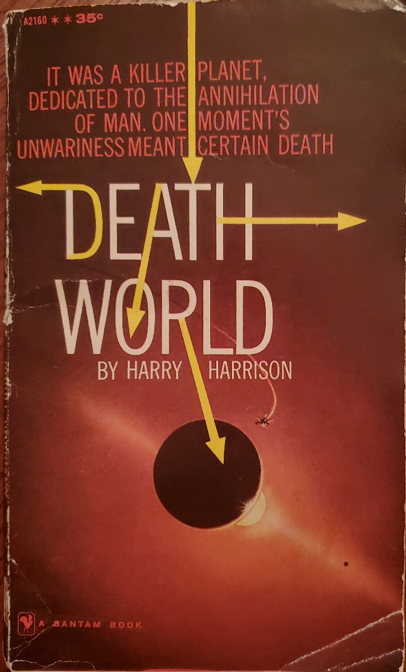
Harry Harrison’s Deathworld, despite it being his first novel-length work, turned out to be one heck of a good read, and a book that has held up well over time. It is a perfect example of the house style John Campbell demanded of Astounding/Analog writers, but at the same time has all the hallmarks that run through Harrison’s work: a self-reliant protagonist, authorities who need a comeuppance, and a deep distrust in violence as a solution to problems. The planet that gives the book its title is a nifty piece of world-building, and there is a strong ecological message that runs throughout. And while the book is full of action and adventure, it ends up advocating a remarkably peaceful solution
When I found this paperback edition of Deathworld in a used bookstore a few months ago, I thought I was in for a re-read, but was surprised to find, while I had read the sequels, the book was new to me. When I was young, I often picked up Analog and read stories at random, and even jumped in in the middle of serialized novels. Analog made that easy to do by providing a synopsis of what had gone before at the beginning of each installment. Even after all these years, it was a pleasure to discover that I had finally found the start of the Deathworld series.
I also had the vague impression the Deathworld novels were the first adventures of the character known as the Stainless Steel Rat, or James Bolivar DiGriz. But it turns out the main character of Deathworld, Jason dinAlt, is a different person altogether. Others have commented on similarities between the two characters, so it’s not surprising my memory conflated them. And I suppose I can blame some of the fuzziness of my memory on the fact it was about fifty years ago I encountered the stories.
Deathworld was serialized starting in January 1960, which was the last issue of the magazine that had only the name Astounding on its cover (for a time, Astounding appeared alongside Analog on the cover, until the former name eventually disappeared altogether). The story was popular enough that a sequel, The Ethical Engineer, was serialized starting in July 1963. And in February 1968, a third novel, The Horse Barbarians began its serialization. When the novel versions appeared, they were much more simply titled, with Deathworld being followed by Deathworld 2 and Deathworld 3.
Harrison closely follows Campbell’s house style in many aspects of the tale. His protagonist has extrasensory or “psi” powers, and is a competent, action-oriented hero who excels at solving problems. But you can also see Harrison’s anti-war attitudes coming through as the story progresses. To survive, the inhabitants of Deathworld must learn not to kill their enemies, but make peace with them.
About the Author
Harry Harrison was a popular science fiction author for many decades after his career began in the 1950s. He got his start in the comic book industry as an illustrator and writer, and for a time, scripted the Flash Gordon newspaper scripts. He was one of the stable of writers who contributed to John Campbell’s Astounding/Analog Science Fiction magazine, but eventually grew weary of Campbell’s heavy-handed editorial policies, and branched out to other magazines, including Fantasy and Science Fiction, If and Vertex. Among his most popular works was the often-humorous series of tales that followed the career of con man James Bolivar DiGriz, known as “The Stainless Steel Rat,” and mixed satire with adventure. He wrote many works in a variety of sub-genres, including humor and alternate history, and also more serious books like Make Room! Make Room!, which was later adapted into the movie Soylent Green.
Harrison was liberal in his politics, anti-war, and distrustful of bureaucracies and authority in general. His classic satire Bill, The Galactic Hero (which I reviewed here), was written in response to Robert Heinlein’s jingoistic Starship Troopers. And in 1991, with Bruce McAllister, he edited the anthology There Won’t Be War, which included stories from Isaac Asimov, William Tenn, Kim Stanley Robinson, James Morrow and others, an anthology which was intended to provide an alternative viewpoint to Jerry Pournelle’s pugnaciously titled There Will Be War anthology series.
Harrison did not have any individual works that won either the Hugo or Nebula Awards, but because of his overall body of work and contribution to the field, he was inducted into the Science Fiction Hall of Fame in 2004 and was named as a SFWA Grand Master in 2008.
As with many authors who were writing in the early 20th Century, a number of works by Harrison can be found on Project Gutenberg, including Deathworld.
The Art of Astounding/Analog Science Fiction
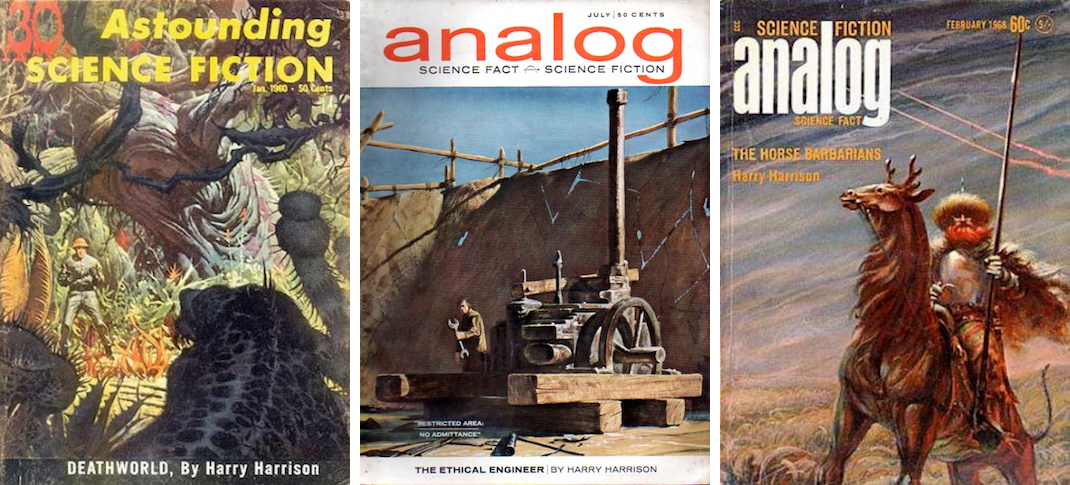
As a young reader, one of my favorite part of reading my father’s science fiction magazines was seeing the artwork. I enjoyed having an image of the characters, the settings, and the technology portrayed in the stories. I have read that John Campbell had a role in changing the artistic approach for the magazine, replacing the lurid covers of the pulp era with much more respectable illustrations, something an aerospace engineer like my father could read during his lunch hour without embarrassment. And the interior black and white illustrations were as good as the covers. The Deathworld trilogy provides a good cross-section of that work, having been illustrated by three of Analog’s best artists.
The first installment of Deathworld had a cover by Henry Richard (H. R.) Van Dongen (1920-2010). His figures were often angular and stylized, but rich with fascinating detail. His association with Astounding ended during the 1960s, just as I was starting to read the magazine, so I didn’t see much of his work until his return to science fiction illustration later in his career. Many of his works can be seen on Project Gutenberg.
The cover for first installment of The Ethical Engineer was painted by John Schoenherr (1935-2010), who had a very distinctive style, and was a noted illustrator in both the science fiction community and beyond. His illustrations were often loose and impressionistic, and his imaginings of alien creatures were very evocative. One of his most famous cover illustrations was for Dune by Frank Herbert. His awards included a Best Artist Hugo, a Caldecott Medal and induction into the Science Fiction Hall of Fame. You can see examples of his illustrations on Project Gutenberg.
The final novel of the trilogy, The Horse Barbarians, appeared in an issue with a cover by Frank Kelly Freas (1922-2005), in my humble opinion, the best Analog artist of all time. One of my favorites is the cover of Astounding for “The Pirates of Ersatz,” by Murray Leinster. He had a very bold, colorful and often humorous style that appealed to my young eyes, and still pleases me today. One of my most valued possessions is an original interior pen and ink illustration he did for The Horse Barbarians. Freas garnered nine Best Artist Hugo Awards and two special Hugos, was inducted into the Science Fiction Hall of Fame, received a wide range of other awards, and is sometimes referred to as “The Dean of Science Fiction Artists.” You can see his cover work accompanying numerous entries on Project Gutenberg.
Deathworld
Jason dinAlt, a professional gambler, has a request to meet a man named Kerk Pyrrus. Pyrrus reminds Jason of a retired wrestler, and wears a gun in a sleeve holster. Jason is suspicious, as his profession can often lead to trouble, but Kerk wants to hire him. He has a stake of 27 million credits that he wants to run up to a billion. Jason has psi powers that he can use to influence the dice, and Kerk seems to know that. The job will be dangerous, as no casino wants to lose that much money, especially the corrupt casino they have selected. Jason wins three billion, but the casino isn’t content with the results, and the two must battle their way off the planet.
Kerk is from the planet Pyrrus, an intensely volcanic, heavy two-G world with extremely volatile weather systems, which is also rich with heavy and radioactive elements. And these intense conditions have caused an ecology to evolve that is aggressively hostile to the human colonists. The money will go to buy the military weapons and materials the colonists need to survive. Jason, even though his cut gives him enough money to retire comfortably, is bored with his life, and insists that Kerk take him to Pyrrus so he can see this planet for himself.
The two men travel to a world where they can buy their materials, and board a Pyrran space vessel for the return home. The ship is piloted by a beautiful young Pyrran woman named Meta, who Jason falls for, and they begin an affair. Meta is notable for stories from that era, as she more than just a love interest; she is every bit the equal of the men in the tale, and has plenty of agency. While the story hints at the equality women have on Pyrrus, the story would have been improved by showing us more female characters. Everyone he meets treats Jason like he has signed his death warrant, and when he arrives on Pyrrus, he is thrown into training classes with children, and treated like a child. And on Pyrrus, that means he trains to kill, without hesitation, anything that is the least bit threatening. The gravity and weather are bad enough by themselves, but the animals and even plant life on the planet is constantly threatening the colonists with gruesome death. Jason is surprised when Meta dumps him, an indication of the unsentimental attitude the colonists have adopted in their efforts to survive. Harrison does a marvelous job describing the colonists, their attitudes, and the harsh conditions and dangers they face.
Jason finally gets permission to go outside, and has some exciting encounters with the vicious creatures he finds. He sees signs that the colony is not thriving, and decides to investigate their history, something the Pyrrans have not done. He hears a reference to “grubbers,” despised humans who live outside the colony. Despite being warned away, he decides to meet them, and finds something strange. There are people living fairly peaceful lives outside the colony despite the harsh conditions. Without going into details, Jason finds there are strange conditions and organisms in the local ecology that make the planet truly unique, and discovers that the colonists might be their own worst enemies. Revealing those mysteries, and how Jason brings the colonists to face their situation constructively, would spoil a big part of the book’s appeal, so I will leave my recap here.
Final Thoughts
Harry Harrison was a marvelous author, often thought-provoking, and always entertaining. While I just read Deathworld for the first time, it immediately ranked among my favorites of his many works. Like all books of its era, there are elements that date it. But it hangs together quite well, the central mystery is fascinating, and the resolution is very satisfying. And, since it is available for free on-line, there’s no reason not to hunt it down and dig in.
And now I’m finished talking, and it’s your turn to chime in. What are your thoughts on Deathworld and its sequels? Are they your favorite works by Harry Harrison, or are there others you like better? I always enjoy seeing what other people have to say, so don’t be shy about joining the conversation.
Alan Brown has been a science fiction fan for over five decades, especially fiction that deals with science, military matters, exploration and adventure.


I read these as a teenager along with his Planet of the Damned which I remember as being quite similar. He is mostly known for Make Room, Make Room filmed as Soylent Green. My favorite of his works is a short story called Streets of Ashkelon.
Thank you! I had forgotten about this one. I should go find it again. I read a copy until it fell apart, back in the day.
I’ve read a lot of Harry Harrison’s work (and met him and got a couple signed around 2004, where he asked if my 1 y.o. daughter was reading SF yet), but hadn’t gotten to the Deathworld series yet. Now that I know it’s on Gutenberg, maybe I’ll get to it.
Also, the Gutenberg link here gives a lot of irrelevant results, this link by author is a specific list: http://www.gutenberg.org/ebooks/author/25395
I’m another one who hasn’t read these since he was a teen – downloaded, and its on my list for this weekend. Thanks for the memories, I’m glad to hear that it will likely hold up.
Enjoyed the first Deathworld a lot, don’t remember the second one too much, and the third always reminds me of some other book I’ve read; though there are lots of SFnalized Mongol hordes and stories about blowing away the wogs, so I may just be confusing it with a genre.
I think the fact that dinAlt is the protagonist gives away the ending somewhat because if a conventional, straightforward battle against nature could have won through, Pyrrus and gang would have long ago tamed the world even with difficulty. To me, the training that dinAlt goes through to allow him to survive is a lot of fun, but also somewhat disheartening. I wonder if this is the way that Harrison sees boot camp and the military.
Incidentally, although Bill the Galactic Hero is the most famous of Harrison’s pastiche/satires, my personal favourite is Star Smashers of the Galaxy Rangers, which nails Doc Smith et al dead center.
One of my favorite series. Thanks.
I was very fond of a juvenile he did called Spaceship Medic. Puffin (a UK children’s books publisher) brought out a copy in 1976. A spaceship is hit by a meteorite and the ship’s doctor turns out to be the highest ranking surviving officer. Over an action packed 141 pages he has to deal with an escalating series of problems before winning through in the end. Must dig out my old copy and give it a re-read.
Nice to see Harrison get a good write-up for something aside from Make Room! Make Room! – for which he generally gets denigrated these days, actually, since we’ve passed 7 billion and things aren’t as horrible as he predicted they would be. Plenty of time for that, though, and he got the actual squalor of overcrowding spot-on.
Also nice to see Kelly Freas get a bit of a boost. I remember him from this late 60s and subsequent work for Analog, and of course book covers such as those for the Lazer impression, but his interior illo work was worth looking at as well (a real pity that interior illustration has died out to the point of modern relictuality, not just in magazines but in novels as well – a good illustrator can add so much to the reader’s enjoyment of a work of fiction). Agreed that he had, aside from his technical skills (and a tendency to actually read what he was illustrating and attempt to hew to the authors’ descriptions), a great sense of visual humour.
@8 Glad to hear from another Kelly Freas fan. And someone else who laments the death of interior illustrations. I had the pleasure of meeting Freas, and the humor was not just present in his art; he was one of the most good-natured people I ever met.
Haven’t read these, but I did find his To The Stars trilogy in my teens. It’s the only library book that I have actually purchased from the library.
My favourite ever Freas illustrations are his interior illustrations for Eric Frank Russell’s Plus X (the original magazine version of Next of Kin/The Space Willies); they’re adorable and hilarious. Sadly I can’t find them online.
I’m a big fan of the Deathworld books, though as Alan says they’re very much of their time and 2 and 3 have a rather-uncomfortable-in-the-light-of-recent-world-politics attitude towards manipulating the societies of the planets they’re on, though in Jason’s defence a) book 2 involves him trying to work out a way to get the hell off the planet he crashed on as well as survive on it and b) both societies suuuuck.
Still, I’m sure there’s a lot of theses to be written on colonialist attitudes in 50s/60s SF.
I met, very briefly and very superficially, Harry Harrison at the first of the Campbell Awards at Illinois Institute of Technology in 1973 (http://www.sfcenter.ku.edu/campbell.htm#history), shortly after the publication of Stonehenge, with Leon Stover, who was one of my professors. The other writers there were Ben Bova, who was leading an informal discussion group, and Barry Malzberg, who seemed to interact with no one except the woman he came with.
Harry struck me as funny, chatty, and personable.
I’ve read quite a lot of his books. Sometimes, he seemed to try too hard to be funny and snarky, so things seemed contrived. The Deathworld series is the only series of his that I’ve read; I was never able to “get” the East of Eden series, and the follow-on books to Bill the Galactic Hero struck me as simply goofy.
Any idea if we can have an English translation of the latter death world saga written in Russian?
You might be interested to know that a British children’s weekly – “The Eagle” -included a pictorial version of “Deathworld”, re-titled “The Angry Planet”, and with some changes made to the ending, some decades ago (not too far from the publication of the actual book). I found the frames quite impressive.
With regard to “Planet of the Damned”, I seem to remember that it involves an agency which hires a group of people to use violence to defend a threatened planet, so that the leaders of that planet can still claim that they had progressed beyond the use of violence – an idea which struck me as morally dubious, to say the least.