






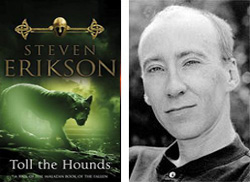
Now that Amanda and Bill have concluded the emotionally-fraught reread of the eighth book in the Malazan Book of the Fallen series, Toll the Hounds, we’re opening the floor for questions to Steven Erikson!
The procedure is pretty direct. Steven will do his best to answer your questions in the thread below as soon as possible. Keep in mind that the timing of the answers is subject to Steven’s schedule, of course. (And whether he’s scaled to the top of our office again.)
There are no strict guidelines for questions, but concise and well-composed questions are always always always best! And once again, a big thank you goes to Steven for taking time out of his schedule to engage in depth with fans of the Malazan series!
.

As always, thanks for your time Steven! As for my question:
Way back (in 2009!.. I think) you penned this statement:
While I’ve got my own interpretation, I was hoping you’d elaborate more fully now that we’re a bit further along in time and the series has come to a close.
I ask because “cipher” (to me) seems to indicate that there something hidden in the work, and without understanding the cipher, there’s something there I’m missing in the work. Since I enjoy reading about your process as much as the fiction itself, I just want to try and ensure I’m not missing out on some deeper meaning that would enhance the read/re-reads.
Steven,
Thanks for your time. My question relates to death and grieving. It has become known that you were struggling with the death of your father while writing this book. I’ve been through deaths in the family as well and I know how painful it can be. Were any of your plot decisions (Rake’s death, Hood’s death) inspired by the desire to connect with your audience on that viceral level that mourning puts you in? Or were these choices long established in your gaming sessions with Ian?
Hi Steven,
Why do Pearl (the demon) and Pearl (the claw) have the same name?
Hi Steven,
Not a TTH question strictly speaking, but I was hoping you could shed light on whether the June 2014 release date listed at Amazon UK for Fall of Light is accurate. If so, did the slightly longer-than-usual wait time between books stem from some difficulty in the writing process, or do you find that writing is simply slower going than it used to be?
Many thanks!
Dear Steven
– Was it easy to write this book in Kruppe’s voice?
– Why did Mother Dark “manifest” in Aranatha after millennia of being “turned away” from the Tiste Andii. What caused her to want to get in touch with them again? And why through Aranatha?
(I’d have plenty of other plot-related questions, but I haven’t yet completed the series, so I’ll wait with those).
Thanks for your books, Thanks for giving us the opportunity to “speak” to you and question you after ever book reread, that is so generous and totally amazing. (If this sounds awkward, I blame it on not being native english speaking, take it as praise please.)
Hmm, what to ask here.
At heart, this is one of my favourites in the series, for reasons I can’t really explain.
Darujhistan. Apart from the closing of the circle from a narrative point of view, was there any particular reason in universe that the final convergence happened there? We’ve been discussing this, and there doesn’t seem to be any justification for it other than rule of cool, which is fine by me :)
Dragnipur. Bit of speculation – was there any connection between the forging of the sword, and the first Chaining of the Crippled God?
I’m curious otherwise why the breaking of the sword was so significant in the grand sweep of things. Also, was the Grand Battle against Chaos purely to buy time, or also a rather carefully considered means of emptying the sword of its accumulated nasties?
Skamar Ara … are we likely ever to learn of him and his Jakuruku Legions, or is that just another byproduct of history?
Just finished the series about a month ago and it was awesome. Thanks for the great reading experience. Now for my question. Will we ever find out more about the Tyrants or the pickled seguleh?
Is the name Kruppe pronounced with one syllable or two? (I preferred the audiobook reading of GotM wherein the reader used two syllables to that of the single-syllable TtH reader.)
In GotM, Kruppe seemed to use the third person to refer to himself much more often, and to be altogether more cheerful than the Kruppe we see in TtH. Is this a valid reading of the text, and if so, why or why not?
Thank you for these very enjoyable, diverting, and thought-provoking books.
There has been quite a lot of discussion on why Rake needed Traveller to fight him to enable his demise rather than just killing himself. What reason(s) were you thinking of?
hey steven,
thanks for taking the time to do these Q and As. They are greatly appreciated by all. Since this is my first chance to connect since I joined this reread, I have a couple of general questions too, if you’d humor me, I’d greatly appreciate it.
1) why does none of the poetry in the malazan world rhyme? is it a stylistic choice on your part, or is it that they do rhyme in their original languages, and it was just too hard to ‘translate’ :) ?
2) being a huge fan of the other steve erickson as well, i was wondering if you’d ever read him. if so what did you think?
3) in regards to your writing process, do you write each scene in the order they appear in the book, or do you write each story line as a unit?
4) In Toll the Hounds we learn that Hood is/was Jaghut. I was curious if the I’mass knew that Hood was a Jaghut at the time of the Ritual of Tellann, or if Hood was indeed the god of death at the time of the ritual.
Thank you for the time you give on these Q & A sessions. Really appreciate it.
My question is, when writing the flash backs to Kharkhanas in this book, had you already planned what you were going to write in FoD?
I really wan’t to know how many of the characters you and Ian actually played? I’ve spent almost a year now getting way more involved in a place and a history than I think is decent. I’d like to thank both of you for that. I’d like to.
Hi Steve!
I’m curious as to whether the Wrecker’s Coast where Mappo and the Trygalle group found themselves in a cursed town with a probably-Napan-related-Jaghut is supposed to be in any particular place? I suppose if their warren travel corresponded more or less to a straight line from Darujhistan towards Letheras where Icarium is then it would make sense for the Wrecker’s Coast to be at the northern part of Assail but that’s just my speculation.
Also, can you make an official “word of god” declaration of whether the undead dragon that wakes up and speaks to Kallor is Tulas Shorn? There’s been quite a controversy over it with some people believing he sounds too different and must be a different undead dragon than Tulas.
Thanks!
I’m not a native speaker and I’m confused by the meaning of the title. Steven, can you shed some light, esp. on “toll”? Is it a noun/verb? Which definition did you have in mind: tax, ringing, summoning?
I remember the phrase appears in the book in the form of “the hound’s tax” (as mentioned by Kruppe). Does this mean the title could just as well be “The Toll of the Hounds”? If so, why isn’t it?
In the Polish translation the book is called ca. “The Hound’s Tax”. Would you say this is a correct translation?
Toll the Hounds is one of my favourite books that you and ICE have put out. I feel like it slips more into the tragedy with epic elements than the other way around (especially with the cast in Darujhistan). So thank you for that, it’s different than a lot of current fantasy!
I have a couple questions.
1) in the book we see a lot of children with well developed inner life’s, be they terrible (Snell) or not (Harllo). I’ve stated my problem with other readers being somewhat blood thirsty when it came to the bad kids (I’m a bit more empathetic toward them, I’ve grown up with a few bad kids who turned it around). Was this your purpose when writing them? For contrast against Harllo? Or did you simply want to write the full spectrum that children can be?
2) I may be one of the few people whose not it total love with Rake for the sole reason I don’t think he was a very good father to Nimander. I think Nimander’s personality and self-esteem issue wouldn’t have existed if not for the absences of parents. Was this a conscious choice to give Rake that particular flaw or I’m I misreading it?
3) and finally I’ve never been able to make heads of the title. What does it mean and how does it relate to the book outside of fact that Hounds show up?
Steven,
Thanks for your time – I’ve thoroughly enjoyed the series on all 3 of my reads (so far!). No other book or series has had me even a tenth as emotionally invested.
Expanding on what thomstel said in the first question, regarding your reference to TTH as the series’ cipher. I’ve always taken that to be in reference to Kruppe’s often hyperbolic and frequently unreliable narration of the book.
One of the recurring elements of the series seems to be that a great deal of the major players know only fragments of what’s happened – or is happening – at any one time (and you’ve extended this to the reader more than once). History is passed down and always blurred.
I’ve felt since my second read of TTH (at which point I had read your comment about it being the cipher) that Kruppe is to the narration as you are to the series as a whole: what we read may not be precise, it may even be an outright fabrication, but it makes for the better story.
Am I completely off target here? It’s a theory I’ve regarded as ridiculous more than once, but now that I have the chance to ask you I’m happy to open myself to public ridicule :)
Again, thanks.
Dan
Steven, I’ve noticed that inns/pubs/bars are either promiment locations in your books (The Phoenix Inn and K’rul’s Bar in TTH) or are very vividly described (e.g., the bar that Kalam finds himself in Aren, the one with the floor tilted towards the center). Any comments on this? Are you a fan of them yourself? Also, does coffee (or its equivalent) exist in Wu? Will we ever see characters meeting in a cafe?
Hi Steven, thanks for doing this Q&A.
I have two questions:
1) In the Q&A for House of Chains, on the subject of cultural relativism, you said:
So my question is, what did you go after? (Sounds like a question from a quiz show *chuckles*)
2) In the Q&A of Reaper’s Gale you said that
So my second question is, what was your initial plans for Toll the Hounds at the beginning of writing the whole series (and after Reaper’s Gale obviously) and how did it change during the planning and writing of the book itself?
Cheers!
Its CSI Darujhistan and as one of the investigators I have to ask, where has Hood’s beheaded body gone to??? Cos thats kinda essential for me to piece together what Traveller’s motivation is.
He sees Rake, he sees beheaded Hood, why doesn’t he go for a beer and consider the job done? What was he thinking?
Its a fantastic book, one of the bets I’ve every read and its been 5-6 rereads for me. Yet I still can’t fathom Traveller’s motivation. Did one of the Hounds eat Hood’s body? Why does he have to attack Rake? Are his cultists forcing him to act wven if he doesn’t want ot? Was the vengence “transferred” to Rake?
Such a fantastic book, one of my favourites in the series!:) Two brief questions:
1. Who was the Azath-building Elder that Nimander met and what is the significance of there being an Azath House inside the blood of dragons?
2. Why didn’t Kallor attempt to claim the Throne of Chains after the convergence had passed? Was he emotionally affected by Spinnock and Rake or did he conclude that the breaking of the sword would lead to the end of the Crippled God and that the House of Chains could not survive without the Chained One?
Thanks!
Hi Steven, thanks for taking the time to read and to ultimately answer our questions. Much appreciated.
Just finished Memories of Ice on my first re-read of the series. I love this series and I imagine I’ll be re-reading it many times over the course of my life.
My question is this:
You don’t just write epic books, you write epic characters and where some authors may leave the powerful swordsman or world devouring god in deep shadows as to add to their mystery. You on the other hand show their mortality, insecurity and sometimes (or mostly) hubris, and instead of down playing those characters it actually manages to make them that much more appealing than the unknown all mighty entity. I imagine if you had written the Lord of the Rings, Frodo would have died, and we would have had POV of Sauron and maybe even have developed a soft spot for the orcs.
I was just curious to hear why you decided to bring these usually background entities into the foreground?
Also, I think Gothos and Hood are two of the most interesting characters in the entire series or for that matter in fantasy.
Thanks for writing such great books, I just got round to starting Forge of Darkness as well and I just have to say it is brilliant, a complete joy and privilege to read. Well done sir.
Hey Steve,
Toll the Hounds had me shouting, disturbing my girlfriend, the cats, and probably the neighbors. “He killed the god of death!”
This book, even though a lot of bad things happen, really seems like a breath before the storms in Dust of Dreams and The Crippled God. A lot of circles are closed, and though Darujhistan and the world in general are still in danger, for many of the characters danger has ended. Like poor Stonny. Barathol, Chaur, and Scillara. Karsa, well, at least until the next series when he presumably wages war against every civilization larger than a village. Pearl. Kruppe stepping into Brood’s path one more time. Lovely and wonderful Blend and Picker, and I could go on. The characters are given grace as they leave, a bow to the audience. I don’t know if you meant it like this, but I love saying goodbye to them in this way.
I’ve tried and tried to think of a serious question, something I absolutely need to ask. But the posters above took care of most of it. So here’s my question. The selfsame ox is the true hero of Toll the Hounds, right? And he’s the metaphor and cypher for the whole series? Ok, that is maybe going too far. But I love that ox.
Thank you for this book.
Cartographer is one of my favorite minor characters in this latter half of the series, and I was wondering if you could elaborate some on your inspirations for this character. Even though a lot of his commentary tends towards wry humor, there’s hint of plenty in him below the surface, and he gave me weird pangs of emotion like all such independent wanderlusty characters (fictional or not) often do.
And this is a more general series question (though TTH appropriate I suppose), but was it a deliberate decision you guys made not to have a formal God of Love in the pantheon? A bit of healthy cynicism regarding real-world gods of love? Is it an unspoken province of High House Life? Or is “love” simply a rubric by which all the pantheon should be judged? I don’t necessarily mean to get individual answers to all these questions, as I’m not even sure any of these premises stand, but maybe some general thoughts on the subject if possible.
Thank you for your time, and your stories.
Dear Steven, although I’m only halfway MoI (and enjoying it enormously), I’d like to take this opportunity to ask you about your working relationship with your translators. How do you ensure that they don’t mess up any foreshadowing or other things that are not immediately clear in the book itself? Do you have a FAQ or guide for them, like Patrick Rothfuss? Do you sometimes read their work?
Chaur is a very interesting character, and I adore his unconditional love of Barathol and the internal monologue you gave him. Does he have any basis in reality? I say this because I have a nephew with Downes Syndrome and you seem to have a great understanding of the internal workings and behavior of a person who lives with a mental handicap. Many times authors idealize the “slow-witted giant” character, and you too did that as well in a way, but you also made him human and gave him a kind of focus or drive for why he feels such a kinship with Barathol, even back in The Bonehunters. Knowing someone with the issue of a mental handicap, it doesn’t surprise me that he behaves the way you wrote his character, but did you at all find it challenging to write from that perspective or did you feel obligated to research it in any way so as not to come off as condescending?
Also, there is a theory that Downes syndrome is a vestige of the neaderthal line that interbred with homo sapiens before their species died off. As you are an anthropologist, I thought you would find that interesting, if you weren’t already aware of it.
Thanks for the wonderful book, by the way. Toll the Hounds is my favorite of the series.
I really appreciated your candor about your perspective on religion and the importance it has on “is that all there is?” during the re-read as well. Refreshingly open and honest dialogue from an author of one’s most-loved modern fiction is not something I take for granted.
Steven, Thanks as always for the gift of your time. I was just wondering if you might address a bit more Itkovian’s revelation at the end, though I perfectly why you wouldn’t, so feel free to say “Take it as you will . . .” But just in case, I’m going to cheat and cut and paste my musings in the reread here as my question (s) I feel I’m missing something subtle here as the “the Redeemer leaves judgment to others. This frees him, you see, to cleanse all” seems to be just the problem he’d (and others) had been struggling with before. I can see Rake’s lesson as Monkrat says—one redeems oneself through one’s actions (as opposed to waiting for some higher being to do it, or someone else). Or the lesson of selflessness as the child-god takes. But I can’t mesh either of those with Itkovian at the end or the idea of “cleansing.” What does it mean to be “cleansed” by the Redeemer? What does it mean to be cleansed but not judged by him? Is the lesson that he has a “gift” and the truth of gifts is that they be shared? That if one can Redeem (whatever that means) one simply should, and leave all the other complicating stuff to others? . . . but can Gradithan, for instance, be “cleansed” or “redeemed” without judgment? I’m wondering if it has anything to do with simply it being the “end” and thus that non-judgmental embrace is the epitome of that theme of “compassion” that runs throughout? The idea of what does judgment matter at this point anyway—who is it for after all at this point—and so if one can “embrace”, the compassionate thing is to do so, the cruel thing to withhold. If that makes any sense.
I have an additional question, not related to TdH,
(It would have fit better with RG but I completed my first reading of RG about 2 weeks after it’s Q&A):
Several times it is hinted, that the Bridgeburnes ascended because of the Tanno Spiritwalker (eg. Hedge to Emroth in Reaper’s Gale, Ch17) – Did Parans “I bless you” have nothing to do with it? Or are the characters in the book wrong?
Hi Steven — thanks again for taking our questions.
short and simple: did Rake send Spinnock to fight Kallor to stop Kallor from getting Dragnipur?
Hello everyone. So, if we’re to follow the pattern, I usually begin with a preamble of sorts, before responding to your specific questions. It’s kind of a warm-up for me, a way of grounding myself, so hopefully you’ll indulge me… After a summer of travel I am now back in Victoria, settling into the daily routine of work on Fall of Light, the second book in the Kharkanas Trilogy. It’s proved a bit of a beast, to be honest. I had intended to run parallel storylines (Jaghut and Tiste), only to realize that the civil war side (the Tiste storyline) was in itself novel length, never mind the Jaghut war on death. In other words, if I wrote them both as intended, we’d be looking at a two thousand page novel. While readers might like that, the book-binding people would weep. It also occurred to me that I should have known better by now, don’t you think? But then, I’m not used to trilogies. I have an intellectual understanding of the necessary structure, but my appetites for story proved unruly to the constraints.
Well, the decision was made to excise the Jaghut storyline from Fall of Light, and to give it its own distinct work, which may turn out to be a novel, or something somewhat more ambitious (I’m mulling the matter right now, so don’t press me. In any case, I probably won’t ‘announce’ anything anyway, I’ll just do it … whatever that is). Conversely, I could get to the end of Fall of Light, only to find that I can re-insert the Jaghut storyline after all (at say, oh, fifteen hundred pages).
Anyway, these are the mechanics at work at the moment, and with them a certain fugue of confusion. You see, what’s keeping my claws in that Jaghut story, is that it’s a good story, but more to the point, it had a function in the narrative of Fall of Light. Leaving me to wonder, what happens when it’s removed? Fortunately, the book is still in its early stages, so what I write will be composed in a seamless fashion – you won’t sense any gaps, because there aren’t any.
There’s those old workshop challenges echoing in the back of my mind: but what’s the story about? Whose story is it, anyway? And asking those questions is what set me back on track (oh, and one of my advance readers asking them helped, too – thanks, Sharon). The story’s about the effing civil war … isn’t it?
Problem is, Gallan is just as unruly when it comes to creative necessity. I think I just realised that we’re in a bit of a fight, he and I, and that I was the first one to pull out a knife. Now I’m uneasy – who can guess with what he’ll come back at me.
I’ll have a better sense of all this after the novel’s done. The retrospective stance is quick to invent clarity, once the dust settles and the blood drains away, and you can sort of see how you got here from there. So I keep telling myself.
Which brings me to the utter clarity with which I can now look back on Toll the Hounds (where’s that irony emoticon? How come no-one’s invented it yet? We need some kind of squiggly symbol … just think of the peace that will come once we can avoid all the misunderstandings of online commentary and ambiguous twittering. But first, of course, we’ll need to resurrect irony itself).
First off, thanks to everyone who weighed in on the Chapter Fourteen discussion. That was fascinating and illuminating, but perhaps most astonishing, it was downright honest and courageous, from everyone involved. So, who says such things aren’t possible on the internet? I can’t say that my angst has been swept away or anything, but it does seem to have slipped onto the backburner, as I strive to focus on Fall of Light. But I have been back to that discussion a few more times, and may well do so again. As I get older, I begin to suspect that any and every position (on virtually any and every subject) is in fact, and with sufficient intensity of deliberation, a slippery slope. We may carve our beliefs in stone, but that stone can tilt. For all that, there was meat in that debate, and gristle to chew on, so thanks again.
Toll the Hounds. It’s very difficult for me to extract that novel from its context. The grieving process is a complicated one: it begins before the fact and lingers on well afterward. The preliminary stuff is all re-adjustment, to new truths, no matter how unpleasant, and, ultimately, to new realities. It’s the experience of being knocked askew, and then finding your feet, while being more than a little punch-drunk. And then the event arrives, and with it comes a cascade of emotion, but it’s like a distant roar – you know it’s on its way, eager to drown you, and you can’t step from its path, because that torrent’s following you. It has your name on it. So, while death was the trigger, the response is the essence of life, and it’s the cruel distinction – the war between the two – that hurts as much as it does. [And yes, this is what Hood’s war on death is all about, as a storyline, with ‘presence’ at war with ‘absence,’ with all the useless weapons of longing at hand, and an enemy whose utter indifference cannot be breached … does that stir the soul? It stirs mine, dammit. As Gallan might say to me: Hey, Erikson, are you listening?]
Still, in the end, it’s just a book, and the context is, in so many ways, utterly irrelevant. Context may serve in some kind of retrospective analysis, long after I’m gone, conducted by frowning apostles of literary mysteries (who may, in the end, prove apologetic): or, more likely, it will pass unnoticed, as befits all works of art that barely cling to the edge of notoriety. Either way, no skin off my back.
Accordingly, I will try to address the following questions in as direct a fashion as I can. Some of them, I am sure I have already answered, if obliquely. Well, here goes…
1. thomstel
view all by thomstel | Wednesday August 28, 2013 12:55pm EDT
As always, thanks for your time Steven! As for my question: Way back (in 2009!.. I think) you penned this statement:
Toll the Hounds is the cipher for the entire series. As an added hint, it begins with voice and intent, and proceeds through to structure and the creative conceit that is story-telling itself.
While I’ve got my own interpretation, I was hoping you’d elaborate more fully now that we’re a bit further along in time and the series has come to a close. I ask because “cipher” (to me) seems to indicate that there something hidden in the work, and without understanding the cipher, there’s something there I’m missing in the work. Since I enjoy reading about your process as much as the fiction itself, I just want to try and ensure I’m not missing out on some deeper meaning that would enhance the read/re-reads.
Thomstel: see #16 below. Danau’s outrageous reading is entirely correct. I’ll elaborate in my response to him, but add this here: you see, it was rather simple after all. It’s all about the creative process, and the stance of deliberation, manipulation, and outright chicanery of the narrator. Consider Kruppe and consider him well. He’s ready with the wink, the sly regard, the coy glance, as he tells a tale all the details of which he cannot possibly know, and yet does, with every revelation arriving with purpose. Toll the Hounds is fractal, a scaled iteration of the entire series. He’s showing you, in this novel, that nothing is chance, nothing is accidental, and, by virtue of that, nothing told happened as it is told (well of course not: this is Fantasy after all). It happens because it’s necessary. For the story. For the fiction. For the sole purposes of eliciting in the reader an emotional response. When it hits, all to the good. When it misses, well shit, I fucked up. It would be nice to blame Kruppe, but really, I can’t. His stance is wry, but knowing, and under it all is something white hot that might be rage, or dismay, or both. If I’m honest, this was how I approached the entire series, from page one of Gardens of the Moon. One might be led to conclude that I (and Kruppe) took none of it seriously, but that couldn’t be more wrong. I was/am deadly serious. So what if Kruppe can make you laugh? He can also make you cry.
Even in writing this, I sense that Toll the Hounds is not nearly as far away as I thought it was. That simmer, beneath the surface, remains.

2. Kulp
view all by Kulp | Wednesday August 28, 2013 01:45pm EDT
Steven, Thanks for your time. My question relates to death and grieving. It has become known that you were struggling with the death of your father while writing this book. I’ve been through deaths in the family as well and I know how painful it can be. Were any of your plot decisions (Rake’s death, Hood’s death) inspired by the desire to connect with your audience on that viceral level that mourning puts you in? Or were these choices long established in your gaming sessions with Ian?
Kulp: Oddly enough, no. The story was already set in stone. That its telling coincided with personal loss was … well, I don’t know which way to go here. Bad luck? Fortuitous in dragging me into a place of raw anguish? Sometimes, a writer can be just plain fucked up, in that lure of crass opportunism … but it may be that I’m being too hard on myself here. I achieved similar levels of emotional engagement in previous books (Deadhouse Gates, Memories of Ice). What was all that? Subconscious preparation? Well, if so, I suppose it came in handy, in that it told me that I could write through the grief, evading mawkish sentimentality and melodrama. So, when the time came, as it inevitably did, when it all became too real, the machine didn’t stutter, and I held to the line. I wrote through it, and made honesty my fuel.
That proved risky, as the novel wasn’t well received initially. And to this day, even re-readers and readers on this site will state that this novel ranks among their least liked. It’s been years, and I’ve long since learned to harden my skin to such things. And, in a way, my own experience of real grief has proved a kind of armour against criticism.
We use what we can.

3. Nellius
Wednesday August 28, 2013 01:50pm EDT
Hi Steven, Why do Pearl (the demon) and Pearl (the claw) have the same name?
Nellius: I know five guys named Peter. What the hell’s going on with that? Why, if they all showed up in my novels, we’d be screwed (hey, and so would they – so, Peter, Peter, Peter, Peter and Peter, if any of you are reading this, relax, you’re safe. Well, four of you are).
But then, you’re right. This was a fiction. If names end up repeating, why, the author screwed up. Worse, I think I did it again, in Forge of Darkness. There are two Bursa’s. I’ll have to kill one of them. Shall we have a vote? Bursa #1 attended, uninvited, the Wedding. Bursa #2 is with the Wardens. Who will live, who will die? It’s all up to you. Vote now, vote often.

4. CallMeMhybe
Wednesday August 28, 2013 03:09pm EDT
Hi Steven, Not a TTH question strictly speaking, but I was hoping you could shed light on whether the June 2014 release date listed at Amazon UK for Fall of Light is accurate. If so, did the slightly longer-than-usual wait time between books stem from some difficulty in the writing process, or do you find that writing is simply slower going than it used to be? Many thanks!
CallMeMhybe: Light shed, yes?
5. travyl
view all by travyl | Wednesday August 28, 2013 03:32pm EDT
Dear Steven – Was it easy to write this book in Kruppe’s voice? – Why did Mother Dark “manifest” in Aranatha after millennia of being “turned away” from the Tiste Andii. What caused her to want to get in touch with them again? And why through Aranatha? (I’d have plenty of other plot-related questions, but I haven’t yet completed the series, so I’ll wait with those). Thanks for your books, Thanks for giving us the opportunity to “speak” to you and question you after ever book reread, that is so generous and totally amazing. (If this sounds awkward, I blame it on not being native english speaking, take it as praise please.)
Travyl: was it easy to write in Kruppe’s voice? It was hard not to. I stripped away a layer and let him come through. I girded him in fat to protect his all-too-vulnerable heart. I knew that Toll the Hounds was his tale to tell from very early on in the series, and left him to wait until it was time (but really, he never waited at all, because that fractal was there all along, on a much broader scale. Am I saying the entire series was Kruppe’s story? Maybe. One thing is certain: we shared the same impulses, the same needs, the same fever of love and fury. I saw him in the funhouse mirror, and he winked).
Mother Dark manifested when and where she needed to, because in this tale, each question asked needed an answer. I don’t mean to sound coy with that. Sometimes the one you love turns out to be right at your side, and that can be easily forgotten. And, sometimes the one who went away (even in their own heads) will come back. Fictional or real, I don’t like a world where these things aren’t possible.

6. Mayhem
view all by Mayhem | Wednesday August 28, 2013 04:41pm EDT
Hmm, what to ask here. At heart, this is one of my favourites in the series, for reasons I can’t really explain. Darujhistan. Apart from the closing of the circle from a narrative point of view, was there any particular reason in universe that the final convergence happened there? We’ve been discussing this, and there doesn’t seem to be any justification for it other than rule of cool, which is fine by me :) Dragnipur. Bit of speculation – was there any connection between the forging of the sword, and the first Chaining of the Crippled God? I’m curious otherwise why the breaking of the sword was so significant in the grand sweep of things. Also, was the Grand Battle against Chaos purely to buy time, or also a rather carefully considered means of emptying the sword of its accumulated nasties? Skamar Ara … are we likely ever to learn of him and his Jakuruku Legions, or is that just another byproduct of history?
Mayhem: Thanks so much for your Chapter Fourteen commentary, by the way. I do admire the cogency of your thoughts, and your writing, and it well pleases me that Toll the Hounds is your favourite in the series. To your first question: Darujhistan. Well, this was Book Eight. We last saw any of the city at the end of Memories of Ice. There were stories left unfinished (mine and Cam’s), and, as you might have guessed from my above commentary, it was also time to hop back into that setting, for other reasons. Also, the notion of what was to follow (with Dust of Dreams and The Crippled God) meant that proper send-off’s for a number of characters wasn’t going to be possible, unless I returned to the city and its people. In another way, it was also my predilection for looping back in structural terms that demanded a revisit. Hmm, what else? Well, when Cam and I gamed the clash between Traveller and Rake, it was in Darujhistan. And, of course, there was Kruppe, the cipher, my original series outline – everything took me there, in fact. Everything. Consider, finally, the synchronicity of certain crucial elements: in Gardens, Rake above the city and his descent – down to the street to do battle with a demon. All reiterated in Toll the Hounds. Closing the loop. In Gardens, we had the twin gods of chance. In Toll, the god of death himself comes to the city, to voice his own denial of chance and fate. In Gardens, we had Brood and Kallor in the wings, and Whiskeyjack on centre stage – but out of his league: in Toll, Brood again in the wings, until the end, then Kallor pushing his way to the front, only to be stymied by a man out of his league (Spinnock, another friend of Anomander, just like Whiskeyjack). The parallels continue with many other characters, from Crokus/Cutter/Crokus; the Hounds of Shadow; Korlat and Orfantal; Raest; Baruk; Malazan Bridgeburners; Vorcan, Rallick and the assassins; Challice; the Moon’s Spawn and the moon … echoes, closing the loops, seeking grace in their send-off’s … shit, it does go on and on….
Dragnipur: Yes, all the reasons you stated (but no connection to the Chaining). To determine the reasons for things happening (in this series and maybe in all my stuff in general), work backwards from observed effects. What was achieved by the shattering of the sword? How much of that could be controlled, and if so, why wouldn’t it be? Then, who had a hand in manipulating events to achieve those desired ends? And why would they choose to do so? Sometimes, the reasons aren’t the least bit complicated. Sometimes, they’re just about compassion, and doing the right thing.
Skamar Ara: The hitch in the sentence as I wrote, all the swirling emotions surrounding it, and then … oh, insert here this wayward tidbit, like tapping a bell in some unseen place, and smiling as the echoes come back. Invention! Off the cuff spontaneity! Throw it in and wait for the shiver of mystery! Who the fuck is Skamar Ara? I haven’t a clue. But oh, I like that. Will anyone else? Or will they gnash their teeth and curse my name (again)? But don’t you get it? Kruppe just got sly, because he knows what he’s doing, the scheming little shit.
But hey, the wonder of it is, isn’t stuff like that why we’re here, doing all this? The writing, the reading, the sharing?

7. Stephen68522
Wednesday August 28, 2013 07:52pm EDT
Just finished the series about a month ago and it was awesome. Thanks for the great reading experience. Now for my question. Will we ever find out more about the Tyrants or the pickled seguleh?
Stephen68522: Read Cam’s Darujhistan novel yet?

8. Wilbur
Wednesday August 28, 2013 08:24pm EDT
Is the name Kruppe pronounced with one syllable or two? (I preferred the audiobook reading of GotM wherein the reader used two syllables to that of the single-syllable TtH reader.) In GotM, Kruppe seemed to use the third person to refer to himself much more often, and to be altogether more cheerful than the Kruppe we see in TtH. Is this a valid reading of the text, and if so, why or why not? Thank you for these very enjoyable, diverting, and thought-provoking books.
Wilbur: I wasn’t consulted on pronunciation with the audio (except with Forge of Darkness). Kruppe is one syllable (Krup). As for Kruppe’s tone shift between Gardens of the Moon and Toll the Hounds, yes, your observation is valid. He too was stripping things back. The necessity for addressing himself in the third person was, for this novel, entirely redundant, don’t you think?
9. stevenhalter
view all by stevenhalter | Wednesday August 28, 2013 08:46pm EDT
There has been quite a lot of discussion on why Rake needed Traveller to fight him to enable his demise rather than just killing himself. What reason(s) were you thinking of?
Stevenhalter: ah, if only I could answer your question. The thing is, there are all kinds of necessities in a story, and even outside the story, that determine how things turn out, and while the notion of convergence often appeared, up until this point, to be as much accidental as deliberate, there was always a certain amount of manipulation taking place (hell, if you look at it from a meta standpoint, it’s all manipulation … so, consider again the novel as cipher, that veil torn through, all the pudgy little fingers poking through it again and again…). Consider also, how this meeting was set up from the very beginning: the weapon in Dassem’s hand, its origins, the full-circle it demanded. Consider also, the absolute sincerity of Rake’s response to Dassem’s demand for Hood. Had he died to Dragnipur, he would indeed have found Hood. But it seems that such was not to be: the sword Vengeance refused to lose, but no such implacability accrued to its wielder. Such is the difference between iron and flesh. Was Traveller abused? Yes, brutally so.
10. aaronthere
Wednesday August 28, 2013 09:50pm EDT
hey steven, thanks for taking the time to do these Q and As. They are greatly appreciated by all. Since this is my first chance to connect since I joined this reread, I have a couple of general questions too, if you’d humor me, I’d greatly appreciate it. 1) why does none of the poetry in the malazan world rhyme? is it a stylistic choice on your part, or is it that they do rhyme in their original languages, and it was just too hard to ‘translate’ :) ? 2) being a huge fan of the other steve erickson as well, i was wondering if you’d ever read him. if so what did you think? 3) in regards to your writing process, do you write each scene in the order they appear in the book, or do you write each story line as a unit? 4) In Toll the Hounds we learn that Hood is/was Jaghut. I was curious if the I’mass knew that Hood was a Jaghut at the time of the Ritual of Tellann, or if Hood was indeed the god of death at the time of the ritual.
Aaronthere:

1. There are many forms of poetry: fully rhyming poetry has mostly shifted into song lyrics (a few of those show up in the series). A lot of people will pronounce (why is it always a pronouncement, anyway? As if the tone of an assertion guarantees its credibility. It doesn’t) that I can’t write poetry. The poets I know tell me that I can, and that I can write it well (and a collection of my poetry, called tall boy, is due for publication from a US university press in the next year or so). The key for reading my poetry is a simple one: read it out loud, disregarding the actual line breaks – the real breaks will show up naturally. I often avoid a consistent rhythm, at least on the surface, but once you add a voice to the poems, they start making sense.
2. I’ve not read Erickson, and to be honest, for some reason it would feel strange to do so. He might well feel the same regards my stuff. I’m not saying it’s rational.
3. I write in a linear fashion, taking it as it comes (no cut and paste). One of the reasons why I like doing it that way is how certain themes will bleed across into new scenes, new situations with different characters, thus giving those themes a twist. Put that all together and the book comes across as more cohesive, as if each setting is talking to the others (but in a secret language, or, rather, the language of meta).
11. Nisheeth
view all by Nisheeth | Wednesday August 28, 2013 09:56pm EDT
Thank you for the time you give on these Q & A sessions. Really appreciate it. My question is, when writing the flash backs to Kharkhanas in this book, had you already planned what you were going to write in FoD?
Nisheeth: the Kharkanas flashbacks certainly set the mood and atmosphere that would find its voice in the Kharkanas trilogy: but I wasn’t much concerned with specifics, since memories are sneaky liars. But the tone, which came of the sense that things recalled often find as their focal points the instances of deep trauma in our lives (and, by extension, the lives of characters who are once more pushed to extremes), seemed to reverberate in me, and that resonance remains, and may well be the primary muse for the trilogy.
In terms of ‘plans’ for the trilogy, the answer is probably ‘no.’ In fact, at that time I doubt I had any real sense of the trilogy’s setting – which was always going to be the most problematic aspect of this particular creation myth. But the flashbacks gave me a focus (and at least one setting: the city of Kharkanas itself), and that helped. I quickly realized that I was going to have to reverse the telescope, making it a microscope instead. If the Malazan series was outward, then the Kharkanas trilogy would be inward.

12. bellsybell
Wednesday August 28, 2013 10:34pm EDT
I really wan’t to know how many of the characters you and Ian actually played? I’ve spent almost a year now getting way more involved in a place and a history than I think is decent. I’d like to thank both of you for that. I’d like to.
Bellsybell(aw, what a sweet name): You’re welcome. Cam and I played a good many characters who have since showed up in these novels. We even played out some major events (including the Anomander/Dassem clash): but perhaps more importantly, by playing these characters we gave them histories, and that grounding permitted us to each run with them, in our own ways, into new scenes, events, and stories, via these novels. Like a shared toy-box filled with soldiers, we could reach in, pull one out and look at it and think, oh, right, this one went through this, and this, and that. Look a bit battered and bruised, do you? Well, my friend, what’ll you do when this happens? So, on the one hand, we recounted events we had played out for these characters. While on the other hand, we extended their lives, into new futures.

13. Tufty
Thursday August 29, 2013 12:03am EDT
Hi Steve! I’m curious as to whether the Wrecker’s Coast where Mappo and the Trygalle group found themselves in a cursed town with a probably-Napan-related-Jaghut is supposed to be in any particular place? I suppose if their warren travel corresponded more or less to a straight line from Darujhistan towards Letheras where Icarium is then it would make sense for the Wrecker’s Coast to be at the northern part of Assail but that’s just my speculation. Also, can you make an official “word of god” declaration of whether the undead dragon that wakes up and speaks to Kallor is Tulas Shorn? There’s been quite a controversy over it with some people believing he sounds too different and must be a different undead dragon than Tulas. Thanks!
Tufty: Yeah, I think I had the Wrecker’s Coast of Northern Assail in mind. But then, with Cam nearing the end of his Assail novel (which I’ve not yet read), why, everything may change! Isn’t life exciting? Regards the dragon, yes, that was Kagamandras Tulas Shorn. Or so I have been told by the God of Intentions, who’s good at, uh, pronouncements.

14. sssimon
view all by sssimon | Thursday August 29, 2013 05:58am EDT
I’m not a native speaker and I’m confused by the meaning of the title. Steven, can you shed some light, esp. on “toll”? Is it a noun/verb? Which definition did you have in mind: tax, ringing, summoning? I remember the phrase appears in the book in the form of “the hound’s tax” (as mentioned by Kruppe). Does this mean the title could just as well be “The Toll of the Hounds”? If so, why isn’t it? In the Polish translation the book is called ca. “The Hound’s Tax”. Would you say this is a correct translation?
Sssimon: The Hound’s Tax? Oh dear. It’s the curse of the English language, isn’t it? All that connotative crap we gleefully employ in order to confound translators worldwide. The title just sounded good to me. It hovered there, amidst swirling clouds, hinting at this and that, and the other, too. Things like sonorous bells (the Vikings are coming! Run!); things like the price that must be paid (what your translator called ‘tax’); things like tallying the toll, as in just how many major characters are going die in this damned book, anyway? As for the ‘Hounds’ bit, well again, echoing back to Gardens of the Moon and their first appearance. As you note, many languages are strictly denotative, but not English. Makes for problems all the time.

15. BDG91
Thursday August 29, 2013 06:05am EDT
Toll the Hounds is one of my favourite books that you and ICE have put out. I feel like it slips more into the tragedy with epic elements than the other way around (especially with the cast in Darujhistan). So thank you for that, it’s different than a lot of current fantasy! I have a couple questions. 1) in the book we see a lot of children with well developed inner life’s, be they terrible (Snell) or not (Harllo). I’ve stated my problem with other readers being somewhat blood thirsty when it came to the bad kids (I’m a bit more empathetic toward them, I’ve grown up with a few bad kids who turned it around). Was this your purpose when writing them? For contrast against Harllo? Or did you simply want to write the full spectrum that children can be? 2) I may be one of the few people whose not it total love with Rake for the sole reason I don’t think he was a very good father to Nimander. I think Nimander’s personality and self-esteem issue wouldn’t have existed if not for the absences of parents. Was this a conscious choice to give Rake that particular flaw or I’m I misreading it? 3) and finally I’ve never been able to make heads of the title. What does it mean and how does it relate to the book outside of fact that Hounds show up?
BDG91:

1. The portrayal of children (not just in this novel, but in my novels in general) is something I wanted to explore in an as unsentimental a way as possible. Sociopathy aside (good grief, how can Word Spellcheck not recognize ‘sociopathy’?), everyone’s redeemable, and as you say, circumstances can both make and, at some later point, un-make a person. In Toll the Hounds, I wanted a contrast in extremes: and just as various adult characters were set up to play off one another, so too the children characters. Anyway, for Snell, yes, there were plenty of environmental triggers to make him the way he was: but he was also a sociopath (the evidence is good that the condition is neurological, physiological, and that it expresses itself very early on in a person’s life – the old poking out a cat’s eyes, or setting a bird on fire, etc). Needless to say, getting into such a character’s head wasn’t much fun, but the voice finds veracity once you write it without ‘feeling’ working as an impactor on Snell’s thoughts – well, feeling only as utterly self-centered, with all other beings existing solely for the pleasure or torment of Snell. It’s a Snell world for Snell, and as such, the only thing he fears is everyone else: that is, those who could get to him, see through him, right down to the nasty little secret of his remorseless soul. From a personal standpoint, there’s no-one I fear more than a sociopath, and the chill I get when I recognize what I’m dealing with is probably the most unpleasant experience I know (I got it early when working with what used to be called ‘troubled’ kids, back in the late seventies – most weren’t troubled at all: they just needed someone to listen to what they weren’t saying, and a little space, and a place in which to step outside their home world, and as camp counsellors we provided all that. But one or two of those kids … yeah, getting that shiver when you’re all of sixteen or seventeen, with scant training behind you … traumas go both ways, I guess, and one could probably argue – knowing what I’ve just related about me – my literary obsession with empathy and compassion, stems from such memories… yeah, you could argue that, and you might be right).
2. Nimander’s personality and self-esteem issues go, I would suggest, far beyond his relationship or non-relationship with his father. Sure, there’s nurture, but there’s also nature, in what makes up a person. In a way, it’s too easy to lay all the blame on Anomander: besides which, why should any of us assume that low or shaky self-esteem is itself always a flaw. People are different. Some are forward, others reserved. Some have nothing but internal questions: others have none. Yet none of these traits are set in stone. When I first did a fiction reading to an audience, I was a nervous wreck. But that changed. The progression for Nimander in this novel was mapping out just that (after all, Skintick grew up in the same circumstances, yet he experienced none of Nimander’s so-called flaws – suggesting that Anomander’s role was less important/relevant than you might think). So, it might easy to blame the father for the sins of the son. I don’t buy it. In any case, it was Nimander’s slow ‘flowering’ that was the point of his development and his story. From one kind of person, to another – but the same person in the end after all.
16. Danau
Thursday August 29, 2013 07:20am EDT
Steven, Thanks for your time – I’ve thoroughly enjoyed the series on all 3 of my reads (so far!). No other book or series has had me even a tenth as emotionally invested. Expanding on what thomstel said in the first question, regarding your reference to TTH as the series’ cipher. I’ve always taken that to be in reference to Kruppe’s often hyperbolic and frequently unreliable narration of the book. One of the recurring elements of the series seems to be that a great deal of the major players know only fragments of what’s happened – or is happening – at any one time (and you’ve extended this to the reader more than once). History is passed down and always blurred. I’ve felt since my second read of TTH (at which point I had read your comment about it being the cipher) that Kruppe is to the narration as you are to the series as a whole: what we read may not be precise, it may even be an outright fabrication, but it makes for the better story. Am I completely off target here? It’s a theory I’ve regarded as ridiculous more than once, but now that I have the chance to ask you I’m happy to open myself to public ridicule :) Again, thanks. Dan
Danau: You see, isn’t this just the nature of public ridicule? All those nay-sayers with their mocking commentary, well, who’s looking ridiculous now? You read it true. I’ve always held that one can be subtle with metafiction (just as one can be subtle with magic realism): it needs no hammer, or someone in the crowd hopping up and down holding a huge sign screaming ‘HERE I AM!’ Even more curious, why not metafiction that hides in plain sight? Hmm, where can I do that best? Oh, how about Epic Fantasy – when everything’s invented to begin with! I mean, can any Fantasy author really say, with stern visage, that they’re writing only what’s real? Well, maybe a few can, if they have something sharp and prickly shoved up their own arses. No. It’s all invented. All right, then (should come the obvious follow-up question), what can I do with that? What can I say and how can I say it in different ways? How can I actually be serious while inside this utterly invented world, with its utterly invented story-lines and its utterly invented characters? Well, for me, the answer was: I can’t always be serious, because we all know that nothing in these books ever happened. Thus, the occasional wink. The sly nod. But mostly, the shared smile. Because what is epic fantasy all about, anyway? I’d suggest, that part of it is about ‘what would be cool,’ and ‘what would really send a shiver through you/me,’ and ‘how would it feel if something like that actually happened?’ and all of these notions and the feelings they engender, why, they are real. And for the writer of this stuff, those notions and feelings are not to be mocked, not to be denigrated, not to be abused. And that’s where responsibility comes in, for the writer. Well, for this writer, anyway. Whether I succeed or not, according to your judgement, I hereby promise to never abuse your excitement. More to the point, through my writing, I will endeavor to share it. Fair enough for a compact between you and me? I hope so.

17. sssimon
view all by sssimon | Thursday August 29, 2013 07:31am EDT
Steven, I’ve noticed that inns/pubs/bars are either promiment locations in your books (The Phoenix Inn and K’rul’s Bar in TTH) or are very vividly described (e.g., the bar that Kalam finds himself in Aren, the one with the floor tilted towards the center). Any comments on this? Are you a fan of them yourself? Also, does coffee (or its equivalent) exist in Wu? Will we ever see characters meeting in a cafe?
Sssimon: Tipping the hat to the gaming ancestry of these novels: the classic opening scene of way too many D&D campaigns and sessions. The worst I ever got on that was in Blood Follows, when I had a laugh with the mysterious stranger in the corner – a joke only a fellow gamer would get, probably. So, hence, bars and bars and bars: the islands of refuge (even when they aren’t), the pause before the storm, the place where characters can speak with each other in relative ease and comfort. In Crime Noir, it’s Marlowe’s office; for Bond, it’s MI6 HQ: for fantasy, it’s the tavern or bar. Blame you know who with his damned green-hooded stranger in the corner…
Coffee? Oh, somewhere in the books, either mine or Cam’s, there’s someone drinking the corollary. I write in cafes, not bars for the most part. I have no special affiliation with bars.

18. Nimander
Thursday August 29, 2013 10:04am EDT
Hi Steven, thanks for doing this Q&A. I have two questions: 1) In the Q&A for House of Chains, on the subject of cultural relativism, you said:
Every culture justifies its own idiocies. In House of Chains I went after one “foreign” to most of us (female circumcision). In Toll the Hounds, I went after one dear to all of our hearts.
So my question is, what did you go after? (Sounds like a question from a quiz show *chuckles*) 2) In the Q&A of Reaper’s Gale you said that
In terms of tone and style and intent, this author needed a break (but, in keeping with one’s plans not meeting one’s expectations, etc, not the one i got).
So my second question is, what was your initial plans for Toll the Hounds at the beginning of writing the whole series (and after Reaper’s Gale obviously) and how did it change during the planning and writing of the book itself? Cheers!
Nimander:
1. Refer to Nimander’s own story. The black goo dripping from anonymous victims, so viciously addictive that an entire civilization can end up serving it, and indeed, kneeling before it, in the belief that without it, everything would fall apart. I was writing about our addiction to oil.
2. The only element that changed was my relationship with the story, as fictional deaths (always intended, planned for) and real death blurred my relationship between story-telling and living, and changed the way in which the act of writing a novel is and can only ever be an ongoing conversation between the author and his/her reality. All that hit home in a way I could not have anticipated. In my mind and to this day, that conversation stands. I see it locked in aspic, but that aspic bleeds.
19. Eoin8472
Thursday August 29, 2013 11:04am EDT
Its CSI Darujhistan and as one of the investigators I have to ask, where has Hood’s beheaded body gone to??? Cos thats kinda essential for me to piece together what Traveller’s motivation is. He sees Rake, he sees beheaded Hood, why doesn’t he go for a beer and consider the job done? What was he thinking? Its a fantastic book, one of the bets I’ve every read and its been 5-6 rereads for me. Yet I still can’t fathom Traveller’s motivation. Did one of the Hounds eat Hood’s body? Why does he have to attack Rake? Are his cultists forcing him to act wven if he doesn’t want ot? Was the vengence “transferred” to Rake?
Eoin8472: Hang on, Dassem walks up to face off with Anomander who seems intent on fighting him. At what point in this meeting does Dassem take off his sun-glasses, tilt his head to one side, and stare down at a headless corpse some distance behind Anomander – one being worked over by a Hound – and then, with a squint up at the Miami sky, ask, ‘And … would that … headless corpse behind you … would that be … oh, I don’t know … would that be Hood, the God of Death?’ Cue music and titles and The Who singing Who Are You (if that’s the song they sing).
Whenever Hood appears/has appeared in the novels, he has been … hooded, cowled, shrouded, face hidden in shadows. His identity was deliberately kept from everyone – character and reader alike (though the reader could, ultimately, put it together).
You’ve got a headless corpse. How exactly does that offer up positive identification? More to the point, is Dassem – in the grip of the sword’s need, and shaken by whatever conversation preceded this moment – in any shape to set aside the Tiste Andii Lord standing in his face? Two such forces in imminent collision see nothing else, no-one but the one they face. Trust me on this – it’s what happens to boxers, or fencers on the piste – the world beyond the target/foe vanishes, utterly. Those are small, modest examples. Dassem and Rake are anything but.
So, try thinking of it this way. Hopefully it’ll help.

20. Midnight
Thursday August 29, 2013 04:02pm EDT
Such a fantastic book, one of my favourites in the series!:) Two brief questions: 1. Who was the Azath-building Elder that Nimander met and what is the significance of there being an Azath House inside the blood of dragons? 2. Why didn’t Kallor attempt to claim the Throne of Chains after the convergence had passed? Was he emotionally affected by Spinnock and Rake or did he conclude that the breaking of the sword would lead to the end of the Crippled God and that the House of Chains could not survive without the Chained One? Thanks!
Midnight:
1. Can’t really answer you here: the Elder was just that, an Elder; and the nature of the Azath Houses will see more air-time with the Kharkanas Trilogy, but even there, some mysteries need to remain mysteries.
2. Kallor was kept away because he’s a pain in the ass, and Rake wanted to make sure he stayed out of it. The claiming of the Throne and title of King of the House of Chains (with the challenger present in Karsa Orlong) invited complications to the plan. So Rake put Spinnock in his way. Once everything was done in Darujhistan … well, even a pain in the ass has feelings, and even Kallor can know grief, and end up feeling utterly rattled, shaken and depressed as hell. He may not have known why Rake wanted him blocked at the time he met Spinnock, but he sure as hell understood afterwards. Imagine you finding out that there was a huge party of all your friends and just about everyone you know, friend or not, and then finding out you weren’t invited. How might you feel? Down in the dumps? Some self-pity? Bitterness?
Poor Kallor.

21. Grimjazz
Thursday August 29, 2013 05:53pm EDT
Hi Steven, thanks for taking the time to read and to ultimately answer our questions. Much appreciated. Just finished Memories of Ice on my first re-read of the series. I love this series and I imagine I’ll be re-reading it many times over the course of my life. My question is this: You don’t just write epic books, you write epic characters and where some authors may leave the powerful swordsman or world devouring god in deep shadows as to add to their mystery. You on the other hand show their mortality, insecurity and sometimes (or mostly) hubris, and instead of down playing those characters it actually manages to make them that much more appealing than the unknown all mighty entity. I imagine if you had written the Lord of the Rings, Frodo would have died, and we would have had POV of Sauron and maybe even have developed a soft spot for the orcs. I was just curious to hear why you decided to bring these usually background entities into the foreground? Also, I think Gothos and Hood are two of the most interesting characters in the entire series or for that matter in fantasy. Thanks for writing such great books, I just got round to starting Forge of Darkness as well and I just have to say it is brilliant, a complete joy and privilege to read. Well done sir.
Grimjazz: Yes, Frodo would have died. Sauron probably had things to say, dammit. And the orcs were just dehumanized stand-in’s for the other side in WWI, which may have made sense contextually but not ethically. Soft spot? As soon as they’re made into an actual culture (which they are) rather than zombie-like slaves or drones, you’ve established a potentially personalized entity: to then abuse them utterly and deliver genocide without an ounce of compassion is, to me, manipulative in all the wrong ways.
The point is, yes, it’s important to me to humanize the conflict. Sometimes, understanding the reasons for why people do bad things is far more effective and affective than to just shrug and say ‘yeah, they do bad things.’ A flawless character is a boring character, ‘good’ ones and ‘bad’ ones both.

22. Mr Glum
Thursday August 29, 2013 10:58pm EDT
Hey Steve, Toll the Hounds had me shouting, disturbing my girlfriend, the cats, and probably the neighbors. “He killed the god of death!” This book, even though a lot of bad things happen, really seems like a breath before the storms in Dust of Dreams and The Crippled God. A lot of circles are closed, and though Darujhistan and the world in general are still in danger, for many of the characters danger has ended. Like poor Stonny. Barathol, Chaur, and Scillara. Karsa, well, at least until the next series when he presumably wages war against every civilization larger than a village. Pearl. Kruppe stepping into Brood’s path one more time. Lovely and wonderful Blend and Picker, and I could go on. The characters are given grace as they leave, a bow to the audience. I don’t know if you meant it like this, but I love saying goodbye to them in this way. I’ve tried and tried to think of a serious question, something I absolutely need to ask. But the posters above took care of most of it. So here’s my question. The selfsame ox is the true hero of Toll the Hounds, right? And he’s the metaphor and cypher for the whole series? Ok, that is maybe going too far. But I love that ox. Thank you for this book.
Mr Glum: I liked your use of ‘grace’ so much I used it in my preamble. Yes, it was very much a conscious send-off, a saying ‘goodbye’ to many characters (for me. They show up again in Cam’s Darujhistan novel): and of course, I was saying goodbye to a lot of other things as well (the shift from being both a father and a son to being just a father, and the seeming death of youth that that entailed, for example), so that flavour or wistful sorrow permeated the writing of all that, with one final snarl reserved for Kallor, of course.
The ox is the Platonic ox, the ox of ox’s, the apex of oxhood. He eats, he pulls things around, he shits, and as such represents the grinding cycle of life. I’m (mostly) kidding.

23. worrywort
Friday August 30, 2013 12:47am EDT
Cartographer is one of my favorite minor characters in this latter half of the series, and I was wondering if you could elaborate some on your inspirations for this character. Even though a lot of his commentary tends towards wry humor, there’s hint of plenty in him below the surface, and he gave me weird pangs of emotion like all such independent wanderlusty characters (fictional or not) often do. And this is a more general series question (though TTH appropriate I suppose), but was it a deliberate decision you guys made not to have a formal God of Love in the pantheon? A bit of healthy cynicism regarding real-world gods of love? Is it an unspoken province of High House Life? Or is “love” simply a rubric by which all the pantheon should be judged? I don’t necessarily mean to get individual answers to all these questions, as I’m not even sure any of these premises stand, but maybe some general thoughts on the subject if possible. Thank you for your time, and your stories.
Worrywort:
We were two heterosexual guys sharing a flat, and you’d think we’d talk to each other about love? Of such squirming discomforts a pantheon is made, with the sweetest of all angels notably absent. I may be closer to the truth here than it might at first seem. I can’t recall us talking about the absence of a god or goddess of love at any later date, but if we did, it was already too late. Besides, love seems a virtue of countless aspects, and since we had the aspects covered, the virtue was destined to show a thousand faces.
Yeah, Cartographer was fun – I like those characters, too. Droll and yet idiotic. He proved the perfect foil to the rest of the Guild.

24. Meadowmeal
Friday August 30, 2013 09:00am EDT
Dear Steven, although I’m only halfway MoI (and enjoying it enormously), I’d like to take this opportunity to ask you about your working relationship with your translators. How do you ensure that they don’t mess up any foreshadowing or other things that are not immediately clear in the book itself? Do you have a FAQ or guide for them, like Patrick Rothfuss? Do you sometimes read their work?
Meadowmeal: Rothfuss prepared a guide for his translators? Don’t you just hate people who think ahead? I mean, where does he get off being so smart, anyway? Even worse, the guy sounds positively professional. Yeesh, what is the literary world coming to with all these young bearded bucks doing clever stuff like that?
My translators rarely contact me. I’ve exchanged info with my German, Czech and (once) Hebrew translators. Have I read my translated works? I tried, but I don’t understand them.

25. Karlreadsthesebooks
Friday August 30, 2013 12:43pm EDT
Chaur is a very interesting character, and I adore his unconditional love of Barathol and the internal monologue you gave him. Does he have any basis in reality? I say this because I have a nephew with Downes Syndrome and you seem to have a great understanding of the internal workings and behavior of a person who lives with a mental handicap. Many times authors idealize the “slow-witted giant” character, and you too did that as well in a way, but you also made him human and gave him a kind of focus or drive for why he feels such a kinship with Barathol, even back in The Bonehunters. Knowing someone with the issue of a mental handicap, it doesn’t surprise me that he behaves the way you wrote his character, but did you at all find it challenging to write from that perspective or did you feel obligated to research it in any way so as not to come off as condescending? Also, there is a theory that Downes syndrome is a vestige of the neaderthal line that interbred with homo sapiens before their species died off. As you are an anthropologist, I thought you would find that interesting, if you weren’t already aware of it. Thanks for the wonderful book, by the way. Toll the Hounds is my favorite of the series. I really appreciated your candor about your perspective on religion and the importance it has on “is that all there is?” during the re-read as well. Refreshingly open and honest dialogue from an author of one’s most-loved modern fiction is not something I take for granted
Karlreadsthesebooks:
A real sleeper of a novel was Brin’s Existence, which for me was probably the best SF novel in the past five years, which seemed to get passed by for no reason that I can fathom. Anyway, he makes use of the ‘Neanderthal’/Downes hypothesis in a most beautiful way.
Writing such characters involves a truncation of communication more than anything else, so that stylistically you end up simplifying their language. But that is just a mechanic effect, when the truth is, neither me nor you can ever know the mind of someone else: its inner landscape, its ways of seeing and dealing with the outside world. With Downes people, again, we engage with and listen to and observe, but all of that is always through our own filter of experience and our notions on the very nature of experience. If something then comes across as ‘realistic’ in fiction (when writing such characters from their own POV), it really is only a concurrence of how we see and think about such people. It’s not the reality, and can never be the reality. I don’t mean this to be a negative response to your observations, but neither am I going to brag about anything regarding Chaur or other such characters. So often when I talk about the writer’s relationship with his or her characters, I talk about respect, because this is very much my take on that relationship. Other writers disagree with the very notion, pointing out how all characters are not-real, and as inventions of the writer’s mind, why, anything goes. But that brings me back to that slippery slope idea, because the abuse of fictional characters and the abuse of real people may not be as far apart or as distinct as they might at first seem. After all, one can be practice for the other. And even if that’s absurd or offensive as a possibility, how does a writer’s abuse of his her own created characters, reflect their view of the world and people in general (maybe it doesn’t, but I can’t be sure and that always makes me uneasy)? There is manipulation and then there is manipulation. For me, if I don’t respect my characters, who do I respect? And what’s the difference between the two? If the obvious answer is: one set of characters is real and the other set isn’t, well, given what I use to invent characters in fiction (real life, real people), is that really that big of a distinction?
Looked at from another way: because our individual consciousness is self-contained, everything we experience externally is in fact an invention, or an interpretation if that makes you less uneasy. There are elements of the fictional to every single aspect of it, as created by our internal dialogue with it. Speaking of slippery slopes … can someone throw me a rope?
6. Billcap
Steven, Thanks as always for the gift of your time. I was just wondering if you might address a bit more Itkovian’s revelation at the end, though I perfectly why you wouldn’t, so feel free to say “Take it as you will . . .” But just in case, I’m going to cheat and cut and paste my musings in the reread here as my question (s) I feel I’m missing something subtle here as the “the Redeemer leaves judgment to others. This frees him, you see, to cleanse all” seems to be just the problem he’d (and others) had been struggling with before. I can see Rake’s lesson as Monkrat says—one redeems oneself through one’s actions (as opposed to waiting for some higher being to do it, or someone else). Or the lesson of selflessness as the child-god takes. But I can’t mesh either of those with Itkovian at the end or the idea of “cleansing.” What does it mean to be “cleansed” by the Redeemer? What does it mean to be cleansed but not judged by him? Is the lesson that he has a “gift” and the truth of gifts is that they be shared? That if one can Redeem (whatever that means) one simply should, and leave all the other complicating stuff to others? . . . but can Gradithan, for instance, be “cleansed” or “redeemed” without judgment? I’m wondering if it has anything to do with simply it being the “end” and thus that non-judgmental embrace is the epitome of that theme of “compassion” that runs throughout? The idea of what does judgment matter at this point anyway—who is it for after all at this point—and so if one can “embrace”, the compassionate thing is to do so, the cruel thing to withhold. If that makes any sense.
Billcap:
It seems, from reading your comment, that you worked your way to a conclusion, to a reading of it that makes some sort of sense to you. I’d go with that. This is one of those areas in a work of literature where the reader is invited to plunge into and think about, and if so inclined, parse something out of it that works. I can’t think of a more volatile subject in human affairs than the notion of judgement. It’s no accident that every religion tackles the subject as a central tenet to the prescription of how to live a life. Judgement, and punishment, redemption and forgiveness, what’s withheld and what’s given freely, and what’s the value of each and do they demand comparison – scales on which to weigh that which is coveted (say, forgiveness), and that which is given away? If these notions or ideals should be seen as currency, why, it’s a volatile, fluctuating market. In the span of a few moments, the worth of forgiveness can go from a handful a coins to a dragon’s hoard.
Yet, we seek to formalize such notions, and affix to them set values. But history shows us all how all of these values are arbitrary, and subject to sudden change. Nations can decry genocide even as they economically poison a foreign culture, leading to the extinction of countless ways of living – so, do we constrain the notion of genocide, or can we expand it to include absolute cultural assimilation? And how often does cultural assimilation precede cultural annihilation, or even physical extinction (think of the Eastern tribes of North America following contact, particularly the ones offshore)?
The Redeemer struggles with these concepts, just as I did then and probably would again if I approached them. I don’t think I have any answers, and sometimes it’s best to just set it all out and let it lie. Make what worth of it as you choose.
27. travyl
view all by travyl | Sunday September 01, 2013 05:58pm EDT
I have an additional question, not related to TdH, (It would have fit better with RG but I completed my first reading of RG about 2 weeks after it’s Q&A): Several times it is hinted, that the Bridgeburnes ascended because of the Tanno Spiritwalker (eg. Hedge to Emroth in Reaper’s Gale, Ch17) – Did Parans “I bless you” have nothing to do with it? Or are the characters in the book wrong?
Travyl: The Spiritwalker’s hand did the deed (all right, get yo
Thanks, Steven. Your answer works, at least for me, very well. And thanks for all the other answers here.
Hey Steve, thanks for the answer.
That is pretty much what I thought about the ox. I like him, I think, because day to day I’m kind of an ox. I think of it like this. If I ended up physically in Malazan (or Wu, as I guess it is, and I’m tickled by the fact that Shadowthrone was originally Dr. Wu…) if I was in Wu and met Anomander on a bad day, I may have ended up pulling that wagon myself. What a thing, right? You have to eternally take one more step, because that step is a step away from chaos. You’re forever pulling that wagon along with whomever circumstance and those darn chains put you next to. No choice, just that one more awful step. So then I think of fixing the tap, taking care of the orders at work, doing the grocerys and everything else, and hey! I’m pulling a big damn wagon away from chaos.
A saving grace is that wagon could be carrying a gate, some bloke who was in the wrong place, could be carrying someone special who desperately needs help. Could be carrying the guy who redeems a whole people. The selfsame ox doesn’t know, it’s just one more step away from chaos, because that’s what it does.
Thanks from me as well, Steven, for my own answer as well as all the rest.
And for that glorious one-shot: “Kallor was kept away because he’s a pain in the ass…”
Made my morning it did.
Steven, first let me say that The Malazan Book of the Fallen affected me in a way that no other book has ever approached. When I finished the tenth book, I spent the next couple of days inconsolable and locked in my dark apartment listening to sad music and reliving the adventures I’d shared with people that I considered my friends, even though they aren’t even “real” (you know somebody has become unhinged when he starts assigning quotation marks to reality).
One thing I have to ask is what inspired the character of Karsa Orlong?
Did you ever feel that maybe he was overpowered? I mean, Jesus H. the guy can take out The Hounds like it’s no big deal. Did he serve as sort of an equalizer in a world filled with gods and monsters? Are all as nothing when standing before Karsa?
Also, his is the only story amongst the cast of Toll the Hounds that really didn’t seem to close. I mean, the ends of his circle met, but they didn’t seem to clasp. I got the feeling that there’s a LOT more in store for this guy. So, and I don’t want to seem pushy, is there a Karsa trilogy coming at some point?
Not to steal SE’s thunder, but I believe Karsa character that one of his friends (not Ian?) RPed. Also, there is a Toblakai trilogy that is supposed to be in the works after Kharkanas gets completed.
Anyway, thank you for answering everyone’s questions Mr. Erikson (Steve? Steven? SE? Hard to figure out how I should address a masterful writer such as yourself). I do have one of my own. It might be better suited for Q&A that will presumably happen after Bill and Amanda finish The Crippled God, but it’s been on my mind for awhile.
In interviews, you’ve said that you set out to write these books not with the idea that you were searching for the right answers, but instead the right questions. I know that myself and many others have taken a lot away from these books. In addition to being unmatched epic fantasy novels, they’ve also made me think deeply about a lot of things. Reading this series over the course of three or four years, I learned a lot about myself. Now, for my question: What did you learn about yourself when writing these books? What are the most startling realizations you had, if any? Do you feel that writing these books made you a better person or a more understanding one?
Thanks for everything. I hope you’ll do a reading in Iowa sometime. I was crushed when I found I missed seeing you in Cedar Rapids last year.
Thank you for your answer, Steven! In fact it wasn’t until his Dutch translator, Lia Belt, overwhelmed him with questions that Rothfuss came to consider the ‘perils of translation’ and realized his translators might need some help. It may be his just reward for his love of wordplay …
In fact, Lia has also translated some of your books and has said she’s a fan of your work.
Thanks for the great answers Steven, and also for Toll the Hounds – it is my favorite book in the series. I have a question about the series in general, about names and language.
There are rare examples of names whose meaning is given. I can think of Arathan, Kilava (kind of), I’m sure there are one or two others. Some other names (Envy, Cutter, Shorn) are translated for us from their original language.
My Question: do untranslated names rarely/sometimes/usually have a hidden meaning? (If so, would you tell us a few?) Or are they mostly picked because they sound nice?
And related: Have you done any language designing, for Tiste, Imass or other languages? Or is it just a make it up as you go thing?
The reason for this is that it seems like another piece of the puzzle, if there’s information in the names. I like that kind of puzzle. But if I go looking for something that isn’t there I’ll just frustrate myself, so I thought I’d ask first…
Many thanks for the answers. Also thanks for clearing up the identitiy of the dragon who talked to Kallor.
I have only one question, but I fee it is central to my understanding of the world.
Who, really, is Iskaral Pust’s donkey?
In all seriousness, I know there is something up with that donkey beyond what it appears to be (I probably missed a clue or six buried in all the other madness), and it is the one thing which had me feeling unsatisfied at the end of the series. Which, I think says more about your abilities as a writer than any compliment I could attempt would, so I’ll leave it at that, and, a Thank You.
Hey Steve!
I missed the first round, thought I’d have more time to post. Ah well, should you get to these questions, fantastic. If not, I’ll catch you on Dust of Dreams =]
One of the things that constantly leaves me in awe, and forces me to put my nose to the grindstone with my own work, is your sense of plot. Not just in its beat-by-beat movement through the book, but also, the weaving and tightening of various plot threads throughout the entire run. How do you keep track of these strings? How do you envision them books and books down the road, from the one you’re working on?
We start getting out first glimpses of Kharkanas in this novel, (and my heart breaks every time for loyal Endest and the rest of the Tiste). Having read Forge of Darkness, how much of that prequel was percolating in your head when you were working on Hounds, and how much did it affect Forge?
We get a glimpse into the mechanics of Ascension with The Redeemer in Hounds. Should the Redeemer come into his own, as it looks like he does toward the end, will he only ascend further with that acceptance, or does it rely on the whims of the people who believe in him?
Lastly, in a series of such scope, you take your time and develop story upon story, that may barely touch or may never even come anywhere near the “main plot,” of the series. Do you feel a pressure to not include those stories, or did you make a conscious decision to introduce many aspects of this world, regardless of their relationship to the narrative?
Thanks for your time, Steve. Don’t worry if you don’t get to ’em, I’m just happy you stopped by.
Thanks again for everything, and happy writing!
Late question…
Steven — I was intially going to throw out a silly question and ask if this series was a scheme between Ian and yourself to get a book of poetry published. (With several pages of filler between each poem, of course.) But part of your answer to aaronthere kind of derailed that joke. :-)
But I had a question regarding the poetry/quotes/etc at the beginning of the chapters and sections. Are some of these bits intended to speak to some unmentioned far future of the world (or worlds) in this story?
Early on, as I was reading the series, I developed the habit of going back to the beginnings of the chapters/sections to reread the poetry, historical references, etc. to see how well they set the stage or embodied the chapters that followed. After a while, I started interpreting them as unearthed artifacts (a recurring theme in the series) and puzzle pieces that unnamed future observers would have to use to figure out what happened in the past (or the present that we’re familiar with as readers). I know, there could always be a couple Jaghut left who’d just come out from under a rock and tell these future archeologists all about it.
And I realize I might be going down the wrong path with that question. I’m a first-time reader of this series, and as far as I know, absolutely everything has gone to Hell, and no one is left alive. At least that’s one of the possibilities I have bouncing around in my head. :-)
Thanks for the kind answer Steve. Based on your answers to me and
stevenhalter in #9, that has opened my mind to the concept that the sword Vengence itself was driving Traveller.
hey steve,
thanks for you response. I didn’t get my fourth question answered, so here is a slightly late attempt to remedy that… the question was…
4) In Toll the Hounds we learn that Hood is/was Jaghut. I was curious if the I’mass knew that Hood was a Jaghut at the time of the Ritual of Tellann, or if Hood was indeed the god of death at the time of the ritual.
I also wanted to clarify my question regarding the poetry, since I seem to have struck a nerve. The question was less a judgement of your poetic prowess, and is more a question regarding the archeological nature of the poems. So to me, the question was more, is the poetry a reflection of Steve Erickson the poet, or is it more you writing the poetry trying to reflect the idiosyncrasies of the different cultures being represented in the world. But I think I got an answer to that regardless, unless you’d like to expound some more with this new dichotomy in mind… thanks.
@SE
Makes perfect sense to me, back with elliptical writing.
No wonder it felt right.
Sometimes, they’re just about compassion, and doing the right thing
Heh, the old hide it in plain sight trick. We (and half the characters) spend so long looking for deeper motivations, we completely overlook the obvious.
Why do something?
Because they can, and someone should!
Sometimes I wonder if I don’t have a healthy enough appreciation for magic swords.
Hi all,
Just a note to let you know our first Stonewielder post will be on the 18th–see you then!
Bill
Steven,
Sorry, thought I’d responded on here to you. Thanks for the answers (mine is exactly the answer I’d expected but hey, had to take the shot, right?)
“some mysteries need to remain mysteries”
Often a dividing line between kinds of readers
“Still, in the end, it’s just a book”
as is this :)
Hello everyone. Just touching base with this follow-up, before you all get into Stonewielder.
33. ChrisMLoren: What inspired Karsa? Well, Conan, I guess, but more of an anthropological take on the classic barbarian of sword and sorcery fantasy: less of the noble savage motif and maybe a bit more clear-eyed. These are foreign cultures in every way imaginable (try working out the mindset of the characters in, say, Beowulf … it’s not easy). At the same time, the ‘barbarian’ POV s maybe not quite as far away from us in the modern age as we might believe. Consider the notion of ‘saving face,’ and before too long, you’ll see the impact that notion has on history, ancient and modern. Right now, from politicians lying to their citizens, to the notion of cultural affront, triggering riots, burning embassies and the like. There is more to our modern world that has to do with saving face as one might at first think. And even worse, it seems that the notion is predmonantly a male one at that. Sucks.
Anyway, that was/is Karsa, the voice of Ir-reason.
34. The Gunslinger: What did I learn from writing the Malazan Book of the Fallen? I learned that one should not complete one’s life-work too early in their lives, as it makes for a messy spate of soul-searching, weariness, bouts of dismissal (as in, ‘fuck this, I’m done’), and so on, once the project is done and dusted. Even worse than all that, there’s this sense in me that I’m writing better now than I ever did, but that it’s gotten harder: the fires are banked, and I have to keep kicking at the coals to get it going again.
As for other life lessons, well, sure: the more one explores the human condition, plunging into as many aspects and points of view as possible, the more you end up sensing just how disparate we are as a species, and just how powerful are our prejudices in re-shaping the world around us, to suit whatever convictions we happen to hold. In one way, I learned that argument is mostly a pointless excercise, beyond the simple entrenchment of views; and that opinions win through quantity and volume, not quality — now, that last one has a meta element, stemming from my observations as a writer, which has less to do with the Malazan Book of the Fallen as it does with the process of writing books and, through those books, seeking some kind of restorative balance (in me, specifically).
36. Casanne: There’s a word-list for Imass as a language, along with a few grammatical rules: but mostly, for Tiste and the rest, it was made up as we went along. Sometimes we invented meanings for names when they suited the scene (and then, like an idiot, I’d not even make a note of it — Cam, I think, was/is better at making notes). So, beyond the Imass language, I wouldn’t work very hard at the rest if I were you (well, I wouldn’t bother at all, in fact).
39. Marty Cahill: Plot. Well, it’s all about working backwords. You imagine heavy, resonating scenes (encounters, final moments, cross-roads instances) and it comes with a host of details to add to the substance of that scene, and then you backtrack to figure out what’s needed to get to that scene. Sometimes, what’s needed is more than just the necessary waypoints: sometimes, you also need to build an emotional load (which is often what frustrates readers who complain about how long it takes to get to the action: but my counter-argument would be, that action wouldn’t have the emotional impact without the build up, that layered load of people just doing stuff, like walking, or conversing, or getting off on side tracks and tangents, and on thinking about who and what they are, what they want, what they fear, and so on — it may seem like so much filler, but it’s anything but. Sigh, I don’t think my argument ever gets through to those impatient readers, alas). Oh, and I got an email today from some reader who, upon reaching the end of Book Nine, looked at the Dramatis Personae for The Crippled God, saw none of his favorite/expected characters, and fired off to me a nasty note saying I’d let him down and he wasn’t going to bother with The Crippled God. Of course, that Dramatis for The Crippled God is only the added characters from the Dramatis provided in Dust of Dreams. Sometimes, I despair.
Back to the questions on plot, etc. The Redeemer’s fate awaits and may be touched on in the Karsa trilogy. As for incidental scenes, etc, as above, but also, you’re right, I’m not fussed if those scenes or vignettes do not directly advance the plot, provided that they advance something else, anything else, be it characterisation, theme, setting, and so on. And yes, it adds that element of ‘things beyond what you see’ which broadens the world being created. Sometimes, you want the resonance, the echoes, to ripple right off the edges of the page.
40. conspiracytheory… There’s all kinds of takes you can argue for with respect to the poetry. Some of it is certainly intended as after-the-fact stuff, of varying distance from the events themselves. The historical excerpts are in line with that notion, and for both, the idea that truth changes through time was always present in the composing of those poems and excerpts. This is the Iliad legacy that operated in the Malazan series: the twist through time, the innumerable and often incredibly subtle biases in the points of view (imagine The Iliad written by a Trojan poet, kneeling in the ashes of his beloved city. Imagine the whole Minotaur tale written from the Minoan point of view, rather than the mainland Greek backwater possible subjects to that island nation, and written centuries later to build up those same Greeks).
At other times, the poems crossed the thin barrier between the fictonal world and the author’s own world (though always with a plausible context to keep it ‘Malazan’ no matter how personal it happened to be): that element became more prevalent as the series progressed, when I was confident that both me and the reader could handle that ambiguity.
42. aaronthere … apologies for misreading your initial question. I fell into the rote of my normal response to criticisms of the poetry. My reply preceding this one should answer your questions. Yes, I suppose it all is rather archaeological, isn’t it?
As for what the Imass knew regards the God of Death at the time of the Ritual, who can say. But Hood was certainly there for it.
Anyway, thanks everyone. See you again with Dust of Dreams…
Yours
SE
Thank YOU, Steven.
I didnt’ ask a question, or rather, others asked the questions I would have asked…..but I sincerely thank you for your thoughtful and complex answers. The time you give us is humbling.
The books continue to be a revelation, in each rereading.
Yes Steven, thank you very much for taking the time to answer our questions.
I also have a few questions forming, which started in this reread, but I will save them for the DoD/TCG session.
BTW, are we going to treat those as the one book they form, or will we do separate sessions with SE?
Those who aren’t first readers know what I mean here. Cliffhanger and all…