






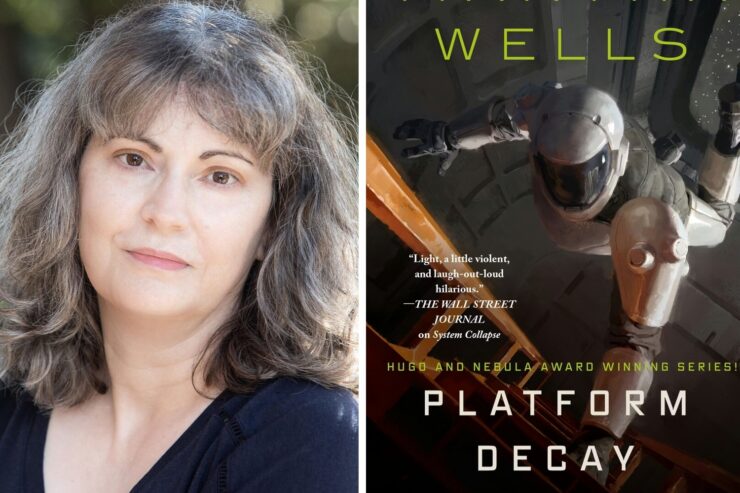
In Platform Decay, the eighth and latest entry in author Martha Wells’ Murderbot Diaries series, our favorite SecUnit embarks upon a rescue mission, navigates interactions with strangers, and wrestles with the implementation of a mental health module that forces it to occasionally run a kind of emotional self-diagnostic check. It is, in some ways, just another day on the job for the cyborg that won our hearts nearly nine years ago when we learned it had hacked its governing software largely so it could watch its favorite programs in peace.
Except there really is no such thing as just “another day on the job” for Murderbot, just as there’s really no such thing as just another Murderbot story for the character’s millions of fans. Since the release of All Systems Red in 2017, Murderbot has become a full-blown cultural phenomenon. Though it’s easy to measure its success in sales or even the quality of its Apple TV series (one of the best sci-fi adaptations in recent memory), the truest testament to the series’ impact is found in the hearts of its fans. Murderbot has become an unlikely beacon of hope in troubling times, just as the Murderbot Diaries have become some of the most anticipated new SFF releases in any given year. Nobody, including Wells herself, could have predicted that the story of an emotionally confused cyborg in a world run by ruthless corporations would have become a comfort to those navigating often unprecedented times. But as this series grows, so does its legion of fans who look at Murderbot’s adventures and say “Same, Murderbot, same.”
I recently got the chance to speak with Martha Wells about the latest Murderbot book, why these stories mean so much to so many, and, ultimately, what is next for the character as Wells begins to consider writing the final chapters of the Murderbot Diaries.
Matthew Byrd: To jump right into it, I want to ask you about how Platform Decay also just jumps right into it. I was talking to a few readers about how the opening caught them off guard by throwing us into the middle of the mission, and how the whole story has this incredibly fast pacing. Was that meant to capture the exhaustion of it all, or was that just how the story took shape as you worked on it?
Martha Wells: That was basically how it took shape as I worked on it. I was having a little trouble getting it started, as I do pretty much all the Murderbot books, and was looking for a place to really start the story. I tried a couple of other openings that started further back and offered more explanation, but this one just really felt right. I wanted to focus on the Torus setting. So starting right as they got into it just felt like the right way to go.
Matthew: It’s interesting because the pacing contrasts a bit with Murderbot being in a healthier place mentally throughout the book, or at least making progress emotionally. To what extent do you track the progress of the series at this point by Murderbot’s emotional growth versus big story revelations?
Martha: It didn’t start out that way, but now it is very closely tracked by Murderbot’s mental health progress. I think Network Effect was really the only one that had that kind of epic, big story. The series, to me, has always felt really personal. Personal to Murderbot and personal to the reader. I’ve kind of been tending in that direction for a while.
Matthew: How do you approach balancing what this character means to you personally with what it’s come to represent to so many people, and how they’ve read the character in their own ways?
Martha: I just try to stay true to what I feel the character is, because I think that’s what people are responding to.
Matthew: Did you ever expect these stories to become almost a comfort to those who look forward to just being able to exist in this world, as awful as it can be at times?
Martha: I didn’t anticipate that, but I didn’t anticipate anything about how popular the series would be. It’s really nice to hear that it has, because… for me, a lot of books were like that. Basically, my whole life… I started to say when I was growing up, but it’s pretty much the same case now, where a new book comes along from a favorite author, and it’s just such a relief to step out of the world for a while with that author you trust. I’m just really glad it’s become that way for some people.
Matthew: I’m sure inquiring minds want to know your secret to writing a character that improves their emotional state despite living in a corporate hellscape. It hasn’t become a less relevant topic as the series goes on.
Martha: [laughs] I wish I really knew! Basically, my coping mechanism is the same one I gave Murderbot, which is basically TV, movies, stories, books… anything that just kind of takes you away from reality for a while.
Matthew: Speaking of which, since the Apple TV adaptation came out, I’ve been fascinated by how much people have latched on to The Rise and Fall of Sanctuary Moon, and how it’s developing its own fandom. Has that reaction changed the way you’ve engaged with that series?
Martha: Not really. It’s pretty much the same for me. I just think the way they did [Sanctuary Moon] in the TV series was so much fun. Just having so many surprise actors, and just the whole… taking the soap opera, telenovela concept and really pushing it as far as it could go into the outrageous. The costumes, the great music, and the situations. I just think that’s what people are responding to. It’s so silly, and it’s so fun, yet it’s kind of serious stuff. It was just incredibly likable.
Matthew: People have tried to nail down what Sanctuary Moon is in the Murderbot universe vs. ours. Some say it’s their Doctor Who, others say Star Trek, and some compare it to Days of Our Lives. What do you think is the best comparison?
Martha: Probably more like Days of Our Lives. I think that also becomes more obvious in the second season, when they’re going to show more of Sanctuary Moon and some other shows. It really shows how there’s a much broader story out there. I think that makes it clearer that it tends more towards a soap opera or a sort of daytime or nighttime drama.
Matthew: Getting back to Platform Decay, I found it interesting that Murderbot has always had these themes of independence, ownership, and even slavery. But throughout the series, and in this book in particular, there is greater emphasis on community and interpersonal relationships. How do you balance that dynamic, and why is it so important to you to evolve that idea as the series continues?
Martha: Well… this can sound complicated, but it’s kind of about the ways the nuclear family has kind of been a little imposed on our society. You read about historical communities and how it’s more helpful for people to be in larger groups, found families, and extended families, just forming little, small communities that help people take care of each other. So I just like to write about that too. I like to show that in the Murderbot Diaries. I think when they’re traveling on the Torus and going through the different segments that have very different… not just styles of government, but different cultures. It was really a good spot to show the variety in how people were living. The worse a place felt, the more signs of community there were.
Matthew: Is it that natural urge for families and communities versus the ways those ideas can be exploited and warped?
Martha: Yeah, I think so. I think humans always want to live in groups, and this whole idea of these very small families being isolated is… It just doesn’t work for many people these days. Especially people who don’t want to get married or don’t want to have a significant other, but who do want to have friends. Or they want a relationship, but they don’t want to have kids, and they don’t mind helping other people with their kids. That kind of thing. It’s just that there are too many variations, and I think people are kind of tired of being put into little boxes as to what their relationship should be.
Matthew: You’ve mentioned that you don’t necessarily think far ahead for the series before you start writing new books. Was there anything that surprised you when writing Platform Decay?
Martha: I don’t think until I really got into it, and they started their escape with Farai, Sofi, and Naja… I didn’t really think of the whole family road trip thing until then. That’s when it really started to come together. So I was kind of surprised by that, but I also really enjoyed how it was trending in that direction.
Matthew: That’s fascinating, because it’s such a big part of the story.
Martha: I mean, sometimes I don’t really know what the story is going to be about until I get into it. It’s really hard for me to figure out whether ideas, plot elements, or even action scenes will work until I start writing them. I kind of write my way into all of it.
Matthew: On that note, I know a lot of people are really falling in love with Three as a character and their relationship with everyone. Were there any relationships in the series that have evolved differently from your initial expectations for them?
Martha: I think Three has evolved differently because, at first, I kind of imagined it almost as a friend or sidekick to Murderbot. Basically, I kept thinking about how that feels similar to some of the things I’ve done before. So I’ve kind of been taking it in a bit of a different direction. Murderbot doesn’t have a lot of interest in fixing big problems or activism. It mostly focuses on keeping the people it cares about safe. The fact that Three might be different, and might be exploring that when it goes off on its own on the Torus is kind of playing with that direction a bit.
Matthew: I saw an interview recently where you mentioned the possibility that the next Murderbot story could be the last one you write. Do you have any updates on where you’re at with that?
Martha: Yeah, I mean, it will certainly be the last one for a while. I do want to take a break from it and maybe try something else. But I won’t really have time to think about that much. I’m still in the middle of writing Hierarch, the next book in the Rising World series. So yeah, right now that’s the only thing I have. I have one other [book] planned to fulfill the contract. I kind of feel like I’ve taken it to a place where Murderbot is in a really good place right now. Not perfect, but much better than it has been before. So that might be a good place to put a cap on the story, if that’s how it turns out.
Matthew: How will you know when it’s time to end the series? Is there anything in particular you’re looking to accomplish narratively, or is it more about when you feel it’s time?
Martha: Well, I had an idea for a long time of wanting to do a big story centered around Preservation, the planet, or in the Preservation system, with something happening there. I would like to be able to do that. Usually, I come up with ideas and think, ‘Oh, I’ll do this book,’ and then it barely touches on that or there’s just not enough room in the book to get everything done. But that’s really something I’m hoping to do in the next book, if I can come up with a good idea.
Matthew: I’ve heard you speak about how this series started as a standalone story and evolved along the way, as you decided to spare the [Murderbot] character and continue their adventures. Did you ever consider any other endings for the series and for the character?
Martha: Not really! In All Systems Red, once I decided, ‘Yeah, Murderbot was going to leave’ and then I had the idea that it would be great to do a story arc getting back to meet up with Dr. Mensa and the others again. That was kind of up to Exit Strategy. Then Network Effect was just me wanting to get ART and Murderbot back together. So it’s always kind of been about more the story I wanted to tell next, and I never really thought of, you know, doing something graphic to the character at the end or anything like that. [laughs]
Matthew: Has this series becoming such a surprise hit changed the way you think about and approach long-term storytelling as you look towards future projects?
Martha: I don’t think it’s changed my approach. I think it’s given me the ability to do things that are more out of the box and risky, like Witch King. I don’t think that’s a book I could have sold earlier, and I don’t think it’s a book I could have written any time earlier, because I just wouldn’t have had the experience to do it. So it kind of lets me be more open to doing different things and push outside of my comfort zone a bit.
Matthew: Is there anything you feel pulled towards creatively that readers who are maybe only familiar with Murderbot may be surprised to learn you’re interested in pursuing?
Martha: Well, a lot of them were just surprised in general and didn’t realize I’d written fantasy before. A lot of them didn’t realize I’d written novels before. When I was getting ready to do Network Effect, people were like, ‘Well, can she write a novel?’ And it’s like, ‘Well… I’ve written all these others.’ [laughs]
Buy the Book

Platform Decay


The last two books have a LOT of dangling plot and character arcs I’d like to see developed, so hearing there may only be one more Murderbot book makes me sad.
That said, I can happily re-read all of these many more times, because there is so much going on, and I can pick out different things to focus on with each read.
Me too, there are so many threads! I love Murderbot so much that I re-read them every few months. Really would love more stories with Art as their relationship is the best.
We also don’t know how the sec unit Murderbot freed has gotten up to. I can imagine an underground network of free sec units, passing on the code and Murderbot’s story. Or Amena working for New Tideland.
I really hope they’re are more stories.
Units, plural, wasn’t it? Plus the free comfort unit, though it might not know how to pass the codes on.
There is so much more to explore!
dang I’m a little disappointed we won’t get to learn more about psumnt before the series ends, I kinda wanted to see what murderbots work with the university was like without all that stuff going on.
I do want to see more preservation but platform decay was already pretty focused on characters from there that it feels like there’s a few loose ends that should be covered before the series ends with preservation.
(hope art will be more present than in platform decay if it’s truly going to be the end of the series. (I also want to see more three…))
I appreciate everything you publish about Murderbot and Martha Wells (Witch King and the Rising World series are also amazing). Thank you.
I’d also like to plug the audiobooks for those who like multiple readings of the Murderbot series. Kevin R. Free does a wonderful job brining the character to life (even if they do reinforce the male presenting take on it).
So does Graphic Audio! (even though that one also reinforces that Murderbot can only be played by male actors. 3 for 3 adaptions where MB is male-voiced/male-presented).
Graphic Audio may be abridged but it has a lovely diverse cast in both gender and races, so it is a lot of fun to listen to. And Murderbot’s “machine system voice” is female at least, so it’s only 95% a male actor.
I hope one day, we get an adaption of Murderbot where they let a female or femme actor be Murderbot.
There’s also a full-cast audiobook adaptation of the books from GraphicAudio, with Murderbot played by David Cui Cui.
https://www.graphicaudio.net/our-productions/series/k-r/the-murderbot-diaries.html
Thanks Martha, I love how your book defies expectations and continues to focus on Murderbot building its family with a bunch of black women and children and girls. Any time I get worried the TV show or the books will suddenly become about the guys, I remember this is Martha Wells and she loves writing female characters and giving Murderbot more and more friends.
It is especially a relief after the TV show’s focus and prioritization of the guys and all the resulting interviews talking about the guys and none of the women characters, to finally get some Murderbot content that is back to elevating the women and nonbinary/agender characters.
I can’t wait to see your final book.
i agree, and I also appreciated the inclusion of Naja! Old disabled women can have adventures too! That was awesome, and I had such a fondness for her helpful mobility device carrying stuff for everyone when Naja could walk on her own. Naja was my favorite of the new characters!
Platform Decay was such a fun and unexpected instalment; and I’m hopeful about the closer focus on Preservation that Wells mentions as a possibility – the limited perspective we get on it from the rest of the series makes me think it would be great to explore more of MB’s experience of it / evolving attitude to it.
I genuinely don’t understand how anyone was able to enjoy the murderbot tv show. I thought it was absolutely awful T_T The human characters seemed like dumb caricature versions of themselves, they behaved like very stereotypical hippies at times and to me it read as if they were being mocked the whole time (which they definitely deserved, what the hell was that humming circle thing). That threesome situation with Ratthi Arada and Pin Lee (also why did they remove Oversee but created Leebeebee??) was so incredibly pointless and bad and immature and shown with a very 21st century approach and awkwardness which makes no sense in context. MB looked nothing like itself, it was basically a ken doll and its behaviour was also weird at times. And so many freaking in-world inaccuracies as well. Like the C on the helmet for company even tho we know it’s not actually called that. Or the entirety of the last episode on that station which had absolutely nothing to do with the book and the creators clearly only wanted to squeeze in more action and drama. That whole riot situation was also bad since MB says so many times in the books that secunits aren’t used on stations and the only times we do see them onstation in the books is when they are dealing with rogue secunits. So yeah. Idk what people see in this show
welp, Martha Wells herself worships it, so you should take that as an example of what her actual views on all these things are. She’s been telling us Murderbot was a person of color since 2018 — but never actually described it as such in the books, and is still cheering on the whitewashing in the TV show.
She’s diplomatic about it and talks about things she enjoyed, but nothing I have seen from her indicates she ‘worships it’.
On the contrary, you should never assume that a creator’s positive comments about an ongoing production they’re involved with represent their “actual views.” It’s bad form to say negative things about an active production you have a stake in, both because it can be hurtful toward your collaborators on the project and because you don’t want to hurt your chances of making money from it by discouraging people from seeing it. So even if creators are personally dissatisfied with choices made in adapting their work, you often won’t hear them say so until after the adaptation has ended.
Also, I can’t find any examples of Wells “cheering on the whitewashing.” All I can find her saying about Skarsgard is that he captured the character better than the other people they auditioned. How diverse the casting pool was to begin with was probably not something she had control over.
Vico Ortiz would have been the IDEAL Murderbot, and that’s a hill I will die on.
That aside, the whole Murderbot series has been profoundly meaningful to me–they were one of the first things I read that helped me understand my own neurodivergence better. To quote Murderbot about Sanctuary Moon, “It gave me context for the emotions I was feeling … It kept me company without making [me] interact.”
I also love the low-key way that women are in charge, the way that brown skin is the norm, and the way that group marriages, sexual fluidity, and human fecundity aren’t disasters or deviant, but the very way that humanity has thrived and spread into the universe. That’s exactly the world I want to live in, and until we create it on earth, I’m so happy to be able to at least visit it frequently.