





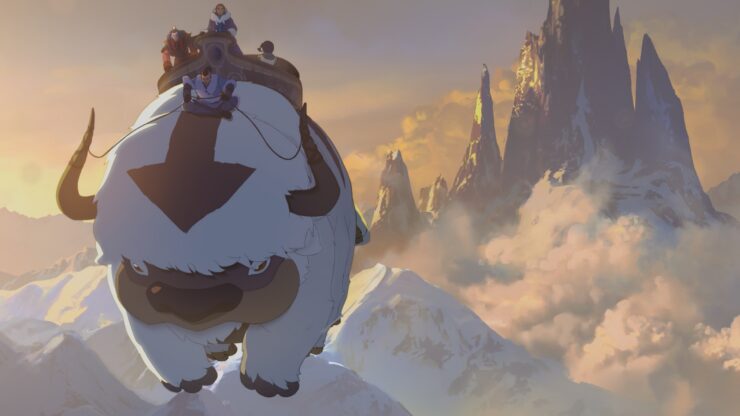
As the first on-screen adventure of the original Team Avatar in nearly twenty years, Avatar Aang: The Last Airbender had a lot of ground to cover, and a lot of hopes to live up to. Unfortunately, the film leaked ahead of schedule, taking the wind out of its theater release sails and confining it to a narrow selection of screens. Most fans were likely to watch on their televisions instead.
This isn’t to say that watching the film on a television was more likely to make audiences root for a return to the show’s original form—Paramount and Nickelodeon certainly put the money in the make the first Avatar Studios film feel like it needed a big screen. With the use of Deep Canvas tech (the same animation technique used for films like Treasure Planet and Tarzan, and Atlantis: The Lost Empire), the world is given a three-dimensional depth that the initial series could never achieve. The soundtrack goes bold, with composer Jeremy Zuckerman back and making the most of the sizable canvas. There are several extensive action sequences that make use of a movie’s runtime, and build out what was already made possible in the shows.
But it does feel as though pieces are missing. There have been reviews and comments that suggest this is due to aging up our core characters, but that couldn’t really be further from the truth—any charm lost is more due to a lack of time and the desire (or perhaps need) to provide film-style spectacle. There are plenty of laughs to be had, plenty of sharp character moments, but the truth of the matter is that ATLA was an ensemble piece at heart; with a movie’s parameters, it really only has time to focus on its title character.
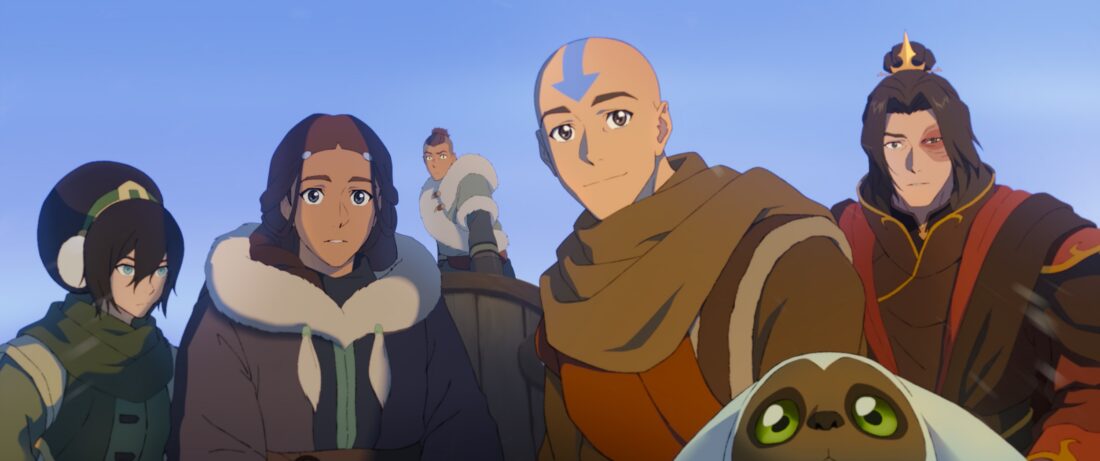
The recast of the original crew to more accurately reflect the diversity of its characters works out for the film as a whole: Eric Nam infuses Aang with all the necessary warmth and silliness that make the character recognizable, even as age and time have brought a worn sadness. While we don’t see nearly enough of them, Katara (Jessica Matten), Sokka (Román Zaragoza), and Zuko (Steve Yeun) have lost none of the sparkle of their original iterations—if anything, they just feel more anchored, having sunk into their personalities. Dionne Quan not only plays an adult Toph to perfection, but is also the only blind actor to have ever portrayed the character.
The film covers a period thirteen years after the series ended, when Aang learns that there might be a staff from a previous, forgotten Avatar named Sonam (Frieda Pinto) that created new Airbenders. Desperate to revive his people and still reeling from guilt at their demise, Aang races a group of violent non-benders calling themselves the Denied to the staff’s location, and instead finds Tagah (Dave Bautista), an ancient acolyte who was given airbending by Sonam. Tagah is eager to show Aang airbending traditions and abilities from his era, and to help him find the staff. Tagah is not all that eager to discuss the fact that he was frozen for millennia in ice, an act that only could have been completed by the Avatar… well, it’s more than a little obvious where this story might be headed.
The fact that the narrative beats are so obvious means that none of this adventure ever feels particularly dangerous or weighty. It’s possible that allowing the film a longer runtime (it clocks in at 99 minutes), or even simply setting the story over a longer period of time, might have prevented such a truncated feeling—even Legend of Korra managed to get deeper into its themes with shorter seasons. But even saying so, the plot feels like less of a concern than actually spending time with the characters who have been so missed.
The film doesn’t have a lot of time for Team Avatar, and that’s a shame because everything we get from them is what makes the movie enjoyable at all. Katara is working tirelessly alongside Aang to make Republic City work, and still one of the greatest masters of the age. Sokka never stops inventing or telling good stories (Zaragoza has that delivery down). Toph and Zuko are both clearly a little bored in the duties they’ve given themselves, and happy to get a distraction from Aang, who is still sending paper letters to his blind friend (which has got to be a joke at this point, right?) and letters that start out “Flameo Hotman!” to his pal the Fire Lord of the whole Fire Nation. (Does Aang put personal details in the letters knowing they’ll get read out loud to the court, or is he just that clueless about how public Zuko’s day-to-day would be? Either option is excellent, I should point out.)
There’s also the team’s entire reaction to Tagah on rescue, where Aang is awed by his existence, Toph is blatantly horny for muscles, and Zuko proves he might be more than a little bit queer. (You saw the bit in the trailer about bone structure. The case is already rested.) The group’s work during a stormy sky-chase action sequence with the Denied right on their tail is frankly the best in the film, proving that the team sans Avatar is perfectly capable of holding its own and with all its members now old enough to trust in this working dynamic implicitly.
Why is Aang not available to help them? Well, he’s unsurprisingly doing whatever Tagah recommends, and while he does get a brief lecture from Katara on the subject, there’s again not enough time in the film for everyone to point out to Aang that he needs to do some work on a few very specific hangups. The movie is ultimately working toward that end—toward Aang realizing what he can do to preserve his people’s memory and toward some self-forgiveness about the whole iceberg hiatus—but seems to get there with very little effort on anyone’s part. The machinations simply play out and Aang Learns Something Important(tm) on the way.
There are some strange worldbuilding questions provoked by the film as well, including the arc from the Denied to the Equalists that we see in Korra’s time, a need for more information about Airbender culture, and some strangeness around Appa—the beloved sky bison gets hijacked by Tagah toward the end of the film in a manner almost identical to Toothless in How to Train Your Dragon’s sequel, but it’s never explained or communicated in a manner that satisfies. Places where there’s a lack of explanation loom a bit larger than they might in part because the worldbuilding for the original show had so much detail carved out.
The film is still a fun journey for the fact that it’s enjoyable to see all these characters and this world again, with a scope to match its ambitions. With a new series on the way, following Korra’s successor Avatar Pavi, it’s relieving to know that this universe is heading back to its proper place on television as animated shows. But I wouldn’t say no to a series about Aang’s generation growing up and working so hard to reconfigure the world they fought so hard for.


I thought it was an excellent movie. The animation is spectacularly good, though I occasionally wished the action sequences were a little less over-the-top and overlong and that we could spend more time catching up with the characters’ lives. But it was nice to get what I believe was the first onscreen appearance of the Beifong Metalbending Academy established in the post-series comics.
Where did you get the figure that it’s 13 years after the series? The Avatar Wiki puts it about 10 years after. Which seems a bit early for Republic City to have already been built, but I guess benders could build pretty quickly. Incidentally, it seems that most of the people Team Avatar met have migrated to Republic City. I saw cameos by the Cabbage Vendor, the Cave of Two Lovers hippies, the mouth-foaming fanboy (and his son and long-suffering wife), and no doubt others who’ve slipped my mind.
It’s surprising that they recast everyone, except Dee Bradley Baker as the animals. I get that they wanted to correct the original shows’ tendency to cast mostly white actors in the voice roles, but they even recast the roles that were played by Asian actors originally, like Zuko, Gyatso, and the Cabbage Vendor. And it’s a bit odd that Zuko is now Steven Yeun, who played Avatar Wan in Korra, and that Gyatso is now François Chau, who was the Great Sage of the Fire Nation in the live-action Netflix series. Also ironic that James Sie was the only original cast member besides Baker to reprise his role in the live-action show, but did not reprise his role in the animated revival.