





Boys Go To Jupiter is a quirky, picaresque, coming-of-age animated musical. It’s a film about wanting to get out of Florida that still honors Florida’s weird beauty. It’s a surrealist comedy that goes in surprising directions without feeling forced. It was created by Julian Glander using Blender software, and the voice cast includes an excellent roster of comedians (Janeane Garofalo, Julio Torres, Grace Kuhlenschmidt, Sarah Sherman, Chris Fleming, Cole Escola, Demi Adejuyigbe, and Tor author Joe Pera), along with writer Tavi Gevinson, actor Elsie Fisher, and singer/songwriter Miya Folick.
Best of all is Jack Corbett as main character Billy 5000. Billy is a sweet, earnest kid whose trying to become something new, and Corbett plays him perfectly. I saw a Q&A with Glander, and he did a parody of the kind of treacly voice acting he didn’t want (“Gee, I HAVE to raise this MOney or I’ll NEVER get outta FLORida!!!”) and it highlighted how great Corbett is. Billy is deadpan, amused, unsure of himself, and, usually exhausted—and he needs to have a real voice to ground all of that in the midst of the poppy, whimsical animation.

I lived in Florida for many years. Too many. There’s a version of Boys Go To Jupiter where Billy is desperate to get out, talks about nothing else, rails against his life there, drones on about how the heat and flatness are killing him.
A version, basically, where he’s me when I lived there.
Fortunately the film takes a different path. Boys Go To Jupiter is joyous and colorful, and made me miss a place I used to hate. The movie gets Florida right, but in a really nice way. It’s easy to malign Florida (and I often do) but there are many Floridas, and a lot of them are beautiful and populated with lovely eccentrics.
Billy 5000 lives in his sister Gail’s garage because life in his mom’s trailer was no longer tenable. He has a small circle of friends: ginger Freckles (Grace Kuhlenschmidt), Beatbox (Elsie Fisher), and his nephew Peanut (J.R. Philips). They hang out on the beach, or at the drained pool, or at a convenience store, doing very little because there’s very little to do.
I’m not sure how it is now, but when I lived there there wasn’t much for kids to do, because the adults, most of them over 50, hated us. This was made clear by the op-eds sent into any paper that dared push back on curfews, or floated the radical idea that maybe cities should fund parks, pools, or skate parks in order to provide kids with things to do other than spending money at a movie or a mall. The number of times I read variations on the words “if they’re bored after school they should get jobs”—a normal and cool thing for a retiree to say about, like, a 12-year-old who wants a safe park to play in—would, I hope, stagger your imagination.
Hilariously, Billy 5000 does have a job. What he doesn’t have is school, because he’s dropped out to try to make enough money to pay Gail (Eva Victor) back for taking him in. (Gail is unaware of this, and would not be pleased if she knew.) He’s a delivery person for Grubster, a job enabled by a hoverboard called a “Swagway” that allows him to keep his performance levels high.

But this isn’t a Snow Crash situation where Deliverators are locked in high stakes races against time and mafia dons. This is Florida, everything moves slower, and capitalism appears to be in freefall, so Billy’s urgency is sporadic and self-generated. A lot of the time he just doesn’t care—he delivers food to the wrong people, leaves the food at the door, whatever—and it doesn’t matter. The things that do matter for in his job are hilarious: he gets performance points docked if he calls his deliveries “food” as opposed to “grub”, and he’s expected to sign off with “Have a grubby day!” as he hoverboards away from each customer.
He regularly watches a youtuber named Mr. Moolah for tips on how to increase his wealth. (Mr. Moolah’s videos don’t have too many views, so I’m not so sure his advice is too solid—i was reminded of Fisher’s earlier role as the earnest Kayla Day in Eighth Grade)
His friends are angry about his new rise ‘n’ grind personality, but it’s not like they’re offering him alternatives. Their idea of fun is sitting on a beach rapping to each other. They have no ambition to leave, no drive to turn their music into anything, while Billy really does feel a pull to do something more. He meets Rozebud Dolphin, the scion of Dolphin Citrus, and for a moment it looks like the two might team up against The Man. But here again there’s a sort of gentle skewing. Rozebud is desperate for her mother Dr. Dolphin’s approval, but can’t admit that need to herself. She has a giant safety net and a guaranteed job, but rather than either quitting and striking out on her own, or actually fomenting change from within, she talks about anti-capitalist manifestos without actually reading them. There’s a distinct sense of a young person who’s content just to drift, which would be fine if she wasn’t also playacting about taking down the system from within—but it’s not like the movie condemns her or anything. It simply presents the different sides of her personality and lets us, and Billy, watch them play out.
As for why the company is called Dolphin Citrus, there’s an extended bit about the urban legends around the dolphin studies Judith Tarr wrote about recently in her SFF Bestiary column, which, having had friends who worked with those people, it’s been kind of cool to see them pop up multiple times in the last few weeks.
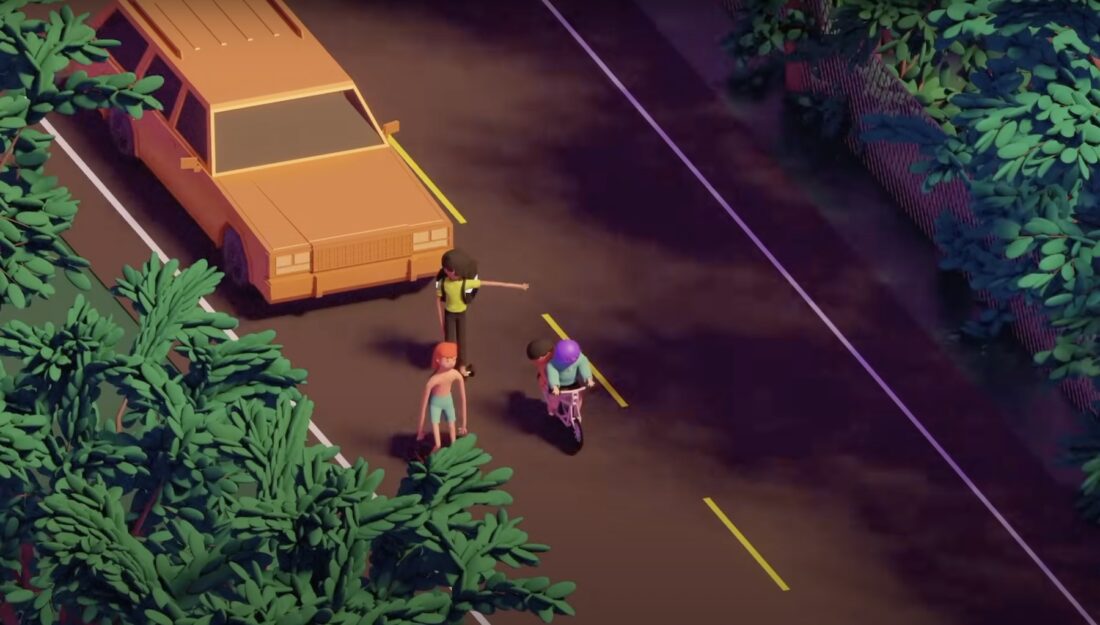
Another thing I love is Glander’s dedication to Florida detritus. Oranges are incredibly important. They’re treated as icons, they’re animated lovingly, the trees are full of them—but as the film makes clear, even though they literally grow on trees they’re not just available to anyone. They are engineered and overbred and hybridized and swirled together with other fruits to make juices with stupid names and generally turned into Frankenstein’s creatures when they started out perfect. There are chicken shops, taco places, hot dog stands that are shaped like hot dogs, whose proprietors wax philosophical about the nature of the dogs. There are mini-golf courses teeming with plaster dinosaurs.
One thing you don’t see? Disney, or Busch Gardens, or any of the other theme parks. The tourists have their own areas, and they don’t cross paths with these kids in their rundown suburban Tampa neighborhoods. You also don’t see libraries or museums or even any parks—nothing here is designed for the kids. There are only abandoned stretches of beach, drained swimming pools, and convenience store parking lots. You see kids walking (or riding a Swagway) down highways, because there are no sidewalks. If you’re not an adult with a car, most of the stuff you really want to do is too far away to get to, and the theme parks are all WAY too expensive anyway.

The problem with writing about this movie, however, is that I really can’t get talk about why I’m recommending it here. Boys Go To Jupiter becomes a sci-fi story pretty quickly, but in a hilariously casual way that just folds into the rest of the story. Glander’s version of Florida is already made surreal with oranges that gain iconic power, (usually) inanimate objects with voices and personalities, and urban legends that are revealed to be historical fact. (Boys Go To Jupiter creates a dream of my old home so vibrant that in writing this, even as I think about all the ways it sucked, I miss it terribly.)
The whole thing already feel so liminal that when the aliens show up, there’s no shock of first contact—they’re just another thing Billy has to compartmentalize before he dashes out for another delivery. But slowly they move closer and closer to center of the story, until we come to a point where to say anything will spoil the last third of the film. I’ll just say that Billy’s relationships with two of them—Glarba (Tavi Gevinson) and Donut—are remarkably judgement-free, and really sweet. (Also, I’m not confident I can express to you just how much I love Donut.) At a certain point these relationships becomes the fulcrum of the film’s lackadaisical moral plot. There is one very particular type of movie that could unfold, but fortunately Glander once again takes his story in a completely different direction, giving us a first contact story that stays surprising and hilarious until the final frame.