






It surprises me how many times I’ve seen the trailer for Jinsei—not just in arthouses but at regular theaters. I thought this could be just my New York cinephile privilege (it has a limited opening at IFC Center on June 5), but the movie’s reported to be playing in over a hundred theaters nationwide starting June 12. That might not be a wide release, but it’s wider than the typical North American anime release from back in my day. No Satoshi Kon film exceeded 37 screens in his lifetime. The Oscar-nominated Studio Ghibli masterpiece The Tale of the Princess Kaguya never played in more than 29 theaters in its initial 2014 release. Summer Wars, as accessible a family-friendly crowdpleaser as any anime, maxed out at 11 theaters in 2010!
It’s cool that anime as a medium is now popular enough to sustain bigger releases (all aforementioned films have since gotten wider rereleases). But even in this era, Jinsei feels like something that would normally play in a dozen arthouses at most. This might be the least mainstream-friendly anime feature to ever get this big a release. It’s certainly the most outside the system.
By “outside the system,” I mean that Jinsei is almost entirely the product of just one guy. First-time filmmaker Ryuya Suzuki wrote, directed, animated, and edited the film entirely by himself, as well as composing the music in collaboration with Yuki Hara. The only other names in the credits are the voice actors, the sound team (led by Shuji Suzuki), marketing people, a long list of Kickstarter backers, effects artist Taishu Tomita, and producer Kenji Iwaisawa. That last name you might recognize as the director of On-Gaku: Our Sound, another crowdfunded indie anime made with only a slightly larger team, and the bigger budget sports anime 100 Meters. Iwaisawa spent seven years animating On-Gaku. Suzuki completed Jinsei in just 18 months.
I realize I’ve spent a long time talking about the circumstances of Jinsei’s release and production without saying anything about the film’s story or quality. That’s because, disappointingly, those circumstances are more interesting to me than the film itself. I was intrigued by the premise of a single character (voiced by rapper ACE COOL) taking on different identities over the course of a century, reminiscent of Satoshi Kon’s Millennium Actress. I also appreciate how it bends genre, starting realistic before gradually evolving into psychedelic science fiction—the bold swerve recalls another one-man wonder of animation, Don Hertzfeldt’s It’s Such a Beautiful Day. Millennium Actress and It’s Such a Beautiful Day are five-star favorites of mine, so why did Jinsei leave me so cold?
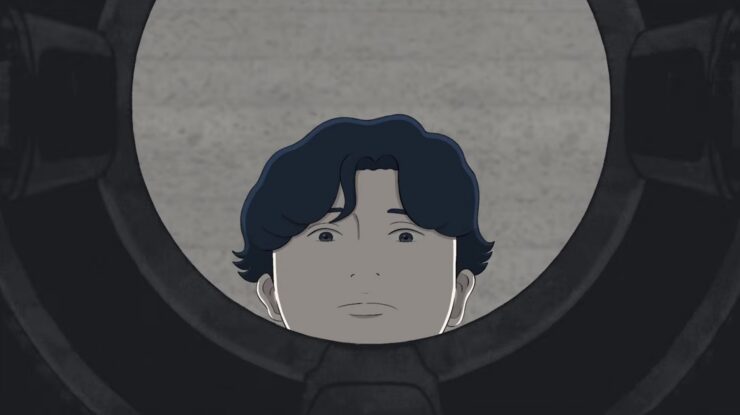
For one thing, I don’t love how the film looks. It turns out the way one person can animate 95 minutes in 18 months is to barely animate anything at all. Limited animation, in my view, works best at extremes: either using graphic simplicity to heighten the appeal of stylized motion (as with something like The Powerpuff Girls or Hertzfeldt’s stick figures), or going the opposite route of providing such lavish detail that the art wows even when the animation doesn’t (the more common route for anime, taken to its furthest extreme with the 1973 erotic horror watercolor slideshow Belladonna of Sadness). Jinsei is neither fish nor fowl, its character designs caught in a bland middle ground between these two approaches, unable to overcome the jerkiness of their movements. At least Suzuki knows how to compose a frame well. The use of symmetry, color design, and different aspect ratios representing different eras call to mind the works of Wes Anderson. Is it coincidence or direct inspiration that the most striking scenes in both Jinsei and in Anderson’s Isle of Dogs juxtapose violence with sushi preparation?
Jinsei divides its narrative into chapters, each using a different name for the protagonist. The first segment, “Se-chan,” makes some of the most effective use of its minimalist visuals, telling the story of the main character’s parents through a montage of car scenes leading up to a deadly accident. In the next chapter, “God of Death,” our protagonist is deep in mourning and subject to bullying but finds a friend in Kin (Taketo Tanaka), a classmate with a love for boy bands. The friends decide to try and become idols themselves (Se-chan/”God of Death” is the son of a famous idol), and so Se-chan becomes “Kuro” as he goes through five years of training under an abusive manager, Shiratori (Kanji Tsuda).
Breaking away from his idol experience with a burst of violence, the protagonist’s next phase of life is as “Reito,” a host club worker who nearly gets killed but survives in an abandoned warehouse. He’s discovered as “Man A,” then gets a second chance at celebrity as “Zen,” somehow ends up getting together with Sakura (Miho Ohashi), a woman he refused to defend from a sexual assault… and then the movie gets really weird, hurtling our protagonist into bunker life during a far-future war and eventually engaging in a 2001: A Space Odyssey-esque alien encounter.
For all the dramatic changes throughout his long lifetime, Jinsei’s protagonist remains a blank slate throughout. Perhaps some might connect to him as a depiction of a certain type of depression, but I never found myself that invested in his journey – the gaps of how he gets from one segment of his life were left too vague for a satisfying character study. The supporting cast also goes underdeveloped. Kin is the most immediately sympathetic and compelling; I found myself wishing we got more time with him. The relationship with Sakura was just baffling. The extreme weirdness and more creative visuals in the gonzo third act make it slightly more entertaining, but the pacing of the film overall feels like a slog.
Despite all my heavy criticisms of Jinsei, it is objectively neat that this film exists. It’s cool that an outsider artist and true indie animator can make a movie like this and get such wide exposure! That doesn’t change how little I cared for the movie itself. Maybe next time, Suzuki can find a co-writer to help develop his big ideas and a few more artistically skilled animators to work with.
