






Is Australia the spookiest country on Earth? They make a strong case for themselves with the movies coming out of there. Jennifer Kent’s accidental gay icon The Babadook is widely considered the launching point for the wave of metaphor-heavy arthouse frightfests controversially labeled “elevated horror.” Then there are the Philippou brothers’ movies, Talk to Me and Bring Her Back, which play in the grief-driven thematic sandbox of “elevated horror” but drop the pretense of respectability, pushing the violence and despair into genuinely nasty territory. A lighter mix of romance and body horror helped make Michael Shanks’ Together one of the breakout hits of last year’s Sundance Film Festival. Technically James Wan and Leigh Wannell are Aussies, even if they make their films in the States, so a lot of this century’s most influential horror has Australian roots.
Leviticus, the feature debut of director Adrian Chiarella, is looking like the latest Aussie horror breakout. Like Together, it premiered in Sundance’s Midnight program and got picked up for US distribution by Neon. It has continued to pick up great buzz at film festivals ahead of its theatrical release on June 19. I saw Leviticus as part of Film at Lincoln Center’s New Directors/New Films festival and found it scary, entertaining, and kind of beautiful. It’s not quite a masterpiece of horror on par with The Babadook, but one point in its favor: unlike The Babadook, it’s actually gay!
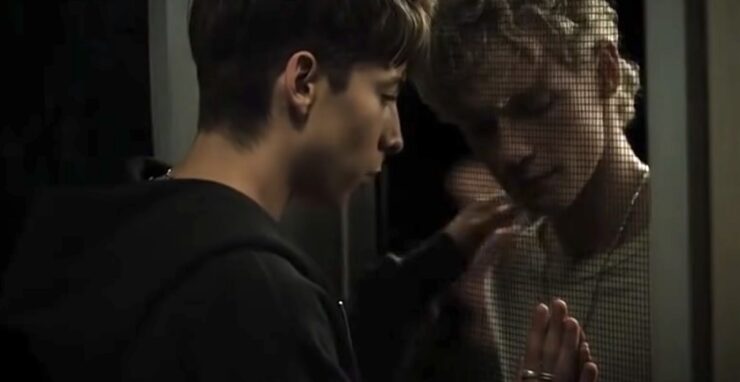
Naim (Joe Bird, who you might remember from Talk to Me’s most horrifying scene) and Ryan (Stacey Clausen) are two boys living in a conservative Christian community who like to throw stuff, wrestle, and, when no one’s looking, make out with each other. Naim is heartbroken to one day catch Ryan making out with someone else, the pastor’s son Hunter (Jeremy Blewit), and rats them both out. Their church brings in a “deliverance healer” (Nicholas Hope) who claims to be able to cure the boys’ homosexuality in a ritual involving a lighter.
This “cure,” it turns out, involves cursing them with a demon, invisible to everyone else but appearing to the afflicted in the form of whoever they’re most attracted to, that will kill them if they get too close. If the person they’re most attracted to changes, so will the demon’s appearance—and the more time one spends with the real person, the better the demon becomes at impersonating them. The demon only comes for people when they’re alone, and it appears loneliness is defined from the person’s own perspective (other people observing you doesn’t stop the demon, but you observing other people does).
Many are describing the premise as a gay twist on It Follows, David Robert Mitchell’s movie about a sexually transmitted shapeshifting entity. It’s a fair comparison, but while it’s been a while since I’ve seen It Follows, I don’t remember it being quite as viscerally compelling as Leviticus. I think I found Leviticus scarier because of the level of intimacy. Whereas “It” is easily identifiable from a distance by its out-of-place behavior no matter what form it takes, the Leviticus demon is able to trick its victims up close, making the psychological aspect of the horror in many scenes closer to John Carpenter’s The Thing. This aspect of “who can I trust?” horror also makes it distinct from Chuck Tingle’s similarly conceived demonic conversion therapy novel Camp Damascus.
Leviticus presents its mythology in a minimalist manner, and part of me wonders if a version of this story that got geekier with demonology and Christian lore could have also doubled as a sharper critique of religious conservatism. However, there’s an elegance to the simplicity of the story’s central metaphor, and at a concise 86 minutes, it doesn’t overstretch what it’s doing. Chiarella’s film shows the isolating effects of homophobia, and the vulnerability such isolation creates. I found myself particularly compelled by how the film deals with issues of the gaze—the push and pull of whether it’s better to look towards or away from the one you love. At times it made me think of a twist on the tale of Orpheus and Eurydice.
The film’s most interesting insight into religious psychology comes in the scene when, following some grisly attacks by the demon, Naim’s mother (Mia Wasikowska) takes her son to see the deliverance healer. Not believing her son’s claims that a demon is behind the attacks, she assumes the violence the healer’s prior victims faced was the result of hate crimes—and surely if the Deliverance Preacher can turn her kid straight, he won’t face the threat of such crimes, right? It’s feeble logic that falls apart with a second of thought (clearly the treatment didn’t keep the other boys safe), but using the threat of other people’s hate as a way to frame her own prejudice within a package of “love” makes for one of the most realistically unnerving moments of the movie.
Visually, Leviticus doesn’t stand out as much as other recent Australian horror favorites. Tyson Perkins’ cinematography is effective in getting across the dreariness and desolation of the rural setting, and there’s one demon attack I suspect will stick in viewers’ memories, but for the most part, the visuals are never as stylish as the expressionism of The Babadook or as twisted as the unblinking nightmare imagery of Bring Her Back. The movie’s strongest technical skill is in Nick Fenton’s editing, which delivers hard on the jump scares right from the opening scene.
Amidst all the horrors, both realistic and fantastical, Leviticus is ultimately a romance. Bird and Clausen have powerful chemistry as young lovers trying to figure out just what they’re willing to do for love. Naim’s guilt over outing Ryan adds another dimension of sadness to work through, yet in spite of everything, the two boys still love each other, and the moments where they express that love offer a cathartic light in the darkness. Like many of the metaphorical trauma-monsters that have defined “elevated horror,” the demons in Leviticus can’t be fully defeated, but they don’t have to kill you—maybe someday they will, but not yet. The path to survival may be the scariest yet most wonderful thing of all.

The premise sounds very similar to Chuck Tingle’s “Camp Damascus,” too…