






With Halloween nearly upon us, many folks are going through annual rewatches of their favorite scary, or spooky, or (god forbid) spoopy movies. And, almost exactly as old as movies themselves is Dracula, Bram Stoker’s 1897 novel that revolutionized horror, catapulted vampire media into the mainstream, and gave dark-haired, brooding actors an excellent role to play for the next hundred years.
I got my PhD in Victorian Gothic literature and Dracula is among my very favorite novels. I’ve taught vampire literature classes for the last fifteen years and have something of an obsession with film and television adaptations of the infamous Count. So, this October, I’m attempting to rank the best and worst on-screen Draculas (Draculai?) so that you don’t have to sift through the mediocre middle and watch a bunch of vampire stuff that’s just ok.
The Criteria
First and foremost, this is a ranking of the best and worst on-screen Draculas—not the best and worst vampire movies. I adore Let the Right One In and A Girl Walks Home Alone at Night but those don’t feature Dracula in any way so they won’t show up here. I’m trying to stick to actual Dracula himself and not just “a Dracula type.” I loved Matthew Goode playing the Elder Vampire in Abigail and he is heavily implied to be Dracula, but it’s still a tenuous connection. Alternatively, while Max Schreck in Murnau’s 1922 Nosferatu is named Count Orlok, that was to avoid a copyright lawsuit and, for all intents and purposes, he is Dracula, so I do count that movie. Other than that, the plot doesn’t have to reflect the plot of Stoker’s novel. This ranking considers any film in which Count Dracula appears to be a Dracula film.
That said, Dracula has appeared in over 600 films. There’s simply no way for me to watch all of them. I’ve garnered a fairly extensive knowledge in my years as a Gothic literature professor but it still falls far short of the totality. So, this will certainly be an incomplete sampling. That said, I’ve tried to pull from a wide variety of time periods and genres to get a more even spread.
I’m judging the portrayal of Dracula himself. That is obviously going to be affected by both the film in which the Count appears and the choices of the actor portraying him. Sometimes a film’s script or production design uplifts a less compelling Dracula. Sometimes an awful movie highlights the quality of a good performance by making it feel out of place. The reverse is also true for both these scenarios. Also, as a general rule, I talk about the performance and the actor behind it in these rankings. Any performance of a role is shaped by a variety of factors—the talent of the actor, sure, but also the talent or confidence of the director, the quality of the material provided by the screenwriter, the way in which the performance meshes or fails to mesh with fellow actors and the rest of the film. Please don’t take my condemnation or praise in this list as vitriol or encomia leveled at the actor portraying Dracula alone.
I am also attempting to avoid performances that don’t stand out from one another. Rudolf Martin, who plays Dracula in the Buffy the Vampire Slayer episode “Buffy vs. Dracula” (S05E01) is basically doing a C+ impression of Gary Oldman. Adam Sandler in the Hotel Transylvania films is parodying Bela Lugosi (and maybe also Catskills Vaudeville comedians?). In fact, hundreds of Dracula performances are just conscious knockoffs of the Hungarian actor’s iconic portrayal. Going through all of those isn’t particularly compelling.
Covering the Basics
While I am not judging these performances by their plot accuracy, it’s probably important to give a brief summary of the novel and its adaptation history so that deviations from it don’t require endless, repetitive explanations later on. Spoilers for a 127-year-old novel follow!
Dracula is an epistolary novel, meaning it’s composed of letters, diary entries, newspaper clippings and other diegetic texts. Count Dracula is an ancient vampire who rules over a remote portion of Transylvania in what is modern day Romania. He is visited by real estate lawyer, Jonathan Harker who is finalizing a deal for the Count to buy a number of English properties, including a Gothic ruin called Carfax Abbey. Harker discovers that Dracula is a vampire and is trapped in the castle by the Count, where he assumes that he will die.
Back in the English town of Whitby, Harker’s fiancée, Mina Murray, and her childhood friend, Lucy Westenra, await Jonathan’s return. Lucy (far and away the novel’s best character) is caught between three men all vying for her hand: local aristocrat Arthur Holmwood, Dr. Jack Seward (the closest thing the novel has to a narrator), who works as a sort of proto-psychologist, studying the clinically insane, and Quincey Morris, a Texan adventurer who is drawn from a bunch of stereotypes about cowboys. Lucy eventually chooses Holmwood but the marriage is not to last.
Dracula stows away aboard the cargo ship Demeter, kills its crew, and begins stalking Lucy after the ship runs aground off the coast. Seward notices that one of his patients, Renfield, is obsessed with eating flies and spiders, promising lives to a mysterious master. As Lucy grows ever sicker, her husband and former suitors ask Dutch scientist Abraham van Helsing to come and examine the case. Her former suitors all contribute blood to an emergency transfusion but Lucy dies of anemia anyway. When Lucy rises from the dead as a vampire and begins to kidnap and murder local children, van Helsing and company drive a stake through her heart (this whole section is as weird and closeted and uncomfortable as it sounds).
Jonathan escapes Transylvania and marries Mina. Through her, van Helsing and Lucy’s former suitors learn about Dracula, Carfax Abbey, and some of the rules of vampirism. Renfield is killed by Dracula while the men go out to reconsecrate the properties defiled by the Count. They confront the Count, but he has already begun to seduce and turn Mina. Defeated temporarily, he flees back to Transylvania and the heroes use Mina’s half-transformed visions of the vampire to track him to his castle where Morris cuts off his head stabs him in the heart with a Bowie knife.
The Count Dracula of the novel is only seductive by inference. He is never described or portrayed as particularly handsome. In fact, most of his physical descriptions imply he is old, ugly, and somewhat bestial (he has hairy palms and pointed ears). He did not become explicitly seductive and handsome until the Hamilton Deane play of the same name (first performed in 1924, with a revised version by John L. Balderston in 1927). The revised version of the play simplifies the plot of the novel significantly, with Jonathan being affianced to Lucy Seward who is now the daughter of Dr. John. Mina and Lucy swap characterizations and plot significance with Mina being Dracula’s first victim. Additionally, the play takes place entirely in Whitby rather than moving between Whitby, Transylvania, and London. Also notable in this version, Dracula is known to all the protagonists as an eccentric but fundamentally charming Romanian aristocrat. Many film adaptations use the Deane and Balderston version, not only because it’s an easier plot to fit in a two-hour film, but also because it lets Dracula have much more screen time and non-violent interactions with the rest of the cast.
The book is a nasty narrative: deeply sex-negative, wildly misogynistic, anti-immigrant, and arguably anti-Semitic. It is invested in valorizing middle-class professionals and the aristocracy as intrinsically more worthy than the lower classes, and presents its women as the passive, fragile victims of “reverse colonization,” with even Stoker’s independent New Woman archetype, Mina, eventually being tamed by marriage and motherhood.
The book also has an uncertain relationship to the historical Voivode of Wallachia (a region of Romania that borders Transylvania), Vlad Țepeș, sometimes styled as Vlad III or Vlad the Impaler. Count Dracula shares his name with Vlad III’s sobriquet; Dracula or Dracuglia means “son of the Dragon” (his father, Vlad II, was known as Vlad Dracul—Vlad the Dragon). Other than the name (and the fact that van Helsing supposes he must be “that Voivode Dracula who won his name against the Turk”) Stoker’s Count has little in common with his historical counterpart. Stoker’s inspiration, aside from previous pieces of vampire literature like Le Fanu’s Carmilla and Polidori’s The Vampyre, is likely borrowed from slanderous legends about the Hungarian Countess Elizabeth Bathory mixed in with some liberal interpretations of Stoker’s documented research into Romanian ethnographies and political history. Prior to his name being used in Stoker’s novel, Vlad Țepeș was mostly known as a Romanian National Hero whose bloodthirsty reputation was often considered (at the time) to be no more than what the situation demanded in a never-ending fight against the Ottoman Empire.
The Worst On-Screen Draculas
This is, in some ways, the harder of the two lists. Because of both the volume of appearances and the eventual public domain status of the Count, I’m sure there are much worse Draculas than the ones I’ve listed here, but they are likely worse by dint of being boring. I’ve sifted for the spectacular failures and the controversial picks: These are the Draculas who either took huge swings and missed, or the ones who completely failed to meet the expectations an audience reasonably had for them.
9. Luke Evans in Dracula Untold (2014)
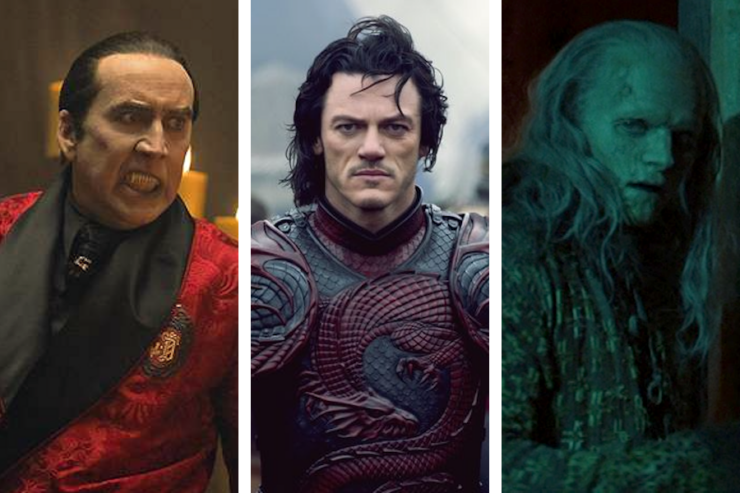
Originally supposed to launch Universal’s “Dark Universe”—a sort of MCU for Universal monsters that crashed and burned with the Tom Cruise flop, The Mummy (2018), Dracula Untold has an interesting premise. It takes the biography of the real Vlad Țepeș and attempts to square it more thoroughly with the Dracula myth. Vlad III, whom history rightfully remembers as a brutal and sadistic ruler, was, after all, raised as a noble hostage in the court of the Ottoman sultan, Murad II. Dracula Untold asks its viewers to conceive of the Count as a traumatized former child soldier who takes on the curse of the Vampyr in order to save Transylvania from his foster brother, the sultan Mehmed II (played by Preacher and Mamma Mia!’s Dominic Cooper in uncomfortable brownface).
Not a bad premise! The film is meant to show us Vlad Dracula, played by The Hobbit’s Luke Evans, slowly losing his grip on his humanity as he fights for his people and attempts to spare his son (Game of Thrones’ Art Parkinson) from life as an Ottoman prisoner. Also, Evans spends a lot of the movie exploding into a swarm of bats, flying across the battlefield and reforming, long sword in hand, to decapitate a bunch of Turkish soldiers. Good dumb fun.
But Evans’ performance is one of dreary, mopey, sorrow. He spars with mournful monk Paul Kaye and ignores the warnings of Master Vampire Charles Dance (Game of Thrones alumni always travel in packs of three or more) but there’s not much depth to the script. Evans’ Vlad is stoic, kind-hearted, and boring, which is bad enough, but the film has the added problem of suggesting that, just maybe, we should give a little bit of a break to the guy who was known for impaling enemy combatants on spikes and nailing turbans to the heads of negotiators. It’s the same fundamental problem of movies like The Greatest Showman where any sympathy generated feels like it’s being used to whitewash a historical monster’s legacy. Combine that with the discomfort of some post-9/11 Islamophobia in the form of representing Mehmed’s sultanate as monolithically bad, and a failure to really explore the complexity of what could have made this retelling interesting and you get a Dracula that is too disappointing and banal to matter.
8. Klaus Kinski in Nosferatu the Vampyre (1979)
I know I’m going to get in trouble for this one, as the Werner Herzog remake of Nosferatu is generally thought of as one of the best Dracula adaptations and, certainly, generally superior to the Murnau original. I have no qualms with Herzog’s direction. It is as beautifully and unsettlingly shot as any of his best work. Returning to the novel’s names after the 1922 film changed them in an (unsuccessful) attempt to avoid a copyright lawsuit, but keeping the German setting, Herzog brings out the cold beauty of Wismar’s canals, dresses his sets in macabre bone and brass automata, and uses the unresolved strains of Wagner’s “Rheingold” to produce an arthouse horror film for the ages.
The problem is fully Klaus Kinski’s. Herzog’s fickle, occasionally violent muse is given every advantage by the auteur’s tenebristic lighting and Dutch angles but mostly just sits there. Sure. He’s weird. If nothing else, Kinski is always weird. But this performance is borderline soporific. Rumor has it that Herzog got Kinski to tone down his usual frenetic furor by filming takes after provoking Klaus into throwing a temper tantrum, so that he only got the most worn-out version of the troubled thespian’s talents but, far from seeming subtle or subdued, Kinski just seems tired.
Strip away Reiko Kruk’s ghastly makeup and Jörg Schmidt-Reitwein’s eerie cinematography and Kinski’s Dracula is just a very sleepy man aping the Max Schreck thousand-yard stares of the original film with about half the energy and 150% of the eyeball exposure. One wonders if the film would have been better with Bruno S, Herzog’s other outsider leading man.
7. Gerard Butler in Dracula 2000 (2000)
In one of his earliest starring roles, 300’s own Gerard Butler is credited here, incredibly, as “Gerry Butler.” He’s much more in the soft, sad-boy mode he adopted for 2004‘s Phantom of the Opera than the shredded, gleeful, tough-guy persona he’s known for today.
Set in (you guessed it) the year 2000, the story chronicles Dracula’s search for his lost love in New Orleans after his coffin is stolen by high-tech thieves (led by Omar Epps) from an Abraham van Helsing (Christopher Plummer!) that has been microdosing vampire blood to keep himself alive for the last century, the better to ensure that Dracula remains imprisoned. The film folds in the publication of Stoker’s book with the fictional van Helsing having been inspired by Plummer’s real-life vampire-hunting doctor—though it still manages to throw some shade his way by insisting that the Dracula myth is more than “the ravings of a mad Irish novelist.”
It’s got a great cast that includes Johnny Lee Miller, Nathan Fillion, Vitamin C, Jennifer Esposito, and Jeri Ryan, and hinges on the reveal that Dracula fears crosses and silver because he is, in fact, Judas Iscariot, who walks the earth as a vampire because God cursed him to never know his embrace in the afterlife. It takes itself slightly more seriously as a tentpole action horror than something like Blade 3, but is let down by Butler’s wide-eyed mugging and “who, me?” reaction takes, filtered through a heavy smear of attempted late ’90s cool. Dracula sports a long coat over a crew neck black tee that feels very close to, but legally distinct from, Keanu Reeves’ costume in The Matrix, performs acrobatic feats of coitus while hovering in midair, and executes the world’s dopiest, straight-armed Tom Cruise run through a hallway I’ve ever seen.
The film knows that Butler’s voice, not entirely free of his natural Scottish burr, combined with his permanently bewildered and slightly amused expression won’t really cut it, so they keep him off screen as much as they can and only have him speak in a whisper. His thick mane of black curls may look better than other vampires on this list, and he may inspire momentary thrills when he enters a room in a dense blow of music video fog, but there is still an ignominy to a Dracula who only looks good in promotional stills.
On top of all that, despite being set in New Orleans at Mardi Gras, way too much of the film is takes place at a Virgin Music Megastore, with its love interest wearing a branded “Virgin” t-shirt for half the film.
6. Nicolas Cage in Renfield (2023)
Billed as a gonzo comedy focused on a redemption arc for the titular character, played by Nicholas Hoult (of The Great and X-Men First Class), Renfield also gave the world Nic Cage’s spin on Dracula. Portrayed as something between a bad boss and abusive ex in the movie, Cage’s Dracula should have been as wildly unhinged and meme-able as that particular combination of actor and role implies. After all, he had already given one of the all-time great, unhinged, meme-able, Nic Cage performances as a vampire (or at least a man who believes he is one) in 1988’s Vampire’s Kiss.
The concept of a Renfield who learns to stand up for himself after joining an AA-style self-help group is fun. And they add a weird bit of seemingly Sam Raimi-inspired lore where eating bugs gives him superpowers rather than just being a weird thing Renfield likes to do. But neither Hoult’s charm nor Cage’s manic mugging has much of a chance in this forgettable comedy. Buried under gross-out makeup and saddled with an accent that can’t quite reconcile itself with his prosthetic teeth, Cage’s Count is an incoherent mess that feels more like an SNL sketch of what Cage-as-Dracula would be like rather than the genuine, batsh*t (pun intended) performance we were promised. It’s a watered-down version of the kind of wild performances Cage has given a hundred times before.
Worse still, the film, set in present-day Miami, has Dracula join forces with a drug kingpin played by the incomparable Shohreh Aghdashloo who projects far more cold menace and steely terror than the vampire in every scene they share. Obviously, Cage isn’t playing Dracula for menace, but it’s never a good sign when you start wondering, mid-scene, if his co-star might be a much better Dracula if she were to play the Count in a dramatic adaptation.
Also, over in the minor quibble corner, the film knows enough of Stoker’s gloss on history to call Dracula the Prince of Wallachia rather than Transylvania but Cage pronounces it “way-lay-shee-uh.” So close. Look, I’m as disappointed as the rest of you that the film wasn’t better. But we’ll always have Vampire’s Kiss. It may not Dracula, but it is peak Cage.
5. Marc Warren in Dracula (2006 TV Movie)
Like Dracula Untold, this is another production where a delightfully novel and interesting take on Stoker’s book is thoroughly let down by a rather ho-hum performance from its title character. The BBC TV movie chooses to center Arthur Holmwood (a young but still uncompromisingly weird Dan Stevens) as a syphilis sufferer who, along with his cabal of wealthy, British Illuminati types, arranges for Dracula to come to Britain in order to donate his vampiric blood to cure him.
It features Tom Burke, Rafe Spall, and the inimitable David Suchet as Seward, Harker, and van Helsing respectively and does a good job of assembling an almost entirely new plot out of the themes, scenes, and dialog of the original novel. They shore up some of Stoker’s plot holes, give Lucy and Mina something more interesting to do than be mere damsels in distress (it’s one of the few Dracula adaptations to pass the Bechdel test), and take some of the grotesque anti-immigrant sentiment out the tale by making its clear that it’s British greed and hubris that opens the way for Dracula’s invasion.
The problem is Marc Warren. Similarly miscast as the Thistledown Gentleman in the BBC One adaptation of Jonathan Strange & Mr. Norrell, Warren presents a gruff, laconic exterior punctuated by moments of rage and a sort of slimy entitlement in place of seductive verve. Dracula doesn’t have to be sexy. He isn’t in the original novel, but if you’re going to play into his potentially seductive qualities, get an actor who is disarmingly attractive or capable of looking at least halfway charming as he paws at the women in the cast or half-heartedly fumbles around with a fig a la Tom Jones.
And all of this is without mentioning the atrocious way Warren has been styled. I assume that they were attempting to go for a sort of rakish, Byronic look with a loose-fitting shirt, colorful vest, and shaggy black curls. But, between Warren’s deep-set eyes and prominent brow, his bafflingly bad wig, and the slightly unplaceable Continental accent he affects, this Dracula is far too close to Tommy Wiseau for comfort.
4. Dominic Purcell in Blade: Trinity (2004)
The third installment of the Blade franchise is probably most famous for being the first Marvel film Ryan Reynolds appeared in. It contains an unexpected vampire crossover with Interview with the Vampire’s Eric Bogosian playing a reporter, as well as some phoned-in turns from James Remar, John Michael Higgins, Natasha Lyonne, Patton Oswalt, and Parker Posey sporting a hairstyle that my friend described as “Funko Pop chic.”
In the first of these early Marvel successes, Blade fights a gonzo Stephen Dorff (delectably named Deacon Frost). The second is a gruesome, twisty Guillermo del Toro classic. This third film has him fighting Dracula, whose name is rendered, within the film, as “Drake,” played by Prison Break star Dominic Purcell.
Presented as the ancient Babylonian vampire progenitor, Purcell’s Dracula is a big, muscly beefcake who mostly dresses like a Miami Vice cocaine kingpin and speaks in a low growl (and some slightly archaic dialogue that the writers aren’t fully willing to commit to). By the end, he’s a fully CGI Predator knockoff with quadripartite jaws, wearing a single pauldron and fighting with a bone-handled machete. All of that could work (especially in the Nu Metal-tainted wastelands of 2004) but Blade: Trinity doesn’t seem invested in giving Purcell much of a specific character. They try a few times to make him to something more than stock, threatening monster, but halfhearted stabs at giving him a fish-out-of-water, archaic style of speech, or comparing him to the Nome King from L. Frank Baum’s Ozma of Oz all fall flat.
Or, perhaps he just gets lost in the shuffle. Blade: Trinity had a notoriously troubled production, spawning rumors that Wesley Snipes refused to break character while on set. The end result is a film that ping-pongs between long takes of Snipes’ stoney stares from behind his wrap-around shades and Reynolds taking some first stabs at the profane, motormouth swagger he would spend the next twenty years honing into a lucrative brand. Amidst all that, what room did Dracula—sorry, Drake—have to be anything more than a broad-chested heavy, cursed with period-appropriate CGI?
3. Udo Kier in Blood for Dracula (1974)
Obviously, Paul Morrissey’s campy, broad directorial style leaves a lot to be desired in terms of verisimilitude and subtlety. The Andy Warhol-produced Blood for Dracula (1973) is, like most of the Factory’s horror movies, an exercise in blurring the line between art film and exploitative giallo. Blood for Dracula adds an interesting layer of class revolt to its source material, with its servant anti-hero being a Bolshevik who despises the Count for his aristocratic roots. It’s probably unfair of me to even include Udo Kier’s performance as the titular Transylvanian. Great performances are definitely not the point of the film (as one can see, plainly, in every loving shot of Joe Dallessandro’s nude backside). But that said, there is such a disappointment in getting one of the great, arch-camp heartthrobs in the role and wasting his talents in a frivolous, seedy romp that he seems utterly disengaged from.
Kier manages to be, above all things, beautiful and sad. His best work is in the first three minutes when he looks mournfully into a mirror that does not reflect him, applying makeup and hair dye, silently and sadly. He spends the rest of the film writhing in quasi-comic pain—seizing ridiculously in the throes of starvation, bugging out his eyes as he sweats nervously, and twitching with hunger and arousal. Most bafflingly, he seems to trip over the German accent. This is doubly strange, given that Dracula is a role nearly always played with an accent of some kind and that Kier is using his real one.
Ultimately, it’s a shame. Udo Kier is a gorgeous man, never more so than in this film. They’ve styled him like Rudolph Valentino, and, even when he’s doing uninspired comedy-vomit takes into the bathtub, there is still something haunting and seductive in the abyssal depths of his green eyes. And one can do a great comic Dracula with the right actor and right direction. This just isn’t it.
2. Jonathan Rhys Meyers in Dracula (2013 TV Series)
The short-lived 2013 TV series was an NBC/Sky co-production that starred The Tudors and Bend it Like Beckham actor Jonathan Rhys Meyers as the Count. This version, like fellow 2013 Sky/NBC coproduction Hannibal, is a remix of the original novel, changing major plot points but touching on familiar relationships between familiar characters and angling towards the same prestige drama transcendence. Meyers’ version of Dracula is masquerading as an American industrialist, Alexander Grayson, obsessed with spreading Tesla-inspired alternating current to the people of England, and hunting down “the Order of the Dragon”—here conceived of as a Freemason-esque secret society that he ran afoul of during his mortal life. The cast is rounded out by some luminaries—the venerable Thomas Kretschmann as van Helsing, Haunting of Hill House/Bly Manor’s Oliver Jackson-Cohen as Jonathan Harker, Game of Thrones and Sweet Tooth’s Nonso Anozie as a sane and calculating Renfield, and Merlin and Supergirl’s Katie McGrath as an explicitly queer Lucy Westenra
By 2013, with the success of Twilight and True Blood, we were well into the era of vampires as dashing, romantic heroes. Count Dracula as a Byronic antihero certainly makes sense as a part of that. The problem is that Meyers, as he so often does, mistakes intensity and volume for substance and gravitas. He was always a sort of whiny Henry VIII on The Tudors, and that carries over to his performance as Dracula. Worse, in giving him a pouty little goatee and having him use an American accent, the show aims for the sexy feel of Secretary or Fifty Shades of Grey and winds up with a reedy, twerpy performance that feels like nothing so much as Count Dracula channeled through Ben Shapiro.
There are very few rules on who should or should not play Dracula in terms of physicality. Certainly, there is a space in the original novel for a Count who is not particularly imposing. But, above all things, Dracula needs to seem dangerous in one capacity or another. Jonathan Rhys Meyers just seems eternally petulant, and that is very hard to come back from.
1. Claes Bang, Dracula (2020, miniseries)
Gods below. Where do we start with Steven Moffat’s misbegotten Netflix miniseries? Let’s begin with a Moffat caveat: the man has an 80-90% hit rate for authoring amazing episodes of Doctor Who and put together precisely five good episodes of Sherlock. But his impulse to engineer clever twists combined with a misogyny that he tries to mask with a series of poorly written “strong female characters” makes so much of his voluminous output sour, cruel, and strangely sophomoric about trying to update its source material.
Despite having the objectively coolest billboard in the history of billboards, Moffat’s Dracula is a trainwreck whose gross conclusions about race, culture, and femininity are made all the worse by the promising set-ups it despoils. It wastes Dolly Wells as a distaff van Helsing and commits the cardinal sin of giving Galadriel herself, Morfydd Clark, absolutely nothing to do.
Enter Claes Bang, the Danish actor whose square jaw, aquiline nose, and dark eyebrows give him the look of a younger, arguably far handsomer Bela Lugosi. Bang is not a bad actor. He sneers and jests and insinuates with a rakish charm that feels like it wouldn’t be out of place in a performance as James Bond. It’s not that Bang isn’t a perfectly good actor. He’s not even bad in this, strictly speaking. The performance, under Moffat’s direction, just lends the Count an air of too-smart-to-take-any-of-this-seriously contempt.
Worse, somehow, than all of this, concerns the fact that Moffat’s script makes much of the queer subtext of the novel text. There is good evidence to suggest that, despite Bram Stoker’s late-in-life advocacy for the criminalization of all homosexuality, the man was deeply closeted. While it is usually inappropriate to use the biography of an author to read into the themes of a novel, it is notable that Stoker compared the sycophantic, unrequited relationship between Renfield and Dracula to his own relationship with the actor (and Lee Pace doppelgänger) Henry Irving. So much of Dracula is predicated on intimate, unclear friendships between men that reading queerness into the novel is a long literary and scholarly tradition.
In Moffat’s series, John Heffernan’s Jonathan Harker is closeted and in love with Dracula, making him a sort of midway point between Harker and Renfield. It should be a slam dunk, but Bang somehow manages to be the straightest Dracula ever put on film. Moffat has Bang flirt rapaciously with the series’ female characters but is only ever violent with its men. He’s a queer Dracula that the show is willing to name as such but who never kisses a man or so much as raises a suggestive eyebrow in a way that is anything but mocking. It’s an insult that could only come from nerd culture’s most infamous queer-baiter.
So there you have it. It is, perhaps, unfair to say that Claes Bang is the worst actor to ever portray Dracula. But his Dracula is the worst committed to celluloid—a version of the Count that seems to find its source material risible and leaves the viewer feeling like they were being rebuked for wanting to watch an adaptation of Dracula.
But what do you think? Do you want to speak up in defense of any of the performances I’ve mentioned here? Is there a truly bad Dracula that has escaped my notice? Let me know in the comments—and be sure to stay tuned for my picks for the Best On-Screen Draculas, coming soon! (Update: the Best Draculas list is now live…)

And there was me expecting Leslie Nielson to make an appearance.
Oh, no, Leslie was among the best.
He was strongly considered but, in the end, he’s just playing Leslie Nielsen. Oddly enough, I think Peter MacNicol is one of the best cinematic Renfields…
Honourable mention to Mr Mel Brooks for playing an unexpectedly perfect Van Helsing and to Mr Stephen Weber for being part of at least one Peak Harker moment (“I’m undead!” “But I’m not un-engaged”).
And Amy Yasbeck for being a luminous Mina, just as she was a luminous Maid Marian in Robin Hood: Men in Tights. Somehow I find her especially stunning in her Mel Brooks films.
As far as standout moments go, mine is “Yes, we have Nosferatu! We have Nosferatu today!”
You have no idea how many times I quote that line utterly needlessly. And I still giggle at it. Every. Single. Time.
I really, really like DEAD AND LOVING IT, despite the film wilfully ignoring a golden opportunity to throw some of the more darkly comic scenes from the novel into the mix (Van Helsing very patiently remarking “That is good logic, so far as it goes” to Doctor Seward being so very painfully logical in the face of Miss Lucy’s very carefully locked-up tomb being quite empty always cracks me up and Quincy P. Morris was MADE to appear in a Mel Brooks comedy, I swear).
To clarify, Dracula Untold was made as a standalone, but Universal concocted its Dark Universe plans late in the film’s production, so they went back and shot a tacked-on present-day epilogue that they tentatively intended to allow tying it into the upcoming Dark Universe, sort of grandfathering it in as a prequel. But as the plans for the Dark Universe evolved, its developers made the understandable decision to come up with their own version of Dracula that worked within their universe, rather than being beholden to what a different set of filmmakers had done. So Untold ended up being unconnected to Dark Universe after all (even aside from how DU ended up being abandoned after the first movie flopped).
Wow! That’s so much more cynical a reason for that final scene than I could have possibly imagined
I wouldn’t call it cynical, just keeping their options open. They were still very early in development on Dark Universe, and they wanted to have the option of incorporating Untold into it if it did well enough to warrant it. The tag scene was just intended as a way of opening the door for that. Though as I said, it makes sense that the people who developed it ultimately decided not to make use of that option, because they would’ve had their own ideas about how Dracula would work in their continuity.
Udo Kier in “Blood for Dracula” (1974), also known as “Andy Warhol’s Dracula.” He portrays Dracula as sickly and weak, in need of “wirgin blood,” and the problem is, all the women he tries to feed from turn out to not be virgins (causing him to vomit repeatedly). It’s a long, drawn-out unfunny repetition of a punchline. I recall it ends with Dracula being dismembered, a la the Black Knight in Monty Python and the Holy Grail, in a scene that is supposed to be horrific but when I saw it the audience was laughing loudly.
Same here – I saw it at my University Film Club in the late 70s (on a double with Warhol’s “Flesh for Frankenstein”) and the audience laughed a hell of a lot, particularly during the final dismemberment scenes – this was just a couple of years after “Monty Python and the Holy Grail” hit the screens. I recall people referring to “wirgins” for a long time afterwards!
I remember in the runup to Blade Trinity thinking that wasn’t even the brother from Prison Break I’d cast as Dracula, and I stand by that.
Well now I want a Shohreh Aghdashloo vampire movie something fierce.
She plays a dragon in DAMSEL, so you can always use that as a substitute for some smoky-voiced supernatural villainy from that particular actress.
I mean this to sound as pretentious as you think it sounds: you clearly do not appreciate the genius of Nicholas Cage, who has never given a bad performance in his life. The man IS a National Treasure.
I _need_ to see Cage as Dracula, if only because of his strong resemblance to the lead in the Spanish-language 1931 verson filmed at night on the same sets as Lugosi’s. (Note that unlike many I do not find it superior to the Lugosi version save in the presence of the effulgent Lupita Tovar.)
And it is obviously could be covered by The Lugosoid Exclusion (not an airport-novel title, yet), but Judd Nelson’s Dracula in “The Night Dracula Saved the World” must be on the list for me, if only because the imitation is fully as bad—excuse me, ‘blaaad’—as Lenny Bruce’s, but goes-on for twenty times as long. Fun fact: the piece was written by the same sentient two-pound bag of cocaïne as wrote the “Star Wars Holiday Special”…after it had run-out of cocaïne.
Question: which “Dracula” series had the Count absorb Harker’s accent and knowledge with his blood, had Harker later take refuge with some nuns, then had a very abortive and much worse second series set in the modern day?
Technically speaking you’re describing the BBC DRACULA who actually ended up at the bottom of this ‘Worst List’ (Quite justifiably too), though there was only ever one series – albeit of three episodes, of which the third takes place in the modern day.
Thank-you.
I think it might be more fair to suggest that when Mr Cage is good, he’s great, and when he’s DELIGHTFULLY Bad.
It pains me to say it, as I love David Niven, but his turn as Dracula in Vampira (also known as Old Dracula) is as terrible as everything else in the film. He just seems very tired and listless in the role, when he could have made the count magnetic and charismatic.
Also, George Hamilton in Love at First Bite, which I watched on Prime on a whim a couple of months ago. Another attempt to play Dracula as a romantic lead, although a comedy, that basically just uses a few trappings and a non-specific Eastern European accent from Hamilton.
“Children of the Night! Shut up!” Sorry, LOVE AT FIRST BITE was *amazing. I will die on that hill.
It’s one of my all-time favorites. When they open the blood bank refrigerator and he says, “Only in America!” Just thinking about that movie still makes me laugh.
i enjoyed seeing Hamilton hamming it up outrageously though, and Arte Johnson’s Renfield was a hoot!
While I’m a massive Tom Waits fan, I think his performance in “Coppola’s Dracula” tops the list of terrible Renfields.
Q: Who were the best Renfield, in whose opinion?
A: Tom Waits for no man.
I actually rather liked his performance: he’s
suitably pitiable and capable of channeling the former gentility, as well as the present lunacy of poor R.M.
I found his accent even harder to bear than Reeves’ and Rider’s—it sounded to me like warmed-over Mel Blanc Karloff—but I think as far as his physical performance you have a point.
In my defence, my blanket characterisation of his characterisation was in the service of an awful, and awfully weak, pun.
Yep, I did enjoy Hamilton’s performance too!
Unless you’re thinking of the technical advances in cinema between 1922 and 1979, I can’t imagine that Herzog’s “Nosferatu” could possibly be considered superior to the original in any way.
That’s not to say that the remake isn’t an admirable film in itself. But I actually found Kinski’s interpretation of Count Orlock – a tired, world- weary creature who clearly longs for his end – to be one of its most interesting aspects!
Oh well – different strokes for different folks……
I ardently disagree with your characterisation of the novel (Of nothing else Mr Morris is not just based on cowboy stereotypes, he’s THE Texas Cowboy stereotype), but it seems discourteous to hash out this sort of argument on an open thread.
It does bear pointing out that that a key reason that DRACULA is a largely sex-negative novel is that it’s villain is quite literally rapacious (While the Count deploys mesmerism, not chemicals, his attacks on Miss Lucy are inarguably date rape; his assault on Madam Mina is an even more blatant act of sexual assault – it bears pointing out that it is Mr Renfield’s determination to keep Dracula away from Madam Mina that inspires his doomed attempt to confront his ‘Master’) and the ‘Weird Sisters’ of Castle Dracula, as well as the Vampire Westenra, all seek to apply a similar technique to various parties (If memory serves Mr Harker, Lord Godalming and Professor Van Helsing, in that order).
Under those circumstances a certain leeriness is perfectly understandable: I have other very serious reservations about your characterisation (Not least the bizarre notion that it’s somehow antisemitic), but I really don’t wish to sidetrack your thread.
Suffice it to say, I suggest that readers of this thread read tbe book for themselves and use more than one annotated edition to form their opinions.
On a less serious note, I tend to feel that Graf Orlock is – or should be – to Count Dracula what Spider-Man is to Superman: the former was clearly inspired by the other, but clearly goes in a very different direction (For one thing Orlock heads to Germany!).
There is a single line towards the end of the novel where a character throws in a crack about someone resembling a stereotype of a greedy Jew. Given that Stoker later criticized Russian pogroms against Jews, I think that her may have not attached as much vitriol to this unfortunate remark as some believe.
I don’t think it generally anti-Semitic, but there is the Jew ‘of the Adelphi Theatre type’, that is to say a walking stereotype, who I recall as being an obstructive Bulgarian bureaucrat who must be bribed near the end. Perhaps the resonance of the Count with the Blood Libel and the Gold-Hoarder, and the Defiler of Our Women stereotypes were meant, though the last really oughtn’t count because it is a universal xenophobic stereotype.
I’d argue that the Count is far more readily understood as the Ultimate Expression of the Robber Baron than as any kind of Jewish Stereotype: part of the reason I really, really like the novel is that it quite explicitly depicts a Bastard Feudalist of the Old World taking on the modern age and being throughly beaten.
Also, that bit with the reporter and the wolf-keeper is hilarious, I will not hear any different!
I agree. Also, Van Helsing explicitly references Lombroso’s then-{cool and modern} explanation of The Criminal Type, and alienists’ opinions on the brains of children and adults.
@Tyler Dean, I fear we are doomed never to see eye-to-eye regarding DRACULA the novel, but here are my thoughts on your shortlist of Worst Draculas:-
– I think we can safely agree that a key failing of DRACULA UNTOLD was that they had Mr Charles Dance as a Master Vampire in their DRACULA movie, but failed to cast him as Count Dracula: tell me that this film would not have been immensely improved were it THE GOOD, THE BAD AND THE UGLY with the Grand Turk, the future Count Dracula and Vlad the Impaler in one of these roles (Doubtless Sultan Mehmed and Vlad III Tepes could wrestle over ‘Good’ and ‘Ugly’, but Dracula will ALWAYS be the Big Bad).
Don’t even get me STARTED on that ‘Resurrection Romance’ angle in the last scene – we HATES it! We hates it forever!
– Haven’t seen this one, but nothing I hear about Klaus Kinski makes me admire the man: no wonder his daughter grew up to play a (sadly unlucky) Vampire Hunter!
Also, as mentioned, I much prefer the notion of making Graf Orlock more distinct from Count Dracula, rather than less (On the other, I would deeply, deeply love to see Mr Werner Herzog play Abraham Van Helsing: he would be Perfect).
– Any DRACULA adaptation that throws shade on the reason we HAVE Count Dracula in the first place is not an adaptation to which I give much credit, even before they replaced his much more entertaining (possible) origin from the novel with one of those vaguely DA VINCI CODE-esque ‘Something something BIBLE!’
I mean Count Dracula attended a School of Black Magic run by The Devil – why would you NOT want to run with that origin?!? (Also, Gerry Butler is a treasure, but definitely not well-qualified to play the sort of aristocrat who has to worry about which fork to use at table).
– Nicolas Cage does not belong on this list, period (and the fact he has the guts to play Count Dracula as a genuinely bad person, as well as a supernatural monster, shows a vanishingly-rare respect for the actual character).
– I actually thought Mr Marc Warren rather good in the role, but he’s clearly playing Lord Ruthven and not Count Dracula (Heck, his ‘Bloodsucking Lord Byron’ look SHOUTS “We were thinking Polidori, but just didn’t have the guts”).
As for the anti-immigrant themes of the original DRACULA, it bears pointing out that Count Dracula isn’t some poor struggling soul looking to make a new life is a safer space: he’s a rich, rapacious b****** whom the locals have got wise to and who is therefore seeking happily ignorant populations to exploit at leisure.
If you can’t think of any recent parallels to this dynamic, then you may have been skipping some of the more ugly articles in the news (I absolutely don’t blame you for that).
– While he absolutely does not deserve the name ‘Dracula’ (Marvel Dracula has a MOUSTACHE, you cowards!), I honestly found Mr Purcell’s performance managed some actual pathos and brought a certain menace, despite being in objectively the worst of the BLADE trilogy.
He’s not one of the best, but I’d have a hard time placing him with the worst (At least not so low down the list).
– Herr Udo absolutely deserved another crack at the role of Count Dracula: I’m very much of the opinion that DEAD AND LOVING IT would have been improved by orders of magnitude with Mr Kier in the role of Count Dracula.
I have never seen his Dracula film, but I’ve seen enough of his worse elsewhere to have absolute faith in this.
– Nothing I read or hear about this version of DRACULA gives me any faith in the writers, but if nothing else they absolutely NAILED their casting of Van Helsing (I’m deeply worried Mr Kretschmann – whose DRACULA absolutely belongs on this list, by the way – will either never get or never take another chance to play the role).
I’m especially bewildered by the choice to make Renfield (R.M. Renfield?!?) a sane, calculating sort – much as I love the work of Mr Nonzo Anosi, he’d have been infinitely better suited to the role of Van Helsing.
Anyway, getting back to the Count of this DRACULA, I honestly feel that the strong element of sullen menace Mr Rhys Meyers brought to the role of Henry VIII (If nothing else he always felt like a dangerously selfish and viciously changeable monarch, which helped make perfect sense of the character’s twists and turns) would have suited Coubt Dracula admirably well: the problem is that the fools cast him as an anti-hero Dracula, when he would have been far better suited to play a Pure Villain DRACULA.
– Good grief, at the last our views on a Dracula and a DRACULA adaptation align almost perfectly (My only quibble is that I never once got the impression of Mr Harker in this series as anything but the victim of Count Dracula’s deeply unwelcome advances and assaults).
Since you’ve already mentioned a number of my key complaints against the series, I’ll sum up my particular loathing for the last episode by pointing out that they had a whole society devoted to making Dracula’s life miserable (one specifically devoted to the memory of a lawyer at that), they gave The Count his own lawyer* and yet they did not make this episode THE TRIAL OF COUNT DRACULA! (Presumably for Crimes Against Humanity).
It seems a peculiar failure of imagination in a series that so often struck me as vexed by the problem of Mr Moffat and Mr Gatiss having so many ideas, but so little willingness to actually choose between them.
*Incidentally, Mr Gatiss is PERFECT as Renfield, yet almost completely wasted (Despite being played by one of the series’ writers!): hopefully he’ll be given another chance to play the role, because he really suits it (Not least because, being a ginger, he reminds me more than a little of Mr Bram Stoker himself).
P.S. We shall, I fear, continue to disagree over many things DRACULA-related, but you’ve certainly taught me one thing: the late Sir Henry Irving really DID look like Mr Lee Pace and I never noticed it (In my defence, I took one look at Sir Henry’s portrait and though “Ah, so THAT’S why Sir Christopher Lee’s Dracula looks as though he sprang fully-formed from the imagination of Mr Stoker”).
…
At this point we’re both imagining a Lee Pace DRACULA, aren’t we?
My personal vote, re: Dracula-adjacent Lee Pace projects is to have a Stoker/Irving toxic romance biopic starring him and Jared Harris.
“As for the anti-immigrant themes of the original DRACULA, it bears pointing out that Count Dracula isn’t some poor struggling soul looking to make a new life is a safer space: he’s a rich, rapacious b****** whom the locals have got wise to and who is therefore seeking happily ignorant populations to exploit at leisure.”
But that’s exactly what makes it anti-immigrant — that it focuses on a dangerous/predatory immigrant and therefore implies that they’re all like that. It’s circular argument to use the writer’s choice of what to focus on as a justification for the writer’s choice of what to focus on.
Anyway, what I found most intriguing about Stoker’s Dracula is how it functions as an extended advertisement for that miracle of modern technology, the typewriter. Much of the novel’s epistolary narrative is driven by the process of its own construction, the way the heroes used the assembly of its contents to build their case and deduce the truth about Dracula. It’s basically the prose equivalent of a found-footage horror movie.
Mmmm. I have reservations about both sides of this one.
On the one hand, I’d quibble with EFMD’s assertion that Dracula is coming to England because “the locals have got wise to him”; his problem is more that there aren’t enough locals to support his longer-term plans.
On the other, I think the characterization of Dracula as a colonizer/immigrant – at least in comparison to (for example) either the British in India or Asians and Latinx coming to America – is equally suspect. There is a qualitative difference between a singular individual with unique abilities showing up in one’s back yard and (relatively) quietly complicating local affairs (Dracula, Kal-El) and a wave of people/creatures showing up in one’s back yard in sufficiently large numbers to actively disrupt local affairs by virtue of their very presence.
Dracula is specifically limned as threatening in get to unleash a flood of demonic but human-resembling beings that would overwhelm the living. See: ‘They breed like rabbits!’—and, for that matter, ‘Rivers of blood.’.
There’s also the common xenophobic double-trope of the foreigner as both contaminatively inferior and frighteningly superior in some non-privileged way, e.g. making money ‘unfairly’ or doing hard work.
There is a big difference between a colonizer and an immigrant, namely which way the power dynamic goes. In the case of colonization, it’s the incoming culture that dominates and represses the local culture. In the case of anti-immigrant xenophobia, it’s powerful factions within the local culture punching down at less powerful immigrants and painting them as a threat in order to serve their own advantage. Yes, those people in power like to paint themselves as the victims, but that’s entirely different from being genuinely colonized.
Sure, in reality….
But that’s exactly the point. You can’t ignore the real-world context if you’re talking about what the book’s message is, because fiction is written to say things about the real world. And a book that panders to real-world anti-immigrant fears by painting immigrants as invaders is profoundly different in intent from a book that critiques real-world colonialism. Equating them because of a superficial similarity is a gross failure of critical understanding.
We may not be able to agree here, largely because I can place both books in the same genre (though neither in that genre alone) without needing to hold that they were created with anything like the same intent. Also, regardless of Wells’ intent I think a large portion of the book-buying public saw only ‘Dangerous Foreigners Are Here!’;
Perhaps it is too easy for me to believe this last, as I get the strong impression that my country is about to be plunged into fascism or something like it largely on the strength of a terrible person’s blurring the lines between {immigrants} and {an invading army} and the readiness of much of the voting public to eat that gross distortion up with a large spoon. (If I were capable of hope [I’ve never understood it] I would hope that I’m wrong.)
I don’t think that the reception of a text were all that mattered, but I think it can count for a lot—I believe “Starship Troopers” and “Farnham’s Freehold” have been discussed in these general precincts in the past….
I just think it’s strange that the analogy would’ve occurred to anyone in the first place. One novel is about surviving a cataclysmic global conquest, the other is about investigating and exposing a single serial killer. It’s an enormous and bizarre reach to say that they both constitute “invasion” stories in anything remotely like the same way. You might as well say that The Silence of the Lambs is in the same genre as Red Dawn.
This came up becuase you commented “I don’t find it credible for late 19th-century English people to depict themselves as the ones being victimized by colonizers.” People, including myself, pointed to the obvious example which came out within a few years of Dracula and was also a ‘genre’ piece: War of the Worlds. I agree that Dracula is a very different novel, and a trickier case, but War of the Worlds was introduced specifically to refute your point above.
And I’ve already explained that that’s misunderstanding what I meant by that statement. I was talking about Dracula specifically, saying that anyone who attempted to claim that “Be afraid of this scary immigrant guy defiling our English womanhood” is some kind of “anti-colonial” argument would be disingenuous at best, particularly since that kind of rhetoric — that individual immigrants are harbingers of some vast invasion to be fought off — is the bread and butter of xenophobic propaganda.
In other words, when I said “depict themselves as the ones being victimized by colonizers,” I meant it in the sense of asserting that such a threat existed in real life. Wells was not saying England was in real danger of being colonized by Martians. He was critiquing England’s actual role as the colonizing power by positing a conjectural situation that inverted that power dynamic.
And to be clear: I don’t even think I’d argue Dracula IS an invasion novel! But I think dismissing that interpretation because ‘no 19th century English people would depict themselves that way’ is obviously wrong, because we can find many examples of them doing exactly that. At least grapple with the claim on its own merits. Also, as others have pointed out, Stoker was Irish.
I did not say no 19th-century English people would depict themselves that way. Of course it’s quite common for racists and xenophobes to claim that immigrants are invaders. What I said was that I wouldn’t find that a credible assertion coming from the dominant colonial power of the day. It’s credible that they’d make the claim, but the claim itself is not credible. I meant that it would be hypocritical for the colonizers to claim to be the colonized.
On the other hand that could also describe…. Colonialism??
I don’t find it credible for late 19th-century English people to depict themselves as the ones being victimized by colonizers.
Stoker was Irish, an important distinction in this context. Although he did have significant English ancestry, and lived and worked in London for many years, he was born in Ireland (sometimes described as the first country colonised by England), spent his first 30 years there, and was a supporter of Irish independence.
This is not to say that he was a thoroughly enlightened fellow on such matters; his treatment of an African character in Lair of the White Worm is atrociously racist. But Irishmen of his era were quite capable of empathising with being on the receiving end of colonialism, even if that empathy was not universally extended.
I had no idea that he supported independence; that shows me for going on a stereotyped notion of an Anglo-Irish, Church of Ireland, trusted civil servant of the time—but then again the usual run of such didn’t kick-over their traces and cross a small sea¹ to become the initially unpaid (if I have that right) business-manager for an actor-manager.
¹(albeit not walking backward)
(not even to Christmas?)
I’m no Stoker expert and I haven’t heard what Stoker’s motivations were for moving to England, but I think a lot of Irish people ended up doing so for economic reasons regardless of their own opinions on British rule. The Great Famine happened a few years before his birth, and there was another famine a few years before his move to London; that sort of thing tends to encourage emigration, though marrying an Englishwoman was probably a big factor for Stoker. He wasn’t by any means a bomb-throwing Fenian but he did support Home Rule.
According to Fred Saberhagen (in The Dracula Tape(s) – the parenthetical is given as there is at least one edition combining both the original novel and its sequel, The Holmes-Dracula File) – the Count would tend to agree on this point.
That said, there’s a certain irony in play here, given the recent appearance of the space-opera series by David Weber and Chris Kennedy beginning with Into the Dark…in which the opening volume begins with the initially successful invasion of Earth by rapacious aliens, which is eventually countered by forces guided by an individual styled as ” Basarab” who is very heavily inspired by Saberhagen’s iteration of Dracula.
I have NEVER been made more angry by the end of a book than when I finished Into the Dark. I was seething and would have burned the book if I hadn’t gotten it from the library.
First, a mea culpa; the correct title of the initial book is Out of the Dark (the sequel is Into the Light, and the third volume is To Challenge the Sun).
I can understand that reaction, though I don’t share it – there was at least some advance publicity as to the twist, and the novel is dedicated to Fred and Jean Saberhagen. (More, it seems extremely unlikely to me that Tor would have published the book if Weber had not had the Saberhagens’ blessings to pursue the project.)
That said, two comments. First, similarities notwithstanding, I’ve never considered Saberhagen’s Dracula and Weber’s “Basarab” (though that alias is dropped further along) the same character. The Weber series is its own thing, separate from the Saberhagen books – and I can appreciate the one separately from the other, much as I can read fanfiction without worrying about the places where it’s inconsistent with its canonical counterpart work.
Second – and I realize here that this will not necessarily make any of the anger fade – having subsequently read Into the Light, I can state that what one sees in Out of the Dark is very much not the whole of Basarab/Dracula’s plot and character arc, and developments in the second book change the script in significant ways. (Again – this may very well not make fans of Saberhagen’s version of Dracula feel any better, but a good case can be made that elements of Into the Light make it even clearer that Weber’s character is something very much other than Saberhagen’s.)
The War of the Worlds would like a word… 19th century Enlish people did explicitly depict themselves as victims of external colonizers. The sub-genre of ‘invasion’ literature was relatively popular around that time, in fact. Still debatable wether Dracula qualifies.
Although one would argue that Wells is deliberately highlighting the issues of colonialism as a bad force by applying the effects of colonialism to the English and showing how it damages England as a result, be it through transplanted flora and fauna, or war machinery.
Dracula isn’t about a coloniser. Dracula doesn’t colonise the country, he turns up on its shores and then steals its women, which plays directly into stereotypical immigrant myths or fear of outsiders throughout history. Stoker seems likely to be pulling from that even if subconsciously as nationalism was rampant in those eras and rarely examined in a critical light. How far we can see it as Stoker outright saying immigrants are bad is open to debate, but to say that reading isn’t there is simply incorrect.
Yes, exactly. Dracula is nothing like Wells’s allegories and satires. Its characters are comfortable, respectable Englishpeople who are threatened by an immigrant depicted as a literal monster and a sexual predator, paralleling the rhetoric directed against immigrants and foreigners throughout history.
War of the Worlds was positing an altered status quo where England became the colonized instead of the colonizer. What I was saying was that it’s bizarre to suggest that Dracula can be read the same way, because it’s about English characters defending their existing social order from outside contamination.
Both can be considered Invasion Novels.
I think that’s a specious oversimplification. You can always cherrypick some single thing that two things have in common, but it’s not right to ignore all the differences in order to pretend that single passing similarity proves some equivalence. Stoker was pandering to British xenophobia, or at least uncritically using common xenophobic tropes to tell his story; Wells was challenging British imperialism by showing them what it would feel like to be on the receiving end.
I feel the need to point out this little known novel called the War of the Worlds.
Beat me to it!
I’d like to see your list of your top 10 picks for best Dracula’s portrayed. Or you can just share them in the comments :)
I’m always down to watch a good interpretation of Dracula, and strong recommendations from an expert would get me to check them out if i haven’t already seen
The opening paragraph of the column states that the author has compiled a “best” list as well, which I assume will come later (next week, maybe?) Though I would’ve preferred it if both lists had been published together. I don’t care for articles that dwell solely on the negative; I generally find it rather petty.
Providing that the companion list appears on reasonable schedule, I’m inclined to forgive this instance – not least because this essay takes pains to point out that even if these are the author’s worst Draculas, there are redeeming aspects to various of the films and series in which they appear.
I’m also gratified to find that one name I thought might make this list is not in fact there – indeed, I’m hoping it will turn up in the next essay, as I thought the portrayal in question was unusually excellent, and unexpected in that particular time and place.
Im not even going to look up who it was that played Dracula in Abigail, but that was about the worst I’ve ever seen.
I haven’t seen most of these films solely because they all looked terrible but I’m with you on Kinski. I’d also like to toss in Carlos Villarias from the Universal1931 Spanish language version of “Dracula.” He’s Mexican dinner theater bad although I do highly recommend the film to anyone who hasn’t seen it. It’s a fascinating and often superior mirror universe version of the Browning film.
…but he looks a lot like Nicholas Cage—perhaps the Spaniards who occupied Sicily left a trace in the Coppola bloodline, or it could just be something Roman, or Moorish.
Or maybe Draculas just tend to look alike?
Honorable mentions:
Michael Nouri in The Curse of Dracula (1979) where ol’ Drac was disguised as a college teacher.
John Carradine as an arthritic Dracula in Nocturna (Granddaughter of Dracula), also from 1979. That movie was perhaps more entertaining for Brother Theodore’s over the top performance, which led to numerous appearances on the Letterman show.
Did not even recognize Brother Theodore! Then again, I mostly know him as Gollum in the Rankin and Bass Hobbit
Is it as bad as his ‘Richmond Reed’ in (pardon the title) “Vampire Hookers”?
Wasn’t aware of that one.
This is such an unhappy list. Clearly I’m no purist as I love innovative takes on Dracula; the Luke Evans version was no masterpiece but it was interesting seeing a heroic Dracula. The 2013 Dracula series made terrific choices characterizing the supporting cast. And I’m a huge fan of Moffat’s Dracula, at least the first 2 episodes; Sister Agatha’s one of the most delightful characters in any Dracula retelling. I guess we’re just going to have to disagree on this one!
Totally agree about the side characters in the 2013 Dracula! My problem is almost exclusively with JRM!
It was a case of diminishing returns, each part worse than the prior one.
Part one was interesting, till the risible bit where the Count tries to intimidate a group of nuns with his nakedness.
Part two was basically a closed room mystery, a la Sherlock Holmes, with vampires.
Part three was batshit crazy.
My only defense for Dracula 2000 is that I saw it when I was fifteen, and therefore it was good. If I watched it again now in my 30s, it would undoubtedly not stand the test of time. XD
It also inspired the title for the far worse Dracula 3000, in which Udo Kier, Caspar Van Dien, and Coolio encounter Dracula in space (on the derelict spaceship Demeter of course). CINEMA!!!
Fifteen: O! Jeri Ryan
On roof-top, kung-fu fightin’
Diaphanously
I am 100% in agreement with your choice for the #1 Worst Dracula. Upon watching the final episode in that series my partner and I looked at each other and said “That was the worst Dracula ever!”
Thank you for this and more power to your elbow / typing fingers.
I have a horrible suspicion that, DRACULA an indefatigable source of cinematic adaptations, we can only say that it’s the Worst Dracula so far…
Not so much a “bad” Dracula as a really silly movie with a very serious performance…. Phil Fondacaro in “The Creeps” from Full Moon.
@ChristopherLBennett: this comes rather late in the, so I wasn’t sure where else to put it: I have real difficulty seeing Count Dracula as an immigrant, because he’s so very blatantly a unique case and also because I find the xenophobia of DRACULA often overstated.
Count Dracula is dangerous, foreign and one of the most gleeful villains in fiction, but it bears pointing out that the novel includes more examples of non-Britons who are just going about their business, fellow victims of The Count or outright helpful than it does Foreign Villains (Even leaving aside Professor Van Helsing and Mr Morris, we find Mr Harker’s fellow travellers, who make an attempt to warn him away from Castle Dracula – one of whom gives him the crucifix that helps Friend Jonathan survive the castle for long enough to make his escape – the brave, nameless woman whose child is fed to the Brides, who is herself torn to pieces by wolves enthralled by the Count after she comes to express her outrage at this theft, the crew of the Demeter, the good sisters at the convent where Mr Harker seeks sanctuary, the distinguished scholar of Buda-Pest who helps Van Helsing put together his profile of The Count … this list strikes me as rather longer than the number of instances where foreigners are depicted as villainous or at least enabling the villain (The Count, the ‘Weird Sisters’, that band of porters who transport Dracula to the coast are the only and that knife-wielding sailor on the Demeter are the only examples that come to mind).
There’s a steak of chauvinism in DRACULA to be sure, but I do feel that describing the novel as an example of pure xenophobia is rather overstating things.
I never said it was “pure xenophobia,” just that it’s disingenuous to read it as an anti-colonialist statement analogous to The War of the Worlds. Perhaps I let my rhetoric get a bit overzealous, but I just meant I don’t think it’s reasonable to suggest that 19th-century England at the height of its empire had any reason to fear being either politically or culturally “colonized” by Wallachia, so there’s no way in which Dracula could reasonably be construed as a critique of a political situation that simply did not exist. It’s the flawed analogy that I’m critiquing more than the book itself.
I don’t think you let the rhetoric get too intense. It’s perfectly justified to call out xenophobia in older stories. That’s how we can understand how it developed and mutated into hateful action. Thank you Chris.
I submit Michael Nouri as Count Dracula in the short lived 1979 TV series, The Curse of Dracula!
Hey! I already said that.
Oh no! He will be on my list of best Draculas. Just his performance mind you, that film is awwwwwwful
Hah! I look forward to that section of the second list – Nouri was in fact the actor I deliberately didn’t name elsewhere in the comment stream. (For Tim Ryan, a technical note: “The Curse of Dracula” was properly one of the serials on the NBC series CLIFFHANGERS.)
I am certainly surprised you did not list Jack Palace in the 1974 version of Dracula, as one of the worst. While Palance’s acting is fine for an old Cowboy, or as a gangster, it does not fit into the Master of Vampires.
@Brian, I tend to feel that while Mr Jack Palance isn’t the classic screen Dracula, he really embodies the idea of a Feudal Warlord working to pass himself off as a fin-de-siecle gentleman (and he definitely sells the raw menace of the character in a way only Sir Christopher Lee quite equals): if nothing else, the fact he had previously played Atilla in THE SIGN OF THE CROSS is a lovely allusion to the novel’s Angry Old Man ‘History’ Rant.
Sadly Mr Palance is yet another clean-shaven Dracula, despite having form wearing an Evil Moustache…
I love Udo Kier! Morrissey’s Blood for Dracula and Flesh for Frankenstein amuse me to no end. And I love the women’s makeup. But for romantic (if you want to go there)…Frank Langella. Sigh. I had recently discovered Yarbro’s St. Germain series and here comes Langella practically embodying St. Germain in the flesh. And they used his nystagmus with candlelight to make his eyes just sparkle.
And I kind of liked Lugosi’s Dracula.
But, yeah, most Drac movies just bore or irritate me because of the hokey acting and bad makeup. Gary Oldman was OK, sort of, but the movie itself is just horrendous.
When you get to best Draculas do not forget Frank Langella. It has been nearly 50 years, but I still remember hm.
Fear not!
Don’t forget Judd Hirsch as Dracula in The Halloween That Almost Wasn’t.
Mr. Dean, I wonder when you last read Stoker’s novel. Your encapsulation of the plot has a couple of glaring errors, including the misspelling of Van Helsing’s name and having the wrong person cutting off Dracula’s head. More important, I can’t see how you consider Lucy Westenra, a stereotypical dumb blonde, as the most interesting character in the book. She’s a victim, and not much more. On the other hand, Mina Murray, is intelligent, proactive, and brave. Yet she is also conflicted by her desire for Dracula but fights against those feelings. Anyone reading the novel and not seeing her as the main focus and the closest thing to reader identification, is missing something.
I largely agree with your assessments of the movies you’ve listed. But I do disagree with you saying that the Gay themes ever originated in Stoker’s novel. There is only one line, where he tells his women that “this man belongs to me”, that could be interpreted that way. But remember that Dracula is a Medieval nobleman, who would consider that everyone in his fiefdom was his property. Gay subtext in Stoker’s novel comes from the minds of reviewers, not from Stoker. That said, I think the sexual subtext is pretty obvious.
Just a heads up that the Best On-Screen Draculas article is now live! https://reactormag.com/the-ten-best-on-screen-draculas/
“Dracula is among my very favorite novels.”…………”The book is a nasty narrative: deeply sex-negative, wildly misogynistic, anti-immigrant, and arguably anti-Semitic.”
??
Despite the tendency of modern society to performatively insist on throwing the baby out with the bathwater whenever any creative work is even slightly problematical, it is entirely possible to recognize that the same thing has both positive and negative attributes, and to appreciate the good in it without excusing the bad. Especially regarding older works from eras that we can’t realistically expect to have been as (relatively) enlightened as our own.
I mean, just look at Shakespeare. Rampant misogyny, casual racism, a glorification of monarchy and a deep mistrust of populism and democratic thought. And yet it has multidimensional women as capable of the men, a positive portrayal of Othello, and the routine portrayal of kings and nobles as every bit as fallible and human as everyone else, while the peasants are often the wisest commentators. A rich work of creativity can have multiple facets, even ones in conflict with each other.
Fair enough, but given the adjectives he used, It shouldn’t be one of his favorite novels, certainly not something “nasty”.
This answer tells me that you didn’t listen to a word I said.
Claes Bang Dracula is hardly a bad Dracula. Of everything I’ve read, it all seemed like squeezing too hard to find aguments.