







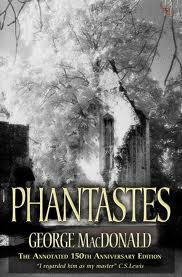
The 19th century Scottish theologian George MacDonald originally planned to be a respectable minister, earning theological degrees and finding a deep faith that was to underlie most of his works. Unfortunately for this first career choice, by all accounts he was terrible at it, to the point where annoyed parishioners cut his salary. But if this failure was a (possible) loss (or gain) for the Congregational Church of Scotland, and a heavy personal loss for MacDonald, it turned out to be a decided gain for fantasy literature. For with a family of eleven children, MacDonald needed money, and if he had failed as a minister, he could, he hoped, turn his love of fairy tales, writing and Scottish culture into profitable stories.
This did not work out well either; MacDonald’s works failed to hit the bestseller lists, and he was forced to turn to literary patrons and lecture tours for further financial assistance. But if his writing was a financial disappointment,his explorations of fairylands helped establish the genre of English children’s literature of the fantastic.
His influence, however, tends to be forgotten or underrated, largely because MacDonald, who can be occasionally annoyingly Victorian, is not always the easiest writer for contemporary readers to approach. His books could be—in fact, frequently were—meandering, sometimes delightfully, sometimes annoyingly. He was more fond of morals than the Duchess in Alice in Wonderland (a book, incidentally, that he enthusiastically encouraged the publication of), dropping morals into all of his fantasy books, sometimes into seemingly every page. Many of his characters, particularly his children, are either stereotypes or unrealistic or both. But for all of this, he could also create scenes of stark beauty and delightful detail. His works proved that the fairy tale in English did not need to be merely a didactic children’s tale, but could contain philosophical and literary depth.
And, by showing how Christian theology could be subtly, almost invisibly, woven into the fairy tale and creative mythology, his works caught the imagination of writers as disparate as J.R.R. Tolkien, W.S. Auden, Madeline L’Engle and (reputedly) J.K. Rowling.
(And, as it turns out, he was the grandfather of the guy who wrote Forbidden Planet. So now you know. Influential everywhere.)
One word of warning before we continue: I will not be covering all of MacDonald’s works, which include several romantic and realistic novels set in Scotland that were apparently very influential in Scottish literature and which I just couldn’t get through. I will only be sampling some of his fantasy works. Also, although this is mainly meant to be a reread of his children’s books, I’m starting off with a discussion of one of his adult books, Phantastes—largely because if I start with the first of his children’s fantasies, At the Back of the North Wind (coming up soon) none of us will get through this reread.
So with that out of the way: Phantastes!
Phantastes seems to open as a typically ponderous Victorian novel. You probably know the type. And then, two paragraphs in, a fairy shows up. Which just goes to suggest that the first paragraph can create a slightly misleading impression. Slightly. The fairy promises the narrator, holder of the unlikely name of Anodos, that Fairyland does exist, and he will be lucky enough to travel there, and soon. And indeed, by the very next day, he finds his room transformed into the borders of Fairyland.
Or, as others might suggest, allegory.
Shortly thereafter, after ignoring the well meant advice of various women (including an ogre) he is tricked by beauty, and meets his shadow—in this world, a near demon. By now, he realizes, he cannot easily return home, so, followed by the demon—and distracted by more women—he makes his way to the Citadel which has been magically prepared for him, where, in proper fairy tale fashion, he finds himself served by invisible hands eager to fulfill his every desire. And, in somewhat less proper fairy tale fashion, he sings a white lady to life before falling into the underworld of fairyland and its dangers, trapped in a tower with his shadow, and finally dying—the only way he can return to the mortal realm.
Oh, and encountering some terrible poems along the way.
I’ve left out most of the (many) digressions, which give this work the feel of fairy tale piled on fairy tale piled on fairy tale, all adding to the struggle—and it is a struggle—of the narrator to move through the realm of faerie. Fairyland, for MacDonald, is a world of transformation and deception, dream and nightmare, song and silence. His fairies dance between archetypes, characters stolen from Grimm’s fairy tales or Arthurian knights, and creatures of nature, living in flowers and infusing trees with the ability of independent thought and movement, or creatures of fancy.
(Incidentally, I don’t know, but I wonder how much of Tolkien’s Ents may have come from MacDonald’s trees—not quite Faerie, but somehow infused with magic and independent thought and movement, some dangerous, some benign, some protective. Tolkien himself, of course, claimed to have been inspired by—or deeply annoyed by—his great disappointment in the ending of Shakespeare’s Macbeth, but he was familiar with at least some of MacDonald’s work. And MacDonald, too, may have been filled with Macbeth disappointment, although I can’t be sure about that.)
But Fairyland is also, for MacDonald, a metaphor for the journey of the soul, and its search for beauty and truth. Anodos has little personality—some might say no personality—aside from the occasional tendency to justify deserting women because, after all, he’s given them a wonderful memory of him. Oh, and his tendency to open doors even when advised not to, but, that is standard for fairy tales. Oh, and his ongoing tendency to want to kiss the beautiful women he encounters even when he’s already learned that many of them are evil. One mistake I can see, Anodos, but this ongoing search for beautiful women who want to kill and maim you is just not healthy. (And for someone apparently familiar with fairy tales he’s learned absolutely zilch from them.) Oh, and his tendency to fall for women who very clearly have other romantic attachments, although to be fair that part is undoubtedly drawn from the courtly love tradition.
Aside: some of the gender stuff here is rather, well, odd, even for a Victorian novel. Anodos keeps running into—and lusting after—beautiful woman after beautiful woman, most of whom end up being evil or severely unavailable, but his real admiration and love is reserved for the men he meets: the two brothers ready to fight giants, the knight romantically attached to the marble lady Anodos lusts after, and so on. The beautiful lady who turns out to be evil is another standard Victorian trope, but falling for a man—as Anodos does, if chastely, towards the end of the book—is slightly more unusual for the period. And for all of Anodos’ pursuit of beautiful women, the fairy tale does not end with even the hope of his marriage. As far as I know, MacDonald’s own marriage was happy—he and his wife had 11 living children, and she accompanied him on lecture tours—but Phantastes was written after they had been married for some time, and a certain ambivalence towards women appears strong in this book.
But most of this book is not about Anodos’ character growth, or his dealings with women, or even about Anodos at all. He is, all too clearly, a stand in for the soul’s journey through faith and dreams, troubled by doubt, unsure of what to see and to believe. Anodos’ shadow demon, as we learn, is actually Doubt; as he falls under its influence, Anodos finds it harder to see aspects of fairyland – or beauty. The suggestion here is that without faith in God, no one can find or see goodness or beauty, but the Christian part of this is not overly explicit, and the book can be read without any overlay of faith at all. But to see wonder, to see beauty, and to not have it vanish takes, MacDonald claims, the ability to banish—or at least control—all doubt. That done, the traveler can move through Fairyland and see and understand its beauties and dangers.
(And learn the important truth that cats can’t be trained by fairies, either. So now you know that too.)
Phantastes gives a hint of what would be MacDonald’s later strengths and weaknesses as a writer: his brilliant imagination, his often poetic writing, his gift for magical description, coupled by unfortunate sentimentality, a gift for forgetting his plot and getting way, way off the point (in this case, illustrated by a digression to chat about an alternative universe immediately followed by the interjection of a long short story right in the middle of the narrative, just as Anodos is supposedly exploring a strange and mysterious magical castle. Mind you, in this book, that short story is one of the highlights. Here and in later books, these digressions can help illustrate his themes, but I couldn’t help wishing more than once that he would illustrate his theme with something that would either advance the plot or illustrate his characters.
I hardly know whether to recommend this book. It can be exquisitely beautiful, and painfully slow, and occasionally dull, and overly moralizing. But I can say that from time to time I was caught by MacDonald’s enchantment, by his underlying concept that we can build a land of Faerie in our minds, and travel there. And I loved the fairy library. I do think, if you read it, this is a book best taken in short gulps, chapter by chapter, allowing the enchantment to linger, but not overstay its welcome.
(Oh, and most of you will want to skip the poetry. It’s okay, I promise.)
Fair warning: the free version of this book available at Gutenberg in HTML format contains numerous formatting errors and can be difficult to read. Try a library copy.
Mari Ness promises that if she ever meets beautiful women in fairy land, she will be careful. Especially if they look like trees.

I read MacDonald’s Lilith right before I read Jonathan Strange a five years ago and in my brain they will be forever cousins in spirit at least. Lilith was an excellent read and ahead of its time as far as the subject matter goes. I should give Phantastes a shot.
It was interesting to read your review and discover just how little I remember of the book…
I have a place on the top of my bookshelf for George Macdonald’s stories. Even his non fantasy stories are whimsical and the magic is through their God. I am going to admit I am a sucker for wistful sentiment and philosophical moral ideas. I ecspecially adore old world fae, the exquisite and gruesome. The taste of his “settings” and “themes” and their inhabitants have forever taken hold in my imagination. Begining when I earned a free book from the library of The Princess and the Goblin when I was 10 or 11. Thanks Mari Ness, for bringing him up for us!
I recently reread Phantastes and I would have to agree that some chapters and scenes are beautiful and delightful and altogether wonderful. But the majority of the book was a bit of a slog.
But CS Lewis called Phantastes the book that baptized his imagination, and for that, I think, we can all be thankful for MacDonald’s books.
I have to wonder, could C. S. Lewis also be influenced by Macdonald? I ask because you wrote that he was able to use Christian morals and mythology in his story, and anyone who has read The Lion, The Witch and the Wardrobe, or even heard about it, can easily argue how Christian beliefs can be found heavily entrenched in his story. When you were describing Macdonald’s work, my mind immedietely jumped to Lewis, yet you do not mention him in the list of those influenced by Macdonald’s work.
Oh, yes, Lewis said MacDonald was “his master” and said he fancied he had never written a book in which he did not quote from him (not sure that’s entirely true, but he certainly did make frequent reference to GM). But even he couldn’t stick the poetry in _Phantastes_. (I think Lin Carter’s edition, which is the one I would have read, left the poems out, or nearly all of them.)
@cranscrape – I’m planning on doing Lilith later in this series, if The Back of the North Wind doesn’t kill me first.
@aedifica – Interesting. Yeah, I got the impression that Phantastes is like one of those dreams that you remember for its strangeness and vividness for awhile, but then ends up swiftly fading. We’ll see how well I can remember it after a year or so.
@cemry – I think The Princess and the Goblin is a much better work, but of course by that point MacDonald was a much more experienced novelist and had apparently started to finally listen to people yelling at him, STAY ON TARGET, PLEASE, especially in books specifically aimed at children. But we’ll get there.
@ashaef – Quite a bit of MacDonald, alas, is like that — beautiful, beautiful stuff mingled with less beautiful stuff that makes his writing a bit of a slog, which is why, I think, he’s less read now. But the beautiful stuff helped inspire a lot of other great works of fantasy literature, so I’m with you in being grateful.
With that said, I think MacDonald wrote some individual works that have stood the test of the time and still read very well indeed.
@erick G – Yes, I absolutely should have mentioned and included C.S. Lewis in that list, who was fonder of MacDonald than I am and cited him as an enormous influence.
@HelenS — The poetry is downright awful, and I say this as one who LOVES Victorian poetry and rhyming poetry and poetry with cute sentimental fairies. But not MacDonald’s. It doesn’t even scan well, which is odd for Victorian poetry, and the rhymes can be kindly described as banal. I completely agree with Lin Carter’s decision to remove them.
But I have to assume that SOMEONE in MacDonald’s era liked the stuff, since he kept writing these ongoing terrible poems and putting them in his books…
I got my copy of Phantastes in the “A Treasury of Fantasy” anthology, which includes Eirikr Magnusson and William Morris’ translation of “The Story of Sigurd” from the Volsung Saga and thus amply repays the twenty or so dollars I spent on it way back in 1983 or so …
And yes, it includes the poetry. I think I survived it by blanking it out, not by chewing my leg off … because to this day I cannot remember what they were about.
The short story of Cosmo included, on the other hand – I took that like Ivan Karamazov’s short story The Inquisitor in The Brothers Karamazov – not strictly necessary, but it adds an insight into the mind of the character. In Anodos’ case, his “necessity” for self-sacrifice, though he fails to understand that when he reads the story – “Are you free, lady? The mirror is broken:are you free?”
Very Victorian – in many ways, a Victorian rewrite of Pilgrim’s Progesss …
Thanks for this, Mari. As a George MacDonald scholar, I’m delighted to see people reading and discussing his works. And I think you bring up some very interesting points. I tried to think up a reply but it just went on long beyond comment length; do you have an email address I can use? I’d be keen to chat about this further.
@Aladdin_Sane – I think the short story does add to the dreamlike, fairy, other world of the piece, but it does not bode well for MacDonald’s plotting structure with longer works, and I say this after reading the next couple of books where I am honestly wondering if he added in more pages to get his publishers to pay more. (He wouldn’t have been paid per word, but maybe he thought a hefty book would be, I don’t know, more momentous or something. I almost wrote “weighty” there but figured that would be a terrible pun.
I never could get through Pilgrim’s Progress, so I will have to take your word for that.
@mrpond47 – Sure, but I should warn you that I can be VERY slow to reply by email, and I’m certainly not a MacDonald scholar of any sort. The email is mari_ness at hotmail dot com.
Okay, Phantasies, Lilith, Back of the North Wind, Princess and the Goblin- any others?
Thanks for that intro to the Bastables, by the way! It’s true that Lewis mentioned them first, but until you pointed it out, I had never bothered wondering just who they were.
Eek!- my interlibrary loan lists a two-volume collection of macDonald’s poetry. The horror!
The novella The Light Princess, along with a few comments about Adela Cathcart, The Day Boy and the Night Girl, and possibly The Princess and Curdie.
I am not reading a two volume collection of MacDonald’s poetry. I need to keep a working brain.
Depending upon where we are in the calendar at that point, I may need to move directly onto L’Engle, but I will definitely be covering Edith Nesbit this year as well.
To get a fuller picture of MacDonald, you should read the biography of him written by his son, called “George MacDonald and His Wife.” His sermons are very interesting, too: he left the church not because he was not good at it, but because he was a heretic, who thought that everyone would eventually get out of hell after they had been transformed. He thought that God was so good that even hell had a purpose. And amazingly, my favorite work by him is a slight volume of devotional–yes–poems, called “Diary of an Old Soul.” MY second favorite is “The Golden Key,” with that marvelous image of the Oldest Man as a child playing (a shout out to Heraclitus).
Thanks, MariCats. I’ll be in touch.
Pam @@@@@ 11 — believe it or not, I’ve got that two volume set out from the library right now. MacDonald’s not Tennyson, of course, but he’s not Swinebourne either. Though if you don’t like relgious poetry, ala Herbert and Donne, you probably won’t like these two volumes. The poems in Phantastes are all pretty early works; he got better and more skilled in his later verse, The Diary of an Old Soul being case in point. But even Within and Without (1855), which predates Phantastes by several years, tends to have higher quality verse and fewer experimental forms.
At least two other sites have e-texts of Phantastes:
http://etext.lib.virginia.edu/toc/modeng/public/MacPhan.html
http://openlibrary.org/works/OL15450W/
though I haven’t yet checked either for readability or accuracy.
As always, we ask you to keep the discussion here civil and constructive in tone–making rude, personally-directed comments about the author of the article or other commenters because you disagree with their opinions is neither helpful or in keeping with our community guidelines.
Had to read it twice and relieved everyone else found the poems mediocre. But reckon it is an important foundation piece of English fantasy literature and as such has hard nuggets of pure brilliance. I read it chapter by chapter and mulled over each one. The links to Tolkien and Lewis appear direct to me. I only read him since I live in his birthplace Huntly and thought it a matter of understanding local history. Quelled bonne surprise.
Re attitudes to women: There is also the archetype of the Wise Old Woman who loves & protects Anodos even when he goes through the dangerous door. The beech tree is good & beautiful but regards A as a baby. The Ash tree is an ogre & in league with the Alder who appears like a beautiful woman & apparently seduces A. though it is amazing she manages to hide her back till dawn.