






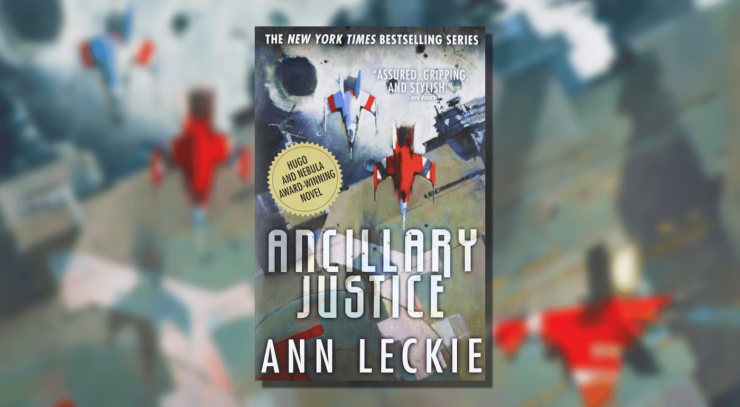
Ten years ago, Ann Leckie’s Ancillary Justice swept up an armload of awards and sped up the bestseller lists, buoyed by rave reviews. With her first book, Leckie recombined the DNA of a space opera into a surprising work that captured all of the gee-whiz of empires in space while at the same time interrogating what such empires were good for. Iain M. Banks, Ursula Le Guin, and C.J. Cherryh are all clear influences on the novel, as is any book about the rise and fall of the Roman Empire. The result, however, is uniquely Leckie and well worth revisiting a decade on.
Leckie hangs all of her big ideas on a propulsive story of revenge. Breq, the last remaining ancillary of the massive starship Justice of Toren, has one goal: to kill Anaander Mianaai, the ruler of the Radchaai Empire (often just referred to as the Radch). As we learn through two interwoven timelines, which span a thousand years, Mianaai is the cause of Breq’s current state and is responsible for the death of Breq’s favorite Lieutenant. Breq is sort of like John Wick with his dog, if Wick were the last remaining fragment of a spaceship’s A.I., now confined to a human body.
Leckie opens with Breq on Nilt, an unforgiving, isolated planet annexed by the Radch. Breq literally trips over Seivarden, an officer who was on the Justice of Toren centuries ago. Seivarden is nearly dead from an overdose, but rather than abandon him, Breq chooses to rescue him, even though Breq never really liked him.
In that early scene, Leckie efficiently sets up one of the key features of this world: the Radchaai language doesn’t gender people. Breq defaults to she/her pronouns for everyone unless she is speaking the language of the colonized. We only know Seivarden is a “he” because a bartender on Nilt refers to him that way. Frequently, Leckie shows Breq struggling with finding the right pronouns for the languages that require them.
In the genre today, a number of writers have engaged with gender and gendered pronouns in thoughtful and thought-provoking ways in their work. Leckie does so herself with Translation State, her new book set in the Radch world. But she’s doing something decidedly different in Ancillary Justice. Rather than pin down how a character identifies, she’s removed gender as a factor altogether. In Radch space, gender is irrelevant. All humans are “she.” As a reader, the default feminine is noticeable until it very much isn’t. It doesn’t matter to Breq, whose head we are in most of the time. In short order, it stops mattering to us, except if we stop to think about how irrelevant gender can be in many science fiction stories (though of course, it’s absolutely central to others).
What’s crucial above all else in Leckie’s story is how she explores power and the responsibility it confers on those who have it. “Power requires neither permission nor forgiveness,” Breq states, echoing Mianaai. But that’s not how Breq behaves. We see it in the early scene of Breq saving Seivarden. Breq isn’t certain why she chooses to do so—and Seivarden is a massive pain in the arse to Breq most of the time—but Leckie slowly reveals a more complex understanding of power than might always making right. It’s an aspect of the Imperial Radch series that didn’t get as much attention or spark as much discussion as the books’ approach to gender/pronouns at the time they were first published.
To spoil the plot of an almost ten-year-old trilogy, Breq as Justice of Toren does as commanded by Mianaai. Breq has no choice because the ability to decide isn’t programmed into the ship’s A.I. When Mianaai, whose sense of self has begun splintering after a millennia, orders Breq to shoot Breq’s beloved favorite Lieutenant, Breq does it. That wielding of power like a blunt weapon is ultimately what leads to Mianaai’s undoing. Breq brings Mianaai down with soft power rather than brute force. Even with the A.I.s who have been freed (by Breq’s crew) from their mandate to act only as they’re told, Breq has to use her words to convince them to support her fight, despite knowing that these powerful ships may make a different choice. The path she’s chosen isn’t the easy one.
While Breq’s larger campaign to change the Radch is what drives the plot, it’s not where the deeper nuance lies. Instead, a subtle exploration of power reveals itself in how Breq interacts with the colonized and with those that the colonized have subjugated in return. On the tea plantations in the Athoek system, for example, where the plantation owners treat their workers like serfs. Breq uses her power, without asking for permission nor forgiveness, to upset this oppressive class structure. While the results aren’t always satisfying for our protagonist, these interactions reinforce Breq’s understanding that power also comes with responsibility… which is something that Mianaai has forgotten, if she ever knew it in the first place.
Breq’s approach to building coalitions, rather than pursuing wholesale destruction, is what triggers the fault lines already built into the Radch civilization. For complicated reasons I won’t go into here the empire can no longer expand, nor can it make new ancillaries. Once those pressures start exerting themselves, those with the greatest power demonstrate all of the various ways it can be wielded, from Mianaai’s impulse to kill the non-compliant to Breq’s enlightened team building. Examining power structures is something that science fiction has long done and will continue to do far into the future, or course, but Leckie’s particular way of doing it is worth revisiting now, if only to remember how subversive parts of it seemed at the time, and how subversive other parts of it have become in the intervening years.
Adrienne Martini is a writer, an elected official, and a historic interpreter. Her most recent book is Somebody’s Gotta Do It: Why Cursing at the News Won’t Save the Nation but Your Name on a Local Ballot Can. She writes about genre books for Locus magazine.

I found myself annoyed at the lack of genders whenever people would pair up in the novel. What it took me a long time to realize is that, in the world of the Radch, power imbalance in the relationship came not from gender (as it does in our world) but only from station (the level of each person’s family or patron).
I pulled this book off my shelf this weekend, having gotten it for Christmas a few years ago but never read it and said, “What is this? It looks like it might be good.”
Maybe when I finally finish The Wheel of Time I’ll give this one a look.
There are real-world languages that don’t do that: Hungarian, for example. But Hungarians are as capable as anyone else at judging the sex of someone they have just come across: They just don’t have to mention that sex when speaking about that person.
IIRC, the Radch, on the other hand, seem genuinely to have lost the ability to tell what sex someone is, perhaps even when they are stark naked.
I have a more personal view of the book and Breq. I was disappointed in myself for how long it took me to not be bothered by Not Knowing who was male and who was female. The default to “she” was also rather uncomfortable for a time. It was like a mental switch in my head had to keep being reset every time I felt that a character was male.
As for Breq, we never find out if “they” were male or female but I always thought they were male since they were selected as a soldier. It just seems the Radch would select the larger more powerful bodies. They didn’t need the minds, just brute strength cannon fodder. Aside from my internal default gender bias I was also horrified at the fate of these poor souls. If we had that technology today, I believe it would be used, legal or not.
Honestly, I always thought Breq was female because I thought the Toren was female AI. I had this mental picture of a physically powerful female form for Breq, something along the lines of Luisa from “Encanto”.
“IIRC, the Radch, on the other hand, seem genuinely to have lost the ability to tell what sex someone is, perhaps even when they are stark naked.” I don’t think it is that they have lost the ability, it’s that humanity in this universe is so diverse and modified that our conception of biological sex doesn’t necessarily apply, and indeed different worlds have different gender standards.We know that among the Radch the default way to have a kid is to use an artificial womb for instance.
The planet that the spin off novel Provenance takes place on, Hwae, for instance seems to consider children to be genderless, and allows them to choose a gender between man, woman, and neman. As Leckie purposefully keeps her physical descriptions vague, we don’t know exactly how the people of this world distinguish gender when it comes to appearance and dress.
This is why I think the reviewer misses the point a bit, saying “We only know Seivarden is a “he” because a bartender on Nilt refers to him that way.” This is simply wrong. Seivarden certainly wouldn’t consider herself to be a man, or a woman for that matter. What this shows is that on Nilt Seivarden looks like someone would be gendered male. Does that mean that she has a beard? That she’s tall? That she has a penis? That she had short hair? We don’t know Nilt’s gender norms at all, so we don’t know, and we can’t assume as readers that if Seivarden went to Hwae would the people there think she is a man, woman or neman. Trying to figure out the “true” gender of Radchai characters is missing the point that they are lacking our social concept of gender or a biological duality and shows us that those ideas aren’t universal in time or space.
“…as is any book about the rise and fall of the Roman Empire.”
Probably, but I think the British Empire is more directly relevant. Why do you think she called it the Raadch?
For example, the Roman Empire didn’t regularly kidnap people and force them to become warship crew (Ben Hur notwithstanding); the British did.
It’s not a major issue, but I find it interesting that you’re calling out a “clear” influence that Leckie herself has denied (annleckie[.]com/2018/08/27/on-liking-stuff-or-not/):
I thought some of Breq’s difficulties identifying biological gender weren’t due to her being culturally Radch, but being mentally…a spaceship.
I’m interested to see this article say the series’ focus on power relations and class were lost in commentary on its gender ideas. While I enjoyed the way gender is handled in the text, and the way the default ‘she’ pronouns modified some of the assumptions baked into me by decades of other sci fi films and literature for me…the series is clearly *about* power. It’s about why empires are bad, it’s about colonisation and the colonised. It’s about the Raj and its tea plantations!
It does some interesting things with gender along the way that let a bit of light and air into a genre that can be boringly route one masculine a lot of the time, but I think the crux of it is the exploration of the idea that the solution to the evil space emperor isn’t a good space emperor.
Re the evils of imperialism. A core example of this is Breq herself – an AI who has colonised a human body.
I can’t believe it’s been ten years since Ancillary Justice was released, even though I’ve had time to re-read the whole series several times now. Personally I didn’t feel thrown by the pronouns in the books, I just sort of imagined everyone as female (but not necessarily femme), which probably wasn’t the intent, but it made it not-jarring in a way that it seems to have been for many people.
@@.-@
Breq is referred to as a particular gender (by another character) in the first page or so of Ancillary Justice, but as it occurs just before the explanation that Radch don’t use gendered pronouns, I think a lot of people miss it.
Really enjoyed the article, but Nilt was not a Radch-annexed planet.
As far as physical gender of the characters goes, my head imagined the novels as populated entirely by a cast of Honor Harringtons.
Thank you @cyrano! It’s ironic that people get wrapped up in the pronouns, when the most radical thing is that the protag isn’t human!
There’s a lot of fallacious assumptions built into that statement, many of which are explicitly contradicted in the text. We see the selection process for ancillaries, and size isn’t a consideration. Ancillaries have physical augmentations that increase their physical capabilities to a point that the those of the original body are largely irrelevant. Ancillaries have force fields and guns and spaceships, they aren’t wrestling people into submission on the regular and when they are it’s generally in perfectly coordinated groups. So no, there’s absolutely no reason to think that a majority of ancillaries are made from people who our society would assign male at birth.
@14
Protagonists who aren’t human are nearly as old as sci-fi. Societies without any concept of gender are much rarer.
Absolutely agree with @phuzz – Breq is called a “tough little girl” very early on and as it’s on Nilt, which does use gender, think it’s a fair assumption Breq presents as a human female. It feels like “she” is often underestimated – because presumably “she” has the body of a smaller size woman? The key thing though is that whatever the pronoun, Breq is not human! I hugely agree with @cyrano here – and btw isn’t it Breq who asserts that gender isn’t important to the Radchaai? Are we ever told that objectively? (Just to throw the proverbial cat among the pigeons, sorry!). Actually I do think Leckie is invested in the gender discussion but really her bigger theme, amplified in the next two books and the other Leckie books including Translation State, is that there are alternatives to being human and seeing through these non-human eyes should help us humans see differently…. For anyone about to read Translation State, more Presger Translator joy coming your way (I love them).
Leckie has said that she started out with gendered characters, then decided to just eliminate them. When asked if she knew their gender, she said no. They just were people. It is fascinating how many of us, myself included, kept trying to impose genders while we read the books. It would be fascinating to talk to someone from a culture that does not use genders in its language about their experience.
I almost didn’t read those books, because everyone was excited about the gender presentation. If I hadn’t, I’d have missed some very fun SF about the nature of distributed intelligences and quite a few other things.
Ah, young people don’t know their history. Scalzi and Kowal are both excellent writers, but nowhere near originating this game.
As far as I know, the stfnal granddaddy of pronouns-that-don’t-tell-you-someone’s-biological-sex, and a clear predecessor to the version in the Raadch books, is Samuel R. Delany’s orphaned first half of a duology, Stars in My Pockets Like Grains of Sand. In which the main narrator (after a longish prologue) speaks a language (or dialect or something) in which everyone is referred to as “she/her,” except for persons in which the speaker has sexual interest, in which case they become “he/him.”
Earlier than that, in the late ’70s, — I think it was in the first of the Chrysalis anthos edited by Roy Torgerson — someone (Quinn Yarbro?) wrote a lovely little story about a spaceship crew, where, though the male and female pronouns were occasionally used, it was always done in a way such that you couldn’t be sure which character was being referred to; so you had no idea of the sex/gender of any of the individuals in the story.
Adrienne, do you purposefully misgender real trans people, or only fictional characters whose understanding of gender is different from yours? Seivarden, regardless of what genitalia she has, identifies and is called “she” by every character in the book. By calling her “he” you’re claiming that the people on Nilt who don’t know her name, don’t care if she lives or dies (and try to kill her later) know her better than she or any of her friends and colleagues do. Simply on the basis of her genitals.
@15,
Breq is an unreliable narrator only when it comes to herself (there are numerous times when her internal narration is completely dispassionate and we only find out she’s crying or obviously distressed because someone else comments on it.). However, her narrations of Radchaai thought and perspective are always spot on, no doubt due to her millennia of time spent watching them and being ordered around by them. As regards gender, we never have even a hint of it being a category the Radchaai use or consider important; and when she arrives at the station in the beginning of the second book and they’re in the middle of the genitalia festival, she’s not the only one bemused by the fact that the locals only have models of one sort of genitalia … and when she asks about it the local Radchaai authorities shrug and say it’s part of the locals’ primitive society, basically. So differentiating between types of genitalia is associated with un-Radchaai ‘primitive’ society.
@CaptainCrowbar wrote, “Probably, but I think the British Empire is more directly relevant. Why do you think she called it the Raadch?”
I don’t know of any phonetic connection between “Raadch” and “England” or “Britain”? If anything, I’d associate it with “Reich”.
Lots of SF has non-gendered alien societies, e. g. Simak’s All Flesh is Grass. Other nonhuman societies have totally different sex/gendering than us mammals, e. g. Asimov’s The Gods Themselves.
@carl, i can’t speak to whether this is actually why it is called the Radch, but the British Empire in South Asia was called the Raj, which is the word for king in several South Asian languages. names in the Imperial Radch trilogy are often randomly generated (from Ann’s answer here: https://www.goodreads.com/author/3365457.Ann_Leckie/questions) but i don’t know whether Radch was one of these.
@carl When I pronounce it, sounds a lot more like Raj, and thus referring to Bitish colonisation of India. That’s the association I also had in mind.
@20: The British Empire’s direct rule of India was popularly referred to (then and even to an extent now) as ‘The British Raj’. That and the obsession with tea makes it look like a clear and intentional allusion to me.
@19: as it’s a fictional society rather than an account of a real one, I think we can engage with it in different ways. For example, over the last ten years my perspective has grown (I think for the better) and I think one possible reading of this fictional society which has a deeply ingrained, top down insistence that only gender exists, is as a sort of two-d metaphor for the three-d trans experience of real life – a little like people have received Pratchett’s depiction of feminity among Dwarves.
Regardless, I don’t think any mis-gendering is happening here, in this discussion of fictional societies in part written to explore and encourage thinking about different presentations in different cultures.
It’s been awhile since I these books even though they are definitely favorites of mine in this millennium. The way I understood the gender problem is that Breq is Justice of Toren and at base, JoT is an AI, ie. Genderless. As I said, this is my post hoc interpretation. I didn’t return to the text to see if my theory holds up. When I do return to the text I’m unlikely to read it that closely.
That’s interesting, I would have phrased it the opposite way: it is unnoticeable until it very much isn’t (i.e. you reach a sentence like “she was probably male”). Up until then you’re just meeting a succession of characters referred to as “she”, which may be a bit improbable but hardly mindblowing.
Like some commenters above, I think that Breq’s difficulty perceiving human genders owes a lot to Breq not being human, and a human Radchaai would probably “effortlessly” perceive things that she didn’t feel a need to reinforce every time she used a pronoun. (Isn’t there a scene where Breq, speaking a non-Radchaai language, misgenders a human and all the humans react, revealing that they wouldn’t have done the same or expected each other to?)
If someone is “consistently referred to as ‘she'” in a language that only has one pronoun, I don’t think it says anything about her gender identity or lack thereof. We don’t know how Seivarden, or any other Radchaai human, would self-describe in some primitive language with gender markers, such as English. It just wasn’t important, there’s a lot else going on in the series.
It’s kind of a radical instance of the idea that what a society cares about will be reflected in the language they collectively create: in this case, what their society DOESN’T care about (except possibly on a personal micro-level) is reflected in their language, compared to most languages the reader is likely to be familiar with. (Although given comment #3, I wonder if the Radch series has been translated into Hungarian, and if so, how the translator dealt with the issue?)
P.S. I’m also curious how readers’ impressions of characters like Awn, the plantation owners, or Tisarwat are influenced by the pronoun convention even *after* they’re theoretically aware of how much it does and doesn’t mean in the context of their society.