







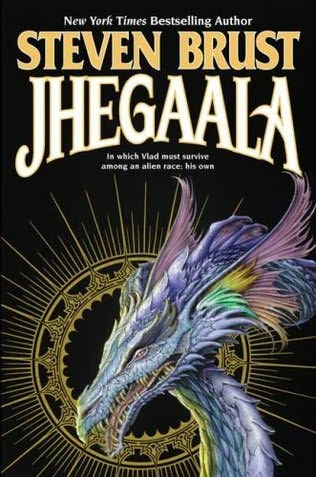
Jhegaala is another one that I hated the first time I read it. As it only came out last year, I’d only read it once before this, so I haven’t yet had time to get to like it. As I also hated Teckla and Athyra on first reading, I’m reasonably confident that I will. All the same, I picked it up with a certain amount of reluctance, and I didn’t enjoy it all that much.
Jhegaala is definitely not where you want to start this series. It’s out of the main continuity, set between Phoenix and Athyra. When I finished Phoenix I wanted to read it, because I never have read it there, where it belongs in internal chronology, and I swear next time I’m going to read them that way and see Vlad developing and having my events in order rather than doing all this complicated juggling. After Phoenix, Jhegaala might have more appeal. After Dzur it feels like stepping back. Vlad’s less mature here, still smarting from Teckla and Phoenix, and we have to watch him go through the process of becoming more mature. I know it can’t all be meetings with old friends and dinner at Valabars, and I would get bored if it was, you need shade as well as light, but even so, even appreciating that they can’t be all “Vlad has a nice day,” this book is a real downer.
Spoilers.
Jhegaala is an expansion of a couple of lines in two of the other books. Emotionally, it’s an expansion of the bit in Taltos where Vlad mentions that the Easterner kids beat him up for being too Dragaeran and it didn’t hurt as much as when the Dragaerans beat him up for being an Easterner, except that it hurt more inside. Jhegaala is Vlad discovering for real that Easterners are just as bad—good, bad, and mixed—as Dragaerans, it isn’t that the ones he knows in South Adrilankha are immigrants damaged by the immigrant experience, they’re like that in Fenario, too. And then, literally, it’s an expansion of the bit in Orca when Loiosh suggests they go East and that it needn’t be as bad as it was last time. This is the story of how bad it was, and it really was awful. It’s also probably the true story of how Vlad lost his finger, though it’s carefully not quite specific there.
Jhegaala seem to be some kind of insectoid thing which metamorphoses a lot. I don’t remember anybody from House Jhegaala in any of the other books, and the only one we see here is in the chapter start-quotes from the rather odd mannerist murder comedy play Six Parts Water. There we are told that you need to find out what phase they are in. I suppose Vlad does metamorphose in this book and he also does a lot of waiting around and eating, and a lot of time when he might as well be in a coccoon, like the animal jhegaala in some phases, and he’s certainly moody, so it does fit. Vlad comments that Jhegaala grow into and out of things in different phases, and this is certainly the book where he does some of that.
Good things: Vlad in the East, without any magic, without an organization or any friends. No, hang on, this was supposed to be good things. A little bit of Noish-Pa. Some interesting information about Vlad’s mother, which I’d have liked if it didn’t go where it did. Some lovely Vlad and Loiosh banter “There’s nothing worse than a smartass who pretends not to understand hyperbole.” The East, its reality, economics, and sky.
What is with the Overcast anyway? It’s not something the Orb is doing—it was there during the Interregnum. Loiosh and Rocza hold their breath when they fly through it (Athyra, Rocza POV) but when they climb through it on the way up Dzur Mountain in Paths of the Dead it just gives a reddish cast to everything and they breathe normally. In Phoenix, Zerika talks about disasters the Orb prevents that weren’t prevented during the Interregnum, and it struck me that they are natural disasters—mountains spewing fire and lava, people being blown away by strong winds, the ground shaking and cracking open. I assumed then if it was preventing volcanoes and hurricanes and earthquakes it was causing the overcast, but no. Also, what is it for? It hides the sun and the stars (no moon!) but while Vlad’s blinking in the sunlight, Morrolan missed it when he went to the Empire after being raised in the East, so it can’t harm Dragaerans, which was my first thought.
So, why I don’t like it. Too much torture, too much angst, too much helplessness, and a very complicated plot that relies on everyone being idiotic—very much the way that people are idiotic, but even so. I also can’t help feeling that it doesn’t entirely make sense—the whole thing with Vlad mentioning the Merss family being taken as a threat and then the way they’re all killed doesn’t entirely fit with the explanations at the end. I don’t say “Ah-ha!” I say “Huh?” Which no doubt means I’m missing something, but I missed it this time, too.
On the subject of missing something, the book has two layers of extra-narrative quotation. One layer, about the natural history of the jhegaala, fits perfectly and makes sense—it illuminates the stages the animal goes through and these have some metaphorical relationship to what Vlad’s going through, no problem. The other, the quotations from the play, baffle me. They’re mostly funny little bits of dialogue, but there’s not enough there to deduce the whole play from the fragments, it seems to concern a Jhegaala but we don’t know who, and they serve generally to cast shadows instead of illumination. As this is a book about shadows, I suppose that makes sense.
On to Iorich, which I have not yet read, and which isn’t even published until January.
Jo Walton is a science fiction and fantasy writer. She’s published eight novels, most recently Half a Crown and Lifelode, and two poetry collections. She reads a lot, and blogs about it here regularly. She comes from Wales but lives in Montreal where the food and books are more varied.

I rather liked Jheggala, especially because it shows Vlad without his usual resources — and how his most important weapon really is his brain. (While his worst liability is his luck — seriously, this guy can’t catch a break with a net!) And while I might be a little confused about the chronology, I’m pretty sure this book is set after Issola — he’s got Godslayer, though he only uses it to demonstrate the Morganti “aura”.
Also, I’d always assumed the Overcast was simply a natural phenomenon. Except for a few superstitious peasants (probably encouraged by Sethra ;-) ), nobody (including sorcerers, witches, gods, etc) seems to consider it important or significant, and I’m content enough to accept that.
I adored this one, both for the main story, and because I’m a huge Hammett fan. Six Parts Water is a delightful Thin Man pastiche, and the main plot reads like a Dragaeran version of Red Harvest (then again, so does Vlad’s entire career, at times). Imagining him as The Continental Op makes me smile (even though there’s little physical resemblance).
I’m relieved that you opened this review as you did–I thought it was just me. I loved Issola and eagerly looked forward to Dzur, thought Dzur was OK and read Jhegaala when it came out, didn’t enjoy Jhegaala at all but will still read Iorich. (And actually, your posts on the series have reignited my excitement about Iorich.) But I will re-read Dzur and Jhegaala when I’m re-reading the series, and I hope they’ll grow on me.
I thought the playlets were intended to give a “Waiting for Godot” sort of feel, as all of Vlad’s relatives (the ostensible cause of the action) remain offstage through the entire book?
Actually, I think I want to retract that comment about his luck — in Jheggala, he actually seems to be making good use of his “aura of disaster”.
Yeah, my principal reaction on finishing it was that I needed to read it in its chronological place. For one thing, I’d never imagined that this time period was *that* dark for Vlad.
I’m so glad it wasn’t just me! I really disliked Jhegaala upon first reading, but every other review of Jhegaala I’ve read has been very positive, and I was beginning to wonder just what, exactly, I was missing. It’s good to hear that I’m not missing anything. Or, if I am, people a lot smarter than me are missing it too.
I have to say that I rather liked Jhegaala, which I read a few weeks previously (but then, I also liked Athyra). It is not my favorite Vlad, but I have been longing for some time for Vlad’s racist hypocrisy to kick him in the face, and here it does.
Also, it highlights Vlad’s essential violence and vengefulness.
Oh, and I also wondered why somebody didn’t try to take the approach, that was used on Vlad in Jhegaala by the Count, for some time.
It was nice that in the end Vlad was forced to employ an entirely cerebral solution to his predicament, rather than being an unstoppable bad-ass, as he usually is.
His continued survival _was_ a tad implausible, though. Some people went beyond the call of duty to keep him alive.
So, Jhegaala has a lot of stuff that I wanted to see – but lacks the support cast, whom I adore, alas.
The priceless moment for me was when Vlad wondered in which of the 17 Houses he would be re-born, LOL.
The comedy seemed rather opaque to me, albeit funny.
Oh, and somebody from House Jhegaala would be one heck of an opponent/mystery for Vlad and Co. Too bad that we never ran into them yet.
Dave: You’re confused, I’m afraid, he definitely does not have Godslayer/Lady Teldra in Jhegaala. Nor does he have his finger in Issola. This comes pretty much right after Phoenix as I said.
Once upon a time there was a series of gaming books (sort of like the Choose Your Own Adventure series, only with dice to roll) called Crossroads. One of them was called Dzurlord, and it has a preface by Brust explaining a number of facts about his world. It starts off thus:
It also has a list of the houses, with a description of each of their animals and a comment on what is symbolized. Here’s the one for Jhegaala:
OK, if the Overcast is magical pollution, why didn’t it fade away or at least lighten up during the Interregnum?
Too much buildup to disperse in that amount of time? The Interregnum was about 200 years, wasn’t it? Given what’s been said about pollution in our own world, I could believe that. Or it could have been a gradual enough change (first a slight lessening, then the increase back to previous levels) that nobody noticed.
I am definitely glad it wasn’t just me with this book. I didn’t like it at first and over time, I tend to view it as kind of a dull thud of book. Not good, not bad, jut there and forgettable.
I think the problem was the East. When I first saw Vlad was going there, I was excited but that wore off pretty fast because the East is a dreary and depressing place. It’s like stepping out of New York City and into Mogadishu.
So with a depressing setting and a book that is hardly upbeat in any way, shape or form, you get this.
Maybe in time (like with Taltos) I’ll grow to like this book more but for now, I couldn’t wait for it to end and the next book to arrive.
Yay. I’ll look forward to your review of Iorich. Mine is already posted at my blog, although I need to warn of massive, massive spoilers should anyone follow me back there to read it.
To aedifica, I think you’ll enjoy Iorich a lot more than you did Jhegaala.
I, too, got the Waiting for Godot impression when reading the play at the beginning of each chapter, however, having done Godot, I have to tell you it makes less sense than Brust’s dialogue.
I did like a lot about this book, although it was very sad. The mystery was great and some of the dialogue was scintillating. I do like it that Brust doesn’t feel the need to describe exactly how Vlad is being tortured but allows us to to understand his pain.
I thought from here he was going farther east so maybe that is a book or two away.
Doesn’t he say in the end that after healing up in Fenario city itself, he turned around and went straight back to Dragaera?
The overcast: I was also going to quote _Dzurlord_, but was beaten to it :-) Having built up over such a lengthy period, it’s not surprising that it lasts through the Interregnum. (Though I expect that the edges retreated somewhat — we know from _Brokedown Palace_ that its extension over the borders of Fenario is of variable size.)
“I also can’t help feeling that it doesn’t entirely make sense”
Personally, I am quite sure it doesn’t make sense. In order to keep my Timeline up-to-date, I do very close readings, and there’s a *lot* of contradictions and unsupported leaps of logic here. I won’t go on at length (unless invited), but I did write up a long rant about this at the time. I do have a (completely unendorsed) theory that explains these issues — briefly, Vlad is leaving much more out of this story than usual, because he doesn’t trust the box far enough to tell it about his surviving family members in Fenario City…
“The other, the quotations from the play, baffle me.”
Members of House Jhegaala are often professional actors, which is at least some of why we have play extracts.
“but there’s not enough there to deduce the whole play from the fragments,”
Which might be a tell that Vlad is deliberately giving us only fragments of this story.
Isilel@16: Yes, Vlad went back to the Empire shortly after leaving Fenario City. But he spent roughly a *year* healing there. There could easily be another book or two set in that period, should Brust be so inclined.
This was the first one I read.
Then I read as many of the others as I could get hold of.
We have seen a few Jhegaala in very minor roles, especially in Paarfi; I remember a jeweler, a weaponsmith and a minor lawyer. They seem to be mostly tellable by the House clothing colors, which would make sense.
I liked this book much, much more on second reading– the first time through it was too long since I’d read Phoenix, and also it really is very depressing.
But I think it’s one of the best of them, actually, on a technical level, if not *the* best, and here’s why: the first time through, I was really disappointed that the book didn’t have a person of the title House the way they usually do, and then the second time I realized that it does. Because except for the brief and offstage Jhereg assassin, there’s only one Dragaeran in the book, and that’s Vlad, and he’s not a Jhereg anymore, but he is a Dragaeran, different species or no (after all part of the book is him finding that out, that in some ways culture trumps nature). So for the course of this book, and for some while afterward maybe, I think we can take Jhegaala to be Vlad’s House (metaphysically), which he passes through, appropriately, on his way to being something else. In other words I mean I think the metaphor from the science book bits should be extended even more than obvious, to the point where it really isn’t a metaphor.
(I’d love to know what House he is eventually, but ever since leaving the Jhereg he’s been taking on the characteristics of the Houses of the book names very much more than he did while he was a Jhereg, I think.)
And that’s what explained the detective play to me: the murderer the two detectives are trying to catch is a Jhegaala, and if you see Vlad as the Jhegaala in question, the detectives’ fumblings and accidental success line up very well in a black-comedic way with the way all the different Eastern factions are stumbling around Vlad trying to catch him out at something. (Which leads me to think that the detectives probably have as little idea of what really happened in their case as most of the Fenarians do about Vlad, as would be suitable in a play written in a witty, ironic, elegant mode about people who while funny to read about and very polite are also fairly drunk and incompetent.)
I really admire that. I also like Vlad’s emotional growth here, though I agree with people who say there must be more after this one than ‘and then I spent a year in the capitol recovering and then I went back to the Empire the end’.
Wasn’t there something a few books back that implied (or even stated outright) that the Overcast was something Sethra was doing to keep the Jenoine from being able to spy on the Empire?
Hmmm, guess there’s no way to delete one’s own comment.
Avram, not delete that I’m aware of, but you can edit it out of all recognition!
It was my understanding that the overcast was caused by off-gassing from the Seas of Chaos — hence its continuing presence during the Interregnum.
William
William: That makes a lot more sense, and works as “magical pollution” too.
I’ve been wondering about the way Verra and sorcery interact too.
I see I commented on the original review, and I wanted to come back to revisit, although I don’t know that anyone will read this. I am in the process of rereading the series in chronological order, and thus read Jhegaala directly after Phoenix. I’ve never reread Jhegaala, because I hated it so much on first reading. I really enjoyed it this time. Well, maybe not enjoyed, appreciated. Vlad changes so much in Jhegaala and learns a lot of vital lessons. One of the things I appreciated most was the way all of Vlad’s strengths were turned against him in the course of the book. I can’t imagine that Vlad would have behaved as he did in Athyra and Orca without experiencing the events of Jhegaala.
My husband is currently reading publication order (so we wouldn’t need two copies of everything) and just started Jhegaala. It will be interesting to see what he thinks of it.