






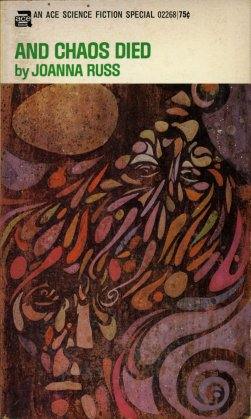
The next book on the reading-stack is the short novel And Chaos Died, published in 1970 as an Ace Special. It was reprinted a few times—my copy is a Berkley paperback—but is no longer in print and hasn’t been since the 1980s. The book was a Nebula nominee and the fourth-place runner up for the Locus Award for Best SF Novel.
And Chaos Died is a strange, psychedelic book that, in many ways, doesn’t age well. (The implicit commentary on male queerness in the text is hair-raising, for one thing—that it’s something to be “cured,” an abnormality not allowed to coincide with greater mental development.) It’s my least favorite of Russ’s works; I wouldn’t likely read it again, beautiful as it is.
Russ begins the book with a translation of a tale by Chuang Tzu, about how the gods Fuss and Fret wanted to thank the god Chaos for treating them well, so they decide to bore orifices into him—as he had none, and was featureless—which kills him. The title comes from the last line of this morbid little myth. It makes for a rather dire opening thematic statement, one to keep well in mind as the novel unfolds.
And Chaos Died is definitively New Wave SF, concerned as it is with psychic phenomena, mind-bending imagery, nearly impenetrable—but beautiful—prose and an experimental sensibility. It’s not an “easy” book; in fact, after the straight-forwardness of The Adventures of Alyx, it feels in some ways like a book written by a completely different person. They’re difficult to read back to back, but the juxtaposition shows the sheer range of Russ’s writing abilities: she’s as comfortable with the experimental as she is with the adventure-story; her prose can shift and evolve to handle whatever material she needs to handle.
However, despite the level of craft-skill on display in And Chaos Died, my feelings for the book are mixed—as I’ve said, it’s my least favorite of Russ’s novels. I find its sexual politics deeply problematic. Also, on a more workmanlike level, scenes in the text are at times exaggerated to the point of silliness, as if the project of developing such an experimental narrative got away from Russ and started gallivanting around on its own. As I read, I noted that it often felt like I was scrabbling at a rock face, trying to find a grip into the story and failing—the emotional connections weren’t there; the characters sometimes felt like dolls being moved about a stage. The push to validate the thematic statement of the text devours the potential for meaning and connection; it becomes an extended allegory, in its way.
I find it deeply interesting to see Russ not quite getting it right—again, because my entry-points to her work were her most acclaimed pieces, where everything was just about perfect. And Chaos Died is something else. It has rough edges.
That doesn’t mean the book isn’t startling and intense, because it is. The blurb on the back of my Berkley paperback by Samuel Delany says, “Many novels have dealt speculatively with psi-phenomena, describing the effects on people and society. Ms. Russ has taken it on herself to put the reader through the experience.” (May I note how jarring and weird it is to see her name written as “Ms. Russ?”) I’d say he’s got the right of it. The most intense, vibrant, weird parts of the book are her descriptive flights during the scenes of psychic phenomena—the imagery is like a blow to the gut; it’ll steal your breath and send starbursts of sensation and wonder through your brain. Her lines are referential on a grand scale, containing allusions by the fistful, often several per sentence—there are layers and layers of echoes and meanings in Russ’s prose. It’s impossible to exaggerate how dense and beautifully crafted And Chaos Died is.
For that alone I’m glad that I read this novel, though in the end it didn’t win me over.
I suspect the thing that puts the book firmly in my “not again” pile, more than the puppet-like characters, is the sexual politics. Jai Vedh, the only male protagonist in Russ’s entire oeuvre, is introduced as a “homosexual.” At first, it seems that Russ is going to explore homophobia and prejudice against male queerness—the military officer who Jai crash-lands with is a big-macho masculine guy, who’s constantly responding badly and violently to Jai. There’s a lot of tension; Jai derisively tells him at one point, “I won’t touch you. Not even in your sleep. Calm down ” The captain’s response is to get even antsier and eventually try to physically throw him out of the small escape-pod spacecraft. So far, so good, I suppose; the explorations of masculinity and homophobia are interesting.
It starts to get bad when the psychic society comes in, because Jai ends up getting together with a woman who uses her powers to “cure” him of his sexuality, which is framed as a dysfunction. They become lovers, and he’s all fixed from being gay, because when his mind begins to expand and he develops abilities like hers, he becomes heterosexual. It turns out, being gay was just a problem caused by his society, and when he’s mentally healed he’s straight. In this construction, straight equals healthy, straight equals better, straight equals right. It’s exactly the party line of the psychiatric associations of the 60s and 70s: gay is sick, straight is healthy.
What?
I had a fairly visceral “you have got to be fucking kidding me” reaction to that scene. I nearly threw the book. It’s hard to believe that Russ, about to publically become an advocate for queer women’s sexuality in her next novel, could make such a nasty implication—that all a gay man needs is a good woman to make him straight. How many times do lesbians have to listen to the reverse, that a good man is all they need to give up other women? Hell, deconstructing that myth is part of the point of The Female Man.
Is it because Jai is male? Does his gender really make such a categorical difference in the validity of his identity and sexuality? There are threads of this tendency in second-wave feminism, so it’s not like it’s new; I likely shouldn’t be surprised, but I was. It felt like a betrayal.
That’s in addition to the fact that nearly every sex scene or sexual scene has elements of non-consent, on the parts of both men and women; Jai isn’t really willing to have sex with the woman the first time, but she makes it happen. Perhaps this is supposed to feed into the point that Jai’s society is so absolutely wrecked, socially, that aggression and violence are the only possibilities for interpersonal relation. If it is, it only succeeded in making me extremely uncomfortable and a bit disgusted—the sex scenes don’t seem to be written to be icky on purpose, and there aren’t many hints in the text that there’s anything wrong with the dubious consent. It’s just—there. It’s how sex is in And Chaos Died. I can read books with sexual violence, when there’s a point, but I didn’t get that vibe here.
And Chaos Died has its bright points, make no mistake, and it’s valuable as a part of Russ’s bibliography. It was popular with its audiences when it came out, as evidenced by the awards nominations. However, I finished it upset and disgruntled, tangled between the beautiful parts and the ugly parts, unsure of how I should feel. I’m a fan of Russ as a whole, but not this book. This book says things that I cannot agree with, that I in fact find reprehensible.
I’ve already discussed The Female Man as part of the Queering SFF series, so I’ll direct you to that here. The next book to discuss after that is We Who Are About To , a wrenching, deconstructive novel about a crashed spaceship.
Lee Mandelo is a multi-fandom geek with a special love for comics and queer literature. She can be found on Twitter and Livejournal.

Your review is very much mine- I read the book, but didn’t connect with it. Along with Jai’s sudden ‘cure.’ the other point of squick for me was the little girl- 9 according to the text– who approaches him sexually.
[i]”Don’t you,” she cooed, half her face hidden by a fold of her hat, “like little girls?”
“Good God, no!” said Jai, exasperated.
“Oh, every man does,” said Evniki, rubbing her knee against his. “And every little girl likes men. Nobody would be surprised.”
@Pam Adams
Oh, yes, that.
Also, Jai Vedh being Hindi-named, but otherwise blond and blue-eyed was odd.
Disappointing book. I have the same reaction you have.
So much of SF and non-fiction in the early 70’s cast same-sex attraction in such a negative light (I was 15 in ’70 and so finding lit affirming to my identity was pretty critical). Delany’s “Return to Nevèrÿon” came just a bit late for me. It was probably a bit too kinky for a 15 year old, as well.
Evniki is a character, not a general statement about sexuality.
IMO, the most pertinent datum here is the date: And Chaos Died was published in the summer of 1970. It’s hard for anyone who didn’t live through those times to appreciate what an oceanic amount of ignorance, confusion, and misinformation about sexuality was then in circulation. (You could do worse than to read the Wikipedia entry on the Stonewall Riots, which took place while And Chaos Died was being written, paying particular attention to the aftermath of the riot, the rise of gay rights activism, and some of the strange misapprehensions that had to be sorted out.) Even among people who were living openly transgressive lifestyles, there was just this terrible confusion about sex and sexuality.
You betcha people talked about “curing homosexuality.” After all, homosexuality was listed in the DSM as a psychiatric disorder; of course they’d try to cure it. Arguments about the nature of homosexuality focused on stuff like whether it was a variety of sociopathic behavior, a pathological aversion to the opposite sex brought on by a bad relationship with one’s parents, or a sign that the person had gotten stuck at an immature stage of personality development and never moved on to true heterosexual adulthood. It would take years, and a great deal of work, before that argument got relocated to the vicinity of “you can’t cure it, you shouldn’t try to cure it, and by the way it’s not a form of mental illness.”
You ask:
In 1969-1970? Yes, absolutely it did. Every information channel in Western Civilization was saying so, over and over again. Joanna, who was thin and very tall, who won a Westinghouse Science Prize in high school and came of age in the 1950s, would never have heard anything else. The male/female dyad was universally assumed, as unnoticed as oxygen. Traditional gender roles were thought to be indissolubly bound up with who you found sexually attractive, which was why male homosexuals were assumed to be effeminate, and couples were assumed to divide up butch and femme roles.
Gender essentialism was everywhere. There’s a thread of argument about it running through the SF novels of the period. It’s explicitly present in the only ham-handed scene Roger Zelazny ever wrote (it’s in Lord of Light), lurks behind everything that happens in And Chaos Died, and turns up in more sophisticated forms in later novels like Triton and The Dispossessed. That was another major piece of work: uncoupling gender roles from sexual orientation. The 1970s saw huge changes in the general understanding of sex and gender.
Joanna’s writing engaged with all that. Please don’t feel betrayed. What you’re seeing is an early instantiation of the same process that would produce books like The Female Man. She’s groping in the dark, navigating by strange means, but she knows there are things out there worth finding. And later, she did.
@tnh
Thank you for this comment – it’s difficult for a reader from my perspective, who has only studied the 70s in relation to queer history and not lived it, to correlate all of that.
And later, she did.
Yes, absolutely – the next book, in fact.
I remember hating this novel in 1972 (at the age of 14), when I first read it, because of the inability to connect with the characters, but it had been so acclaimed that I felt I was somehow wrong. It’s been on my shelf to re-read ever since. I still want to do so now to see how I would feel about the sexual problems mentioned here. At the time I was brainwashed to believe exactly what she wrote about homosexuality and so it did not bother me. As tnh writes, it was a truly different time back then.
What TNH said. Also, And Chaos Died is a not-very-well-encoded part of an ongoing discussion happening in person between a lot of New Wavish SF people in NYC in the late 60s. I was first handed the book to read by half of the model for Jai Vedh, really quite accurately portrayed, except for the part about going straight.
And Delany refering to Russ as “Ms. Russ” in his blurb was revolutionary. The title “Ms” had not yet gained acceptance. I can tell you (Terry Carr told me) that they had a hell of a time getting through copyedit at Ace. One simply did not refer to a woman without specifying her marital status.
@Beth Meacham
Huh! I didn’t know that. (It seems like there’s actually quite a lot of outside-the-text personal freight that accompanies this book.)
And Delany refering to Russ as “Ms. Russ” in his blurb was
revolutionary. The title “Ms” had not yet gained acceptance. I can
tell you (Terry Carr told me) that they had a hell of a time getting
through copyedit at Ace. One simply did not refer to a woman without
specifying her marital status.
That’s really interesting, too – it’s odd to see it, today, but cool to know that it was a big deal then.
The use of “Ms.” as a term of address was a flashpoint for feminism in the ’60s and ’70s. I can remember being totally embarrassed when my mother, a charter subscriber to Ms. magazine, used “Ms.” on a document to my elementary school. Them were fighting words, back in the day.
@eugene R.
Sounds like your mother was an awesome woman. *g*
I know I’m very late to comment on this post, but I’ve just finished reading the book for the first time, and I wanted to add two tidbits I’ve found. First of all, my edition is the third Ace printing, from 1980ish, and it has Delany saying ‘Miss Russ’ on the back cover, which is sadly retrograde.
Second, I’ve just read the second chapter of Rhonda Gilliam’s master’s thesis from 1988, which argues that the telepathic society should not be read as utopian, and that the ‘cure’ is intended by the author to be considerd an act of violence against Jai’s personhood. I’m not entirely convinced, but it has given me food for thought. (I’m also looking forward to reading Delany’s reading of And Chaos Died in Starboard Wine.)
@DavidGolding
I actually disagree with my own reading as it is here, now–mostly thanks to reading letters discussing Russ’s opinions of the book, and the piece in Starboard Wine. (I hate to be like “Well, I wrote this book!,” but I get into the whole issue of this post’s reading versus a new reading in “We Wuz Pushed: On Joanna Russ and Radical Truth-telling.”)
This really took me back to them days back then :) esp. TNH description. Just two years before in the late 60s I was in London (UK) struggling to find my feet as a teenage dyke. I remember all that about homosexuality as a curable illness. I was dancing at the Gateways just off the Kings Road and also in seedy clubs un Soho. Mostly the seediness passed me by.
I think my most interesting and relevant memory of those days was the rebellion by a small number of lesbians against the established idea in our circles that you had to be butch or fem. We refused that and were much disapproved. There were not many of us. We skidded about laughing at the fuddy duddy copies of straighties. We did dress either way – I mostly dressed as a boy with a boy’s haircut. It was as much camouflage to stop the ruddy men pestering me as anything. But also it was a joyous striding free, a playfulness that had something deadly fierce at the core. I loved elegant tailored shirts and cuff studs. My bare chest suddenly exposed in a roomful of young men where we were trying on shirts caused a sensation and made me giggle.
So it’s not quite true there was nothing else except gay – sick. But my little girl band of rebels was tiny, even though in one of the biggest cities ever. You’d have to luck into it. We’d never heard of feminism either.
By 1971 I did know feminism just a little and it was very exciting. But it then became tricky to navigate very different ideas of being lesbian. By now I didn’t feel the need of playing boy, and happily swayed in long hair and high heels. Plus a few male lovers for variety. Then the Women’s Movement big time, activist, and either I was too feminine or too tough – it was the old gay scene all over again, each CR group had its own unspoken rules of how to be a feminist woman. Plus ca change.
I’ve just read _And Chaos Died_ for the first time (it’s now available in a nice ebook edition, published by Open Road Media), and I stopped by here to see your take on it, Brit.
I largely agree with much of what you said here (though I see in comments that you later retracted some of your take on it), but I have a few thoughts I wanted to toss in, in response to some things you said and some things commenters said:
* Jai Vedh is far from being Russ’s only male protagonist. A brief glance over my notes on her short stories show at least four stories with male protagonists before _And Chaos Died_, and at least five after. I suspect there were several more than that; I didn’t note protagonist gender for a lot of her stories. (Or did you mean the only male protagonist in her novels?)
* He’s also not her only *gay* male protagonist. She had written a story with a heavily fictionalized Oscar Wilde as the protagonist a while earlier, and she wrote various other stories in which the male lead is gay. In none of them that I recall is the man’s gayness seen as something to be cured. So I’m hesitant to go along with the she-was-just-reflecting-the-beliefs-of-the-time argument. I don’t have a good explanation for the troubling curing/dismissal of Jai’s homosexuality, but I think there’s more to it than just Russ believing that homosexuality should be cured. (And look at how Jai is contrasted with the macho Captain in the opening sequence; Jai is clearly meant to be a far more sympathetic character.) Also worth noting: Russ wrote several stories, both before and after this book, in which lesbian possibilities or subtext are raised, but in this book all of the female characters are desperate for sex with men. I don’t have an explanation for that either.
* Russ and Delany knew each other by the time she wrote this book; their correspondence goes back to around 1968. (And I don’t know for sure when she wrote the book, but Delany guesses 1968-1969 in his 1979 review of it.) Which also makes me doubt that Russ believed that gayness should be cured, though I haven’t yet seen the contents of their letters so I don’t know for sure that they discussed queerness early on.