







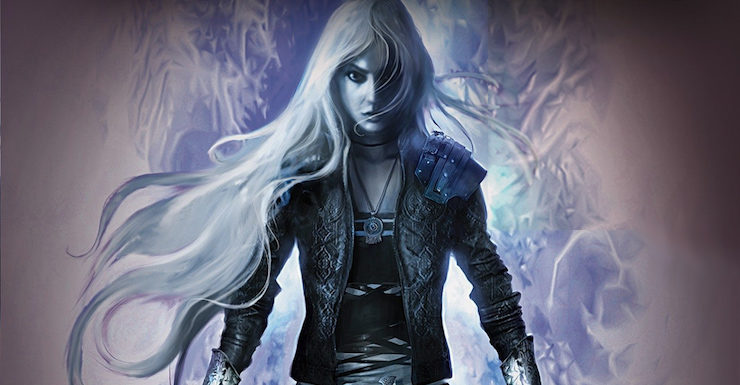
When a series is seven books long and each book seems to get longer and longer, the first book is bound to raise more questions than it answers. And that is entirely the case with Throne of Glass, the first book in Sarah J. Maas’s series of the same name: it leaves a reader with so many questions. Where’d magic go? Is there really a whole kingdom of witches? How can a prince be so nice when his father is a total monster? And when am I going to get the whole story on teenage assassin Celaena Sardothien’s history?
I’m pretty sure I’m going to have to be patient with these and some of my other endless questions—or relatively patient, anyway…
In anticipation of the seventh and final Throne of Glass book, I’m reading the entire series over the next six weeks! This isn’t a reread for me, but a first-read: if you’ve already read the whole series, you will be able to feel extremely superior while I ponder things you probably know backwards and forwards. My fellow first-readers, though, beware: there are likely to be spoilers for future books in the comments.
There’s so much to talk about. Let’s start at the beginning.
Spoilers for all of book one, Throne of Glass, discussed below!
A Brief Summary of Throne of Glass
Buy the Book
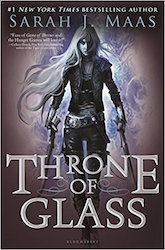
Throne of Glass
Eighteen-year-old Celaena Sardothien, Adarlan’s Assassin, has been toiling in the salt mines of Endovier for a year when two extremely handsome men appear to take her out of the mines. One, Dorian Havilliard, is the king’s son. He needs a Champion for a brutal game his father has concocted: a whole bunch of murderers, thieves, and assassins will fight each other for the title of King’s Champion—which is a nice way of saying “pet murderer.” The other man, Chaol Westfall, is the captain of the king’s guard. Dorian is fairly friendly, Chaol standoffish and gruff; Celaena flirts with them both while bargaining with Dorian about her willingness to fight for him. They make a deal: If she wins, she earns her freedom in four years.
In Rifthold, the capital of Adarlan, Celaena trains with Chaol, endures Tests against the other would-be Champions, meets the delightful Nehemia, princess of Eyllwe, reads every book she can in the sprawling castle library, and tries not to die. The last part is especially complicated given that something is killing Champions, and in a very ugly way.
The mystery of the nasty murders is solved by the time Celanea—with Nehemia’s help—triumphs at the final duel. But it’s just one of the book’s mysteries: Why is there a tomb in the castle’s secret tunnels? Why’s it the tomb of the land’s first king and queen? What exactly are Wyrdmarks, and why are they everywhere? What strange magic did Cain, the biggest and meanest of the Champions, and his sponsor, Duke Perrington, and the king tap into? How can there even be magic when everyone knows it disappeared some years ago, after the king banned its use?
I’m Just a Teenage Assassin Baby
Throne of Glass’s plot is fairly straightforward—for all the tension Maas can pack into certain scenes, Celaena’s eventual victory is never really in doubt. But the worldbuilding around Celaena’s story is cleverly full of gaps and mysteries, most of which serve to deepen the major looming questions: Who really is Celaena, and what’s really going on in this world?
What we know, at this point: Originally from the northern kingdom of Terrasen, Celaena began training as an assassin when she was 8, when the King of Assassins, Arobynn, dragged her out of a river. At some point she spent time with the Silent Assassins in the Red Desert; at some point Arobynn broke her right hand, to make her learn to fight with her left; at some point she saved a lot of slaves from a Pirate King (pirates!!!); she loved a fellow thief named Sam, who’s dead now; eventually, she was betrayed and captured, though she still doesn’t know exactly why, or by whom. She’s vain, arrogant, playful, confident, extremely good at all things related to murder, suspicious of other women, and prone to fits of anger both justified and petty.
But how did she get in that river? Who murdered her parents, who she found dead when she woke up next to their bodies one morning as a child? Why could she rattle the stars, as the spirit of Queen Elena suggests to her? How can someone so interested in other people’s approval and attention be a good assassin, when that requires sneaking and secrecy? Was Arobynn’s approval all she needed, when she was younger?
Celaena’s a fascinating character, a passionate, scarred, flawed person who doesn’t seem aware of her own flaws—at least not yet. I feel a ton of sympathy for all the things she’s been through, and I definitely enjoy her defiance of authority—but I’m not entirely sure I like her all that much in this first book: her scorn towards so many other women is frustrating (though she admits, at one point, she might be wrong on that front); she’s so dramatic I feel like she’d be exhausting to be around.
But those aren’t complaints, because we’re only in book one, and all of the things that frustrate me about her mean she has a lot of room to grow. (I do love that she’s the world’s greatest assassin and she adores clothes so much she’s not afraid to wear an outdated gown just because that’s the one she loves. It’s so Kaylee Frye in that confection of a dress in Firefly.) She’s not perfect—well, she’s perfect at murder. But she’s impatient and impetuous and impulsive and cocky, yet you can see how Maas is setting her up to grow beyond these traits. At the book’s outset, she—fully understandably—agrees to be Dorian’s Champion for her own freedom. After a year in the salt mines, which would’ve killed most people, she’d do just about anything to be free (and her life before then was hardly free of trauma). But by the end of the book, she’s thinking about how she actually wants to stay in Rifthold, to understand what’s happening … and to help. Freedom is still the endgame, but other things matter, too. If she gets revenge on the king, who’s the reason she was in the salt mines in the first place, all the better—but not just for herself.
One of Celaena’s better traits is her acute awareness of other people’s suffering, whether her fellow prisoners in Endovier or the Eyllwe rebels in the rumored-to-be-terrible labor camp of Calaculla. She hates slavery, hates cruelty, and hates the king who perpetuates all of these things. So she’s in a notably complicated place at the end of the book, when her freedom—and the lives of her new friends—depend on her working for him.
The King in His Castle and Assorted Other Folk
The king, so far as I can tell, is nameless, arrogant, bad at naming swords (“Nothung”? Seriously?), really into burning books, and overall extremely not good. His wife, Queen Georgina, is a fairly minor character except in that she really, really wants Dorian to get married, and she really, really seems oblivious to the fact that her younger son, Hollin, is apparently a terrible brat. Notably, the other important nobles are also not very nice: Duke Perrington, who is responsible for would-be-Champion Cain’s magical prowess, and Lady Kaltain, a conniving opium addict with her eye on the prince.
The thing about Kaltain, though, is … I feel bad for her. Throne of Glass doesn’t dig into or question Adarlan’s very traditional-Western-fantasy setup: There’s a monarchy that passes down through the men, as far as we know; women are serving ladies and such while men are soldiers. Celaena is the exception. There are no other women among the contestants to be the King’s Champion (I really wish there were) and appear to be no women among the castle guards. Eyllwe, from whence comes Nehemia, seems potentially a little different, but we haven’t yet seen enough to tell.
So Kaltain is a scheming, power-hungry woman in a world that doesn’t seem to like to give power to women, and she gets taken advantage of by an even more power-hungry Duke. The reveal that Perrington has been controlling her, in some magical way, only cements this: I already felt terrible for her by that point. I can’t quite tell if the book intends me to feel this way, or if I’m reading too much into it, but I’m curious to see if she reappears, if she’ll ever get out from under Perrington’s magical thumb, and if she, too, can grow out of thinking that other women are her enemy.
The people in the castle I’m really supposed to be thinking about, though, are Dorian and Chaol, both of whom are—naturally—drawn to Celaena despite themselves. It’s not exactly a love triangle, which I appreciate, so much as a sort of game of attraction pinball, where Celaena, still adapting to even being out of the salt mine and into something like polite society, bounces off both men in different ways.
I admit: I’ve been spoiled for exactly three things in the following books, and one of them involves Celaena’s love life. So I may not have been as invested in this as I might’ve been otherwise; I watched the three of them with a slightly more detached amusement. Chaol’s reserve frustrates her, and makes her want to poke him; Dorian, though he’s got a bit of a reputation as a flirt, is more the gentle, good-natured tease, the one who sends her presents and knows he shouldn’t fall for her. (But his dogs like her on sight, which is an absolute guarantee that this is exactly what’s going to happen.)
(Somehow, I decided that Dorian’s ladies-man act is just that: an act. But nothing in the text really backs up this theory, I realized by the end. It just seems like there are more references to him knowing things about certain ladies, or being a flirt, than there is evidence of him actually, y’know, flirting or skirt-chasing or what have you. I think it’s an act he puts on so his mom will think that’s why he doesn’t want to get married—and that the truth is that he’s a romantic who just hasn’t found the right girl. But am I imagining this?)
One of the greatest signs of Celaena’s maturation over the course of this book is when she tells Dorian, at the end, that they can’t be together. Her reasoning is sound, her logic fair, but what I love about this moment is that she does it for herself, for the thing she’s wanted since the beginning: freedom. She’s thinking about the impossibility of the King’s Pet Murderer being with the Crown Prince, sure, but she’s also thinking about how she got here in the first place, and what that really means to her, and what it means, at least in this moment, is not making any promises to the future four years down the line, when she’s done doing the king’s bidding.
Chaol remains a mystery to me. I like him? I think? But he’s the strong-and-often-silent type, and there’s so much left to be filled out in his character. I like the way his personality and Celaena’s are complementary rather than matching, but I want them to be besties, like siblings, having each other’s backs in the fight that’s obviously coming.
And then there’s Nehemia, sly, brilliant, magic-wielding Nehemia, about whom I would like an entire book. Sharp-tongued, secret-keeping, she’s so clearly good that the slight misdirect when Celaena thinks she’s responsible for the gruesome murders is hard to buy, even for the brief time before Maas lets us in on what’s really happening.
But Also All These Questions About the World
Throne of Glass is absolutely full of hints about how its world used to be, before—whether that “before” is “before the King of Adarlan wanted to rule everything” or some other, not-yet-defined “before.” There were Fae; there was magic; there’s a whole hinted-at mythology about King Brannon that I’m dying to know more about. Magic is gone, but not: tiny fairies bring Celaena flowers in the night within just the first few chapters. There’s a land of witches, for crying out loud! (Take me to the witches!) Duke Perrington is using some kind of magic that the king knows about; the castle glows green when Celaena sees it at night, which is not a thing a non-magical building tends to do.
And then there’s the whole issue of Elena, the half-Fae first queen of Adarlan, and her pretty tomb beneath the castle, which, narratively speaking, is full of shiny toys: The mythology of Elena and Gavin is fascinating, probably super-relevant, and not necessarily the story everyone knows, as Elena eventually tells Celaena: She wasn’t a passive queen but a warrior. And now she’s dead-but-appearing-to-our-heroine, having been led there by someone to tell Celaena … all kinds of things. There’s evil in the castle. Someone led them both there. Someone wants her to learn. The gargoyles are watching. What she doesn’t tell Celaena is what the heck the words on her tomb mean: “Ah! Time’s Rift!”
All of this makes Throne of Glass feel like the tip of a giant fantasy iceberg. There’s still the not-yet-fully-explored issue of the king’s rule over the rest of the continent. Nehemia is a princess, and Eyllwe has a king, but the King of Adarlan is their king, too—and their rebellions are constant in the background of the story. (The meaningful gesture of Celaena winning the final duel with Nehemia’s staff is just gorgeous.) There’s another kingdom, across the sea, that the king is also trying to dominate. How big is his army?
Beyond the shape and contours of the physical place, I grew fascinated as I read with the shape of belief in this world. In chapter 16, Celaena says a prayer—but to whom? Maas doles out bits and pieces as the book goes on: the people celebrate Samhuinn, when the gods and the dead are closest to the earth; they go to temple for that holiday, and for Yulemas. People swear by different things: They might say “Gods help you,” or “Wyrd help you,” despite the fact that few people seem to know what “Wyrd” means.
It struck me as slightly odd that Celaena would know the phrase “Wyrd help you” but be so baffled by Wyrdmarks. When Yulemas finally comes around, just before the final Champions’ duel, Maas is generous with the details: Yulemas celebrates the birth of the Goddess’s firstborn, Lumas, whose birth brought love into Erilea and “banished the chaos that arose from the Gates of the Wyrd.”
So the Wyrd is part of the major religion of Erilea, yet Wyrdmarks are largely unknown—except to Nehemia and her family. And even for them, Nehemia tells Celaena near the end, the Wyrdmarks are only “a last defense against evil”—but they can be used for other things, like Cain’s calling forth “demons from the Otherworlds.”
This is so much worldbuilding—and world-expanding—in the course of one conversation that it must have been agony to read this book when it first came out, knowing you would have to wait ages to get any answers. What are the Gates of the Wyrd? How are the Gates and the Otherworlds related to the world’s religion? Does it have a hell? What about the “dark lord” Elena and Gavin fought, way back in Adarlan’s history? Was that a dark lord in the “lord of the dead” sense or just a nasty man? There’s also a reference to evil creeping out of the Witch Kingdom—but what kind of evil?
Of course the king knows all about Wyrdmarks. Of course the king banned magic so only he could use it. Of course he’s basically stealing the power of Nehemia’s family, of the southern lands, so he can use it to subjugate them and others. This is going to give me a lot to chew on as the books progress.
And of course no one knows what the Wyrdmark on Celaena’s forehead means.
I Still Have a Lot More Questions and Random Thoughts
In no particular order:
- Do I get to see Nox again? I liked him. I like someone smart enough to know when ghosting is definitely the right move.
- “Blood ties can’t be broken,” Elena says, so … she and Celaena are related, right?
- Why are there “shining buildings” at the salt mines? With a throne room?
- The name Rifthold is a hint, right: magic is locked behind a Rift? Or did I read too much Raymond Feist as a kid?
- There’s got to be more to her hatred of the glass castle than just feeling like it shouldn’t be able to hold her up.
- What’s up with the many references to the brutal White Fang mountain men, of which Cain was one? At one point, the king comes back alone from the White Fang mountains; everyone else in his party is dead. No one knows what happened. This seems relevant.
- I appreciate that Maas addressed the fact that Celaena’s periods stopped when she was malnourished in the salt mines, then returned when she got healthy—it’s a small thing, but it’s a realistic detail that makes the world feel more solid.
- The minute I read about Wyrdgates I wanted to know if Celaena’s mysterious heritage is behind one.
- I absolutely love that Celaena isn’t snobby about her reading.
- “You bear many names,” Nehemia says to Celaena, while giving her another one. Does she? Whispering voices in the duel call to her by a different name, “a dangerous name.”
- These hints about thundering hooves! And a bridge! And young Celaena running! Tantalizing hints!
Next week, we’ll see how many of my questions are answered by Crown of Midnight!
Molly Templeton isn’t sure how she didn’t read this series already, but is so pleased to be reading it now.

Interesting post considering I am currently reading, also for the first time, the Throne of Glasd series. I’ll admit I picked it up at semi-random: I wanted a book with a female protagonist (check) written by a female author (check) with some romance tossed into it (check). I was also looking for a quick read (check) of a finished or near-finished series (check), so Throne of Glass seemed like a good contender. The back blurb was also interesting, a Champion, a contest, an assassin being offered a second chance.
I have currently finished the first two books and I am barely starting the third one. My thoughts oscillate in between liking and not liking the series though I definitely enjoy enough to keep on reading it. The main protagonist is often irritating and jumps from one extreme to the next (I think the description in this post is accurate, Celeana is vain, superficial, arrogant, dismissive and selfish which can be very annoying), but I found the second book to be superior to the first one. A lot of the mystery falls down during the second book, so many questions are answered, what are the wyrdmark, who is Celeana, what is the King up to, what happened to Kaltain (not funny, very sad). The main protagonist cement herself and appears more defined (in the first book, it is unclear is the author was trying for a dark Cinderalla tale or an assassin tale with a conquest in the middle not serving to add much tension). The world is interesting and the over-arching narrative is compelling though the romance arc, which I was looking for, is not quite what I wished it would be. It is at times too over-powering and well, sometimes eye-rolling. Any readers not enjoying romance arcs should avoid this series.
As for other characters, I really do not like Chaol’s character for reasons which will become more obvious within the second book. I find Dorian’s character to be the most interesting of the male protagonists though I suspect fans of the series think reversely. Nehemia is a solid character. It is hard to say more without giving away spoilers for the second book.
So great post, I’ll be following around as I read the series as well.
Heeey,
I have read all of the books that are out. And I have to admit I was disgusted by Celeana at first. But as I was reading more and more into it she was growing on me in ways I had never thought were possible for her. And I found it interesting to read this post that a lot of your theories are right. Mostly the one about Dorian (100% true, it ends sad tho…) and OMG you’ll love Manon (a witch) and her 13. Just keep reading with an open mind and know, even tho you’ll probably want to kill Maas in the 2nd book. Everything that happens is for the greater good. I’ll be looking out for the rest of your posts.
Love,
A fellow reader😄😄
Just dont mind the bad spelling/grammar please i noticed a mistake. Know that English is not my native language😂😂
Hi……
you are in for a huuuugeee roller coaster, coz seven books is like a lifetime, also the questions u have now won’t even compare to what ull have after seven books.
and here I am waiting from almost a year to see what happens to aelin and of course all the other characters as welll…….ugh
sarah j Maas is one of the most amazing authors there are,I have read all the books written by her, so I don’t know if you have read ”ACOTAR”….another series which is awesome by the way….only 3 books for nowwww….
I’ll be waiting for to you finish the other books I’m sure you’re gonna kill someone by then…and there are so many characters coming…omg especially the witches ….and I wouldn’t start shipping Aelin with anyone yet ……😏
p.s. Welcome to the S J Maas fandom….
with love,
The unexpected gem
I must say, when I picked up this book, I thought it was going to be a typical teenager read, with a cliché love story…
Was I ever so wrong…and ever so grateful to have proven myself wrong. This was the first YA fantasy series I read and never imagined that I would love this magical world building genre. I think SJM is a brilliant storytelling genius, and this is evident going further into the series (also true for ACOTAR series). When I started reading this series, me and my wife would lie in bed at night, both of us unable to encourage each other to go to sleep. It’s that good. I am currently rereading the entire series in anticipation of the last installment
For the first time readers I strongly recommend that you read the Assassin’s Blade novelas as it gives you better understanding about Celaena’s history and background.
This is one of the best series I’ve read thus far and not afraid to say, a hard core fan.
No spoilers, but as someone who has read the series in its entirety of what’s released, you’re not ready. Also, an interesting thing is that most people either like the first few books but not the next, or they don’t overly like the first few and do like the subsequent books. I look forward to seeing your further experiences with the series and if you fall into either of these groups.
@@.-@ (Massive, massive spoilers – be quick and kind and maybe edit your comment a little so the author of the article and others can find out about… stuff…by reading?)
Hey,
I’m the same girl as @2 and @3. little update:
I CANT GET THE BOOK TILL MARCH 2019!!!!!!!
I’m in a bit of a dillemma, should I get it in october in English or should I wait till I can read it in Dutch? pls help me. because I can’t wait to read the book but also want to keep my series complete in the way it is now.
Oh and @@.-@: You really need to change your comment if you dont want to spoil anything for molly. Also ACOTAR has 4 parts SJM made a sequel. If you are happy with the way 3 ended: DO NOT READ BOOK 4
A fellow reader
Ps: my username really is that cringy, couldnt come up with something better
I couldn’t stand these books. I quit halfway through 4. Celaena is annoying. She’s not believable, I never believed she was an assassin. She wasn’t clever or witty like everyone says, she’s a bitch. Plain and simple. The later books would be half the length if they did away with the repetitive pity party she has. She’s ungrateful and vain. I feared she’d be put in power because her selfish ways would lead her to be worse than Joffrey. If other fantasy is like Game of Thrones this bull is Disneys Descendants. Bubblegum garbage that thinks it’s badass and so adult.
@9 as the author of this article posted, Caleana still has a lot of room to grow, and she grows throughout the series. I wouldn’t give up after 3.5 books, Book 4 was one of my favorites… finish it! I felt similar to how you feel about her now, but there is still a TON of character development.
This series got me into being an avid reader for the first time. I hated reading, and now regret that because there is so much imagination, so much adventure out there that I was ignorant to. I can’t wait for the final book to come out, and I will probably reread the entire series again before I read the final book.
I love Sarah’s writing and am looking forward to reading the “ACOTAR” series (my wife loved the first book so far). I am a 35 year old man and so far my favorite book series is a teenage fantasy series called “A Throne of Glass”… am I that pathetic? or is it that Good? If you haven’t read this series yet, them pick it up and see for yourself! Me… I’ll be waiting for the series finale to arrive.
– Adam (A 35 yr old male fan)
i just want to mention that the Assassins Blade is the prequel and a helpful read to answer some of the questions about who the heck is sam and why is she a slave etc.. i have found it best read in between #1 TOG and #2 COM then there is the Tower of Dawn novella best read after # 6 ie: empire of storms so technically you have committed to 9 books but i think you will like it much more from # 3 on. happy reading.
I just wanted to say that this series is incredible. Sarah J. Maas is an amazing author that has the power to pull on all of your heartstrings at once. Her books also have some many levels of complexity, forethought, and planning. Sarah is incredibly talented. You are in for a crazy emotional ride reading these books. I am currently reading Tower of Dawn (I think it’s being called the sixth book in the series but it parallels the fifth book’s events. It’s vital to read prior to the finale Kingdom of Ash. You’ll understand soon enough) and I am hooked. This series has a quality that just draws you back in to this magical world book after book. Reading your summary of the first book has reminded me of how far this series has developed. The events from the first two books (at least in my opinion) seem like they happened a lifetime ago. Everything is so much bigger and crazier now. I also enjoy reading your theories and questions having some of the same reactions while I read this series. I don’t think that you will be disappointed with the remainder of the series. I look forward to reading your later articles about the remaining books and experiencing everything all over again through your reviews. After you finish this series I would also highly recommend reading her other series as well ACOTAR (A Court of Thorns and Roses). If you enjoy Sarah’s writing in this series her other one won’t disappoint!
P.S. Just a helpful tip that you might want to take into consideration: Read The Assassin’s Blade before you get to the fourth book Queen of Shadows. (It is a budle up of five short stories about Celeana’s past.) I didn’t do this (I read it before the fifth book Empire of Storms and everything made sense then) but I wish I would have read it earlier. It will help immensely.
Enjoy the rest of the series!
I find this book series are rather enjoyable one seeing as I am waiting for the last book to come out. I find Sarah J. Mass’s writing wonderful and intuitive. The first book sent me on a train a thoughts wondering about how is this story going to continue on and so far I love it. P.S. this is just my opinion feel free to tell me yours.
So, I’m currently about 300 pages into the 5th book. And so far, I’ve definitely enjoyed the series. I would not say it’s one of the best written series I’ve ever read, but it’s kept me interested and I /gobbled/ down 3 and 4. Lol my main critiques of this series and Maas’ writing are that a lot of the characters seem to share similar habits, like sucking their teeth when they’re upset or being saucy. Descriptors and actions get recycled a lot. Consistency is one thing, but this is like in fan fiction when suddenly everyone is witty and can perfectly arch a single eyebrow. Also, dang Maas says the word “gobble” and “gulp” so much that now whenever I see it, I’m completely taken out of the story wondering what would be a better word choice.
Minor spoiler ahead—regarding Fae naming conventions… There doesn’t seem to be much of a difference between what humans are named and what the Fae are named? Like for a race that believes themselves superior, I’m surprised that names sound so similar. Like I know high fantasy based in medieval times tend to favor certain sounding names, but usually between races they differentiate a bit. Bigger spoiler of a name a species drop—Ombriel is human and Gavriel is Fae, and yet? There’s a handful of world building critiques I have but ¯\_(ツ)_/¯
Regardless, I’m glad folks like the series. I didn’t pick it up expecting fine literature and I appreciate it for what it is.
Thanks, everybody who’s advised me about when to read Assassin’s Blade! I’ll work that into my reading schedule … somehow.
A note on spoilers: You’re absolutely welcome to discuss tidbits from later in the series, but it would be greatly appreciated if you’d white them out, so no one gets spoiled accidentally! If you’re new to our comment system: Type your comment, then highlight the part that’s spoilery and change the text color (the underlined A in the formatting tools above) to white. (It helps if you leave the word “Spoilers:” before the whited-out part, so people know where to highlight if they want to see what you’ve said.
I read the first book TOG in mid July of 2013. I really loved it and luckily I didn’t need to wait so long for COM to come out. I’m so happy I found this series. Can’t wait for the final book to come out.
Welcome to the TOG fanclub, Tor. I love Throne of Glass series. It’s one of my top three favorite series. FYI before you read Queen of Shadows, read The Assassin’s Blade. There are characters and events that you have read before but in further detail that you need to know about before you continue with the series.
@10, I like @9, did not enjoy this book at all, for me, the worst part of Celaena’s character(-ization) is that she’s not proactive o thoughtful. She doesn’t decide to do things, things happen to her (getting dragged out of slavery). She is obedient when she should be rebellious (she doesn’t actively form a contingency plan in case she loses the contest or something else goes wrong–stumbling upon a secret passage out of the castle doesn’t count). She doesn’t take good advice when she hears it (re: using an alias, first suggested by Dorian or Chaol). All her other flaws she can grow out of, but faced with these, I find myself unable to believe that she is the world’s best assassin.
I’m really excited for this read! I love this series, and appreciate seeing it taken seriously in the fantasy community.
The first book had a lot going against it, but as Celaena grows as a character, you begin to see Maas grow as a writer and really create something beautiful. By Queen of Shadows and Empire of Storms, this went from a fun guilty pleasure read to one of my favorite series of all time. I can’t wait until you get there!
Loved your post. It reminded me why I’ve waited impatiently for each book. I believe I started when there were three. Assassin’s Blade contains much of Caleana’s back story before Endovier and should be included in a reading of the series.
I hope you enjoy it as much as I have. There’s a FB group where fans hang out. It is not spoiler free, but many posters warn. Incidentally, Bloomsbury is doing some pre-sale promotions that include reading from the books on FB.
I read the first of these and the writing is absolutely juvenile self-insert fanfic. The characters are absurd, and act nothing like anyone would expect from people in the positions they hold. They’re randomly given character traits that have nothing to do with what they would have to be like to support the story being told, rendering an unlikely story even more ridiculous.
If you’re looking for well-wriiten YA fantasy with a female heroine try Leigh Bardugo’s Shadow and Bones books. For well-written fantasy with great female characters, go to Megan Whalen Turner’s Queen’s Thief books.
@21: Thank you for the suggestions. As a reader, one of my target, this year, is to increase my reading of female authors, preferably with female protagonists. I noticed how most of my latest reads were written by male authors and most had a majority of male protagonists.
I want to see what else is out there. I picked up the Throne of Glass for those reasons. I am not disliking the series, it has weaknesses such as Celaena’s characterization being bizarre and inconsistent given her backstory, but I still want to see how it will end. I never really bought she was the “best” assassin, it felt as her reputation was overdone, probably based on a handful of more spectacular deeds which were highly memorable, but she has too many issues and she falls into traps too often to be “the best”. Hence, having only read the first two books, my thoughts are her reputation is circumstantial. She is so young, it is impossible she had an extensive visiting list.
The real “best” assassins are probably rolling their eyes at her or that’s how I am currently reading it.
I will be following along, I did enjoy this series. So thanks.
I’m doing a re-read in preparation for Kingdom of Ash in October and just started the third book. Celaena is arrogant and annoying and a total brat but I swear, character development comes in and the world-building is so interesting. If you can, at least listen to some of the audiobook for each because I did NOT expect Adarlan to be pronounced Odderlan or Ellewye to be Eelway. They’re not my all-time favorites, but they’re fun enough that it was worth it to buy them, which, as a librarian, is saying something. And for a series that’s six years old, our copies are still all always on hold and never on the shelves.
These books are trashilicious for sure. BUT….after the first three books they get much better and more mature. Character development really kicks in, Maas becomes a better writer, and the series really takes off. I even loved book 6, which i was going to skip because after the first few books you just truly hate Chaol, but it turned out to be one of the best in the series. I loved Maas’ “A Court of” books even more.
@14
Barked. Bleated.
People both bark their knees and elbows, bark commands. They bleat when they bark their elbows, and I swear at one point she mentions blood bleating out of someone. I literally started taking a photo of the page every time one came up.
I definitely think recycled vocab and traits are her worst tendencies as an author, not to mention the slew of “this is the hottest and most badass of all the guys Calaena knows…” The worst offender being Aedion-I swear she entirely 180*d what she had planned for him as a character arc and just has him sit in a middle ground where he has no definable characteristics.
Still, I enjoyed them enough that I’m happy to read the final one next month, and am curious to see what Hulu does.