






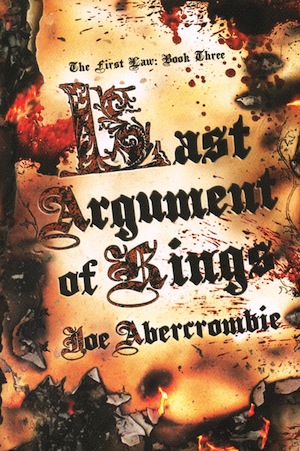
When I began this reread over 18 months ago I had no idea how much I would enjoy it. In fact, as we begin Last Argument of Kings I’ve begun to appreciate even more the skill with which Abercrombie has constructed the most subversive piece of epic fantasy that has ever been written. It is clever and funny and revelatory. I am once again ensorcelled.
We begin the third book with a quote from Paul Gauguin, a man whose work was only celebrated after his death. ‘Life being what it is, one dreams of revenge.’ So, there’s that…
Summary: Glokta waits to see Lord Ingelstad, a member of the Open Council and a vote to be counted. The torturer announces he is here on behalf of Arch Lector Sult, who wants Lord Ingelstad’s vote on who will be king. Ingelstad insists that he is unimpeachable and that he will support the best candidate. Glokta grimaces because of what will come next.
First, Glokta threatens to expose the man as complicit with the traitorous Mercers. Unfortunately for the House of Questions, High Justice Marovia beat them to it and threatened Ingelstad with the same fate. But, Glokta is not to be deterred and makes his second threat. If Ingelstad stands with another faction Glokta will have his daughters taken to prison where, so he Glokta hears, women are not well treated.
Ingelstad wilts, but back at the Arch Lector’s office Glokta cannot confirm whether or not Ingelstad will ultimately side with the Inquisition or High justice Marovia. Sult becomes angry when Superior Goyle suggests killing the irksome Lord. They cannot afford to take rash action at a time like this. They must play the game.
Lord Brock leads with fifty votes, with Isher not for behind, and Skald somewhere behind there with thirty votes and Barezin about the same. Sult sits at twenty-five votes and Marovia with eighteen.
Goyle suggests asking for help from their friend at the University. Sult hisses at him and orders the pair to get back to work harassing the Lords of the Realm. He needs more votes.
Important Characters Introduced: None.
Minor Characters Introduced: None.
Quotes to Remember:
‘You are mentioned often in the confessions of senior Mercers, you see? Very often.’ And he held the crackling pages out so they both could see them. ‘Here you are referred to as—and not my choice of words, you understand—an “accomplice”. Here as the “prime beneficiary” of a most unsavoury smuggling operation. And here, you will note—and I almost blush to mention it—your name and the word “treason” appear in proximity.’
This is such a fun and clever piece of dialogue. It’s both threatening, but self aware at how cartoonish it is.
‘…This bastard they call the Tanner, this demagogue, this traitor, speaks in public at village fairs, urging open rebellion! Daily now, peasants leave their farms and turn to banditry, perpetrating untold theft and damage. Chaos spreads, and we have not the resources to stamp it out.’
More Tanner. This whole plot is simmering. Simmering. Simmering.
Analysis: Alright. So what’s going on here exactly? Are there two contests going on simultaneously? Are Brock and the Lords competing against one another and Marovia and Sult are going to help one of them? Or are Marovia and Sult trying to put themselves on the throne? It’s very unclear. Based on the way the chapter is written, it would suggest the latter. But, that seems incongruous with what we know about the Closed Council and their attitudes toward royalty.
It’s also interesting that Sult is speculating a possible insurrection. With the war in the North there aren’t nearly enough soldiers left in Adua to fight off any kind of effort by one of the great lords to stage a coup. Or, perhaps, even the peasantry as inspired by the mysterious Tanner. However, Sult and Marovia seem deaf to the fact, that even if they did have some unity over who would succeed the King after his death, the King is not dead. Until he’s dead all the lack of governance will likely continue unchecked. Does this perhaps mean that there’s a plan in place to assassinate the King once an heir is identified?
Finally, Goyle’s comment about a friend in the University has me very curious. I’m curious if for no other reason than Sult clearly doesn’t want Glokta to know about it. Who is this friend? And what capability do they have? And notice he said ‘again’.
Oh the secrets.
“Being Chief”
Summary: Dogman hollers at three men standing guard the coast of Uffrith. He feigns a limp, offering a drink to each of them and commiserating on their shit lot in life with Bethod making war to the south. They trade news of the death of Rudd Threetrees and rumors of the Dogman’s ascension to leadership and wild speculation that the Bloody-Nine fights for the Union. Dogman scoffs at their rumblings. Despite his task, Dogman finds himself liking these men, but such a thing doesn’t matter. He pulls his weapon as Black Dow and Harding Grim take them from behind.
With the guards dead Dogman signals across the water and soon boats of carls arrive led by Shivers. Dogman divides the men into squads with tasks assigned. Uffrith is now under Union control. Dow compliments Dogman on his duplicity, calling it plausibility, which of course gives the aspiring good man the willies.
Once the missions are complete Dogman rings the town’s bell, calling the citizens to gather. Rather than butcher them where they stand, he disarms them and lets them return to their homes. He even makes special note to protect the women from Dow’s advances. The citizens hardly know how to react and stumble away.
Important Characters Introduced: None.
Minor Characters Introduced: None.
Quotes to Remember:
He hadn’t deserved to die like that, most likely. But that’s what war is. A lot of folk getting killed that don’t deserve it.
I haven’t gotten tired of depressing quotes about the nature of war. Yet.
Unless your name’s Black Dow, of course. That bastard would kill a man as easy as he’d take a piss. That was what made him so damn good at it. Dogman watched him bed down, strip the cloak from One-Arm’s limp body and pull it round his own shoulders, then roll the corpse off into the sea, careless as dumping rubbish.
There’s lots of interesting honesty in this chapter. See below for some commentary on Black Dow.
Analysis: You know what I love in fiction? Is when we get someone who isn’t tied to a character providing a perspective on said character. Dogman approaches these three strangers who are guarding Uffrith and they started talking about him and his crew. They mourn Threetrees, and call the Dogman a ‘Mean bastard’ and ‘Huge’ and someone who ‘bit some woman’s teats off’. Isn’t that interesting? We see the Dogman as small and kind and not remotely blood thirsty. He’s scared every time he has to do something dangerous. He’s almost retiring. Which is the real Dogman?
Furthermore, knowing that Abercrombie initially wrote the Dogman in first person, I can’t help but assume that Dogman was always set up as an unreliable narrator. Perhaps he really is the things the guards say about him?
Does Black Dow seem a little off to anyone else? He’s been a mean bastard throughout the first two books, but in “Being Chief” he seems to be much more extroverted than before. He’s almost down right chatty. He seems much more talkative, even flip, and much more comfortable in his role within the crew. Could this be a result of a lack of fear? Did Threetrees keep him in line and the Dogman isn’t capable of doing the same? Are these Black Dow’s true colors emerging?
Even more interesting, is this intentional from Abercrombie who will need Black Dow to emerge into a bigger role in this book? Or is it some kind of inconsistency in voice that isn’t really explained? I’m betting on the former.
Next week: Checking in with West and Bayaz who have made some progress since the last book.
Justin Landon runs Staffer’s Book Review where his posts are less on-color. Find him on Twitter for meanderings on science fiction and fantasy, and to argue with him about whatever you just read.

On first read, that Glokta chapter just seems like a bit of politicking before the baloon goes up. The king is not in good health, probably made worse by the deaths of his sons (if he’s really grasped that fact). But what we are really given is quite a bit of foreshadowing. The business with the university is really easy to overlook, but will come into play way down the line. The Tanner will also prove to be very important, but not in any way the uninitiated might expect at this point.
The Dogman chapter also has a fairly long shadow. Shivers will pay a price for his participation in this in one of the standalones. I forget which one. I think it’s Red Country, but I’m not sure. It’s probably also significant that we’re seeing a different Dow. Not so different that Dogman makes note of it, but he does seem to be bucking at the traces a bit.
If I remember correctly, members of the Closed Council are not allowed to stand for kingship, so Marovia and Sult are mostly trying to make sure that only somebody who is well-disposed to them as well as malleable gains the throne.
Shivers gets his comeuppance in Best Served Cold, fittingly.
@2
I think you’re right that the Closed Council is not allowed to run for king. Sult and Marovia are simply looking to be the power behind the throne. Little do they know just how out of their league they are.
There are a couple more interesting aspects of Dogman’s capture of Uffrith. I think the town once belonged to Threetrees. Wasn’t he also known as the something or other (rock?) of Uffrith? And then there’s the last we hear of Dogman at the end of The Heroes. His actions here will probably pay off.
Yeah totally agree Justin, the construction and thought that has gone into these novels is something else.
Book 3 gives you lots of pay off, clever moments of plot where things come together that have been built up over the previous novels, or passages that can make you laugh, then you have the witty commentary, the great characters.Yep it really has everything.An amazing piece of work!
Moving onto to Black Dow, I think Threetrees kept him in check (maybe one of the reasons why he was killed off?) and without him Dow begins to come into his own.
Although Dow allows Dogman to become leader I think he always see himself in that role eventually, but he’s thinking much bigger and we see this in the Heroes, what he has become by then is the kind of power he always wanted.
Both Sult and Marovia are smart powerful men and are going to great lengths to become kingmakers and with all things being even one of them would have succeeded, however in Adua one man controls all.
One man neither have even considered (and for me as a reader this was a startingly wonderful revelation as it unfolded.I go back to previous statement about great plot construction in these books!)Talkabout the man behind the curtain.
My take on the thing with Dogman is that it’s not so much that he’s unreliable as it is how different things look from the inside and the outside.
Dogman knows that he spends every fight desperately needing to piss, and figures himself for the group’s coward after Forley’s killed. To everyone else, he looks like a killing machine. He’s killed a lot of people over the course of the book, and a lot of people before its start. Other people in the fights can’t read his thoughts to know how scared he is, they just see all the dead bodies. We get some of the same from Logen (when he isn’t having a little moment), where he sees a desperate terrified struggle to stay alive, but anybody looking would see one man slicing through a whole band of armed enemies.
You also see a lot of tales grow in the telling in Abercrombie’s books. The Dogman gets his name for having a good sense of smell, but people telling tales make up a story about tearing a woman apart with his teeth. Shivers, similarly, seems to like people to think he was named for being terrifying instead of being Named after the time he was pissing while drunk and almost died of hypothermia.
That said, Dogman does look a bit more brutish from the outside. It’s a West chapter when he stuffs a salmon into his shirt, and I remember Logen reminiscing about how Dogman broke every window in a city during a sack, because he liked the sound of smashing glass.
I think we have encountered Tanner in the first book, he was the farmer who came before justice Moravia, in order demand justice for the fact his land was usurped by some lord.Also loved glotka the way he manipulates people, and dow becoming chatty that’s got to be bad sign.
@6: You must be thinking of Goodman Heath before Chamberlain Hoff, cf. here. The Tanner we haven’t yet met face-to-face.