







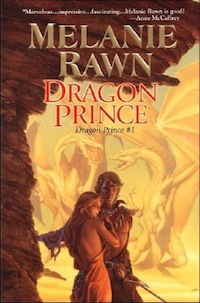
Welcome to the weekly Wednesday reread of Dragon Prince! We’ve reached the end at last. Loose ends get tied up, rewards are handed out, and Rohan comes full circle emotionally.
Chapter 31
So This Happens: Rohan, enriched by dragon gold, has been redecorating Stronghold. He has a new banner, a gold dragon on blue—holding an emerald ring.
The occasion is momentous: Pol is about to be presented to the nobility of the world, all the way down to Roelstra’s twelve surviving daughters, led by Pandsala. None of them knows that Pol is Ianthe’s son.
Sioned gives an unscheduled speech thanking the daughters for surrendering everything and offering them options: retire to Castle Crag, become lady of a manor, or marry a man of their choosing, with suitable dowry.
Rohan reflects on the cleverness of the plan, runs over the reasons for it, and assesses the princesses. “Eight nonentities, he told himself, but four who would bear observation”—Kiele, now married to Lyell of Waes, Cipris, Chiana, and Moswen.
He doesn’t think anyone will want any of them. He also observes that he’s claimed most of Princemarch, including ruined Feruche and the dragon caves.
Finally Andrade and Urival appear. Andrade is expecting “a good show.” Rohan intends to give her one.
The feast begins. Pol is carried off to bed. Various of the younger generation get a mention, including Walvis, who is obviously smitten with “a slim, redheaded girl with gray eyes whom it had pleased Rohan and Ostvel to place at the next table.”
The high table has special commemorative goblets in the various lords’ and ladies’ colors. They each also have “a small, empty golden cup.”
When the feast is over, Baisal, the new spokesman for the vassals, gives a speech. He calls for a toast to “the glorious peace won at Dragonfield.” The crowd also cheers “Dragon Prince.” Then Baisal informs them that Rohan and Lleyn have collaborated to define all the borders of all the realms and domains “for all eternity.”
There is a little sotto voce teasing between Sioned and Rohan. Rohan interjects himself into a pause in the speech, names each prince, has each golden cup filled, and confirms them all in their holdings, with Andrade as witness. He also adds a few new lords, including Walvis, whom Sioned gives a topaz ring and a string of grey pearls. This is a hint that he should marry Feylin at his earliest convenience.
There is more teasing, then Rohan and Davvi bestow River Run on Tilal. Davvi is now Prince of Syr, and his wife is beside herself with delight at the promotion.
“Goddess, how I love being a prince!” Rohan whispers to Sioned. Then he springs surprises.
Ostvel (to his total shock) gets Skybowl and the caves with the dragon gold. There is byplay with Sioned, going back to the death of Ianthe, and mutual forgiveness.
There is cuteness with Riyan, then Rohan names Pol’s teachers and companions. Then Prince Volog proposes to his former enemy and next-door neighbor Saumer that they exchange marriageable daughters for their respective heirs. This will unite their island. Saumer is not happy, but he agrees that it’s an “elegant” solution.
Rohan has a few doubts about arranging marriages, but waves them aside. He then springs his biggest surprise of the night, while Sioned, shattering etiquette, stands beside him. He claims Princemarch in Pol’s name.
Everyone is remarkably in favor of this. “Rohan was their only hope.”
Then he drops the biggest bomb of all. He appoints a regent for Pol: Princess Pandsala. Who is a Sunrunner.
That brings down the house. Pandsala takes the ring of office, and notes all the things she’s done to earn it, but points out that “we all know you don’t really trust me.”
They understand her, Sioned answers. “I’ve touched your colors. You are faradhi.”
Andrade is furious. As Pandsala swears to serve well as regent, Andrade threatens her with being shadow-lost if she betrays this trust.
Rohan warns Andrade to accept this choice. Andrade is not reconciled to it.
There is one more thing. Rohan is exhausted and Andrade is coldly furious, but she has to ask the assemblage to accept Rohan and Sioned as High Prince and High Princess.
Rohan’s mood has gone dark. He’s not unanimously loved, though he’s clearly accepted. He takes count of his and Sioned’s scars and the rest of the pain that has led to this moment, on everyone’s part.
Andrade formally invests Rohan and Sioned in their office. Sioned works magic with the cup, and Rohan lays down a new law: No more killing dragons.
The vision of a fiery dragon emerges from the cup and vanishes into the dragon tapestry. Rohan is hailed again as Azhei, Dragon Prince.
Night. Sioned and Rohan in bed together. Pillow talk. They discuss Andrade’s animosity, and the fact that Pol not being Sioned’s actual offspring means he has nothing to do with Andrade’s plans or plots. Pol is entirely Rohan’s and Sioned’s.
Rohan reflects on his sins: murder, rape, allowing Sioned to claim the child of that rape, making himself High Prince. He wonders what right he has to do all of that, and sees himself as having become a “barbarian” to win power, instead of living as a man of peace. He is deeply disturbed, and worries that power will corrupt him even further. He despises most of the princes, and only likes and trusts his closest allies.
“The only thing he feared was power.”
But it’s all for Pol. There’s reference to “bad times” after the war ended, a quick synopsis of marital discord, but Pol helped pull Rohan and Sioned together. “All he dreamed and planned and did was for this child.”
They put the baby to bed, and Rohan reflects that Sioned has refused replacements for the rings that Ianthe stripped from her. She will only wear the emerald she received from Rohan. “Sioned, while a Sunrunner, was no longer to be ruled by those at Goddess Keep.”
Rohan observes that when Andrade attempted to breed a Sunrunner prince, “What she really did was join those powers in love.” And that makes Sioned and Rohan dangerous. More dangerous than Roelstra and Ianthe’s hate. “There’s nothing we can’t do, and nothing Pol won’t be able to do.”
The book ends with the lovers hinting at making love, and declaring that that fire will never go out.
And I’m Thinking: Aaaaannd, it’s a wrap! Lots of loose ends get tied up. Everyone gets what they deserve, including Andrade, whose plotting has taken on a life of its own.
We see Rohan as both loving and hating being Prince. Loving the good and generous parts, hating the things he’d had to do to get to those parts. Sioned’s viewpoint we don’t get; as far as Rohan can tell, she’s set on her course and has no overriding regrets.
The theme of sons, sons, sons comes to a head here. They’re both totally obsessed with Pol and his future. That’s all they live for. Poor kid will get a complex, with that much pressure on him from both parents; he’s lucky he has so many, much less intense relatives, including his young male cousins.
The Rawn touch with setting and description really shines here. So does her intricate plotting and her ability to keep track of large casts of characters. She’s clearly thought hard and long about the morals and ethics of politics both worldly and sexual, and the role of the ruler, as well as the many dangers of power.
The attempts at lightness, all the teasing and joking and chuckling, slid by Eighties Me; I thought it was kind of amusing and took some of the weight off the heavier themes. 2014 Me is less patient, but does see what these bits are meant to do. They make the good guys more relatable. The bad guys, who have no humor and who snarl and sneer at each other, are clear foils for that lighthearted, easy rapport. And hey, cute kids are cute.
Rohan’s assessment of which of Roelstra’s daughters is worth noticing seems a bit off. He doesn’t count Pandsala in that group, even while he makes her Pol’s regent. Maybe because he’s more or less sure of her, and cannot say the same of her four most manifestly evil sisters?
Considering the era in which the book was written, I wonder about Pol and Paul Atreides from Dune. And there’s the line from Star Wars: “You are our only hope.” Rohan will rather slide off into elder-Jedi territory once the younger generation gets going.
Meanwhile, while we have closure, we also have definite movement toward the next installment of the saga. There are rumblings of discontent among the nobility, and Andrade is downright enraged. One war is over, but we know new ones will soon begin.
It’s been a long, varied, and occasionally wild ride. Lots and lots and lots of setup and exposition and internal monologue in the opening chapters, then escalating action, broken by the interlude that should have been an entire, additional book; and then more action and more conflict and more scheming and plotting, until Ianthe and Roelstra meet their richly deserved ends, and the good guys win—until the next time. This book has enough story for three. And we’re just getting started.
Next week: A new volume, a new set of challenges. We’ll be here. Come and join us!
Judith Tarr’s first epic fantasy novel, The Hall of the Mountain King, appeared in 1986. Her YA time-travel science fiction/fantasy/historical novel, Living in Threes, appeared as an ebook from Book View Café in 2012, and will debut in print this fall. Her new novel, a space opera, will be published by Book View Cafe in 2015. In between, she’s written historicals and historical fantasies and epic fantasies, some of which have been reborn as ebooks from Book View Café. She lives in Arizona with an assortment of cats, two dogs, and a herd of Lipizzan horses.

Great re-read, I enjoyed following along.
My only thoughts here at the end are “And now I remember why I only read this book”. Admittedly it’s been so long, I read it when I was probably 14ish, but even through the recap I was reminded of all the annoyances I had with Rawn’s book.
Mainly the rape, and the attempt at philosophizing (is that a word?) over it. Call me a romantic, but I don’t read fantasy so I can hear about how a woman rapes a guy, then said guy and his wife plot to steal the child of the rape. It just… didn’t feel at all real to me. It was totally unrelatable. Sioned’s anger, sure, but everything else felt so… contrived, I guess.
For instance, Pol being this awesome amazing magic baby. But he isn’t even Sioned’s kid, so where does the sunrunner talent come from? I don’t think that was ever addressed as far as I remember. And it’s not like Rohan is all that special either (other than Rawn telling us he is). Basically the baby being awesomesauce was only because he was a child of this illicit rape affair, and sorry to say that just never sat well with me.
I think another reason why it bothered me was because, as you pointed out throughout the reread, Rawn’s work is heavily contrived–the good guys are plot stupid, the bad guys are “lolz evilz”. I didn’t feel like the Rohan-getting-raped-Ianthe-having-baby was anything other than what Rawn wanted to happen. And I know, all books are what the author intends, but I think there’s a fine line between having your character’s actions feel natural so the plot feels natural, or stonewalling your characters into actions just so the book plays out the way you want.
I guess in the end, the reason why I didn’t read anymore Rawn was that I didn’t like any of the characters, nor could I relate to any of them. And I understand that it’s 100% just my personal taste. But it is what it is.
Still enjoyed the reread though, good job.
Naupathia @@@@@ #1: The origins of Pol’s talent are addressed in later books, though as Andrade’s great-nephew he does have the bloodline from his father’s side–and if Pandsala has the gift, presumably somewhere from his mother’s as well. Spoilers redacted. :)
Yes, they do explain where Pol’s magical talent comes from in the next book. Considering Pandsala trained to be a sunrunner, it isn’t a huge surprise that her nephew could be one as well.
I loved these books when I was in my teens and still enjoy them now. It hurts on some level to see how shallow some of the character are when looked at critically. Will be interesting to see if it gets better in later books.
I do agree when I got to the interlude and hear how much happened that was skipped over I had the same, wait, I want THAT story reaction.
Thanks Judith for wrapping this book – I’ve only occasionally commented but have read each post.
Interesting thought re Pol and Paul Atreides. Pol is actually how Paul is written in Irish (or Gaelic as people outside of Ireland tend to refer to it).
Jessica has no direct equivalent in Irish since obviously it’s not an Irish name. However, if they are brought into Irish, female names beginning with J are generally replaced with Sinead. Sioned is just a mangled spelling of Sinead – the pronunciation matches. Jessica<->Sioned is probably just a coincidence though.
Finally, on a random note, I’m from County Meath (pronounced “Mead”). I always find it odd to have a character called that.
@1 I’m glad you stayed with us even though the book wasn’t your cuppa. If you’d like to keep on, think of it this way: I’m reading the rest so you don’t have to. ;)
@2 and 3: My memory of the other two books is dim and far away, but I do remember Pol better than I remember Rohan. Pol does have a bit of that Atreides charisma. Intentional? That I don’t know. But…
@@.-@: I never thought about the Celtic roots of Sioned’s as well as Pol’s name. I have Thoughts and Feels about fantasy naming, but the names here really aren’t too jarring, and many times make a kind of sense. As opposed to A Certain Massively Popular Series That Is Now On TV, which I have to read as science fiction with lost Earth colonists or the names will drive me barking mad. Names have roots and reasons, people. You can’t just slap random English names on people in alien worlds. Mutter. Grumpfmle.
Helen79
Finally, on a random note, I’m from County Meath (pronounced “Mead”). I always find it odd to have a character called that.
I’m Dutch, from the North to be exact. Many Frisian family names here end with ‘-stra’, my own included. That always gives a small weird feeling when reading about Roelstra…
Oh, and a slight teaser for the next books: remember Ianthe’s other sons being brought out of Feruche by guards when the castle was in flames? The end of this books tells us nothing of their whereabouts… ;)
Thanks for this reread. I read it mostly on my phone, where commenting was a pain, but I wanted to chime in at least once!
I loved this series in high school and college, but I’ve been afraid to touch it in recent years — I dreaded seeing what the Suck Fairy might have wrought in the meantime. Your eighties-me vs. 2014-me observations were spot on.
I look forward to the rest of the series!
Oh my gosh, this was wonderful! I too read every entry but didn’t comment very much. I loved your recap, Judith! I can’t wait to read along with you and the next two books. It will be interesting to follow the story as an adult. I remember being a teen and how strange it was that Rohan and Sioned got so old in the second and third books. But these were my first “adult” fantasy books with adult characters. I had read Mercedes Lackey, but I think if YA had been a thing in the 80s, her books would have been classified as such. Maybe not. At any rate, yay! I’ve had so much fun with your recaps!