







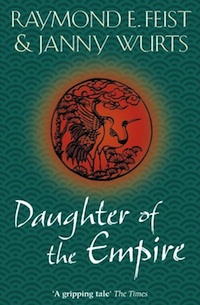
Welcome back to the Daughter of the Empire Reread! Since I last opened this book, I’ve been to London and back for Loncon 3, this year’s amazing and truly multi-national Worldcon. It was lovely to see old friends, to “meet” longtime online friends, and to make new friends. I was very pleased when people came up to introduce themselves, having heard me on Galactic Suburbia and Verity!, or through my writing, but a special shout out to those of you who came up and said hi because you’ve been reading this very column!
Also, if you haven’t already, go read Liz Bourke’s description of the Hugo ceremony—everything she said and more! Liz is one of the many people I was so delighted to get to meet in person instead of in internet.
 And now, the end is here—of Book 1, that is. When we last saw Mara, she was grieving, shocked and under siege from all sides, but still capable of manipulating one murderous concubine, one panicked First Strike Leader, and Lord Jingu of the Minwanabi himself.
Or is she? The magicians have stepped in now, so the final could be anyone’s game… Oh, never mind the sports metaphors. LAST CHAPTER LET’S MAKE THIS A GOOD ONE!
Chapter 17: Revenge
Summary: They have quite an audience. Many of Lord Minwanabi’s guests now fill the bedchamber in which Mara was attacked. She stands there with Nacoya and Arakasi at her side.
Elgahar, the Great One who has promised the Warlord he can tell the truth from the lies, clears the space where the events took place.
Lord Jingu looks a lot less smug than he did five minutes ago.
The spell is cast, so that the whole crowd can witness a ghostly (but silent) recreation of the night’s events from the moment that Teani entered the room. Mara is surprised at how confident she herself seems to be, looking from the outside.
When Teani is seen to attack Mara, and Shimizu stops her, Lord Jingu looks relieved—he might well get away with this if Teani is condemned as a rogue. But then, as they all witness, Shimizu himself bears down upon Mara.
The spell ends, and a whole lot of judgy eyes turn upon Lord Jingu. Quietly, he demands to know why Shimizu would do such a thing and all his man can say is “the witch betrayed us.” It’s not clear who he means, Teani or Mara.
Furious, knowing that the actions of his servants have condemned him to ruin and death, Jingu attacks Shimizu with a dagger, killing him.
Almecho the Warlord disapproves of Jingu’s hasty action, and then ignores him, speaking directly to Desio who will be the next Lord of the Minwanabi:
‘As sunrise is considered the best time for such matters, I expect you’ll busy yourself for the next few hours with preparation for your father’s ritual expiation of his guilt. I’m returning to my bed. When I arise, I trust you’ll somehow restore the gaiety to this shambles of a celebration… Lord Desio.’
Cold, Almecho. After all this drama, he doesn’t want anyone to forget that it’s his birthday and someone (not looking at anyone in particular, Jingu) promised him a party.
Desio looks like someone who just kicked his puppy (or, you know, murdered his Dad) but that doesn’t stop Mara taking quick advantage of the situation, calling on him to provide her with an honour escort to leave the next day, given the violence visited upon her—reminding him of how bad it would look now if she were to, for example, be attacked by water pirates.
He is too distracted to come up with a fast or worthy excuse, though it’s clear to Mara that she has swapped one enemy for another, the blood feud passing from father to son.
The rest of the guests (including Almecho himself) are sending silent approval in Mara’s general direction. Not one of them actually believes that Jingu was stupid enough to send his servants to do the clumsy work they did tonight—and all are crediting Mara with having some how pulled off the scheme of the century.
This culture is so screwed up I can’t even.
Mara speaks gently to the Warlord, suggesting that it’s a bit unfair to make poor little Desio continue the party after having to witness his father’s impending death—so, here’s an idea, why doesn’t everyone come back to the Acoma estate and party on there instead?
The Warlord laughs, admiring her boldness. Yes, they will move the party to her place. He is impressed enough to imply that if anyone woman could aspire to holding the white and gold, it might be her…
Thus, Mara’s transformation is complete, from a miserable and grieving child left with almost no resources, to a calm and confident player in the Game of the Council.
Only when she is on the barge heading home, however, can Mara finally begin to relax. Staging a birthday party with no notice (relying on the entertainers whose favour she won during her wedding) is going to be tricky, but nothing like as overwhelming as what she has gone through in recent weeks and days.
Lord Jingu, the man who orchestrated the deaths of her father and brother, is finally gone. Desio might have inherited his father’s hatred of the Acoma, but he will have nothing like the level of influence and power that his father held.
As they approach Acoma lands, Mara is shocked to see not only her own warriors out in force to greet them, but a thousand or more Anasati warriors as well. With the Warlord’s permission, she hurries ahead to greet Lord Tecuma, her father-in-law.
Tecuma, knowing Mara was in danger at the birthday party, had brought his warriors here to protect the Acoma borders, knowing that Lord Jingu’s first response after murdering Mara would be to go after Ayaki. Keyoke had kept Tecuma and his forces at bay, not allowing them on to Acoma lands.
Mara informs her father-in-law that Lord Jingu is dead by his own hand, along with Tecuma’s own spy. She then invites him to join the birthday party, though she cautions that he must keep his honour guard to a mere fifty men, as with the other guests.
Jican scurries around, performing miracles in the name of an unexpected house party. Nacoya, resilient as ever now that she is on home territory, takes personal responsibility for housing the magicians. Mara joins the Warlord for a private talk, at his invitation.
To her surprise, Almecho tells her directly how impressed he has been with her machinations over the last couple of years, and that both he and Lord Tecuma should be grateful to her because Lord Jingu’s ambition was surely going to threaten them both as soon as he had disposed of the Acoma.
He flatters her, and admires her, but acknowledges as well that she is a danger. Good players always are.
After they part, Mara has a quiet time alone with Keyoke, discussing the loss of Papewaio and his recommendation that Lujan take Pape’s place as First Strike Leader.
Finally, at the entrance to the sacred grove of the Acoma, Mara meets Tecuma and they make peace with each other. He has not forgiven her yet for her actions with his son, but admits that he is likely to have done so by the time Ayaki is of age.
He also names her a true daughter of the Empire, and notes that all the guests who are ostensibly here to celebrate the Warlord’s birthday are in fact here mostly to celebrate Mara herself, and her rise within the Game of the Council.
Mara quietly accepts the accolade, and then takes herself privately into the grove so that she can pray to the natami, and tell her father and brother that they are finally avenged.
The game continues.
Commentary: So basically Lord Jingu is all: “I came out to have a good time and honestly I’m feeling so attacked right now.”
It’s rather chilling that from the moment that it becomes obvious he is going to have to kill himself in expiation, Jingu fades from the story. Characters don’t even talk to him any more, and he does not get to speak. There is no mention of how he leaves the room, as he is no longer relevant to anything.
The Tsurani are rather good at killing people before they’re technically dead. It’s a clever if disturbing touch.
It’s extremely lucky for Mara that the Great One presents the story without sound—her machinations and her share in the guilt of how things ended up are completely hidden without any evidence of what was said, and the silent version of the action makes her look even more of an innocent.
I wonder if this was a choice on behalf of the Great One, or if it was the only way the spell could work?
In any case, she comes out “looking” like a victim with the bonus side effect that no one can see how the trick was done. No one is thinking of her as a victim or as being in any way powerless—the general response of the audience is that she’s been bloody clever. The silence of the magical scene not only adds to Mara’s technical appearance of innocence, but also to her reputation as someone with near superhuman powers of manipulation.
All is not well that ends well—Mara has been burned along the way—but it’s kind of fascinating that the climax of this first volume of the trilogy is not just about the revenge she has managed to get upon the man who destroyed part of her family and was gunning for the rest, but it’s about the way she has earned the respect of several high powered men in her community. The wind down of the book takes us through various short scenes which reiterate this, over and over again.
Gender has been a big part of this story—Mara is technically allowed to be a Ruling Lady but only because all male heirs have been eliminated (or in the case of Ayaki, are underage). It’s also very clear that most of the men who salute her in the closing scenes—particularly those without a close relationship to her such as the Warlord and Tecuma—respect her abilities as a Ruling Lord very much DESPITE the fact that she is female.
What we’re not getting yet is any acknowledgement that many of her ‘wins’ in the Game of the Council thus far have been because she is prepared to exploit the way that women are perceived and treated in their society.
The main thing that I felt was lacking in the final chapter was a conversation between Nacoya and Mara, balancing out the chat she has with Keyoke, because Nacoya is so far the only female role model that Mara has to work with.
Roll on, Servant of the Empire. I remember something vague about a certain redheaded barbarian slave, but that’s basically all I can recall about Book 2. Bring it!
Tansy Rayner Roberts is an Australian fantasy author, blogger and podcaster. She won the 2013 Hugo for Best Fan Writer. Tansy has a PhD in Classics, which she drew upon for her short story collection Love and Romanpunk. Her latest fiction project is Musketeer Space, a gender-swapped space opera retelling of The Three Musketeers, published weekly as a web serial. Come and find her on Twitter!

And there we go …
I love the putting the boot in of stealing the entire celebrations, plus the quiet … say what … Tecuma has when the extra Cho-Ja go back home.
Was a delight meeting you at worldcon … you have more patience than me for sure – I just finished Mistress last week. This one chapter a week lark is waay too hard at times.
Well, it is rather funny how everybody thinks that the bald-faced attack was a result of Mara’s masterful plotting… when, for a change, she had very little to do with it and it was mostly Teani – Shimizu dynamic combo that doomed Lord Jingu. I don’t even think that if the Great Ones could/would reproduce sound, that it would have been particularly damning for her.
Also, yes, Almecho does admit that he saw Jingu as a dangerous rival, so his quick offer of magicians was quite self-serving.
I would venture to think that despite aknowledging that Mara was great at the Game of the Council, he still thinks that whatever her brilliance, as a woman she’d be “safer”, as she can’t aspire to his position. Which, I am dimly recollecting, doesn’t quite pan out that way, heh.
Also, it seems that Anasati weren’t badly damaged by whatever calamity ostensibly prevented them from attending. I imagine that Almecho purposefully left them out, as he didn’t want Minwanabi to be able to swallow Acoma and Anasati in one fell swoop. This way, even if they got rid of Mara, Anasati still had a chance to hang on to Acoma lands, as well as to defend themselves.
Almecho’s insistence on still getting his celebration is as hilarious as it is horrible. And “stealing” it is vinatge Mara, though practically speaking it doesn’t seem very plausible, as things like that normally required weeks of preparation and Acomas just shouldn’t have enough supplies close to the manor house to be able to do a creditable job at such a short notice.
I’ve really been enjoying this reread. It’s been a few years since I’ve actually read the series, but I’ve reread it so many times I remember the books quite well….
I was disappointed by the climax this time around. It’s less Mara maneuvering than Teani and Shimizu’s actions, the role of the magician is a too dues ex machina-y, and another antagonist going down by ritual suicide is redundant.
I still enjoyed the book and look forward to re-reading book 2. Is the re-read going to jump right back in next week?
Herb2539 @5:
I actually liked the irony that Mara had very little to do with Jingu’s fall as an active plotter, but everybody thought that it was some awesome intrigue and gave her mad props. I mean, sometimes you just get lucky. It isn’t like Mara hasn’t earned her reputation many times over and doesn’t deserve some opportune windfall. Also, her immediately taking advanatage and stealing the party showed her chops and was quite funny.
Re: ritual suicide, since Mara is not a martial hero, which I very much appreciate, driving her enemies into financial ruin/ honor suicides has to be her primary focus. I mean, she could have gone for an assassination or three, but, I guess, the authors thought that it would make her too villainious? Also, doing it on Minwanabi’s turf, yet still avoiding the blame, would have been pretty much impossible, IMHO.
I do wonder why Jingu (or Teani, for that matter) didn’t just poison Mara – there could be no defense from that, surely. Or is it beyond the pale for Tsuranni?
Isilel @5
Yep. Sometimes being a hero is all about being lucky and taking advantage of that luck. And Mara certainly deserved a stroke of luck right about now.
I’m not sure why they didn’t just resort to poison. It may be the niceties being observed. An assassin can be denied or disavowed. Poisoning, when all the food is prepared by the host, is less so.
@2 Great to meet you too, Mayhem!
@5 Yep should be going straight into Servant next week, that post is already cued up. It’s the book of Kevin, people, so lots of mansplaining and flexing biceps still to come.
Loving the comments about poison – I would think a nice slow acting poison would be best so you send your guests home & they suddenly die 2 days later. Sounds like a business opportunity for the up and coming pharmacists of Tsuranni.
I DO like to see a protag seize the moment. Too often in SpecFic protags are either victims of fate or in total control; in real life heroes are heroes because they seize the opportunities presented.
Now I have to run home and read the beginning of book 2.