







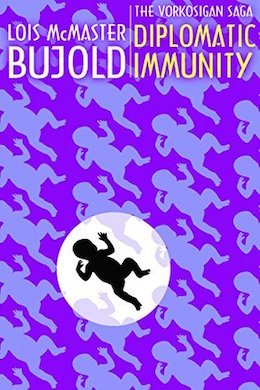
In chapter 17 of Diplomatic Immunity, Miles is confined to the Idris’s infirmary, strapped down (seizure precautions!) and transported in the general direction of Cetagandan space.
I’ve been thinking a lot about Miles this week—as is my habit, now, two-and-a-half years in to this reread, but more than usual because Miles is on his honeymoon, and I’m working on planning my twentieth anniversary. If there is anything worse than a life in ruins with vomiting, it is surely a life finally gotten into perfect working order but with a high probability of imminent death and/or the termination of all sexual contact due to Weaponized Cetagandan Death Plague. I have twenty years of what Miles is could so easily miss: Eating cheese, folding laundry, and making bad jokes about the domestic architecture of New England. I’ve been very fortunate on the Weaponized Cetagandan Death Plague front.
Miles is on the Idris, with Roic to handle important health care issues like alerting the chief surgeon to Miles’s seizure disorder. If he spends time pondering this issue, it’s between helping Bel explain where the Ba left a virus bomb and being mostly delirious. (Miles, like his father before him, likes to keep busy with work when confined to hospital.) The loss we see Miles contemplating—other than his sex life, which is fair in the circumstances—is the loss of his covert ops career, which he is reminded of when Bel calls for “The Admiral.” Ekaterin is following in convoy on his personal courier. She brings a Vor-ish stiff upper lip. We don’t get much of her view, but I imagine the implications of Miles’s death are on her mind. She’s about to have two children, whether Miles lives or not. This is not her first whack at widowhood, but it would be a very different loss than Tien’s. Miles mentions wanting to give her something different, and at the time that he said it, he wasn’t thinking entirely of a large trust fund and some very supportive in-laws.
Miles emerges from his periodic delirium in Cetagandan space, an uncertain but probably short time later. He wrote incoherent letters to his family to be delivered in case of his death, and Ekaterin refuses to destroy them. She says the one to Ivan was particularly touching. I’m glad Ivan finally got his due, even if it’s not delivered for another seventeen years and I haven’t had a chance to read it. Family means a lot of different things, and Ivan has been all of them.
Bujold is emphasizing the theme of family this week as we look at the return of the Haut infants to their families on Rho Ceta. The nature of Cetagandan parenthood has been a topic of a lot of conversation in the comments over the last few weeks, and I have stayed mostly out of it. I wanted to refine my thinking. Bujold deals with a lot of visions of parenthood. Betans get licenses. Barrayarans can have biological accidents. Men on Athos earn credits and grow beards. Cetagandans appear to be the most hands-off. If you think that genetics play a much more significant role in individual destiny (for lack of a better term) than nurture, there’s really only so much to do. Those Cetagandans who the Star Creche has chosen to have children in any given year are being honored. They have proven their fitness—or, at least, their possession of interesting genes—to the review board, and their genes are then passed on. I think it’s likely that Cetagandan Haut babies usually get their genes from more than two otherwise-unrelated contributors—Miles’s genes are added to the Empire’s gene banks, and I can’t imagine the Star Creche calling him back in ten years to ask if he can meet his child and co-parent at a ceremony somewhere. I imagine that a group of engineers as adept as the Star Creche is accustomed to making insertions and modifications for specific purposes. And when two Cetagandans have a child, it’s the subject of a great many very complicated arrangements.
Miles notes that parent and child may never see each other again once the replicators are handed over to the planetary creche to be opened and children raised. That sounds like a bad scene—it didn’t go so well for the Quaddies in Falling Free who had no adult community to superintend their interests or safety. It didn’t go well for Mark, and it went even less well for his fellow clones on Jackson’s Whole. In the Galactic Nexus, having parents has typically meant having protection. But it doesn’t have to be that way. We’ve never seen an adult Cetagandan reminisce about their childhood creche. We have seen many, highly-educated and very competent Haut (mostly women—Miles hasn’t spent much time with the Haut men). This implies that creche conditions are good. And we know that the Star Creche tests genes carefully—the renegade Ba in this story was a clone of the Cetagandan Emperor.
Buy the Book

Static Ruin
Even the most ardent proponents of the belief that genes trump environment will concede that environmental factors can interfere with efforts to optimize genetics. The Cetagandans are looking for the best possible results from their Haut genetic experiments, and they appear to have decided that parental care is not the most reliable route to the best possible outcome. I disagree. But my feelings don’t matter in this case—I’m not Cetagandan and I don’t get to decide what best practices are for raising Haut children to be generals, emperors, and genetic engineers in the Cetagandan Empire. While contributing to the genes of the next generation of Cetagandan Haut is an individual honor, raising children appears to be a collective responsibility managed by institutions. That’s very alien to me. Kind of like Cetagandans.
It’s clear from the ritual Miles witnesses that none of that diminishes the importance of children in Cetagandan culture. After an important moment of mourning for the Haut lady who went down with the ship, the uterine replicators are greeted with joy and enthusiasm. I don’t know if Haut parents choose between privately-owned creches, or all send their children to one, publicly-run one. It’s possible that each clan has a creche of their own. The results suggest that a great many resources are invested in them.
For comparison, Bujold finishes up with Miles and Ekaterin’s childrens’ births. Aral Alexander and Helen Natalia are decanted in the presence of their Vorkosigan grandparents, their older brother Nikki, and their uncle (Ekaterin’s brother, who maybe gets a little over-excited about holding the vid recorder). Cordelia fists her hands in her skirts to keep from grabbing a baby. We will, of course, be dealing with that later.
Next week—Captain Vorpatril’s Alliance!
Ellen Cheeseman-Meyer teaches history and reads a lot.




My impression was each constellation has its own creche run by the elders. I seem to recall Maz saying back in ‘Cetaganda’ that haut aren’t allowed to live independently of their constellation until they’re fifty.
It seemed to me there was a lot of emotion in ‘the Place of Child Hopes’. The parents of this year’s cohort of haut children may not have the kind of feeling we do for our children but there was a definite emotional investment and genuine grief over the loss.
Captain Vorpatril’s Alliance – Whee!
Yay, Captain Vorpatril’s Alliance!
More opportunities to discuss How The Haut Regard Their Children, in combination with How a Jacksonian House Regards Their Children.
I have a lot of thoughts about the Jewels, and how they fit into both haut and Jacksonian attitudes towards children, but I’ll save them til we get there.
The Cetagandan crèche/constellation system makes me think of the Liaden clanhouses- possibly because I’ve been re-reading them.
By Miles’ time, New England architecture will have changed from its current wondrousness to look something like the sort of bad taste that seems to be involved with architects that flunked math.
———-
Norms of child rearing are derived from society, not instinct: the mother-father-2.4 children “nuclear family” supplanted extended families (mother-father-grandfather-grandmother-maiden-aunts-bachelor uncles-N children-fostered cousins-…..). Probably until the 20th Century, blended families were the norm — marriages wouldn’t end in divorce after a few years, but in the (usually natural) death of one of the spouses (I’ve read that half the 18 Century marriages ended before ten years: no divorce, but death)
@@@@@3. PamAdams
I can see the resemblance. In the clan you can be raised to understand the family culture, tradition, and skills. You also may not live with your direct parents, but aunts, great uncles etc will be the one to teach you daily. Your loyalty is not to just the strait line of father to son to son, but to the whole clan/family as a group.
Liaden clans don’t much resemble what we see of the haut, although, superficially, the societies both have a strong focus on aesthetics. But the Liaden reliance on biological reproduction is a pretty huge difference – given access to haut technology, I suspect many delms (and the occasional tree) would find it convenient to collect genetic samples and de-involve the peskily rebellious people. If Petrella yos’Galen could have had her way with a bank of uterine replicators and a handful of gametes, Korval would be both much more populous and far more genetically diverse.
We don’t know how the haut started, but they seem capable of living quite isolated lives, although their bioweapons suggest they’re gravely concerned about some external threat. Or just incredibly malicious and expansionist – but they mostly seem to send the ghem to do the conquering.
The view of Tej’s family that we get in CVA is fascinating, and CVA is just really fun. I’m looking forward to it.
…I doubt Miles and Ekaterin fold much laundry, but I bet the cheese is spectacular.
Gonna admit I’m now super excited to get started on Captain Vorpatril’s Alliance, as whlie I enjoyed Diplomatic Immunity, it can’t really stand up to the hilarity of the novels its sandwiched between (logically so, as its not a comedy like those two other books, but still).
Glad this one is over. Biological weapons always give me the creeps.
News stories within the last couple of weeks suggest that nature has even less to do with intelligence than had been thought; the Cetagandans may be trying frantically to scrape what little advantage they can from genetics. OTOH, we’re getting a somewhat Barrayaran view of Cetaganda, and Barrayarans have their own focus on breeding; it’s possible that another culture (e.g., Betan) would be more aware of what the Cetagandans did to raise their children, and how much effort (as opposed to the ceremony we see) is put into nurture — or the upbringing may be so totally closed that nobody gets a glimpse. I wonder whether they are as experimental about child-rearing as they are about child-creation; they don’t seem to be having enough children to experiment on (contra, e.g., Nou Occitan in Barnes’s series), which raises the question of whether they’re making mistakes as big in child-rearing as they are in diplomacy (cf comments in previous subthreads about Miles saving their asses again).
I was struck on rereading by the fact that the ship transporting that year’s children had somebody guarding a spectrum of bioweapons on board.).Do they make this sufficiently known that pirates avoid them like the plague [sic]? (I get the impression not, but I don’t have the complete corpus of fragments about this memorized.) Bioweapons aren’t defensive, since they’re so slow-acting; are the Cetagandans that interested in revenge? It says something about their culture (but probably nothing new) that they would have an array of weapons, but not be able to offer something that would overhaul Miles’s scarred circulatory system from the inside.
“It says something about their culture (but probably nothing new) that they would have an array of weapons, but not be able to offer something that would overhaul Miles’s scarred circulatory system from the inside.”
To be fair, it might just be they engineered their blood vessels to recover from such issues; given how frequently circulatory issues still cause death by the time of the series (witness poor Aral) it’s a logical target to work on.
Though on a more creepy note, it may be the bioweapons are on the child ships as a way to go scorched earth if somebody tried to steal Cetaganda’s latest work. Melting all the children to goo would be a disturbingly effective way to ensure no DNA could be recovered, not to mention a nice way to plant booby traps for your enemy’s scientists if they try to examine anything. Honestly it’s about the only reason I can think of to transport biowarfare agents and your own children in the same ship, unless the haut casually stroll around with WMDs as a rule.
10 sounds believable. Both bits. Either it’s scorched earth, as you say, or the haut routinely travel with BW kits for the same reason that Barrayar sends escorts with merchant fleets – because it’s always nice to have lethal force close by in case you need it suddenly.
@10 Mike B – More likely, the Planetary Consort always travelled with her personal armoury.
Despite Miles’ attempt to resurrect Nature vs Nurture, it stands to reason the haut have studied nurture as carefully as genetics. And once you know exactly how to raise a child it may become a profession, requiring half a lifetime of study.
Some early socialists thought children should be raised by professionals, not by amateur parents. Of course they were dreaming, just as they were dreaming of a planned economy, they underestimated the difficulty by orders of magnitude. You don’t become a professional just because you are paid to do the job, even if you have passed the exams. Replacing amateurs with professionals may not even be possible, but it is not unreasonable in science fiction.
Miles’s genes are added to the Empire’s gene banks, and I can’t imagine the Star Creche calling him back in ten years to ask if he can meet his child and co-parent at a ceremony somewhere.
Oh, but I can!
CVA!!! Can’t wait. One of my all time faves.
Remember reading it for the first time and just waiting for someone to say “Ivan, you idiot!”
The bioweapons as scuttling device makes it sound like they regard the crop as a matter of national security, the way that the latest codes on a ship are, to be destroyed in the event of imminent capture.
And yet they casually ask Miles for his genetic info, and explain it’s an honour (Miles doesn’t make a fuss as he knows there’s no way they haven’t blagged samples and sequenced his genome already). I think I like the “feudal aristo’s personal armoury” idea better.
If we define a professional as someone whose peers let them conduct business freelance at their own discretion, only stripping them of their permission to practise if they are found to have brought the professional body into disrepute, then parents are professionals already, courtesy of the government and its child safety laws.
Except that professionals usually have to jump through hoops to get into the profession in the first place, so today’s parents are a curious mix, allowed to give it a go with zero training, but not allowed to keep screwing the job up.
@@.-@, the extended family as the norm is a very persistent myth. Actual historical evidence shows the nuclear family has been the norm in the west back to classical times, at least. Even cultures that valorize and urge extended families such as traditional China still had more nuclear style families. What is true is that said nuclear families tended to live near and in constant contact with a web of relatives.
Given that the Consorts in Cetaganda discuss adjusting the attitudes of haut men genetically I suspect that they underrate nurture as a developmental influence. Hand on childcare seems to be provided by Ghem nurses undoubtedly overseen by a haut supervisor, and education may be handled by haut of lower rank.
I wonder if the cetagandans have ship-to-ship delivery systems of the bioweapons. Or they may have internal delivery systems to deal with boarders, including an acidic spray to get through space suits. I certainly wouldn’t want to board the crèche ship in anything less than full powered armor.
So, the next generation of ghem soldiers will be like Miles?
Run away fast.
@18 jmeltzer
One Miles is a terror.
An entire generation of Miles is a civil war.
I suspect that someone with Miles’s subordination issues would have just as much difficulty obeying himself as he would anyone else.
@18, 19: A historical Arabian horse breeder used to say there were some genetic elements you embraced whole-heartedly, and others you added with an eyedropper. I expect the haut would put Miles in the latter category.
Have you noticed that no sooner does Miles deal with one health issue but he quickly gets another? His friable bones are replaced with unbreakable plastic, he gets a seizure disorder. He finds a way to manage his seizures he gets circulatory damage and heart issues in waiting.
So, the next generation of ghem soldiers will be like Miles?
“It’s probably nurture, not nature, y’know,” he whispers during the ceremony. But is it? There’s a good natural experiment – Mark is genetically identical but suffered a radically different upbringing. How has he turned out? More similar to Miles than average, or more different?
But I don’t think the ghem are genetically engineered (except inasmuch as they have haut-wife ancestors, which are deliberately used to leak desirable genes into the ghem population). The haut, on the other hand, are, and Miles’ DNA is going into the pot that the Creche will use to produce the next generation of haut babies.
@22 – While I concur that a lot of Miles’s personality is a result of his environment and experience, I have also noticed that Miles has a lot in common with his parents.
If I were a Haut lady, I would be planning many rounds of testing in the Ba before I turned those genes loose in the general populace.
@23 EllenMCM
As we’ve seen, ba are quite capable of rebelling against their “siblings”.
I think ba are deliberately similar to eunuchs; trusted servants, close to the center of power, but unable to reproduce and pursue their own family.
Unsurprisingly, that kind of treatment often inspires resentment and rebellion. And unlike the general population, ba are in a wonderful position to steal haut biological weapons.
@Ajay, Mark is a weird case for the Nature v Nurture debate….as Mark wasn’t brought up like Miles but to pretend to be Miles. The two are very different in many ways and Mark’s Jacksonian heritage comes very much into play there (more than any Komarran influence), but they are kind of similar in their ability to scheme and want for love, which I suspect is as much due to their similarities in how they were brought up to be a certain person, even if that was for very different reasons.
@24, Ba may often feel resentment but apparently it is rare for them to act on it. Interestingly Haut Pel blames its upbringing.
@23 The thought of what a ba with Miles’ genes might get done in the name of serving its emperor ought to scare the haut properly….
Especially if the ba had Miles’ drive to excel. Of course it could also turn out to be temperamentally more like Alex rather than Helen.
@27 what a story idea. Devoted Ba implicitly loyal to the Emperor and the haut project creating chaos as it seeks to protect both from all threats.
“I know you didn’t order me to eliminate the Ghem general at the head of the conspiracy, I just assumed you would want it done.”
Emperor Fletchir to Empress Rian: “I blame you for this.”
@0: I’m glad Ivan finally got his due, even if it’s not delivered for another seventeen years and I haven’t had a chance to read it.
I thought someone had reported in a previous chapter’s comments (or maybe all the way back to ACC) that LMB said Miles dies at 58? That would would give him 26 years rather than 17 — even more time to rewrite to fit the subject, e.g. Ivan won’t be a gay bachelor (or even a desperate bachelor) in a few years, and after GJatRQ Miles may realize he doesn’t know even his nearest-and-dearest well enough to give advice.
Also: Ekaterin is following in convoy on his personal courier. She brings a Vor-ish stiff upper lip.
She brings rather more than that; she again interfaces between Miles and the less-experienced world (“Miles, unpack!”), and (ISTM) gives Miles a reason to pay more attention to medical advice (although someone else has to tell the medicos about his seizure disorder). I’m still a bit surprised at how much spine she shows; I wonder how many Vor women would be able to snap back to their upbringing after a decade of Tien’s abuse — the men (at least the Counts) seem a very mixed bag, although the women may have been taught to be the ones that hold it together (cf What Every Women Knows).
@10: To be fair, it might just be they engineered their blood vessels to recover from such issues; given how frequently circulatory issues still cause death by the time of the series (witness poor Aral) it’s a logical target to work on.
A good point. One of the Cetagandans in chapter 18 makes clear their life expectancy is much longer than that of Barrayarans; that doesn’t come without fixing physical-degeneration issues, which they seem to prefer doing with gametes rather than the sort of gene-replacement(?) therapy now being explored for (e.g.) cystic fibrosis.
@11: I don’t see comparability between the escorts and the bioweapons; the latter can only avenge an assault (and that if the pirates don’t armor themselves), not turn it back. And a bioweapon that requires personal contact is even less useful, unless pirates boarding a Cetagandan ship are as careless as Miles was. I think @12 has it — this is a Done Thing rather than a defense.
@29: The Cetagandan version of “With Folded Hands” could get strange.
A civil war as the collective noun for Miles? Hilariously apt and also makes us note that he keeps preventing them wherever he goes.
As for the haut Pel, I liked “her name will be remembered” although it was never given. And I wonder who Cetaganda sends to Miles’ funeral.
@12
Yep, I’m pretty sure it’s the Cetagandan equivalent of the nuclear football – it travels with the Planetary Consort at all times in case something is needed. We all too easily overlook that along with the children being kidnapped, most of the crucial female leadership was killed as well. I wonder what happens now – does the Governer get gifted a new haut consort to keep everything moving along, or is the governer replaced by someone whose wife meets the Star Creche requirements?
@32
For a state funeral, Ghem-general Benin for sure and almost certainly Pel, alongside whoever the Cetagandan representative to Barrayar is then and his entourage. They both have personal familiarity with Miles, the vested interest alongside the emperor in seeing that such an event is given due gravitas given his history with the empire, and the quiet intent to make certain he is in fact dead for good in all his identities given that same histor.
@25,
perhaps we could experiment with a few more clones?
I think the reason why I’m not too fond of this one (even though I am amused that Miles is going into the haut gene pool) is that Miles comes out even more disabled after it and I miss his more action-y style. I know, “getting old” and whatnot would ruin that anyway, but still. I still wish we got to see more of his crazy cases and whatnot but this is kind of where it ends until Cryoburn (which I….well, it’s my least favorite).
This article isn’t on the index, btw.
@36 – Fixed, thanks!
Something I’ve been wondering since last week’s discussion is what kind of power the ba as a group have. The women promote the genome (and the genetic experiments of things like bio-weapons). The males rule the empire, but the purpose of the empire (from the haut POV) is to provide for the genome. The ba can serve in either area and can have high positions–Rian’s co-conspirator was a ba and possible sibling of the emperor–but they don’t have the highest positions.
However, it’s a mistake to think of them as just servants or slaves. You can’t test run a ba prototype as an emperor without giving it a chance to act as an emperor, even if it is on a smaller, controlled scale.
What we do know is that all haut are supposed to be subservient to their clans, their political/genomic duties, and to the haut in general. The ba are supposed to feel rewarded if the larger groups they serve prosper and if their male or female counterparts have opportunities because of the ba’s success.
Obviously, as this book proves, that idea has some flaws.
*****
On the issue of haut attitudes towards children, we are given an interesting hint. The previous’ empress’ “mistake” with the ba villain was treating it as a child. Whether that means treating it as if it were her child (which is disturbing, since it seems to have really been her child in genetic sense) or whether she indulged it as a child once it was an adult is unclear, but it implies that parents do have a relationship with their children that does involve some kind of indulgence.
The Cetagandan Haut culture is based on microbiology and genetic manipulation.
Is it fair to say they practice Social Neo-Darwinism?
Aren’t they described that way in Cryoburn? I think the line was “what happens when 20 million practicing social Darwinists invade one’s planet” (or words to that effect)?
@38, I suspect most ba are proud to serve the haut experiment, just as mosst haut are, that’s how they are socialized but there will always be rebels and misfits. This ba is probably not the first of its kind to be dissatisfied with it’s role but it is probably the only one to rebel to this extent.
Haut probably vary in their attitudes to their offspring. Some aren’t interested, others are deeply attached, and all points in between. Those who do take an interest in their offspring may well adopt an indulgent role leaving discipline and training to the creche staff.
@41 princessroxana
“The haut experiment” is a somewhat vague concept, and it may be possible to interpret it in different ways. The entire plot of Cetaganda revolves around the Empress deciding that a divided Empire is good for the haut experiment, a decision that the Emperor obviously disagrees with.
Who is to say that the ba was betraying the haut experiment? Does the Empress have the right to decide what is best for the haut? Does the Star Creche? Does the Emperor? The ideal of haut is not clear, and it’s possible to have different opinions on the subject, just as devout people can agree on the importance of religious doctrine but disagree about the meaning.
My personal impression is the ba was motivated by rage and resentment of the limitations imposed on it by its creators. Other readings are of course possible. Maybe it was trying to fulfill its mother’s goal in some left handed way.
@42 I doubt the Haut practices the priesthood of the believer. From the final meeting of the epilogue in Cetaganda, I think the Consorts, Empress, and Emperor are supposed to make decisions about the Haut as a group and a project collectively.
@43 princessroxana
I agree that the ba was driven by rage and resentment. I also think that the ba genuinely believed that the Emperor was going against the Empress’s wishes (because he was), and more dubiously concluded that it was his duty to fix things by kidnapping the next generation of haut children.
@44 noblehunter
Most of European Christianity didn’t have the priesthood of the believer until Martin Luther nailed his theses to a church door. Heretics are always despised unless they win.
As we see in Cetaganda, there are internal differences about who has the right to act for the haut. The late Empress believed that her plan was best, ignoring the Emperor’s traditional veto.
If you believe strongly in the goal of haut, and you think that the existing authorities are wrong, it’s easy to justify correcting their error. For the good of the haut, of course.
@42 – This seems to be by design. The haut who are contemporary with Miles Vorkosigan seem content with the idea that “the ideal of haut” will be clearer to and better understood by their post-human super-descendants.