










This week, the reread jumps roughly 15 years from Barrayar to The Warrior’s Apprentice. First published in 1986, this is the first book in the series to feature Miles Vorkosigan, the fourth in reading order, and the second in publication order. At the time of publication, the only other book in the series was Shards of Honor, published two months earlier. I’m retroactively jealous of 1986 for getting two Vorkosigan books as beach reads, though I think that going straight from Shards to Miles’s adolescence must have caused readers whiplash.
If you’d like to catch up on previous posts in the reread, the index is here, and a series of blog posts on The Warrior’s Apprentice by Jo Walton can be found by following the Warrior’s Apprentice tag. At this time, the spoiler policy permits discussion of all books EXCEPT Gentlemen Jole and the Red Queen. Discussion of any and all revelations from or about that book should be whited out.
The Warrior’s Apprentice was the first of the Vorkosigan Saga books I read. I’m not completely certain of the exact provenance of my first copy, now tragically lost in the sands of having moved across the country twice, but I believe it was a gift from my father, and that’s the story I’m sticking with. I am completely certain of the cover that book had on it. It was this amazing piece by Alan Gutierrez, redolent with the sweet promise of a rollicking adventure:

The right hand side features Miles in the command chair, probably about to say something cutting (“God help us”). From the way Elena Bothari is clutching him, I deduce that the muscular person in the tank top is Baz Jesek. This is completely inaccurate. Elena Bothari is a young woman in unique and complicated circumstances, wrestling with the truth about her home planet, her parents, and herself. She would never stand on the bridge of a ship and clutch Baz. Other places maybe, but not the bridge. I regret Elena’s exploitation.
Baz clashes with his date, but the intersection between the downwards V that reveals his abs and the upward V that reveals hers is an eye-catching apology for the color of his shirt. Ms. Bothari has chosen a stunning pink evening gown for this occasion. I applaud Elena’s use of the thigh slit to accentuate the length and shapeliness of her leg, while her gaze accentuates the emergency that is taking place in the left half of the image, under the back cover copy. It has some guy characters, there is a girl character, there’s going to be space-fighting—there are many reasons to pick up this book, and these are a necessary and sufficient subset of them. In the art collection of my dreams, this hangs right next to the Boris Vallejo painting of Spock’s shirtless psychic son riding a unicorn through the Guardian of Forever.
This is a hard act to follow, and many have struggled. The Fictionwise ebook cover below seems to draw its inspiration from an imagined nexus of Tron and The Sound of Music, with a sort of hopeful suggestion of space provided by Saturn’s rings in the background.
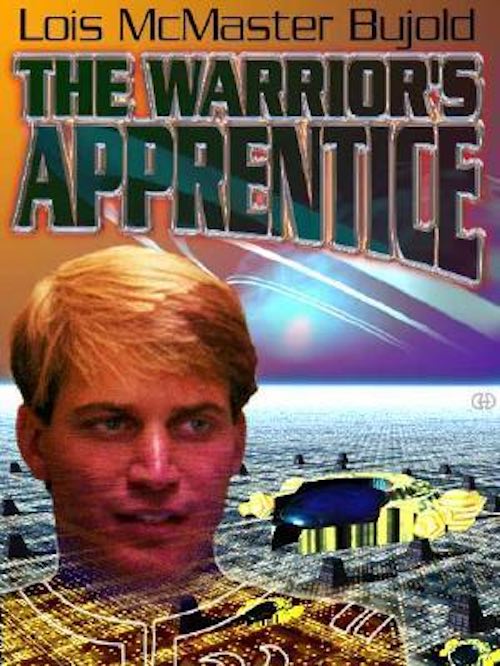
Miles’s hair has turned blonde here, I assume because that’s what was readily available in clip art.
A character gazing upward against a vaguely space-ish backdrop is a great way to imply a science fictional story without saying anything at all. So is the logo of a prominent SF publisher on the cover—the illustration isn’t really adding anything. If you omitted the title, this could just as easily be the cover of almost any SF novel with a white male protagonist.

I feel compelled to point out the awkward intersection of Miles’s ear with the forehead of the guy with the mustache, who could be either Bothari or Tung. Miles looks kind of like a Back to the Future era Michael J. Fox.
And below, he looks like Luke Skywalker. When does this even happen? Nothing like this is in the book.

Both are better than this option, which sticks entirely with space ships that, through their shape and color, evoke feces and phalluses:
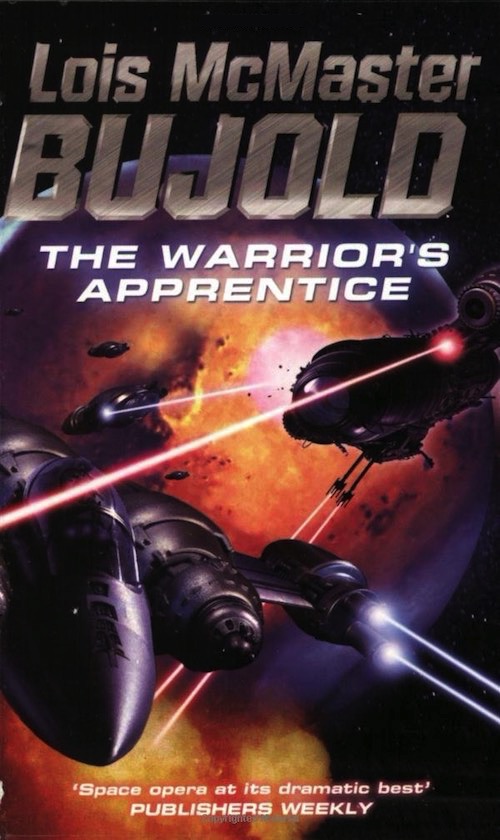
Who is the warrior? Who is the apprentice? Who cares! I appreciate a good space fight, but the lack of character development here is dismaying.
Usually, we run inside the hamster wheel. I can’t tell who’s running or what the circle represents. I have been enjoying the Zen-like abstract minimalism of many of these Amazon e-book covers. Not this one.

The NESFA Press cover brings the characters back into the equation. The characters’ facial features here are oddly unemotional and flat. I’m not sure whether the man on the left, looking disinterested while holding a fuel line for no apparent reason, is Bothari or Baz. The man on the right could be General Tung. The faint orange tinge makes his uniform and beret read more as “aging jockey” than “mercenary commander.” Miles looks unusually effeminate for a character who is described as having a five o’clock shadow. I know that’s space armor, but that doesn’t keep me from thinking that Miles is climbing out of the carcass of a giant earthworm.

I like Alan Gutierrez’s work on this cover too much to give anyone else the time of day.
SUMMARY
Chapter one of The Warrior’s Apprentice begins with Miles’s fondest ambition. He wants to go to the Imperial Military Academy, to learn space-fighting. He’s completed the paper-and-pencil tests already—today is physical fitness. He offers a brief explanation of his medical history for his running partner, helpfully explaining that his lifetime of treatment is “why I can walk around today, instead of being carried in a bucket.” He has petitioned to have his scores averaged, instead of taken separately, to make up for his likely dismal performance on the obstacle course. Miles’s dream dies when he breaks his legs at the first obstacle, a five-meter wall with spikes on top. He returns home to break the bad news to his grandfather.
COMMENTARY
I could make an argument for the persistence of traditional infantry in the Barrayaran military, but I won’t, because Bujold doesn’t. The education Miles is seeking here is “training in the tactics of energy weapons, wormhole exits, and planetary defense”—it’s space stuff. We’ve seen a few space commanders in the series history. Aral Vorkosigan was stunned by his mutinous crew while attempting to apprehend a Betan Survey party and had to hike across 200 km of wilderness to take back his command from the mutineers. But Admiral Kanzian was “overweight and undertall,” and Jolly Nolly had colitis. The physical fitness requirements seem flexible.
The admissions requirements for the Barrayar’s elite space-fighting school include climbing a 5-meter wall, crawling under laser fire, and running both a short (5km) and a long (100 km) distance.
For this week’s blog post, I’ve invented a game I call “Do you get a lot of call for that in space-fighting?”
Round 1—climbing a 5 meter wall with spikes on top—NO
Round 2—jumping off a 5 meter wall—NO. Dude, you got to the place with the wall in a spaceship, have it put you down on your preferred side of the wall.
Round 3—crawling under laser fire—MAYBE, sometimes. I mean, it seems like a thing that could happen. I think crawling under the laser fire would probably not be the best way to handle it in most circumstances, but I imagine that sometimes you need at least one guy to do that for some reason, like to disarm the weapons system. It sounds pretty far-fetched to me, but I’ll let it pass.
Round 4—running 5K—YES—Starbuck was always jogging on Battlestar Galactica. Cardio.
Round 5—running 100 kilometers up and down a mountain—UNDER WHAT IMAGINABLE CIRCUMSTANCES? OK, Yeah, Miles’s dad took that hike that one time. But he didn’t run, he walked. And he had some pretty amazing drugs to help him get there. Veterans of this re-read will recall that Aral was a) febrile and b) higher than a kite for most of the trek. But a simpler solution would be not to send your commander on away missions, particularly if there’s a chance of combat—this is basically why Riker led all the away missions on Star Trek: The Next Generation. The drugs are not available to cadets, who aren’t even allowed to use assistive devices like leg braces.
TOTAL SCORE: 1.5/5 known physical fitness test components have any chance of being at all relevant to space-fighting, and only because the judges are feeling generous.
What do we know about space-fighting? A lot of it gets done in servo-assisted space armor, which means that it would LITERALLY be possible for Miles to be an effective space-fighter if he WERE “carried in a bucket.” Anne McCaffrey wrote characters who did that, more or less, in her Brainship series. Barrayar is applying traditional infantry standards to aspiring space-fighting commanders. Why? We talked about this last week—Barrayaran culture privileges strength. There are a limited number of seats in space-fighting school. So when Barrayar decides how to apportion that limited resource, rather than looking for the individuals who truly have the greatest potential as space-fighting commanders, it looks for the ones who most easily conform to its cultural norms. And its cultural norms are a relic of a time when space-fighting was pretty far outside the scope of Barrayaran imagination. Which is also why Miles’s running partner, Cadet Kostolitz, can complain that Miles’s short stature and brittle bones are an inconvenience. Not to Miles, to Kostolitz. Poor guy won’t be able to pace himself like he would if he had an able-bodied partner. Just having Miles on the course is unfair to him. In the future, we’ll be able to print text files onto durable materials so that it will actually be possible to strangle people with copies of Peggy MacIntosh’s “Unpacking the Invisible Knapsack.”
In case you missed the point about Barrayar taking its own sweet time to evolve out of its masochistic embrace of strength as an individual virtue (to the extent that it undermines Barrayar’s actual collective strength), Miles has a chat with Bothari about his daughter. Bothari means her to have everything right and proper, no matter how out-of-date that is. He’s like Barrayar made flesh.
Miles’s parents love him, which is why they’re letting him tell his grandfather about his failure himself. They’ve had to lie to him all morning—or rather, they’ve had to send Elena Bothari to do it. That poor, sweet child.
Next week—Miles breaks the bad news.
Ellen Cheeseman-Meyer teaches history and reads a lot.

On that last cover, pretty sure the person being put into space armor is supposed to be Elena. Miles would be the person on left, and the one on the right could either be Tung or the other captain-owner, forget his name…
I first thought the space armor person was Elena, too.
I think one reason Bujold had the physicals tests so that the military training bit was familiar. I think it’d be hard to sell a military that was all classrooms and sims.
I’m not sure whether those physical exams are really that inappropriate – after all, space flight does involve dealing with high accelerations, and gravity is a pretty simple way to simulate that.
The 100 km run up a mountain is shows how well cadets handle oxygen deprivation – so that’s fine, too.
The 5 km run looks like the most useless test to me – it doesn’t test the stamina of a fit person, and running fast is presumably the thing a space commander has to do the least.
I like the cover without any people – I generally like covers without characters because the characters never look anything like I imagine.
Kostolitz is obnoxious but he is also right that Miles is only getting this opportunity due to his class. And while Kostolitz doesn’t know this, we also know that Miles is able to get a good enough score on the written portion because he studied using restricted historical material not available to other cadet candidates.
I always liked the first cover. Since I no longer have that edition, it was good to see it again,
It has a kind of old pulp stylized feel to it. Except for the more accurately rendered grumpy little guy on the side. Remember him. He’s the hero.
It’s interesting that Bujold never really mediates on Vor privilege, for all that it stands at the center of every book before Diplomatic Immunity. After which its role is replaced by the even more exalted privilege of an Imperial Auditor. Miles wouldn’t get away with nearly any of his scams if he wasn’t a Vorkosigan.
When it comes to the fitness exams… Artificial gravity clearly exists, shipboard, so it’s not an issue as with modern astronauts where they want them to put on muscle so that they still have some left after it atrophies in 0G. One assumes that the entrance exams are generalized for ground, shipboard, and desk duty, as people who end up in Ops taking Ophidian censuses and escorting diplomats also have to pass them. (Hi Ivan, please smack your teenage self in the back of the head now.) Averaging the scores seems like a fairly reasonable attempt at accommodation for Miles, who is clearly not going to make the infantry by virtue of his bones and his rank, but the attitude around his attempt at the obstacle course is very indicative of Barryar’s issues as a whole. Not allowing him to use his leg braces is, on the other hand, doubly stupid in context. They already know they can’t stuff him into a physical combat role, he’s the Emperor’s foster brother and the prime minister’s son. He’s a security and intelligence hazard on legs. At this point the test shouldn’t be “can he compete with all our other cadets,” it should be “Do we think he has the stamina and maneuverability to do the kind of tasks he might reasonably expect if we stick him on a starship bridge, or underground in the bowels of Imp Sec?” (And speaking of Imp Sec, I can’t think of a reason that you’d need high, or even moderately passing obstacle course scores to run some of the underground desk jobs we see later on. Other than upholding the Patriotic Vor Patriarchy, that is.)
The obstacle course also shows that Barryar’s tactical thinking remains somewhat planet-bound, and potentially based on their Guerrilla campaign against the Cetagandans… which is probably not an asset at this point. (Sure, they won, and they clearly know how to wage space battles, but their traditions are very inflexible and they’ve been in space for, by Miles’ time, three and a half generations or something like that.)
Miles’ thinking remains bound to his pride – seriously, why did you jump Miles, how many bones have you broken falling off things at this point in your life?
The first one has been described by LMB as ‘the battle-nightie cover’.
I like the Amazon e-book cover – it does invoke the ‘he’s running and can’t stop’ that Miles gets stuck in.
I’m always going to love the first cover with the passion of a first middle school crush (which the book it was wrapped around was the literary equivalent of), nothing else stands a chance.
But Admiral Kanzian was “overweight and undertall,” and Jolly Nolly had colitis. The physical fitness requirements seem flexible.
Admiral Kanzian, as we can tell by his rank, has been in the service for quite a long time. He was probably not overweight when he joined up.
But a simpler solution would be not to send your commander on away missions, particularly if there’s a chance of combat—this is basically why Riker led all the away missions on Star Trek: The Next Generation.
Right, you’d send your more junior members, like those who had more recently passed through the fitness tests and basic training.
You seem to have this strange idea that all these candidates will immediately become starship captains or admirals the moment they graduate, so we only have to imagine what captains and admirals might do. And also that the tests are supposed to be accurate representations of their official duties, rather than general screening for physical fitness, endurance, and coolness under pressure.
A very large fraction of modern (US, British, etc.) military personnel spend most of their time at what are essentially desk jobs of one kind or another. But those militaries still insist on some level of basic training and physical fitness (including annual tests), so it’s not completely crazy that the Barrayaran military would, too (leaving aside the conservative cultural issues).
Quill @7:
And speaking of Imp Sec, I can’t think of a reason that you’d need high, or even moderately passing obstacle course scores to run some of the underground desk jobs we see later on.
But there are plenty of ImpSec jobs that do plausibly include physical fitness as prerequisites. You don’t want clumsy, out-of-shape people guarding the Emperor from potential assassins, for example. You would ideally like your undercover agents and couriers to be physically capable as well.
I agree with you that the Alan Gutierrez cover is by far the best. It even manages to suggest Miles as a physical being: short, clearly not Tall, Barechested Hero Striking Heroic Pose with Clinging Maiden — and yet, partly by virtue of being the rightmost person and partly because he’s the one looking at the viewer, somehow the center of things anyway. (And kind of mocking the idea that the hero needs to be Tall, &c.)
@11: Yeah, you’d want your secret agents to be pretty physically fit. The guy who has to break passwords in a basement all day isn’t going to necessarily need those same standards… Of course, in other societies he might not have to get that job via the army. The problem with this model is that it becomes very one-size fits all, rather than trying to figure out an efficient distribution of your human resources. Which would be an issue if Barryar were to go to war again, which can’t be that far from anyone’s mind, considering their outstanding foreign policy issues.
Of note: A lot of these older officers (say, Kazanian,) might have gotten their start in wars, and/or originally been drafted rather than going through the academy. Barryar will forgive a lot for a record of success.
Miles doesn’t just fail the physical test, which may or may not be relevant to his career. He failed to control his own impatience while completing a task, and he failed as a result. If he’d gone through the physical test with exquisite slowness and aced the written portion of the evaluation, Miles might have entered the Academy.
A large part of any career, especially one in a hierarchical military, involves learning how to adapt to circumstances. If the test is stupid, well, there are plenty of backwards and bigoted officers in the Imperial Service. This won’t be the last time Miles Vorkosigan will jump through arbitrary hoops and work around stupidity if he wants to have a real career in the Service. His real shortcomings are mental, not physical; he’s willing to think and work, but he hates the thought of simple cooperation. He can never just do things the way he needs to do them, he has to do them his way, and he doesn’t always think about the consequences in advance. It’s the same attitude that later gets him reprimanded for always needing to “guide” his superior officers into making the choice he thinks is right instead of saluting and doing his job.
Et al – I have read your dissent, and I remain unconvinced. Disagree if you will (and indeed, the comments section was invented for it – have at!) but I will stand by my assessment of the Imperial Military Academy’s physical fitness testing until the day I die. I believe that this sequence, in combination with Miles’s later success as a mercenary commander of space-fighters, is a crucial part of Bujold’s depiction of a culture whose adherence to traditional norms has resulted in policies and practices that are sometimes pointless and arbitrary.
If that is Elena on the NESFA press cover, with Miles pointlessly holding the fuel line, then either he is VERY tall or she is VERY short. Also, she is curiously flat in the chest region for a young lady of her description. If Miles is not the guy next to her, but the guy in the racing silks on her other side, I am no more content. If the artist wanted to convince me that I am looking at Elena Bothari, he has left a great deal of work undone.
Artificial gravity malfunction can leave you stranded in strange places. But the real reason is likely to be, if you have restricted entry to a military education you will likely include some physical tests.
Why did Miles jump? He may have had a fairly good idea about how slow he could be, and the last minute removal of the braces meant he had to take chances.
Except Miles isn’t applying to the Imperial Ship Duty Air-Conditioned Commander’s Academy, he’s applying to the academy for the whole service. Which does include the infantry, as well as plenty of ship-duty posts that require physical fitness. (There are engineering spaces on ships, as we know from both Shards and this volume. The existence of those spaces implies that humans do physical work on machinery in them. In an emergency, that could get awful stressful and dangerous. We’ve also seen fighting aboard ships, not only here but also in Shards, in the Vor Game, IIRC in Diplomatic Immunity… There are good reasons to have some kind of marines for security even though space-to-space boarding actions are ludicrous.)
I do think it’d be reasonable to give Miles a pass into the Imperial Service War College, if he wants to be a strategist or an ImpSec analyst or something. (But I don’t recall anyone telling Mark he’d need to lose weight when a career as an analyst was on the table, so perhaps that option already exists.)’
I also don’t think it’s unreasonable or implausible that Barrayar’s answer to West Point/Annapolis/Sandhurst has the same sort of physical standards those institutions maintain. Sure, elements of Barrayar’s military are farther from the dirt than any of ours, in the vertical dimension. But in the time dimension, they’re two generations from horse cavalry, to our three-plus. And I’m not aware of any push to eliminate physical standards from military academies today…
@15 Ellen MCM
As Miles’s hypothetical commanding officer, I don’t care in the least about his ability to succeed in a pointless, arbitrary test that owes more to tradition than rational thought. I care greatly about the way he failed that test.
Miles’s later success comes from the fact that he is outside any normal chain of command, passing from cadet to admiral at a single step. Brilliant improvisation has its place, but that place is at the top; in order for the upper ranks to command effectively, their subordinates have to follow orders, even if they think that their instructions are suboptimal. It’s better for everyone to execute a decent plan together than it is for a dozen would-be Napoleons to go off in different directions, brilliantly failing to cooperate. Miles may be a brilliant commander, but he is an awful subordinate, a fact noted by everyone who has the misfortune of serving in his chain of command.
@16 Ola
Miles jumped because, in the heat of the moment, he forgot about his physical limitations. He rushed because he didn’t think. That kind of failure is far more disqualifying for a space officer than any physical disability.
In re: physical fitness standards and entry to the military – the Imperial Service Academy is obviously not the only route into the Barrayaran military ever. It produces officers, etc., and may be the equivalent of West Point. But the only way we know that at the beginning of Warrior’s Apprentice is that the Barrayaran military seems to be large, and the fitness test we see appears to be small. I believe that not only is the military academy running some tests that are more than a little obsolete, but that Miles has fixated on one particular route into and through the military (the Academy and then ship duty) in a way that may not be particularly healthy for him. Aral and Cordelia have some things to answer for there.
There has been a lot of effort in this comment section to list reasons why the military needs physically fit and able recruits. However, none of the listed needs turn out to be things Miles can’t do. I believe he actually does most of them. By the end of this particular book, he is sent to the Imperial Military Academy, and his handicaps do not cause him to wash out. He’s physically capable of *attending* the program, but not physically capable of *getting in*.
As far as the physical fitness tests go, remember where Miles ended up for his first assignment. It sure wasn’t aboard Prince Serg doing space fighting, but rather somewhere fitness turned out to be fairly important. The Imperial military is a combined service, even if the space and infantry specializations become mostly separate later in the career.
I think the assertion that Metzov was fit for service and Miles was not tends to support my interpretation
It is certainly a bit much to ask that a 17-year-old kid must perfectly avoid self-consciousness before getting real military training. While I would agree that a military officer must be able to avoid doing stupid things just because they’re embarrassed or angry, part of the purpose of training is to create someone who will do better than they would have beforehand. And indeed, he does much better in that regard later.
For what it’s worth: Yes, there are other sources of new military officers on Barrayar than just the Imperial Service Academy. Simon Illyan went to one of the other ones (needed more points and/or syllables in the name when he wanted to serve), for example.
I doubt there’d be a good way to weed Metzov out (and leave Bothari in? hmmm that gets really complex).
They did weed Bothari out – he’s an armsman. Also, he was a sergeant, not an officer.
@23 true – not an officer, so no time spent at Imperial Service Academy.
While we know there are other officer training places, I wonder if the Vor expect to go to the Academy? (Just wondering why Miles didn’t try for another route, thinking from inside the series – I suspect that thinking from outside the series, I’d probably just figure that Lois hadn’t worked out the details yet, so he didn’t know he could go somewhere other than the Academy to get his officer’s training.)
In the end, the Academy can be as unrealistic and idealistic as it wants – it takes only the best of the best, and it sets the rules for what that is.
Metzof “rose through the ranks,” so probably a battlefield commission during one of the wars of his generation. And both Bothari and Metzof may not have been as obviously mentally damaged at the start of their service. The things they faces, and later did, certainly did not improve their sanity.
As for Vor privilege. . . I’ve noticed a tendency, in Bujold’s books, for protagonists who are at least quasi- nobility. Caz and Ista come to mind. I can see why, though: In a society that’s feudal, it’s easier to start with a character of means than to do an origin story about a penniless serf scrabbling for freedom and position. It’s just a format, not a judgement.
I always read Miles breaking his legs as intentional, self damage to halt a process imposed on him by his family, and his travel off world as finding his own motivation and finding his own power, away from the demands of his family.
If memory serves me right, the Gutierrez cover was painted first with just the strong-jawed hero and the girl in the combat nightie, and then Miles was added in later. He does seem a bit, well, extraneous to the composition.
Warrior’s Apprentice may never have had a really good cover in English, but at least we weren’t subjected to what the poor Germans got:
On rec.arts.sf.written, this fellow has been nicknamed “Miles Usedcarsigan”.
@18 dptullos – Rereading the paragraph with more care, I find we are both wrong. Miles did not take a deliberate risk only to land badly, he realized halfway down he had made a mistake. But he did stop to think before he jumped. I think that was his mistake – if he hadn’t stopped to think, he would likely have made it.
I think the assertion that Metzov was fit for service and Miles was not tends to support my interpretation
No, it would support an assertion that the military needs a better psychological filter, which is orthogonal to questions of physical fitness. (Unless one wants to posit that the physically fit are more likely to be mentally unfit, which would be hard to support.)
(If they’d just gotten rid of the physical tests, how would that have kept Metzov out?)
They did weed Bothari out – he’s an armsman.
Like most armsmen, he’s a retired soldier. He was accepted into the Barrayaran military and rose to the rank of sergeant. (I think we can plausibly assume that the enlisted ranks had to undergo physical tests at least as strenuous as what the officers experienced.) Carlo was talking about the question of whether or not one could “weed out” Metzov (and not Bothari) right at the start, before their military careers actually began.
Also as the series progresses, it turns out that the Academy was right – Miles was and is deeply unfit for conventional military service.
He’s a rebel, a lunatic, a loaded weapon pointed at his own superiors. He’s also brilliant, and an ideal commander of men, provided he has the right support crew of fanatically devoted and intelligent followers.
He’s an improvisational genius, which means he’s also near impossible to work with. He’s the kind of person who can only thrive with supreme executive power, and will only actually obey someone he respects. It’s the one reason Gregor can use him at all – his loyalty to the regime is unmatched, mostly because he doesn’t want that job. Because he greatly respects Gregor AND the Vor traditions that place him as his unassailable superior, he can do a good job as his hand, initially as an agent and later more directly as an Auditor.
The fact that something is “pointless and arbitrary” doesn’t mean it is useless when it comes to military training. It’s important to have activities that seem meaningless but require attention to detail or significant effort to complete. Physical training like this is more about measuring will than it is capability. Is it essential that all the recruits have the necessary physical stamina? No, probably not. But it is essential that you have recruits that won’t quit under duress. What does seem unreasonable here is that Miles only gets the one chance.
@31 I remember an officer I knew describing one part of basic training where they needed to be sure people wouldn’t crack under stress. So they made the trainees track every dollar they spent, recording the serial numbers of each bill. They gave a silly rationale about needing to track expenditures for why the trainees needed to do it, and wouldn’t give better reasons for the requirement no matter how they were asked further.
Utterly pointless and time-consuming, but along with a lot more other time-taking activities also supplied at the same time, it did very well for teaching people to be organized and to manage their time well.
@29 – Bothari was dishonorably discharged.
@33 No. Honorable, on a medical. From Shards of Honor, chapter 14, Cordelia and Aral talking:
“I’m glad Bothari didn’t get in too much trouble over Vorrutyer.”
“It was touch and go, but I got him off. Illyan’s testimony helped.”
“Yet they discharged him.”
“Honorably. On a medical.”
I just wanted to weight in on this debate.
It’s hard to compare a fictional military or culture to a real one but I wanted to give it a quick shot. Miles is going into officer training school for a space program. The closest I could get for this would be Annapolis which is the Officer training school for the US Navy.
It seems similar, not infantry, working with big machines, ect.
Here are the admission steps. Check Medical evaluation,
https://www.usna.edu/Admissions/Steps-for-Admission/
By these standards, Miles would not be allowed into the US Navy as an officer.
@35 Miles isn’t shock-rated. Of course he wouldn’t be allowed into the navy.
@34 – Warrior’s Apprentice has Bothari’s record show that he was dishonorably discharged. It’s coming up in the next section.
@37 Involuntarily medically discharged is still not a dishonorable discharge, I’m pretty sure…. I’m willing to wait and see!
Oops – it’s “involuntarily medically” discharged, not dishonorably. Very different.
Have we forgotten Barrayar so soon?
The Imperial military needs infantry. To keep control of the Counts and put down insurrection. It is for on-planet use. This is probably their biggest task. Being a military force that can not only put down attempted revolution or coup, but to be a constant presence to convince most people it isn’t worth trying.
Also, to actually conquer, they need infantry. Who patrolled the Domes of newly captive Komarr?
This exam is for the military academy, with no promise of ship, or even desk, duty. Most graduates will be there as part of the machine that lets a dictator maintain power.
From Barrayar:
And from Diplomatic Immunity:
And Captain Vorpatril’s Alliance:
(A favorite line from the book, right after Ivan knocks out one of the goons threatening them…)
So, supposedly non-combatant jobs needing to be ready for up-close-and-personal combat is something that gets lampshaded throughout the series, calling all the way forward to CVA. (I could probably come up with more examples – Miles’ realization that he would have sent in someone more physical in “Borders of Infinity”…) It’s usually pointed out as something weird by galactic standards, and peculiarly Barrayaran – but in context, as a good thing in every case I can remember.
Voice of God (Lois) long ago shared that the original cover for WA was created for a different book. When it was assigned to WA instead, Miles in the chair was just painted in. So there’s no logical way to map from the cover to anyone else in the book.
42, yep, for that and other stories…try here and it was Keith Laumer though which book, I don’t know.
After decades of reading SF I don’t expect covers to have anything to do with the contents.
Chapter One. In Which Miles Demonstrates Poor Impulse Control. This is a continuing theme.