





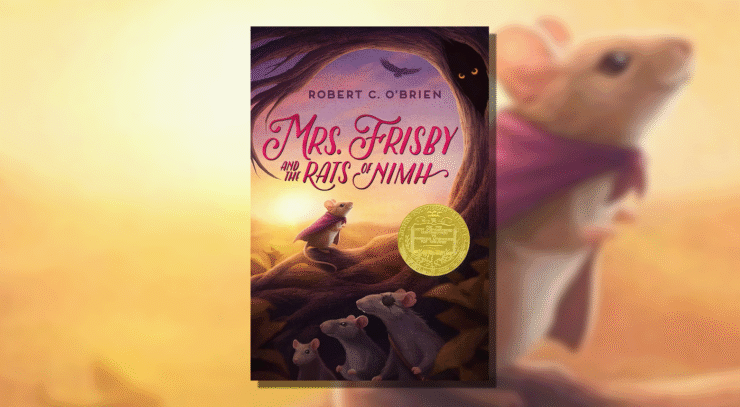
Robert C. O’Brien’s 1971 novel, Mrs. Frisby and the Rats of NIMH, made a bit of a splash when it was published. It won a Newbery Medal; it was adapted into a 1982 film, The Secret of NIMH. It’s still in print 55 years later, and still finding audiences.
The story plays on a number of familiar tropes. Its protagonist, Mrs. Frisby, is a mouse in the mold of The Wind in the Willows and the anthropomorphic mice of Beatrix Potter. She’s mouse-sized and mouse-shaped, but there are flashes of human anatomy: she has hands; her children have foreheads that can be felt to test for fever. Her four children are human-coded, of different ages rather than a more mouse-accurate litter. And they have human names.
That’s true of all the animals, in fact, including Mrs. Frisby’s late husband Jonathan, rats named Nicodemus and Justin and Arthur and Brutus, and a crow named Jeremy. They talk to each other in an apparent common language.
Mice in this world have winter homes and summer homes. Many winter in human buildings, but Mrs. Frisby has her own free-standing house, a cinder block in a farmer’s garden. It’s safe and secure during the cold season, but in spring she has to leave before the farmer comes to plow. The summer cottage is farther out and more communal, with other mouse families nearby.
When the novel begins, the family has survived another winter and is facing the annual move. But there is a problem. Mrs. Frisby’s son Timothy is very ill with pneumonia.
Mrs. Frisby sets out to get help for Timothy. This turns into an odyssey, with numerous twists and unexpected turns. First she ventures into the wider world, seeking out a mouse named Mr. Ages, who has considerable medical skills and a wide knowledge of herbs and potions. He provides her with a diagnosis and a course of treatment, but part of that treatment is that Timothy must not be moved for several weeks.
This is a crisis. The weather has turned; spring is here. The farmer is about to start the garden, and the house is in danger of being plowed under.
On her way to Mr. Ages’ house, Mrs. Frisby has made a friend, a young crow named Jeremy who was caught in a wire. She freed him, and in return he promised to help her whenever she needed it.
This is a feature of talking-animal stories: the being of another species whose life is saved and who becomes an ally. Jeremy carries Mrs. Frisby to the wise owl who knows everything and everyone, and who may be able to advise her as to how to protect Timothy. He helps her in other ways, too, with aerial surveillance and occasional transport.
The owl’s advice is to seek out the rats who live in the rosebush on the Fitzgibbon farm. They can move the house to a specific location and save it from the plow. Timothy can rest and recover, and when he’s well, the family can move to the summer cottage.
Up to this point we’ve been in familiar territory. Talking animals, humanlike families, intrepid expeditions across perilous landscapes. There have been hints of something else: for example the mice can read. Their late father taught the children, and Mrs. Frisby learned, too, though she was slower and doesn’t read as well, probably because she started as an adult. But that could just be more anthropomorphism.
Then we meet the rats. What has seemed to be a fairly standard talking-animal fantasy turns abruptly into science fiction. There is a city inside the rosebush. It has electricity. Elevators. A library full of books. And a population of superintelligent, mechanically inclined rats.
By this time we realize there’s something special about the late Jonathan Frisby. Every animal knows and respects him. That includes the rats. It’s because of Jonathan that they agree to help his widow and his children, and move their house to a safe spot.
Nicodemus, the leader of the rats, tells Mrs. Frisby the story of NIMH. He and a number of his fellows were abducted by scientists and confined to a lab, where they were subjected to numerous experiments. One involved injections that greatly increased their intelligence—and their life spans. They’ve lived far longer than normal rats, and they haven’t aged. It appears they may be immortal, though they can die by violence.
Eventually they were able to escape. In the process they discovered that a colony of mice had been subjected to the same experiments. One of them as Jonathan. Another was Mr. Ages.
Only those two mice escaped with the rats. Mr. Ages ended up a sort of hermit, but Jonathan was younger and wanted more. Hence his union with Mrs. Frisby.
Mrs. Frisby’s problem is solved with the help of the rats, but she discovers a much bigger one in the process. The rats have been executing a grand Plan. They’ve been building their underground city and living there in great comfort, but Nicodemus has an ethical problem. Everything they have is stolen from humans. Electricity, mechanical devices, food. He wants to find a place where rats can live without theft, where they can grow their own food and make their own way.
The Plan is nearly ready to execute, but the humans are closing in, and their city is about to be destroyed. It’s thanks to Mrs. Frisby that the rats are able to escape, and most survive. Her debt is well and thoroughly paid.
I have one big question. How does Mrs. Frisby manage to be as intelligent as she is? Supposedly the mutated mice and rats are over a thousand times smarter than normal rodents. And yet, while she can’t read as well as her children, she does read and she is able to think and process on a high level. She has no trouble keeping up with the super-rats. Is she a natural genius? Is there something about her union with Jonathan that enhances her intelligence by a kind of osmosis? Or are mice just that much smarter to begin with?
The novel cries out for a sequel. O’Brien died in 1973, but his daughter Jane Leslie Conly carried on with two more entries in the saga. Let me know if you’ve read one or both. I’ll be interested to know how they expand on O’Brien’s story.
O’Brien based his novel on the work of John B. Calhoun at the National Institute of Mental Health (hence, NIMH). There’s a rabbit hole and a half, or a mouse hole if you will. Calhoun studied the effects of overpopulation on rats and mice. He didn’t do anything to enhance their intelligence, but much of what was done to Nicodemus and the others comes from Calhoun’s experiments. The novel’s theme is just as relevant today as it was in 1971: the ethics of animal experimentation, and the question of animal rights in general.

What is Mrs. Frisby’s given name?
If I recall correctly, the book doesn’t give Mrs. Frisby a given name, nor does the white mouse, Mr. Ages, have one; they’re just “Mrs. Frisby” and “Mr. Ages.” (Mr. Ages’ name may also be a reference to the fact that, like the rats, he does not age at a normal rate. The other creatures, like Mrs. Frisby, do not interact with the rats, but they do interact with Mr. Ages, since he serves them as a medical practitioner, and while they do not know the full story, it is mentioned they are aware that he is old for a mouse, to the point that rumor has it that he is a white mouse because his fur has turned white from age).
On the other hand, the Frisbies and Mr. Ages are the only animals with last names; Jeremy and the rats (Nicodemus, Justin, etc.) only have first names, the owl is only called “the owl” and Mrs. Frisby’s neighbor the shrew is only called “the shrew” (the movie The Secret of NIMH resolves this by having the children call her “Auntie Shrew”).
It may be a sign of the time (1971) that Mrs. Frisby could be referred to only by her husband’s name (assuming that “Frisby” is Jonathan’s surname; in the scenes at NIMH, he is only referred to as “Jonathan”). O’Brien may have intended it to sound like a more respectful means of address, and it certainly does not keep her from being the main character.
I agree that Mrs. Frisby seems little less intelligent than Jonathan and the rats; I did take the fact that she had a harder time learning to read than her children to be a sign of her unaltered status, rather than being an adult learner. The fact that her children (and the rat children) learn quickly is explicitly seen as a sign that the effects of the alternations are hereditary, although it is noted that it is too early to tell whether the added longevity is as well.
Note that all of the above is taken from memory; it has probably been 20 years since it last read the book (which may go to show how much of an impression it made on me).
In Racso and the Rats of Nimh, Mrs. Frisby’s son Timothy is traveling to the rats’ colony in the hidden valley to continue his education, and meets up with a young rat named Racso, also trying to find the valley. So then the reader gets to see the settlement from an outsiders perspective, before a new threat emerges: the humans are going to be building a dam… Very good continuation of the story, characters and worldbuilding.
R-T, Margaret, and the Rats of NIMH shakes things up by introducing two lost children into the forest, for the Rats to debate whether to help them or hide. Mostly from the older girl’s pov, as she struggles to take care of her little brother – who has severe asthma and is mostly nonverbal. Very different just because of the human perspective, but still a very good read. If you like the original I recommend both.